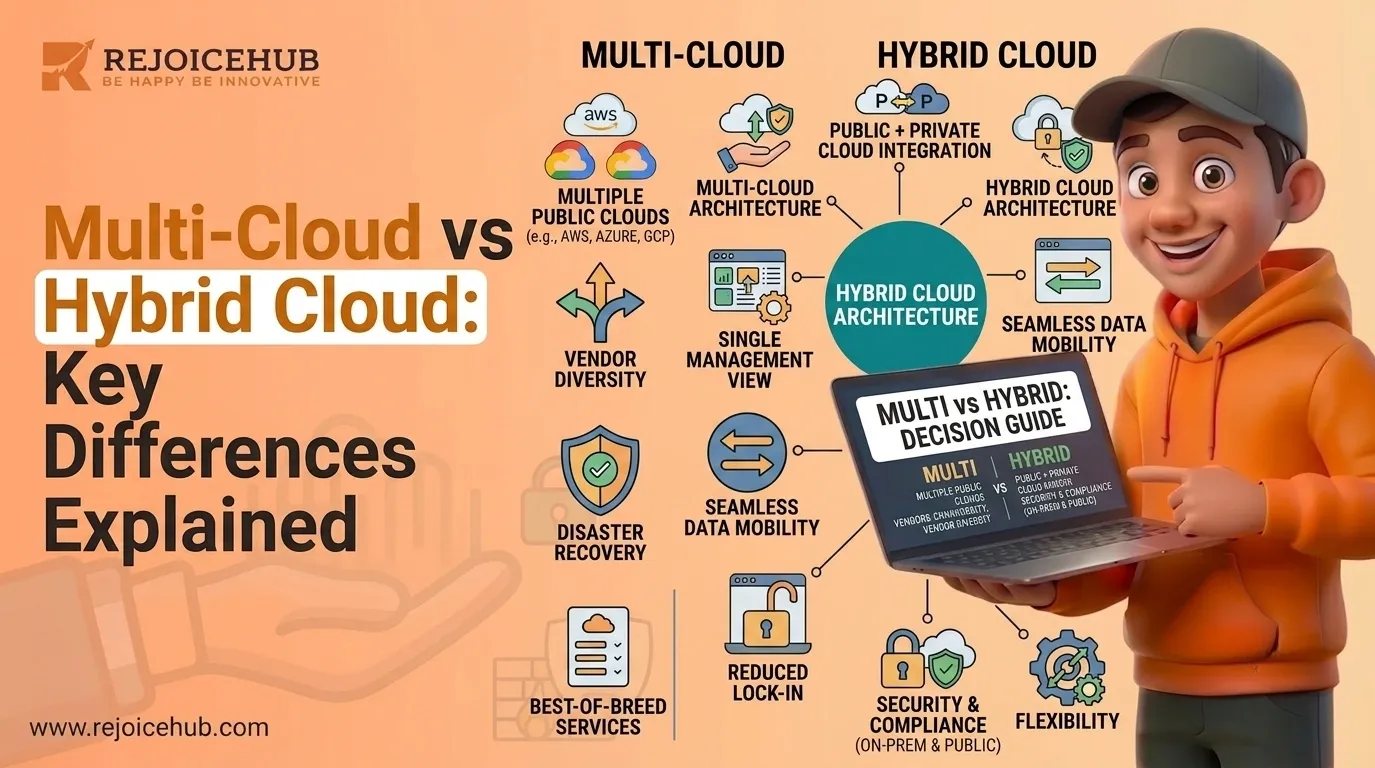
Cloud strategy is no longer a topic of discussion it has become a strategic priority for any organization that wants to remain competitive in the digital economy. The choice of the infrastructure development path is critical and should be determined by the company's long-term goals, and many teams pair this decision with a broader DevOps as a service approach to keep deployments consistent. Two of the most popular options are hybrid and multicloud solutions.
Although they are often mentioned in the same context, these are completely different concepts with significant differences. In this article, you will find an overview of the characteristics of multicloud vs hybrid cloud, their advantages, and considerations for selecting the most suitable option for your business.
What Is Multi-cloud?
Multi-cloud refers to the use of two or more public cloud providers for a business's cloud services, as opposed to relying on one provider. Some examples of public cloud providers are Amazon Web Services (AWS), Google, Microsoft Azure, IBM Cloud, and Oracle.
A company may use AWS for one service, Google for another, and Microsoft Azure for a third. For instance, a company may host their web application on AWS, its data warehouse on Google BigQuery, and run its AI and ML application services on Microsoft Azure.
1. How It Works
Instead of putting all workloads under one provider, teams distribute applications, storage, and services across multiple clouds based on:
- Cost efficiency
- Specific technical strengths (e.g., Google's data/AI tools vs AWS's breadth of services)
- Geographic availability
- Redundancy and risk reduction
Each provider operates independently, and teams typically use APIs, containers, or orchestration tools (like Kubernetes) to manage workloads consistently across environments.
2. Multi-cloud Architecture
A typical multi-cloud architecture includes:
- Multiple public cloud accounts (AWS, Azure, GCP, etc.)
- Container orchestration (Kubernetes is the most common) to keep deployments portable
- API gateways to route traffic between services
- Centralized monitoring and logging tools that pull data from every cloud into one dashboard
- Identity and access management (IAM) layered across providers for consistent security policies
The goal isn't just "using multiple clouds" it's making them work together as one coherent system.
3. Multi-cloud Strategy
A solid multi-cloud strategy usually starts with a clear reason, not just adoption for its own sake. Common drivers include:
- Avoiding vendor lock-in no single provider controls your infrastructure or pricing
- Best-of-breed selection using each provider's strongest services
- Improved uptime if one cloud has an outage, others keep running
- Regulatory or regional needs some data must stay within specific countries or regions
4. Benefits of Multi-cloud
- Reduces dependency on one vendor
- Access to best-in-class tools from each provider
- Better geographic coverage and lower latency for global users
- Improved disaster recovery through redundancy
- Negotiating leverage with vendors on pricing
5. Challenges of Multi-cloud
- Higher complexity in managing multiple environments
- Requires specialized skills across different cloud platforms
- Harder to maintain consistent security policies
- Potentially higher operational costs if not managed well
- Data transfer costs between clouds can add up
Accelerate Your Workflows with Custom AI
Book a free consultation session with RejoiceHub. We'll map out a tailored automation roadmap for your company.
What Is Hybrid Cloud?
Hybrid cloud is a combination of private cloud (either on-premises or company-owned data centers) and public cloud. It enables data and application portability between private and public clouds.
In other words, it allows companies to keep some of their data and applications in-house while using the public cloud for other needs.
1. Public + Private Cloud
The core idea behind hybrid cloud is balance:
- Private cloud handles sensitive data, legacy systems, or workloads with strict compliance requirements
- Public cloud handles scalable, less-sensitive workloads like customer-facing apps, dev/test environments, or seasonal traffic spikes
Businesses often use tools like VMware, Azure Arc, or AWS Outposts to connect these environments seamlessly, and many also weigh a custom vs. off-the-shelf software approach when deciding how to modernize legacy systems within this setup.
2. Hybrid Cloud Architecture
A typical hybrid cloud architecture includes:
- On-premises or private data center for core, sensitive systems
- Public cloud environment for scalable or overflow workloads
- Secure connectivity (VPN or dedicated network links) between the two
- Unified management layer to monitor and control both environments
- Data synchronization tools to keep information consistent across systems
3. Hybrid Cloud Strategy
Companies typically adopt a hybrid cloud strategy when they need:
- Compliance control keeping regulated data on-premises
- Legacy system support older systems that can't easily move to the cloud
- Cost-efficient scaling using public cloud only when extra capacity is needed
- Gradual cloud migration moving to the cloud in phases instead of all at once
4. Benefits of Hybrid Cloud
- Greater control over sensitive data
- Easier compliance with industry regulations (HIPAA, PCI-DSS, etc.)
- Cost savings by scaling to public cloud only when needed
- Smooth migration path for legacy systems
- Balances security with flexibility
5. Challenges of Hybrid Cloud
- Requires strong integration between private and public systems
- Network latency between environments can affect performance
- Managing two different infrastructure types increases complexity
- Higher upfront investment for private infrastructure
- Requires skilled IT teams to maintain both environments
Multi-cloud vs Hybrid Cloud: Key Differences
Understanding the difference between multi-cloud and hybrid cloud mostly boils down to one key aspect. Multi-cloud is about deploying across different public cloud providers, while hybrid cloud is about combining private and public cloud.
Here's a side-by-side comparison:
| Factor | Multi-cloud | Hybrid Cloud |
|---|---|---|
| Infrastructure | Multiple public cloud providers | Private cloud/on-prem + public cloud |
| Deployment | Workloads spread across providers | Workloads split between private and public |
| Security | Requires consistent policy across vendors | Sensitive data stays on private infrastructure |
| Cost | Can increase with data transfer between clouds | Often more predictable with private infra costs |
| Flexibility | High choose best tools per provider | Moderate flexible scaling via public cloud |
| Scalability | Very high, provider-dependent | High, but limited by private infrastructure capacity |
| Vendor lock-in | Low reduces dependency on one vendor | Moderate tied to on-prem systems and one public provider |
| Performance | Can vary due to inter-cloud latency | More consistent for critical workloads kept on-prem |
| Management | Complex multiple platforms to monitor | Complex requires integration between environments |
| Compliance | Harder to standardize across providers | Easier sensitive data stays under direct control |
This table is a quick way to see how multi-cloud vs hybrid-cloud decisions play out across the metrics that matter most to IT and business leaders.
Security, Cost & Real-world Examples
1. Multi Cloud vs Hybrid Cloud Security
-
Identity management Multi-cloud requires unified IAM across different providers, each with its own security model; this increases complexity. Hybrid cloud can centralize identity management more easily since the private environment sets the baseline policy.
-
Compliance Hybrid cloud is generally easier for industries with strict regulations (healthcare, finance) because sensitive data never leaves private infrastructure. Multi-cloud requires careful configuration to ensure every provider meets the same compliance standard.
-
Risk Multi-cloud reduces the risk of a total outage (if one provider goes down, others stay live). Hybrid cloud reduces the risk of data exposure since critical systems stay behind a private firewall.
2. Multi-cloud vs Hybrid Cloud Cost
-
Infrastructure Multi-cloud costs scale with usage across providers, plus data egress fees when moving data between clouds. Hybrid cloud requires upfront investment in private infrastructure, but public cloud usage stays optimized for burst capacity only.
-
Licensing Multi-cloud often means managing multiple licensing agreements and pricing models simultaneously. Hybrid cloud can simplify licensing since core systems remain on a single private environment.
-
Operations Multi-cloud operational costs rise due to the need for cross-platform expertise. Hybrid cloud operational costs depend on maintaining both private hardware and public cloud subscriptions.
Multi Cloud vs Hybrid Cloud Examples
Netflix, which is primarily hosted on AWS, also makes extensive use of other cloud platforms to host its services and uses its own CDN (Open Connect) to deliver content; hence, it can be described as a multi-cloud-leaning organization that prioritizes reliability and performance.
Adobe hosts its Creative Cloud and Experience Cloud products on multiple public cloud platforms and allows different software modules to be operated from different clouds; hence, it is multi-cloud as well.
Hybrid cloud is often the preferred choice among financial sector companies because it allows housing their essential data and applications on private servers while relying on the public cloud to host less critical, customer-oriented applications and data backup solutions a pattern that mirrors how AI in finance is typically deployed under similarly strict data-control requirements.
Which Cloud Strategy Is Better for Your Business?
There's no universal answer to "which is better, multi-cloud or hybrid cloud"; it depends entirely on your industry, compliance needs, and growth stage.
Here's a quick decision matrix:
| Business Type | Recommended Approach | Why |
|---|---|---|
| Startup | Single cloud or light multi-cloud | Simplicity and speed matter more than redundancy early on, especially for teams still validating AI business ideas for startups |
| Enterprise | Multi-cloud | Avoids vendor lock-in, supports global scale |
| Healthcare | Hybrid cloud | Strict compliance (HIPAA) requires private data control, similar to the safeguards seen in AI in healthcare deployments |
| Finance | Hybrid cloud | Regulatory requirements favor private infrastructure for core systems |
| AI Companies | Multi-cloud | Access to best AI/ML tools across providers (GPUs, model APIs, data services), often built on a broader AI agent infrastructure |
| Manufacturing | Hybrid cloud | Legacy systems and IoT application development needs often require on-prem integration |
If you are at a crossroads trying to choose the right direction in which to take your business, then, in this situation, expert assistance will help you save time and money.
If you want to create an AI agent or need assistance with the design of a cloud solution that meets all your business requirements, RejoiceHub's cloud consulting and AI development teams can help you determine the best plan before making the final investment.
Conclusion
Neither multi-cloud nor hybrid cloud is universally "better" than the other; rather, they address different needs.
Opt for a multi-cloud approach if you seek flexibility and want to avoid being tied to a single vendor.
Go with hybrid cloud if you need to meet regulatory requirements and want to modernize your infrastructure at your own pace.
Consider your needs and objectives in choosing between a hybrid or multi-cloud strategy. Make sure you fully understand the implications of each option, including the realistic cost to build an AI agent if AI workloads are part of your roadmap, before committing.
Need expert guidance? Explore RejoiceHub's cloud consulting and AI development services to build a scalable, secure cloud architecture tailored to your business.
Frequently Asked Questions
1. What is the main difference between multi-cloud and hybrid cloud?
The main difference is simple. Multi-cloud means using two or more public cloud providers like AWS, Azure, or Google Cloud together. Hybrid cloud means combining private cloud (on-premises) with public cloud. One focuses on providers; the other focuses on infrastructure type.
2. What is multi-cloud in simple words?
Multi-cloud means your business does not depend on just one cloud provider. Instead, you use services from AWS, Google Cloud, and Microsoft Azure at the same time. This helps you pick the best tool from each provider and avoid getting stuck with one vendor.
3. What is hybrid cloud in simple words?
Hybrid cloud is a mix of private and public cloud working together. Sensitive data stays on your own servers or private cloud, while less sensitive tasks run on public cloud. It gives businesses more control along with flexibility to scale when needed.
4. Which is better, multi-cloud or hybrid cloud?
There is no single winner here. It depends on your business needs. Multi-cloud works well if you want flexibility and no vendor lock-in. Hybrid cloud is better if you need strict compliance, like in healthcare or finance industries handling sensitive data.
5. What is the difference between multi-cloud and hybrid cloud architecture?
Multi-cloud architecture uses multiple public cloud accounts connected through tools like Kubernetes and API gateways. Hybrid cloud architecture connects a private data center with public cloud through secure links like VPN. Both need strong management, but the setup and purpose are different.
6. Is multi-cloud more secure than hybrid cloud?
Not exactly. Hybrid cloud often feels more secure because sensitive data stays on private infrastructure behind your own firewall. Multi-cloud can be harder to secure because you must apply consistent security policies across different providers, increasing the risk of gaps.
7. Which industries use hybrid cloud vs multi-cloud the most?
Healthcare and finance usually prefer hybrid cloud because of strict compliance rules like HIPAA. Enterprises and AI companies often go for multi-cloud since they need access to different tools, better scaling, and want to avoid depending on just one cloud vendor.