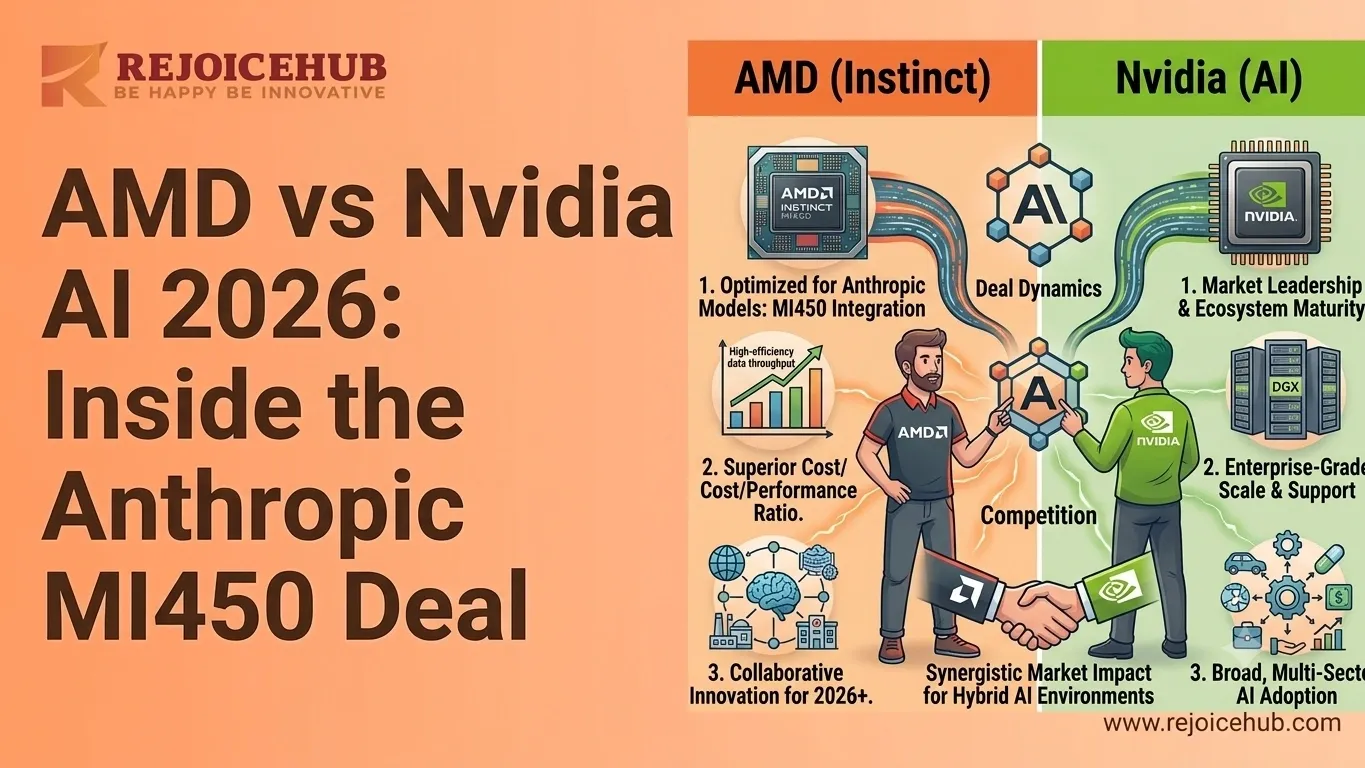
 For the majority of the past decade, if you wanted to either train or host a large language model, there was only one real choice of hardware: Nvidia. It was the duopoly, if you will. That is, until recently.
In July 2026, AMD and Anthropic announced a partnership that would see the deployment of up to 2 gigawatts of AMD Instinct MI450 series GPUs, alongside an investment of up to 5 billion dollars in AMD's equity in Claude's parent company by AMD itself.
This is, by far, one of the clearest signs that the GPU manufacturers are entering into a completely new era in the AI infrastructure market in 2026, and not only should it be on the radar of chip investors, but also those in the know when it comes to infrastructure selection.
In this article, you'll learn:
- What's actually in the Anthropic-AMD MI450 deal
- How AMD and Nvidia AI GPUs compare on training, inference, and cost
- Where CUDA still wins and where ROCm is catching up
- What this shift means for enterprises, startups, and AI infrastructure decisions
Why the Anthropic MI450 Deal Is Making Headlines
What Is AMD MI450?
The AMD MI450 (Instinct MI450 series, including the flagship MI455X) is AMD's next-generation AI accelerator, built on the CDNA 5 architecture.
Key specs reported by AMD:
- Up to 432GB of HBM4 memory per GPU
- Roughly 19.6 TB/s of memory bandwidth
- Up to 40 PFLOPS of FP4 compute performance
- Deployed at rack scale through AMD's Helios system, paired with EPYC "Venice" CPUs and Pensando networking
The MI450 is positioned against NVIDIA's upcoming Vera Rubin, and preliminary comparisons suggest that AMD's most promising feature is memory. At 432 GB per MI455X compared to 288 GB for Vera Rubin, AMD's Helios racks offer about 50% more memory per rack than their competitor's solution.
This is significant to large language model (LLM) operators running trillions of parameters since memory dictates how many of these models can fit on a rack.
Anthropic's Partnership Explained
Here's the deal, in plain terms:
Anthropic will deploy up to 2 gigawatts of AMD Instinct MI450 series GPUs in AMD's Helios rack-scale systems, with the first gigawatt going live in the first half of 2027.
AMD is putting a strategic equity investment of up to $5 billion into Anthropic as part of the arrangement.
The deal builds on Anthropic's earlier use of AMD's Instinct MI355X GPUs, and Anthropic will also deploy AMD's 6th Gen EPYC "Venice" processors, Pensando networking, and ROCm software as part of a full-stack infrastructure package.
Perhaps most interesting: AMD and Anthropic will use Claude itself to optimize workloads for Instinct GPUs and accelerate development of AMD's ROCm software the direct competitor to Nvidia's CUDA.
This is not an isolated incident, as AMD has agreed to several similar multi-billion-dollar contracts throughout 2026, including the aforementioned 6-gigawatt purchase commitment from Meta announced in February 2026, a 6-gigawatt supply deal with OpenAI, and a 50,000 MI450 GPU order from Oracle.
Why This Announcement Matters
Nvidia isn't losing its lead overnight. But the Anthropic MI450 deal matters for three reasons:
- A frontier AI lab is voting with its wallet. Anthropic runs Claude at massive scale this isn't a hobbyist deployment.
- It's a software play disguised as a hardware deal. Using Claude to help build and optimize ROCm is a direct attempt to close AMD's biggest weakness: software maturity, a gap that's also visible when you look at how Claude stacks up against Copilot on enterprise security and reliability expectations.
- It validates AMD as a real second source. AMD has said seven of the ten largest AI compute buyers including Meta, Tesla, xAI, Cohere, Oracle, and OpenAI are now using or evaluating its chips, the broadest customer list AMD's Instinct line has ever assembled against Nvidia.
If you're evaluating infrastructure for your own AI products, this is exactly the kind of shift worth understanding before you commit to a single vendor.
Accelerate Your Workflows with Custom AI
Book a free consultation session with RejoiceHub. We'll map out a tailored automation roadmap for your company.
AMD vs Nvidia AI Performance Comparison
AI Training: Throughput, Scalability, Memory Bandwidth
Training large models is where raw compute and memory bandwidth matter most.
-
Throughput: AMD's MI450 targets up to 40 PFLOPS at FP4 precision, while Nvidia's Vera Rubin VR200 is expected to reach around 50 PFLOPS with a slightly higher 20 TB/s of bandwidth. On paper, Nvidia still edges ahead on raw compute.
-
Memory capacity: AMD leads clearly here, with 432GB of HBM4 per GPU compared to Nvidia's 288GB a real advantage for massive, memory-hungry models.
-
Scalability: Both platforms are moving to HBM4 and similar process nodes, and AMD claims up to 3.6 TB/second of intra-node scale-up bandwidth and 300 GB/second of inter-node scale-out bandwidth, positioning MI450 as competitive at true rack scale.
AI Inference: Latency and Efficiency
For inference, which underlies customer-facing AI products and agents, memory capacity tends to be more important than raw FLOPS, as a larger memory allows one to use smaller batches of data per node, decreasing the latency between GPU operations.
The memory capacity of AMD's offerings is likely to have a greater impact on inference performance for most SaaS companies (which rely on some form of customer-facing AI agents) than on training performance.
Power & Cost
Power draw is becoming a genuine constraint for both vendors as chips get more powerful.
| Feature | AMD (MI450/MI455X) | Nvidia (Vera Rubin) |
|---|---|---|
| Memory per GPU | ~432GB HBM4 | ~288GB HBM4 |
| Memory bandwidth | ~19.6 TB/s | ~20 TB/s |
| Compute (FP4) | ~40 PFLOPS | ~50 PFLOPS |
| Power draw (reported estimates) | Increased by roughly 200W over initial estimates | Rubin Ultra scaled up to roughly 2,300W per GPU |
| Software ecosystem | ROCm (open-source, improving) | CUDA (mature, dominant) |
| Rack-scale platform | Helios | Vera Rubin NVL rack systems |
| Notable 2026 customers | Anthropic, Meta, OpenAI, Oracle | Broad hyperscaler base |
Figures reflect publicly disclosed AMD and industry estimates as of mid-2026; both platforms are still ramping to volume shipment.
The takeaway for buyers: AMD is finally competitive on paper, and the cost implications are already showing up in how labs like Anthropic structure their per-token enterprise pricing. Nvidia still has an advantage in terms of sheer power and, more importantly, software stability, which brings us to the next topic.
CUDA vs ROCm The Biggest Difference
If AMD vs Nvidia AI GPUs were only about hardware specs, this would already be a much closer race. The real gap is software.
1. CUDA Ecosystem
CUDA has been Nvidia's moat for over 15 years. It's deeply embedded in:
- Popular ML frameworks (PyTorch, TensorFlow, JAX)
- Enterprise ML pipelines and MLOps tooling
- Years of accumulated developer knowledge, tutorials, and libraries
Most AI teams default to CUDA because it simply works, out of the box, with the frameworks they already use.
2. ROCm Improvements
ROCm, the open compute platform developed by AMD, has traditionally underperformed in terms of stability and frameworks compared to competitors. However, in 2026, the situation is beginning to change qualitatively, and the deal with Anthropic is part of this turnaround. Anthropic and AMD are using Claude for an innovative approach to accelerating the development of AMD's own ROCm software, which overcomes a critical shortage of human resources in this area an approach that mirrors how Claude Opus 4.7 compares against GPT-5.4 and Gemini 3.1 Pro when it comes to handling complex technical workloads.
3. Open-Source Advantages
ROCm's open-source nature is a significant advantage over proprietary solutions, thus explaining the interest from the enterprise sphere. At the same time, the contribution of the academic community and other organizations in optimizing the performance of particular kernels and tools will allow ROCm to close the existing reliability gap by 2026/2027.
4. Enterprise Adoption
For now, most production AI systems are based on CUDA, but the companies developing new AI infrastructure in 2026 have growing incentive to create a second option: both to gain leverage over Nvidia in price negotiations and to avoid a single point of failure in their supply chains. This is the niche in which AMD would like to position itself, and it's part of a broader pattern of enterprise infrastructure gaps that companies are only now starting to address.
Which GPU Is Better for AI Training in 2026?
There's no single right answer it depends on your workload.
- Enterprise: Large enterprises with existing CUDA-based pipelines will likely stay on Nvidia for now, but should start evaluating AMD for new projects to avoid single-vendor risk.
- Research labs: Institutions chasing the largest possible model sizes may prefer AMD's memory-per-GPU advantage, since it can reduce the number of nodes needed for very large models.
- LLMs and fine-tuning: Fine-tuning workloads are less compute-intensive than pretraining, making them a lower-risk place to pilot AMD/ROCm without disrupting core training infrastructure.
- Inference: AMD's memory capacity advantage makes it an increasingly attractive option for inference-heavy deployments which is most of what customer-facing SaaS and AI agent products actually need.
- Startups: Startups without legacy CUDA dependencies have the most freedom to choose based on cost and availability, rather than sunk-cost software investment.
A Simple Decision Framework
- Do you have existing CUDA-optimized code? If yes, factor in migration cost before switching.
- Is your workload training-heavy or inference-heavy? Inference-heavy workloads tolerate ROCm's current maturity level better.
- How much do you value vendor diversification? If supply and pricing risk matter to you, piloting AMD now is lower-risk than waiting, especially if you're already weighing custom vs off-the-shelf AI software decisions elsewhere in your stack.
- What's your team's tooling familiarity? ROCm has a steeper learning curve today, though that gap is shrinking.
If you're unsure which path fits your product, this is exactly the kind of infrastructure decision worth getting expert input on before you commit budget.
What This Means for the Future of AI Infrastructure
-
Enterprise Procurement
Procurement teams can no longer treat Nvidia as the only viable option. The trend towards multi-vendor GPU strategies is accelerating amongst large AI buyers, and it fits into the wider enterprise AI adoption roadmap that most organizations are now working through.
-
Cloud Providers
Expect to see more cloud providers offering AMD Instinct instances after Oracle's entry with the first public AI supercluster on AMD Helios racks.
-
AI Chip Dominance
After years of speculation, Anthropic, Meta, OpenAI, Oracle and possibly others have placed multi-gigawatt orders with AMD for 2026 deliveries, puncturing the narrative of Nvidia's exclusive dominance over the large AI chip market.
-
Open Ecosystem
The rise of ROCm, plus growing industry support for open standards such as UALink and Ultra Ethernet for scale-out networking, reflects a market desire to avoid being locked into a single stack a theme that also runs through Anthropic's own approach to Claude Mythos and enterprise AI safety.
-
Market Watch
Keep an eye out for three things across the second half of 2026 and into 2027: will AMD actually deliver on the Helios systems it has ordered, will MI450's performance prove out in independent testing, and will ROCm achieve sufficient stability to host production workloads beyond early adopters?
Conclusion
Nvidia still has a big lead in terms of software maturity, for now at least but the rise of competitors like AMD should be a serious concern to anyone looking to make significant enterprise investments in AI infrastructure.
While not likely to displace Nvidia anytime soon, AMD is undeniably starting to look very attractive to major cloud providers. And Anthropic's apparent interest in teaming up with AMD (in addition to their ongoing partnership with Nvidia) is a sign that they're serious about their ambitions in the AI space including not only the silicon, but the software development.
Frequently Asked Questions
1. What is the AMD MI450 GPU?
The AMD MI450 is AMD's newest AI chip, built for training and running large AI models. It comes with up to 432GB of memory, which is more than Nvidia's upcoming Vera Rubin chip offers. This extra memory helps big AI models run more smoothly.
2. What is the Anthropic MI450 deal?
Anthropic agreed to use up to 2 gigawatts of AMD's MI450 GPUs, with the first gigawatt starting in early 2027. In return, AMD is investing up to $5 billion in Anthropic. Both companies will also use Claude to help improve AMD's software.
3. Is AMD better than Nvidia for AI in 2026?
It depends on the job. AMD has more memory per chip, which helps with inference and huge models. Nvidia still wins on raw compute power and has a much more mature software system. Neither one is fully "better" for every use case yet.
4. Why is Nvidia still ahead of AMD in AI?
Nvidia's biggest advantage isn't the hardware; it's the software. CUDA has been the standard for over 15 years and works with almost every AI tool out there. AMD's ROCm is catching up fast, but most companies still trust Nvidia's proven track record.
5. What is ROCm and how does it compare to CUDA?
ROCm is AMD's software platform for running AI workloads, similar to Nvidia's CUDA. It's open-source and improving quickly, especially with help from Anthropic's Claude. CUDA is still more stable and widely used, but ROCm is closing the gap year by year.
6. Should startups choose AMD or Nvidia for AI?
Startups without old CUDA-based code have more freedom to pick based on price and availability. AMD can be a good fit for inference-heavy products, while Nvidia still makes sense if the team wants the safest, most tested option available today.
7. Will AMD replace Nvidia in AI infrastructure?
Not anytime soon. Nvidia still leads in software and overall market share. But deals like the Anthropic MI450 partnership show AMD is becoming a real second option, giving companies more choice and less dependence on a single GPU supplier.