
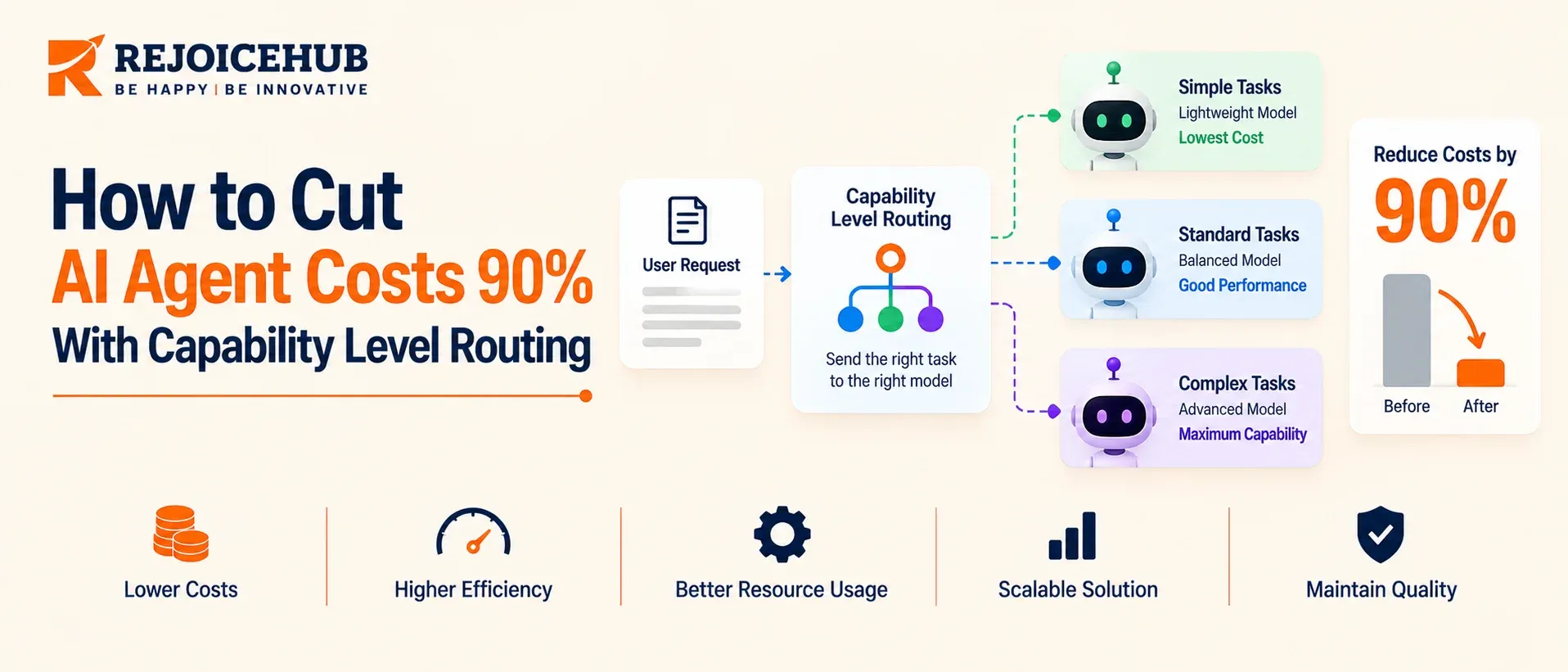
Capability-based routing refers to the practice of grouping every step taken by an AI agent according to the difficulty level it represents and then directing it to the cheapest possible model that can reliably perform that task. Teams exploring AI API cost optimization through model routing are finding this to be one of the highest-leverage architectural changes available today.
Teams that adopt this practice cut blended model costs by 60-90% because most agent steps (classification, pulling information, formatting, questions based on retrieved information) do not require an advanced model at all. The problem with routing badly is that it often ends up costing more than not routing at all due to rework, moving to a stronger model, and a hidden drop in quality.
Key Highlights
- The core pattern: route ~70% of steps (classification, pulling information, filtering) to nano-tier models, ~20% (drafting, summarization) to mid-tier, and ~10% (final review, architecture, high-stakes reasoning) to advanced models.
- Realistic savings range: 60-90% reduction in blended cost per agent run, depending on how much of the workflow is genuinely low-complexity.
- The hidden failure mode: teams that route purely on cost, not on capability plus consequence, see iteration counts climb and rework quietly eat the savings.
- What makes it ready for real-world use: a scored routing policy, an escalation path back to a stronger model on low-confidence output, and an audit trail showing which model handled which decision.
- Who needs this now: any team running agents at meaningful volume (thousands of calls/day+) where a single Advanced model handles every step regardless of difficulty.
Why Your AI Agent Bill Doesn't Match Your Usage
Most teams design their first agent around a single Advanced model, because it's a safe default: capable enough to tackle all the steps in a workflow, and requiring no judgment about which model is best for which task.
The cost of this approach is hidden in production at scale: the simplest way to design an agent is to assume that every step will use the same Advanced model, even though most of what an agent does in any given run isn't actually hard.
Parsing a tool response, classifying a support ticket, extracting a field from a document, formatting a response as JSON, these are all steps that don't require the same sort of model as one that can debug a race condition or reason about a multi-step AI agent architecture decision.
Frontier-model pricing is dictated by the model's hardest capability, but most of what an agent does in any given run isn't that hard.
By routing different steps through different models, you reduce costs while also eliminating the risk of accidental complexity in any one step.
This is the gap capability level routing closes: it's not a model or a framework, but an architectural choice about which model does which sort of work, specified rather than assumed.
What Capability Level Routing Actually Means
Capability level routing is the process of scoring each step in an agent workflow on the basis of two variables: how much work it requires and the cost of being wrong, and mapping that score to a model tier capable of handling the task reliably.
It's different from "just use a cheaper model," which is what naive cost-cutting approaches usually consist of. Switching everything to cheaper models assumes every step is equally tolerant of error, and that's why teams with such measures have agents 40% cheaper and 15% less reliable.
Capability routing keeps the stronger model for decisions where a mistake has high cost: final code review, an architecture choice, any customer-facing work with legal or financial exposure, and puts it on those decisions specifically.
The practical shape of this in most production agents:
- Nano/small models (roughly $0.05-$0.30 per million input tokens) handle classification, keyword pulling, information extraction, short-form formatting, and routing decisions themselves.
- Mid-tier models ($1-$3 per million tokens) handle drafting, summarization, and code generation where quality matters but the cost of a redo is low.
- Advanced models ($10-$15+ per million tokens) are reserved for final review, complex multi-step reasoning, and anything with real impact if it's wrong.
The Cost Math: What 90% Reduction Looks Like in Practice
Cost claims in this space vary significantly, depending on what percentage of your work is low-complexity, since "90% reduction" has to come from somewhere. Let's take a sample workload consisting of 70% simple steps, 20% medium ones and 10% hard, a realistic mix for many support/research/data-processing agents.
| Distribution | Task type | Model tier | Cost per 1M tokens |
|---|---|---|---|
| 70% of steps | Classification, pulling information, filtering, retrieval Q&A | Nano/small | $0.05 - $0.30 |
| 20% of steps | Drafting, summarization, code generation | Mid-tier | $1 - $3 |
| 10% of steps | Final review, architecture, reasoning where mistakes are costly | Frontier | $10 - $15 |
If you were to run every step in that same workload on an advanced model at ~$15/M input tokens, blended cost stays at $15/M. Routed against the distribution above, blended cost lands around $2-$3/M, which is an 80-87% reduction.
Workloads with a greater share of simple steps (high volume support triage, document pulling, information pipelines) can clear 90%. Workloads with lots of genuinely hard reasoning steps will land lower, closer to 40-60%. Treat "90%" as the ceiling for a favorable task mix, not a guarantee for every agent. Teams comparing self-hosted models against API access often run this same math before deciding where each tier should live.
Capability Routing vs. Single-Model Deployment vs. Load Balancing
Teams typically land on one of three patterns. Only one of them is actually a cost strategy, the other two just look like one.
| Single-Model | Basic Load Balancing | Capability Level Routing | |
|---|---|---|---|
| How it decides | Same model, every step | Round-robin or random split across models | Scores task difficulty + consequence, maps to tier |
| Cost profile | Highest, flat regardless of task mix | Lower, unpredictable | Lowest, predictable and tunable |
| Quality risk | Low (more powerful than needed) | High, hard tasks can land on weak models | Low, hard tasks are pinned to strong models |
| Extra work to manage | None | Low to set up, high to debug failures | Moderate to set up, low to run once tuned |
| Best fit | Low volume, pre-product-market-fit | Rarely the right long-term choice | Production agents at high volume |
Basic load balancing is the trap. It pretends to be routing, and using multiple models, but without difficulty scoring, can lead to a hard reasoning step being dispatched to an ill-prepared model, resulting in extra rework rather than savings in inference. This is closely related to the reliability patterns discussed in agent harness design, where weak fallback handling causes similar silent failures.
7 Signs Your Agent Stack Needs Capability Routing
- Your AI model bill scales linearly with call volume, with no relationship to how complex a given call actually was.
- You're running one model for everything because nobody's had time to audit which steps actually need it.
- You've never traced a single agent run one step at a time to see where the spend actually goes.
- Support or ops volume has grown past a few thousand agent calls a day, where a 10-30% waste rate becomes a real business expense.
- You've tried a blanket downgrade to a cheaper model and quality dropped enough that someone escalated it.
- Your team can't answer "what percentage of our agent steps are actually hard" without guessing.
- You're evaluating an LLM gateway or router product but haven't defined the difficulty/consequence scoring it would actually route against.
If three or more of these are true, the architecture work pays for itself faster than most teams expect, often inside the first billing cycle. If this list feels familiar, it may be worth reviewing what typical AI agent development actually costs before committing budget to a fix.
The Three Pillars of a Capability Routing Architecture
1. Score Each Step by Difficulty and Risk
Look at every task based on two things: how much reasoning it needs and how costly a mistake could be. A simple task can still be high-risk. For example, extracting a payment amount may be easy, but getting it wrong could cost money or damage user trust. In such cases, use a stronger model even if the task itself is simple.
2. Set Clear Rules for Each Model Tier
Create clear roles for your nano, mid-tier, and Advanced models. Define which tasks each model can handle instead of choosing models only based on price. These rules make routing decisions consistent, easier to manage, and easier to review. This tiering discipline pairs naturally with a broader AI strategy consulting engagement, since routing policy is really a business decision dressed up as an engineering one.
3. Add Automatic Escalation
If a smaller model is not confident about its answer, send the task to the next model tier. You can use confidence scores, consistency checks, or a quick validation step to detect weak results. If only 15-20% of tasks need escalation, you can still reduce costs while using stronger models when they matter most.
What's Included in a Production Routing Layer
A production-ready routing layer needs more than basic model selection. It should include:
- Task scoring: Rules to measure each task based on its difficulty and the impact of a wrong answer.
- Clear model tiers: Defined roles for nano, mid-tier, and Advanced models, with clear rules for when each model should be used.
- Automatic escalation: A confidence threshold that sends uncertain tasks to a stronger model automatically.
- Cost and speed tracking: Logs for the cost and response time of every step, along with the routing decision behind it.
- Complete audit trail: A record showing which model handled each task and generated each output, which is important for regulated industries. This overlaps significantly with the approval gates and audit trail patterns needed for agent supervision more broadly.
- Performance dashboard: A dashboard that tracks total cost, escalation rate, response time, and how often each model tier is used.
Building this layer correctly usually touches AI integration work as much as it touches model selection, since the routing logic has to sit cleanly inside the existing agent pipeline.
How RejoiceHub Scopes Routing Architecture Work
RejoiceHub typically handles routing architecture projects in three ways:
1. Audit and Routing Rules Design A 2-3 week project that reviews your agent's token usage, analyzes the types of tasks it handles, and creates model routing rules with escalation rules. Typical cost: $12,000-$25,000, depending on the agent's complexity and number of workflows.
2. Full Routing Layer Build This includes building the routing system, escalation logic, and cost and activity tracking into your existing agent setup, drawing on our AI agent development services for the underlying build. Typical cost: $35,000-$90,000 for the first production workflow. Additional workflows usually cost less once the routing framework is in place.
3. Ongoing Tuning and Optimization A monthly service that reviews model usage, escalation rates, and overall costs. The routing rules can also be updated as your task mix changes. Typical cost: Starting at around $3,000/month.
These prices are based on typical mid-market project scopes. The final cost depends on the number of workflows, compliance requirements, and whether the routing layer must connect with an existing model gateway, an area where our automation services team usually gets involved early.
Where Capability Routing Fits in the 2026 Agent Tooling Landscape
Model gateways and router products (Requesty, Not Diamond, OpenRouter, and others) take care of the basic infrastructure work of routing a request to a model endpoint according to a policy.
That's helpful infrastructure, but a gateway pointed at a bad-scoring rule set will faithfully apply harder tasks to weaker models with as much consistency as easier tasks. Teams running agents through session-free, HTTP-based MCP setups run into this same problem at the protocol layer.
RejoiceHub doesn't compete with these routing gateways in most of our projects, we configure routing policy on top of whichever gateway or direct-API arrangement the client has. The architecture work (scoring, tiering, escalation design, audit trail) is what makes the difference between saving money on routing or just moving the failure mode from expensive to unreliable.
Technical Deep Dive: Building the Routing Policy, Escalation Path, and Audit Trail
1. Scoring Each Task
Most production routing systems use a small model for task scoring to check each task before sending it to another model. It gives the task two scores:
- Difficulty: How much reasoning the task needs.
- Consequence: How serious the impact would be if the answer is wrong.
This classification step is usually cheap because it can run on a small model. A well-tuned classifier typically adds around 5-10% overhead to the routing cost. Techniques like prompt caching can shrink this overhead further when the same classification prompts repeat across runs.
2. Adding an Escalation Process
A common approach is to start with a smaller model and validate its answer before using a stronger model.
You can check the result using:
- A confidence score
- Multiple answers to the same task
- Rules that validate structured outputs
- A quick check from a larger model
If the result does not meet the required quality level, the task is automatically sent to a stronger model. Escalating around 15-25% of tasks can help maintain quality while still reducing the overall model cost, a pattern similar to how the OpenAI Agents API handles fallback behavior in production deployments.
3. Keeping a Complete Audit Trail
For highly regulated industries such as finance and healthcare, every routing decision should be recorded.
The record should include:
- Which model tier handled the task
- The confidence score
- Whether the task was escalated
- The final output
This makes it easier to explain and review how the system made each decision during a compliance review, a requirement that shows up constantly in fintech software development work specifically.
4. Avoid Routing Only by Cost
One of the biggest mistakes is choosing a model based only on price.
A task may be easy to process but still have serious consequences if the answer is wrong. For example, extracting an invoice amount may require little reasoning, but an incorrect amount can create a financial error. This is the same principle behind least-privilege governance for agents: permissions and model power should scale with consequence, not convenience.
That's why routing should consider both difficulty and consequence and use the higher risk level when deciding which model should handle the task.
Conclusion
Capability level routing is not about choosing one model over another but rather an architectural decision about which model should be responsible for a given step based on complexity and impact, not convention or habit.
Teams that implement this well see a 60-90% reduction in blended agent cost without sacrificing quality in the output, by ensuring that the Advanced model isn't doing work it isn't required to do.
Teams that get burned are those who route on price alone and avoid escalation paths. If you have agents working at scale and don't understand where the token budgets are being spent, our machine learning development services team can help you find out, this is the place to start.
Frequently Asked Questions
What is capability level routing?
Capability level routing groups AI agent steps by difficulty. It sends each task to the cheapest model that can reliably handle it, saving you money.
How much can I save with AI capability routing?
Teams using this method cut blended model costs by 60 to 90 percent. Most steps do not need an expensive advanced model to work well.
Why is my AI agent bill so high?
Many teams use a single advanced model for every step because it feels safe. This wastes money since most tasks are simple and do not need advanced power.
What is a common mistake when routing AI tasks?
The biggest hidden failure is routing tasks based only on cost instead of capability. This causes high rework rates and quietly eats up your budget savings.
How should I distribute tasks among AI models?
A good rule is sending 70 percent of tasks to nano models and 20 percent to mid tier models. Save advanced models for the hardest 10 percent.
Which tasks should go to nano tier models?
Nano tier models are perfect for basic steps like classification, pulling information, and filtering. These tasks do not require complex logic or high level reasoning.
When do I need an advanced AI model?
Use advanced models only for final reviews, high stakes reasoning, and complex architecture tasks. This limits their expensive usage to about 10 percent of your total workflow.
Does routing lower the quality of AI agents?
No, quality stays high when you use a scored routing policy. You can always pass a task back to a stronger model if the smaller one shows low confidence.
Who benefits most from AI model routing?
Teams running agents at high volume see the biggest financial benefit. If you do thousands of calls a day, switching off a single advanced model saves massive amounts.
How do I audit my AI agent routing?
Set up a trail that records which model handled every specific decision. This helps you track performance, catch errors, and make sure your savings are actually real.
