
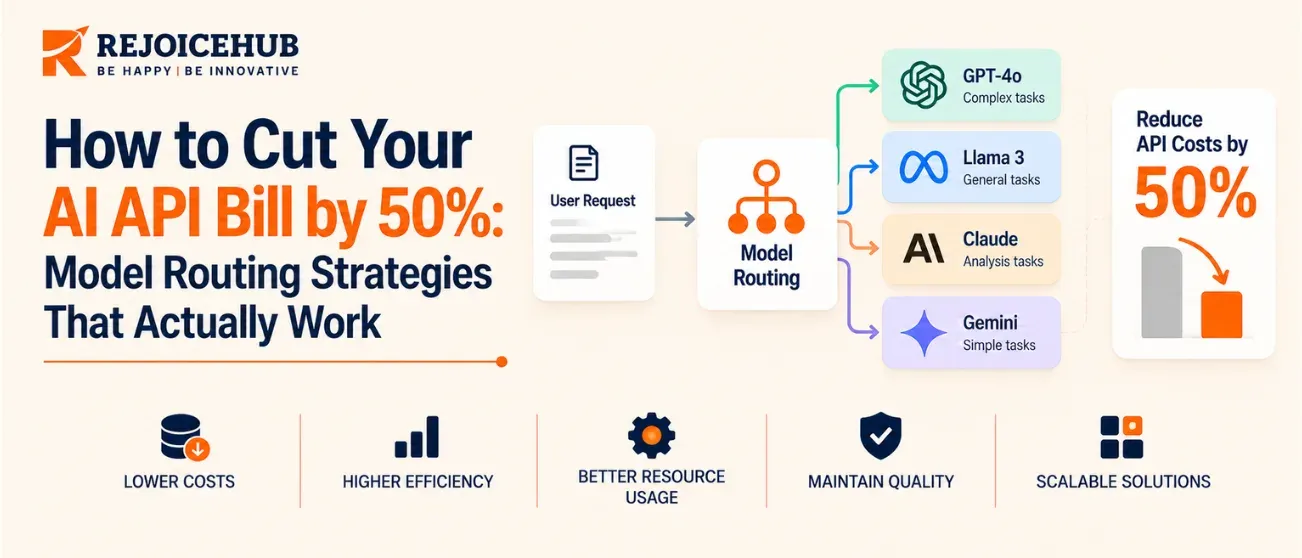
Your AI API costs can climb faster than your number of users. That outcome is common when all kinds of work, from writing a ticket summary to finding bugs in a complex system, go to one large model.
AT&T says it cut its AI coding spend by 56% after changing that setup. Many other teams did the same thing, too. They stopped picking a model once and moved to managing model choice as part of the system they run every day, a shift that usually starts with the right AI Strategy Consulting.
Why AI API Cost Optimization Is a 2026 Problem, Not a 2024 One
Two years into the LLM API growth, many teams chose one model and fixed with it. They often made the call early and then treated it like a fixed rule. Some people picked the most advanced option and said, "quality comes first."
Others went with the lowest price and said, "good enough will cover most work." Either path wastes some money and some ability. By 2026, it is easier to see why a single model setup does not hold up.
For example, input costs differ a lot right now. DeepSeek V4 is around $0.44 per million tokens. Claude Haiku 4.5 is about $1 per million tokens. Sonnet 4.6 is near $3 per million. GPT-5.5 lands around $5 per million. Opus 4.8 is roughly $25 per million.
Uber also built a similar system earlier. Its GenAI Gateway gives each internal team one place to work with models from OpenAI, Vertex AI, and Uber-run alternatives, and setting up that kind of shared gateway is squarely the kind of work handled under API Development. Access is controlled with a standard security check before models are allowed to be used.
What the Data Actually Shows: Cost Reduction by Routing Strategy
Numbers vary by source because workload mix varies. Here's what's been independently reported or benchmarked in 2026:
| Source | Method | Reported Savings | Context |
|---|---|---|---|
| AT&T (internal deployment) | LiteLLM routing to open-source models | 56% on coding costs | 45B tokens/day, 150K employees |
| AT&T telecom-tuned models | Custom fine-tuned models for domain tasks | Up to 90% | Feb–Jul 2026 pilot |
| RouteLLM (academic, cited in Digital Applied's guide) | Matrix-factorization trained router | 85% cost savings on MT-Bench while retaining 95% of GPT-4 quality | Frontier model used on ~14% of queries |
| Eden AI 2026 router comparison | Various commercial routers | 30–85% depending on workload and quality requirements | Cross-vendor benchmark |
| Orzed client engagements | Rules-based cheapest-passing-model routing | 37–59% (48% average) | Four real engagements, 2025–2026 |
| Crude 70/30 split | No learned routing, static ratio | Roughly 67% savings | Cited in Digital Applied's June 2026 guide |
Across the sources, the same theme shows up: your savings track with the share of traffic that is easy to handle, not with how advanced your routing gear is.
A ticket classifier or a document extraction flow usually works well. Most requests do not require deep, heavy thinking. Building that kind of matrix-factorization trained router is a job that leans heavily on Machine Learning Development Services.
But a tool that does open ended research or writes code has a different pattern, and this is where solid Vibe Coding Development Company work matters. It routes with less restraint, because a lot of what users ask really does call for the higher cost model.
Build vs. Buy: Routing Infrastructure Options Compared
| Approach | Setup effort | Control | Best for | Typical cost overhead |
|---|---|---|---|---|
| Self-hosted (LiteLLM) | Medium-high: deploy and maintain proxy | Full self-hosted, open source | Teams with existing DevOps capacity, compliance-sensitive workloads | Infra cost only, no per-token markup |
| Managed gateway (Portkey, OpenRouter) | Low SDK swap | Moderate vendor-defined routing policies | Fast-moving teams that want observability without building it | Small per-token markup, often offset by savings |
| Custom-built router | High classifier + fallback chain + eval harness | Fully tailored to your exact task mix | Enterprises with high-volume, well-understood traffic patterns | Engineering time, amortizes at scale |
| No routing (status quo) | None | None | Never recommended past prototype stage | 40–70% higher than any routed alternative |
Not everything can be labeled "best." A small startup with five people, spending about $2,000 a month, and using one OpenAI key, will likely gain more by using a managed gateway backed by good Automation Services. Building a classifier is not the same kind of payoff.
In contrast, a big company with around 150,000 staff, moving something like 45 billion tokens each day, as AT&T does, can justify custom setup, and that's usually built through dedicated DevOps Consulting Services. The build work spreads out over a huge amount of traffic, so the math works better. For teams that want a fully tailored router matched to their exact task mix, this is where Generative AI Solutions come into play.
7 Model Routing Tactics That Actually Move the Cost Needle
Route on task type before task difficulty. Classification, extraction, and summarization tasks tolerate cheap models far better than open-ended reasoning. Segment your traffic by task type first, it's a five-minute win before you build anything sophisticated.
Use a cheap classifier to route, not an expensive one. A common anti-pattern is asking a frontier model to decide which model should handle a request, you pay premium prices just to make the routing decision. A small fine-tuned classifier or rules engine, often built through AI Agents Services, costs a fraction of a cent per classification.
Set an eval bar per task, not a global quality bar. Without evals, routing is guessing, you need a defined pass/fail bar per prompt type to know which model is genuinely "cheapest passing," not just cheapest.
Add a confidence-based fallback chain. When the cheap model's confidence is low, escalate rather than accept a wrong answer. This kind of fallback logic is a natural fit for AI Agentkit Builder Services, since the cost of a hallucination-driven support escalation usually exceeds what the frontier model would have charged in the first place.
Layer in caching separately from routing. Cache hit rates of 15–30% are common in production apps, and cached responses carry zero token cost, this stacks on top of routing savings rather than replacing them.
Re-price your routing table quarterly, not annually. A model that was the cheapest passing option in 2025 may not be in 2026, new models and price cuts change the equation regularly, and teams that don't re-evaluate leave savings on the table permanently.
Track cost-per-successful-outcome, not cost-per-token. A cheap model that fails 20% of the time and triggers a retry on the expensive model can end up costing more per resolved request than routing there directly. Token price is not the metric that matters, resolution cost is.
The Core Concept: How a Routing Layer Actually Decides
Every production router, regardless of vendor, follows the same two-stage pattern, and getting this right is often a bigger part of a company's broader Digital Transformation than most teams expect.
Stage 1: Classification A lightweight layer (rules, a small fine-tuned model, or both) tags the incoming request with a difficulty score, task type, and any hard constraints (structured output required, latency budget, compliance sensitivity).
Stage 2: Dispatch A scoring function matches that classification against a live cost-performance matrix, current pricing, observed latency, and recent failure rates per model, then picks the cheapest model that clears the eval bar for that task type. A fallback chain handles the cases where the first choice fails or returns low-confidence output.
The matrix isn't static. Provider pricing and model line-ups both shift monthly in 2026, so a routing table hardcoded at launch degrades within weeks. This is the part most DIY implementations skip, and it's the part that erodes savings fastest.
What's Included in a Production-Grade Routing Setup
Putting together a setup like this usually falls under broader Generative AI Development Services, and a solid version includes a unified gateway built through AI Integration so every provider sits behind one interface:
- Unified API gateway (OpenAI/Anthropic/Google-compatible interface, single integration point)
- Task-type and difficulty classifier, tuned to your actual traffic
- Per-task-type eval harness with defined pass/fail thresholds
- Live pricing and latency feed across providers
- Confidence-based fallback and retry chain
- Response caching layer (separate from routing, stacks on top)
- Per-team and per-project budget enforcement
- Cost, latency, and quality dashboards broken out by task type and model
Engagement Models for Building This
Fixed-scope routing audit: traffic analysis, task-type segmentation, and a savings projection before any code is written. Typically 1–2 weeks.
Build engagement: routing layer, classifier, eval harness, and dashboards built and deployed against your existing stack through hands-on Web Development Services. Scoped per traffic volume and task-type complexity, most mid-market engagements run 4–8 weeks.
Managed/retainer model: RejoiceHub maintains the routing table, re-evaluates pricing quarterly, and tunes the classifier as your traffic mix shifts. Priced monthly, scaled to request volume.
The Routing Tooling Landscape
OpenRouter, LiteLLM, and Portkey are not the same. They all fit different needs.
OpenRouter is good at finding models that people in the community have helped shape.
LiteLLM acts like a simple proxy, and it's a natural project to hand to a team that offers Open Source Consulting. It works well when you want to run things on your own servers.
Portkey focuses more on visibility. It also adds governance controls that teams may need.
There is no single clear winner. One setup can beat another.
AT&T chose LiteLLM for its production system. They wanted self-hosted control at very large scale.
A smaller team may not want that level of setup. When time matters, a managed option can feel easier and more useful.
RejoiceHub works across providers. What you pick should match your traffic size, your compliance needs, and how much DevOps work you can handle. It should not come down to which company talks the most.
Technical Deep Dive: Where Routing Projects Actually Fail
The failure modes are consistent enough across engagements to be worth naming directly:
No eval harness. Routing without a defined quality bar per task type is guessing, and guessing eventually routes a compliance-sensitive request to a model that can't handle it.
Stale pricing tables. Provider costs shift monthly. A router that isn't re-priced quarterly slowly reverts to overpaying on models that were once the cheapest option.
Using an expensive model to do the routing. This is the single most common anti-pattern, it burns frontier-model spend on a decision that a cheap classifier could make.
Ignoring retry cost. A model with a 20% failure rate on a task type looks cheap per call and expensive per resolved request once retries are counted.
Treating routing as "set and forget." The savings appear in week one and compound with traffic growth, but only if someone owns re-evaluation. Teams that delay routing don't get the savings retroactively, they pay the difference forever until they ship it.
Conclusion
The model routing strategy described in this paper is not a novel discovery, it reflects the industry-standard approach to balancing the load across different types of infrastructure, applied to the domain of inference spend.
Both peer-reviewed research and production-ready evidence consistently show that complexity-based routing, rather than "always frontier" or "always cheapest" strategies, is most efficient at protecting margin while preserving output quality.
The teams leveraging complexity-based routing achieve a 40-70% decrease in spend, depending on the utilization patterns, and these are the teams that dedicate resources to continuous evaluation of the options and re-pricing of tasks in accordance with the findings.
If your organization currently uses a single model for all tasks, we strongly recommend reaching out to RejoiceHub to set up a discovery call and discuss how this approach affects your margin.
Frequently Asked Questions
What is AI model routing?
AI model routing means sending each request to the right model based on how hard the task is. Simple tasks go to cheaper models, while complex ones go to stronger, pricier models.
How much money can model routing actually save on AI costs?
Most teams save between 40% and 70% on their AI API bills. AT&T reported a 56% drop in coding costs, and some custom fine-tuned setups saved up to 90% on specific tasks.
Is LiteLLM free to use for model routing?
Yes, LiteLLM is open source and free to self-host. You only pay for your own server infrastructure, not a per-token markup, which makes it popular with larger, DevOps-ready teams.
What's the difference between LiteLLM, Portkey, and OpenRouter?
LiteLLM is a self-hosted proxy for full control. Portkey focuses on visibility and governance. OpenRouter gives access to community-tested models. Pick based on your team size and compliance needs.
Do small startups need a custom-built AI router?
No, small startups usually don't need one. A managed gateway is faster to set up and cheaper to maintain for low-volume traffic, while custom routers only pay off at large scale.
What is a confidence-based fallback chain in AI routing?
It's a safety net where a cheap model escalates the request to a stronger model if it isn't confident in its answer. This avoids costly mistakes from a weak model.
How often should you update your AI model routing table?
Update it every quarter, not once a year. AI pricing and model lineups change monthly in 2026, so an old routing table quietly starts overpaying without anyone noticing.
Why shouldn't you use an expensive AI model to do the routing decision?
Because you'd be paying premium prices just to decide which model handles the task. A small, cheap classifier can make that same decision for a tiny fraction of the cost.
What is cost-per-successful-outcome in AI routing?
It measures how much you actually spend per resolved request, including retries. A cheap model that fails often and needs a retry can end up costing more than routing to a better model directly.
What tasks are best suited for cheaper AI models?
Classification, summarization, and data extraction tasks work well with cheaper models. Open-ended reasoning, coding, and research tasks usually still need a stronger, more expensive model to get accurate results.
