
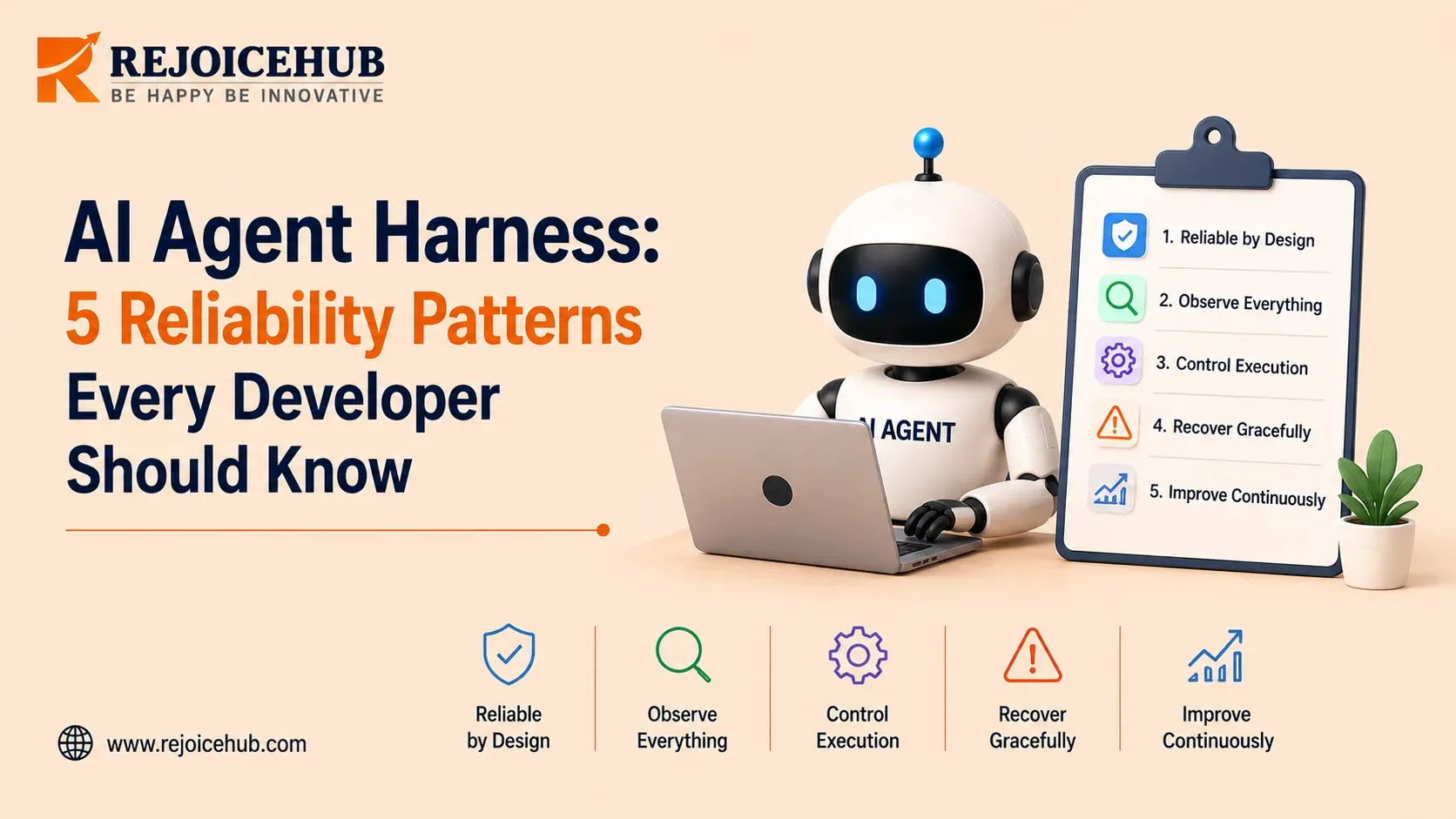
If you've shipped an AI agent to production, you already know the uncomfortable truth: the model was never the hard part. The hard part is everything you have to build around it: the tool-call validation, permission gates, context management, and audit trail that has to exist before legal teams will sign off. This surrounding system has a name now: the AI agent harness.
In 2026, "harness engineering" is becoming the phrase people use when they realize they've exhausted the low-hanging fruit of prompt tuning. Anthropic and OpenAI have both published work this year suggesting that improving your harness (the controls placed around a model) can often generate far better returns than trying to improve the model itself.
The emerging consensus among people working on these technologies can be summed up in the formula: Agent = Model + Harness. The underlying assumption is that while the model provides the reasoning, the harness makes that reasoning safe, repeatable, and auditable in a production environment.
What Is an AI Agent Harness?
An AI agent harness is the infrastructure layer that sits between a language model and the real world: the tool registry, the permission model, the sandbox, the memory and context system, the verification loop, and the logging that records what the agent did and why.
It's distinct from an agent framework, which gives you the programming model and abstractions (tool definitions, memory classes, multi-agent coordination) but leaves the operational hardening to you. Teams working on generative AI development often start here, before realizing the framework alone isn't enough.
An agent harness is the fully assembled system: the framework plus all the configuration, controls, and operational layers needed to run it in production.
In other words: made out of the LEGO bricks. The harness is the finished, load-bearing structure, made out of the LEGO bricks, that has to withstand the 2 am tool call that returned invalid JSON, or the user trying to smuggle their own instructions past the agent by hiding them in a document that the agent has to summarize.
Pattern 1: Never Let the Model Call Tools Directly
This is the foundational pattern upon which all others are built. The model itself does not perform any actions; it produces a structured tool call, while the harness is responsible for validating the schema, checking permissions, performing the action, and injecting a structured response into the conversation.
This is what prevents a prompt injection from resulting in arbitrary code execution.
The benefits of this approach extend beyond security, by declaring each tool use as a formal operation within a conversation protocol, you can treat every interaction as a first-class observable event. This is the same discipline that shows up in solid API development work: every endpoint contract clearly defined, every response predictable.
Regardless of whether an API call succeeds, is forbidden, or times out, the agent always receives a structured observation with an unambiguous result.
It provides the foundation for writing deterministic tests against an inherently non-deterministic system. Teams building custom assistants through ChatGPT customization services run into this constraint quickly once they move past demo-stage prompting.
In practice: define a strict JSON schema for every tool, validate the model's output against it before anything runs, and reject (don't silently coerce) malformed calls. A malformed tool call should fail loudly and return a clear error the agent can reason about, not get "fixed" by a permissive parser that masks a downstream schema drift. This is exactly the kind of discipline an AI agentkit builder needs baked in from the start.
Pattern 2: Draft-Commit for Anything Irreversible
Any action that cannot be reverted cleanly in the database or filesystem, emails sent, rows deleted, code pushed to prod, money transferred, requires a two-phase draft-commit style interface rather than being executed on the model's first inclination. The agent drafts, then an explicit commit is necessary to enact the change on the world. This matters most in fintech software development, where an unreviewed money transfer isn't a bug report, it's an incident.
All enterprise-grade harnesses need an explicit checkpoint between "the agent thought it was a good idea" and "the change is actually applied." That checkpoint could be a human in the loop or a policy engine, but it must be a separately committable step rather than be inferred from the agent's thought process.
This is also why I think of an "AI agent" and an "AI agent that enterprises can actually govern" as two entirely different categories. Because a governed agent has to pass through the same set of "pre-flight checks" and "output safeguards" before doing any risky or irreversible operation. You can't have a different safety mechanism for every possible edge case; you need one consistent checkpoint that all operations have to go through, similar to how mature automation services build in approval gates before any workflow touches production data.
Pattern 3: Close the Loop, Verify, Don't Trust Self-Reports
Left alone, agents are prone to what researchers call "victory declaration," marking a task complete without actually verifying the outcome. An agent that says "done" is not the same as a task that is actually done, and treating the two as equivalent is one of the most common sources of silent production failures.
The fix is a verification loop that operates outside the agent's own self-assessment: run the test suite, check the diff against the ticket's acceptance criteria, re-fetch the record the agent claims it updated, and confirm that the resulting state matches the claim. If your agent writes code, that means running the actual tests, not relying on the model's explanation of what the tests would probably show. Some of the strongest verification patterns we've seen come out of machine learning development pipelines, where model output was never trusted without an independent check to begin with. If your agent updates a CRM record, it means reading the record back and confirming the change, rather than trusting the write confirmation.
This is also where context pressure comes in. As an agent's context window fills, it will tend to rush toward a finish, leaving out detail in order to save space. A verification loop that runs regardless of how certain (or anxious) the agent is about its answer is your safeguard against this behavior.
Pattern 4: Treat Context as an Engineered Resource, Not a Dumping Ground
Long-running agents tend to gather up more context than expected from tool output and previous exchanges, including retrieved documents. Throwing everything into every turn bloats both budgets and accuracy. The solution is contextual layering, which ensures that only the relevant parts of the conversation history are passed with each turn.
Two practices are particularly valuable here. First, context compaction by periodically summarizing and discarding information no longer needed by later processing steps. Second, trust labeling. Untrusted content, such as information extracted from a user-uploaded file or scraped from a web page, should be explicitly labeled so it is treated with less authority than context generated from trusted sources. This kind of layered thinking is common in broader generative AI solutions, where the same content pipeline has to serve multiple trust levels at once.
This helps prevent indirect prompt injection, where a malicious command embedded in an uploaded or retrieved file could be incorrectly treated as higher priority than the agent's normal instructions.
Microsoft's public description of their Azure SRE Agent redesign provides a good example of the value of better context management. By shifting from over one hundred custom tools and a rigid prompt to a filesystem-based approach that allowed the agents to query past work, runbooks, code, and investigation notes as files, they saw a jump from 45% to 75% of new incidents being classified correctly.
Better context management can often provide more value than broader, more specific tools.
Pattern 5: Instrument Everything, Observability Is Not Optional
Industry surveys in 2026 continue to highlight the same gap: many enterprises monitor their AI agents, but far fewer have the ability to stop or contain an agent while it is executing an action. That gap is often less about monitoring and more about control: many agent harnesses were not designed to support containment and intervention.
A production harness should provide, at minimum, an append-only event log for decisions and tool calls, drift detection for unexplained behavioral changes, and a hard kill switch that operates independently of the agent's control flow. An agent that worked reliably last week can fail this week without any code changes in your system. Building that kind of resilient operational layer is squarely the domain of solid DevOps consulting, where kill switches and rollback plans already exist for traditional deployments.
An upstream model may have changed, an API may return a different format, or usage patterns may have moved into an untested scenario. Without a complete trace, diagnosing the failure becomes significantly harder.
This is also where compliance and reliability converge. A well-built harness can generate much of the evidence needed to support compliance and auditing under frameworks such as the EU AI Act. Without structured logging and traceability, assembling that evidence becomes far more difficult. If you're building for regulated industries, observability shouldn't be something bolted on before an audit; it should be a natural outcome of a harness architecture designed correctly from day one, the same way a proper IoT development rollout treats device-level telemetry as a first-class requirement rather than an afterthought.
What DeepSeek Harness Signals About Where This Is Headed
DeepSeek Harness (dsh) is DeepSeek AI's open-source agent harness, built around an "everything is a plugin" architecture powered by a micro-kernel called Cordis. Runtime components, including model adapters, tool registries, sandboxing environments, session-state handlers, event dispatchers, and the UI, can be loaded as independent, swappable extensions rather than being tightly coupled to a single monolithic runtime. Teams evaluating this kind of architecture often lean on open-source consulting to figure out which pieces are actually production-ready versus which still need hardening.
Two aspects of this release matter beyond the DeepSeek ecosystem. First, it is explicitly model-agnostic, so using the harness does not require you to use DeepSeek's own models. That reinforces a broader shift toward treating the harness layer as separable, portable infrastructure rather than as a tightly coupled model-vendor component. Second, it includes traceable sessions and multiple runtime modes, making observability part of the runtime rather than something that must be added later. That directly reflects the fifth pattern discussed above.
That said, DeepSeek Harness is currently a developer preview and is evolving rapidly, so compatibility-breaking changes are possible. It is a useful signal of where open-source agent infrastructure is heading: plugin-based, model-agnostic, and trace-aware. But it should not yet be treated as a drop-in foundation for regulated production workloads without additional hardening and operational controls. That is the practical gap enterprise teams still need to address: taking a promising open-source or vendor harness and adding the permissioning, verification, isolation, and audit controls required for production deployment.
Framework vs. Harness: A Quick Comparison
| Agent Framework | Agent Harness | |
|---|---|---|
| Provides | Programming model, tool abstractions, memory classes | Full operational system: tools + permissions + sandbox + logging |
| Examples | LangGraph, CrewAI, DeepSeek Harness's plugin layer | The complete deployed system built on top of a framework |
| Reliability owner | Developer, per-project | Encoded into the infrastructure itself |
| Compliance-ready? | Rarely, out of the box | Should be, by design |
The gap between "a framework that works in a notebook" and "a system a compliance team will sign off on" is usually where teams underestimate the amount of custom mobile app development or backend engineering required to expose these controls to actual end users.
Building a Harness Your Enterprise Can Actually Trust
None of these five patterns are exotic. Tool-call validation, draft-commit gating, closed-loop verification, engineered context, and end-to-end observability are all established software engineering disciplines.
The shift is applying them consistently to a component, an LLM, that does not behave like traditional deterministic code. The enterprises winning with AI agents in 2026 aren't necessarily the ones with the best models; they're the ones with the most disciplined operational infrastructure around them, often shaped by a clear AI strategy consulting process before a single line of harness code gets written.
If your team has moved beyond the proof-of-concept stage, the next question is what a production-grade harness should look like for your compliance requirements, tool ecosystem, and risk tolerance. RejoiceHub works with engineering and security leaders to build that layer, whether by hardening an open-source harness like dsh, extending an existing framework, or architecting a custom runtime from the ground up, as part of a broader digital transformation effort. Talk to our team about building a reliable agent harness for your stack.
Getting the interface right matters just as much as getting the backend right. An agent that surfaces its draft-commit checkpoints or verification results through a confusing dashboard undermines the trust the harness was built to earn, which is why UI/UX design and user research usually sit alongside the engineering work rather than being bolted on afterward. On the front end, teams pairing agent tooling with AI-assisted coding workflows through a vibe coding development approach are finding it easier to iterate on these interfaces quickly. And once the harness itself is solid, presenting the resulting product clearly, whether through a web development build-out, updated brand design, or a digital marketing push, is what actually gets it in front of the enterprise buyers who need to trust it. Strong AI integration work ties all of these pieces back into the systems your team already runs on.
Accelerate Your Workflows with Custom AI
Book a free consultation session with RejoiceHub. We'll map out a tailored automation roadmap for your company.
Conclusion
Reliable AI agents are not built by choosing a better model alone. They require an engineering harness that controls how the agent acts, verifies results, manages context, and handles failure.
The five patterns discussed here, tool-call validation, draft-commit gating, closed-loop verification, engineered context, and end-to-end observability, turn unpredictable model behavior into a system that can be tested and improved.
None of these techniques are exotic; they are proven software engineering disciplines applied to a probabilistic component.
As agents move into production, this reliability layer will increasingly determine whether an AI system is merely impressive in demos or dependable enough to run real business workflows.
Frequently Asked Questions
What is an AI agent harness?
An AI agent harness is the system built around an AI model that controls what it can do. It handles tool calls, permissions, logging, and checks, so the agent works safely in real apps, not just in a demo.
How is an AI agent harness different from an agent framework?
A framework gives you building blocks like tool definitions and memory classes. A harness is the full working system, framework plus permissions, sandboxing, and logging, ready to run safely in production.
Why can't an AI model call tools directly?
If a model calls tools directly, a bad prompt or hidden instruction could trigger unwanted actions. The harness checks and validates every tool call first, so nothing risky runs without a proper check.
What is draft-commit in AI agents?
Draft-commit means the agent prepares an action first, like sending an email or updating a record, but a separate step is needed to actually apply it. This stops the agent from doing something risky by mistake.
Why do AI agents need a verification loop?
Agents sometimes say a task is done when it isn't. A verification loop checks the real result, like running tests or reading back a record, instead of just trusting what the agent reports.
What does context management mean for AI agents?
It means only giving the agent the information it actually needs for each step, instead of dumping everything in at once. This keeps the agent accurate and stops it from getting confused by extra data.
What is DeepSeek Harness (dsh)?
DeepSeek Harness is an open-source AI agent harness built with a plugin-based design. It works with different AI models, not just DeepSeek's own, and comes with built-in tracking and multiple runtime modes.
Is an AI agent harness only needed for large companies?
No, any team running an AI agent in a real product benefits from a harness. It keeps things safe and predictable, whether you're a startup or a large enterprise handling sensitive data.
What makes an AI agent harness important for compliance?
A good harness keeps a full log of what the agent did and why. This record is exactly what teams need to show auditors or meet rules like the EU AI Act.
Do I need a kill switch for my AI agent?
Yes, a kill switch lets you stop an agent instantly if something goes wrong. Without one, a misbehaving agent could keep running actions with no way to pause or shut it down quickly.
