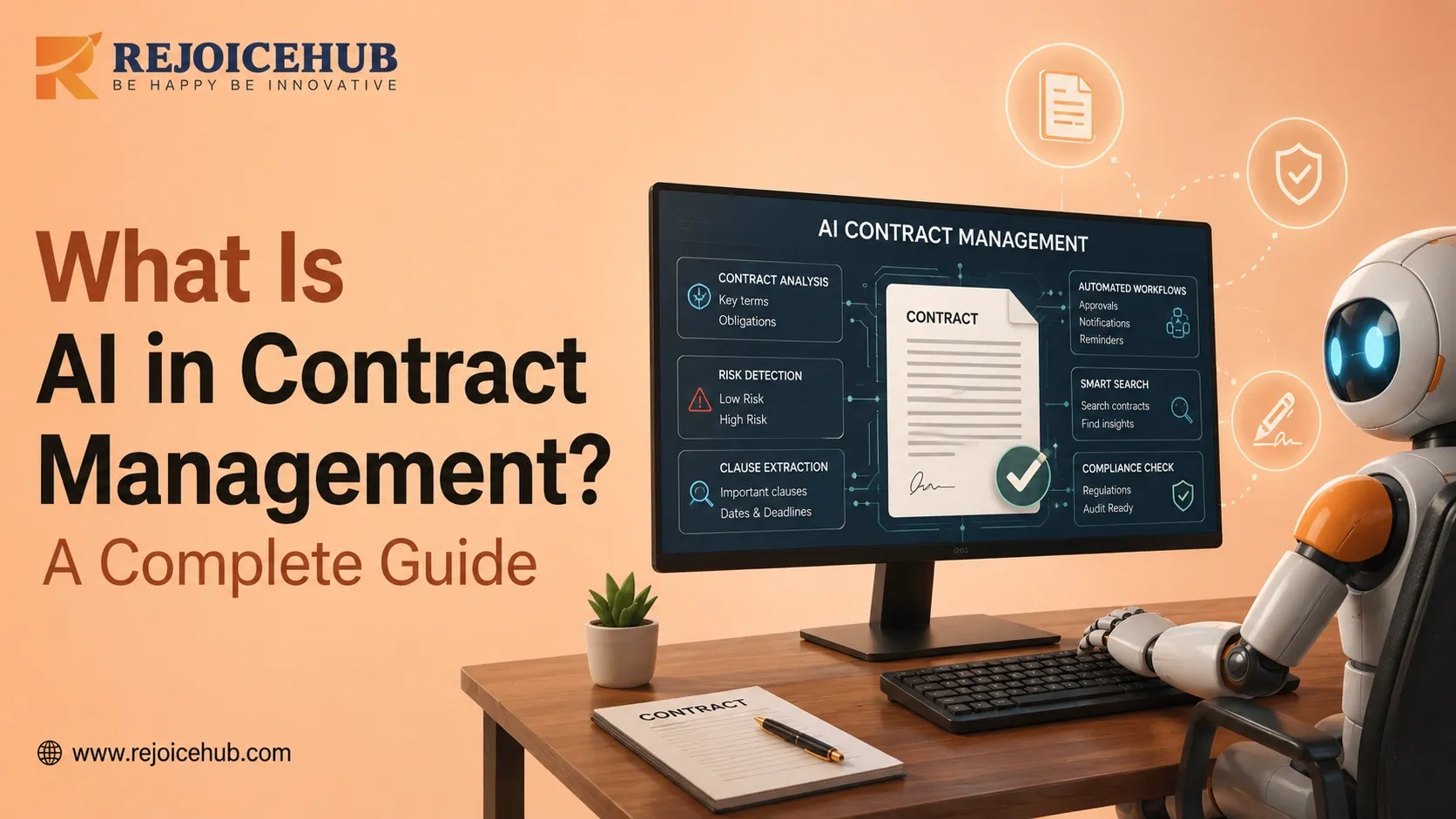
Contracts run every business relationship vendor deals, employment agreements, sales terms, NDAs yet most legal and operations teams still manage them manually in spreadsheets and shared drives. As contract volumes grow, manual review becomes slow, error-prone, and expensive. AI contract management solves this by using machine learning and natural language processing to read, analyze, flag risk, and automate contract workflows at scale. This guide breaks down exactly what AI contract management is, how it works, and how startups, SaaS companies, and enterprises can use it to move faster with less risk.
What Is AI Contract Management?
Featured Snippet Answer: AI contract management is the use of artificial intelligence including natural language processing (NLP), machine learning, and generative AI to automate the creation, review, analysis, approval, and renewal of contracts. It replaces manual clause-by-clause reading with automated risk detection, clause extraction, and intelligent summarization, cutting review time from hours to minutes.
Definition
At its core, AI contract management (sometimes called contract intelligence) applies AI models to unstructured legal text. Instead of a paralegal manually scanning a 40-page vendor agreement, an AI system reads the document, identifies key clauses (termination, liability, indemnification, payment terms), and flags anything that deviates from company policy.
Difference From Traditional Contract Management
Traditional contract management is largely manual: humans read, tag, store, and track renewal dates, often in folders or basic CLM (contract lifecycle management) tools with limited automation.
| Aspect | Traditional Contract Management | AI Contract Management |
|---|---|---|
| Review speed | Hours to days per contract | Minutes per contract |
| Risk detection | Manual, inconsistent | Automated, rule + AI-based |
| Clause extraction | Manual tagging | Automatic via NLP |
| Renewal tracking | Manual calendar reminders | Automated alerts |
| Scalability | Breaks down at volume | Scales across thousands of contracts |
| Summarization | Human-written | Generative AI summaries |
The Role of AI
AI doesn't replace legal judgment it accelerates the repetitive, high-volume parts of contract work so legal and procurement teams can focus on negotiation and strategic decisions. This is the essence of what AI contract management is: augmentation, not replacement.
Key Takeaway: AI contract management is not just digital storage it's active intelligence layered on top of your contracts that reads, understands, and flags what matters.
How Does AI Contract Management Work?
Direct Answer: AI contract management works through a multi-stage pipeline: documents are ingested and digitized via OCR, analyzed using NLP to extract clauses and terms, scored for risk against predefined rules, routed through approval workflows, signed, stored, and tracked for renewal often with generative AI producing plain-language summaries at each stage.
The Workflow, Step by Step
-
Document Ingestion: Contracts (PDF, Word, scanned paper) enter the system from email, upload, or e-signature platforms.
-
OCR (Optical Character Recognition): Scanned or image-based contracts are converted into machine-readable text.
-
NLP Analysis: Natural language models parse the text to understand structure, entities, and intent.
-
Clause Extraction: AI identifies and tags standard clauses: termination, confidentiality, liability caps, auto-renewal, governing law.
-
Risk Detection: The system compares extracted clauses against your organization's playbook and flags deviations (e.g., missing liability cap, unfavorable jurisdiction).
-
Approval Workflows: Flagged contracts route automatically to the right stakeholder (legal, finance, department head).
-
Generative AI Summaries A plain-English summary is generated so non-legal stakeholders can understand obligations quickly.
-
Signature, Storage & Renewal Reminders Once approved, contracts move to e-signature, are stored in a searchable repository, and renewal dates trigger automated alerts before expiration.
Suggested Workflow Diagram
Upload
↓
OCR
↓
AI Analysis (NLP)
↓
Risk Detection
↓
Approval Workflow
↓
Signature
↓
Storage
↓
Renewal Reminder
Accelerate Your Workflows with Custom AI
Book a free consultation session with RejoiceHub. We'll map out a tailored automation roadmap for your company.
Common Mistakes Businesses Make
-
Deploying AI contract review without a defined risk playbook, so the AI has nothing to compare clauses against.
-
Skipping human review entirely on high-value or high-risk contracts.
-
Not integrating the AI tool with existing CRM, ERP, or procurement systems, creating data silos.
Key Takeaway: Good AI document processing isn't just OCR plus AI it's a connected pipeline from ingestion to renewal that removes manual bottlenecks at every stage.
For teams building or evaluating automated pipelines like this, RejoiceHub's work on AI agent orchestration explains how multiple AI steps can be coordinated reliably in production.
Benefits of AI Contract Management
Direct Answer: AI contract management delivers faster reviews, reduced legal risk, stronger compliance, better visibility into obligations, lower operational costs, and the scalability enterprises need to manage thousands of contracts without proportionally growing headcount.
-
Faster Reviews
What once took legal teams hours can be reduced to minutes. AI pre-screens contracts, so humans only focus on flagged risk areas instead of reading every line.
-
Reduced Legal Risk
Consistent, rules-based risk detection catches clauses a tired reviewer might miss especially in high-volume periods like quarter-end vendor renewals.
-
Improved Compliance
AI checks contracts against regulatory requirements (GDPR, HIPAA, SOC 2 clauses) automatically, reducing the chance of a compliance gap slipping through.
-
Better Visibility
A centralized, searchable contract repository means leadership can instantly answer questions like "how many vendor contracts auto-renew this quarter?"
-
Lower Costs
Less time spent on manual review translates directly into legal and operational cost savings a strong enterprise contract automation ROI driver.
-
Automation at Scale
Renewal reminders, approval routing, and summary generation happen without manual intervention, freeing legal teams for higher-value work.
-
Enterprise Scalability
As contract volume grows with company size, AI systems scale without the linear headcount increase traditional review requires.
| Benefit | Traditional Process | With AI Contract Management |
|---|---|---|
| Avg. review time | 2–4 hours | 5–15 minutes |
| Missed renewal risk | Common | Rare (automated alerts) |
| Compliance checks | Manual audit | Continuous, automated |
| Cost per contract reviewed | High (legal hours) | Significantly lower |
Key Takeaway: The real ROI of benefits of AI contract management isn't just speed it's the compounding value of consistent risk reduction across every contract, every time.
Curious what this looks like in dollar terms? RejoiceHub's guide on how to measure AI ROI breaks down frameworks you can apply directly to contract automation initiatives.
AI Contract Management Use Cases
Direct Answer: AI contract management is used across legal, procurement, HR, sales, finance, healthcare, and manufacturing teams to automate review, extract obligations, flag risk, and manage the full contract lifecycle increasingly through autonomous, agentic AI systems rather than single-purpose tools.
1. Legal Teams
Legal departments use AI for AI contract review, redlining suggestions, and clause benchmarking against company playbooks reducing outside counsel spend on routine agreements.
2. Procurement
Procurement teams use AI to review vendor contracts for pricing terms, SLAs, and termination clauses before renewal negotiations, supporting broader AI contract lifecycle management.
3. HR
HR teams apply AI to employment agreements and offer letters, ensuring consistent language and flagging non-standard terms before signature.
4. Sales
Sales operations use AI to accelerate customer contract turnaround a major driver of deal velocity, especially for SaaS companies closing enterprise deals.
5. Finance
Finance teams rely on AI to track payment terms, penalty clauses, and financial obligations across thousands of active contracts.
6. Healthcare
Healthcare organizations use AI to ensure vendor and partner agreements meet HIPAA and data-privacy requirements automatically.
7. Manufacturing
Manufacturers use AI contract intelligence to manage supplier agreements, delivery SLAs, and liability terms across complex global supply chains.
8. The Rise of Agentic AI in Contracts
Beyond single-task tools, agentic AI systems are now capable of autonomously routing a contract through review, flagging risk, notifying stakeholders, and scheduling renewal acting more like a digital contract coordinator than a static tool. Learn more about this shift in RejoiceHub's guide to what agentic AI is and how it differs from traditional automation.
Key Takeaway: AI contract management use cases span nearly every department that touches a legal document the common thread is faster turnaround with lower risk.
AI Contract Management Software & Best Practices
Direct Answer: Choosing AI contract management software comes down to buy-vs-build decisions, integration depth with existing enterprise systems, data security, governance controls, and critically keeping humans in the loop for high-stakes decisions.
-
Buy vs. Build
| Factor | Off-the-Shelf Software | Custom-Built AI Solution |
|---|---|---|
| Time to deploy | Fast | Longer, but tailored |
| Fit to unique workflows | Generic | Precisely matched |
| Integration flexibility | Limited by vendor | Fully customizable |
| Long-term cost at scale | Per-seat pricing grows | Often lower at scale |
| Data control | Vendor-dependent | Full ownership |
Many startups begin with off-the-shelf tools, but as contract volume and complexity grow, generic software often can't match unique approval workflows, industry-specific compliance needs, or existing tech stacks which is where custom AI development becomes the better long-term investment.
-
Enterprise Integrations
AI contract tools should connect with your CRM, ERP, e-signature platform, and document storage. Disconnected tools create duplicate work and defeat the purpose of automation.
-
Security
Contracts contain sensitive commercial and legal data. Any AI system touching them needs encryption, access controls, and audit logging. See RejoiceHub's breakdown of AI agent security risks and best practices for what enterprise-grade protection looks like.
-
Governance
Clear policies on which contracts require human sign-off, how AI recommendations are logged, and how model decisions can be audited are essential for enterprise trust.
-
Human Review Always
AI should flag and accelerate, not autonomously sign. High-value, high-risk, or novel contracts should always pass through a human reviewer before execution.
-
Common Mistakes
-
Buying generic software that can't handle industry-specific clauses.
-
Ignoring integration requirements until after purchase.
-
Treating AI output as final instead of advisory.
Key Takeaway: The best AI contract management software strategy blends automation with governance AI does the heavy lifting, humans make the final call.
If your existing tools don't fit your workflow, RejoiceHub can help you evaluate the right path. See how other teams approach this in how to choose the right AI partner, or explore what it costs to build a custom AI agent for your contract workflows.
Conclusion
AI contract management transforms how businesses handle legal and commercial agreements, reducing risk, automating review, improving compliance, and accelerating deal velocity across legal, procurement, sales, and finance teams. As contract volumes keep growing, manual review simply can't keep pace, but AI-powered contract intelligence can.
If your organization wants custom AI-powered contract management software, RejoiceHub can build enterprise-grade AI solutions tailored to your workflows. Contact our team to discuss your contract automation strategy.
Frequently Asked Questions
1. What is AI contract management?
AI contract management is the use of artificial intelligence — including NLP and machine learning to automate contract review, clause extraction, risk detection, approval routing, and renewal tracking. It reduces manual review time and improves consistency across legal and business teams handling large contract volumes.
2. How does AI contract management work?
It works through a pipeline: documents are ingested and processed with OCR, analyzed using NLP to extract clauses, scored for risk against company policy, routed for approval, and stored with automated renewal reminders. Generative AI often produces plain-language summaries at each step for faster stakeholder review.
3. What are the main benefits of AI contract management?
Key benefits include faster contract reviews, reduced legal risk, improved regulatory compliance, better visibility into obligations, lower operational costs, and the scalability to manage growing contract volumes without proportionally increasing legal headcount.
4. Is AI contract management only for large enterprises?
No. While enterprises benefit from scale, startups and SMBs also use AI contract tools to speed up vendor and customer agreements, reduce reliance on outside counsel, and avoid missed renewal deadlines, often with a strong ROI even at smaller contract volumes.
5. Can AI replace lawyers in contract review?
No. AI accelerates repetitive review tasks like clause extraction and risk flagging, but human legal judgment remains essential for negotiation, novel contract terms, and final sign-off, especially on high-value or high-risk agreements.
6. What industries use AI contract management the most?
Legal, procurement, HR, sales, finance, healthcare, and manufacturing teams all use AI contract management, each applying it to different priorities from vendor SLAs in procurement to HIPAA compliance checks in healthcare.
7. Should a company buy AI contract software or build a custom solution?
It depends on workflow complexity. Off-the-shelf software works well for standard needs, but companies with unique approval chains, compliance requirements, or integration needs often benefit from custom-built AI solutions that fit their exact workflows and scale with the business.