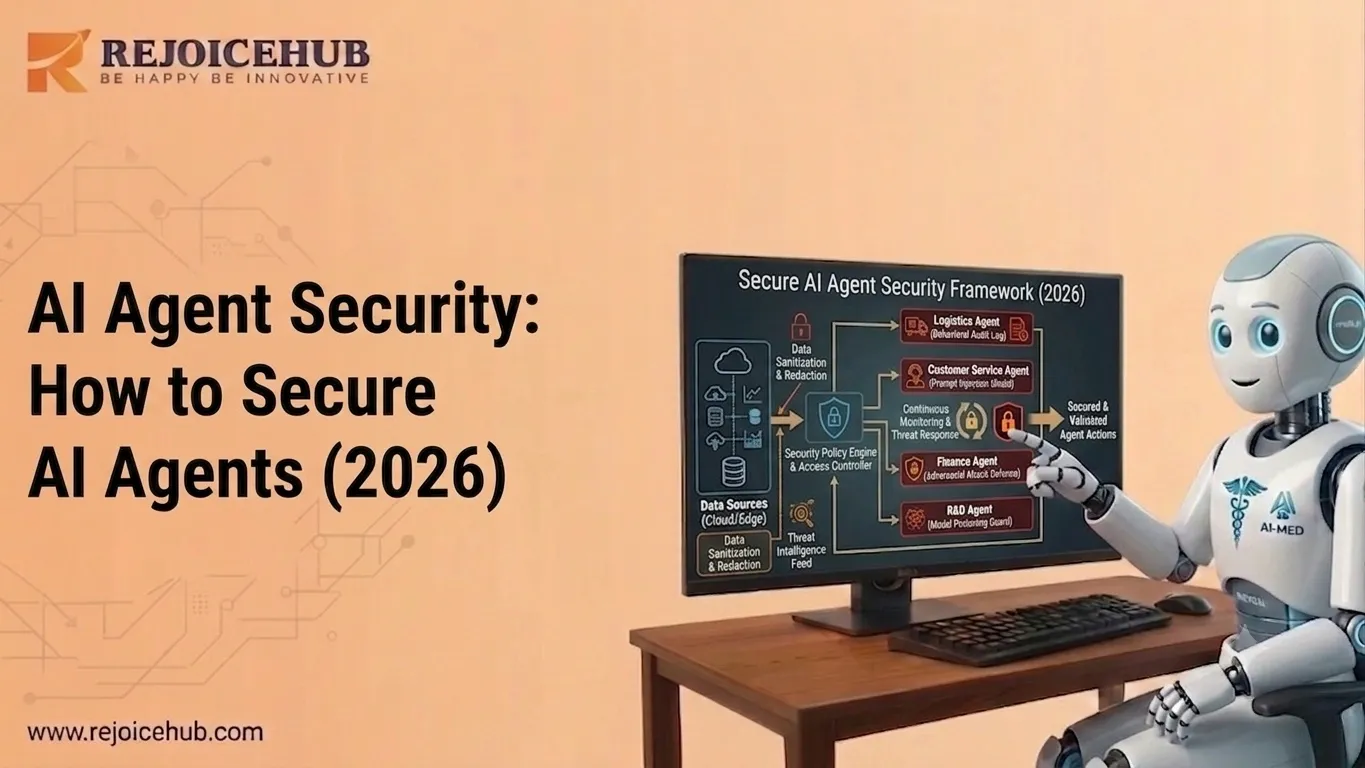
AI agents are no longer just toys in demo sandboxes. They are entering the wild, working in production systems and making real-world decisions.
These agents are calling APIs, querying databases, reading and writing to your CRM, and accessing other cloud and enterprise systems previously only accessible to your internal trusted applications.
This development has critical implications for security, as traditional application security measures firewalls, input validation, and role-based access control were never designed to handle the complexities of an autonomous decision-making system that can perform virtually any action on your infrastructure.
This article covers the basics of AI agent security, the unique risks they pose, and provides best practices for deploying AI agents in production environments.
Why AI Agent Security Matters in Production
An AI agent is not just a fancy chatbot with a nicer interface; it is a computer program that can plan for a goal, decide what actions to take, and carry out these actions while being in control over certain operations, often without oversight from a human.
In other words, an agent has autonomy - the ability to act independently - and this is what makes an AI agent both valuable and dangerous.
Here's what's different about agents in production:
-
Autonomous decision-making: Agents choose their own next steps based on context, not a hardcoded script. You can't always predict exactly what they'll do.
-
They call external tools: Agents plug into APIs, webhooks, search tools, code execution environments, and third-party services; each one a potential attack surface.
-
They access enterprise systems: CRMs, databases, internal wikis, ticketing systems, and financial tools agents are increasingly given the same access levels as employees.
-
One compromised agent can become a security incident: If an agent is tricked, misconfigured, or over-permissioned, it can leak data, take unauthorized actions, or become a foothold for a larger breach.
AI Apps vs. AI Agents: What's the Difference?
This distinction matters a lot for security planning.
| AI App | AI Agent | |
|---|---|---|
| Behavior | Follows a fixed, predefined workflow | Makes autonomous decisions in real time |
| Scope of action | Limited to what the app was coded to do | Can call multiple tools and chain actions together |
| Predictability | High output maps closely to input | Lower behavior depends on context and reasoning |
| Security model needed | Standard app security (auth, input validation) | Identity, permission scoping, and runtime controls for autonomous action |
An AI app answers a question. An AI agent could independently perform a lookup, call three separate tools, update a database, and send a notification. That's a much larger security surface than we've ever had before, and it needs to be secured with a fundamentally new architecture.
Core AI Agent Security Risks
Before you can secure AI agents, you need to know what you're defending against. Here are the five risks that show up most often in production deployments, especially as agentic infrastructure matures across industries.
-
Prompt Injection
Prompt injection is an integrity attack where an adversary embeds instructions in the content being processed by an agent. A webpage, an email message, a document, a ticket sent to a helpdesk - all these can be potential vehicles.
In case of successful exploitation, the victim agent may be persuaded to disregard its primary directive and perform an action of the attacker's choosing, such as leaking sensitive information or performing an undesired operation. This risk grows as agents increasingly connect through standardized protocols like MCP, which widen the surface area for untrusted inputs.
-
Excessive Permissions
Many teams grant their agents broad, standing access to data "in case of need": unrestricted database access, DB admin-level API keys, or CRM access beyond what they need to perform their tasks.
While that may be convenient, over-privileged agents can do far more damage than good if something goes wrong (e.g., if the agent misbehaves or there arises some other unforeseen event). This is why treating agents as non-human identities with governed access, rather than shared service accounts, has become a core enterprise security practice.
-
Credential Leakage
Agents may require API keys, tokens, or database credentials to perform their tasks. If these secrets are embedded in code, logged, passed to the agents via prompts, or even stored on insecure servers, they may become accessible through logs, errors, or the agents' outputs.
Once a secret is known, anyone can impersonate an agent and gain the same level of access as the original one.
-
Tool Abuse
Agents are typically provided a toolset: a code interpreter, a web search, a database query tool, an email sender. Tool abuse occurs when the agent is tricked into executing the correct tool for the wrong purpose: running destructive code, sending unauthorized emails or queries. Without guardrails on how or when a tool can be used, a capability meant to enhance an LLM agent's productivity becomes a vulnerability for attack.
-
Memory Poisoning
Many agents use some form of memory for keeping track of information across different interactions with the user and across different queries within one interaction and, as such, often involve some learning. Memory poisoning attacks target such agents by subverting their memory, causing them to learn and use incorrect information. This type of attack is particularly insidious since the effect of the false information often takes time to manifest itself, making it comparable in stealth to broader adversarial model security threats.
Accelerate Your Workflows with Custom AI
Book a free consultation session with RejoiceHub. We'll map out a tailored automation roadmap for your company.
AI Agent Security Best Practices
Once they understand that there are risks, the solution is not to avoid agents, but to build them responsibly, using the same methodologies that one would use to build any production system that handles sensitive information the same discipline that goes into building a proper AI agent stack for a business.
1. Permission Scoping
Permission scoping means giving an agent exactly the access it needs for a task, nothing more.
-
Least privilege: Default every agent to zero access, then grant only what's required for its specific job.
-
Role-based permissions: Define roles (e.g., "support agent," "billing agent") with distinct, limited permission sets, instead of one shared super-user identity.
-
Session-based access: Grant permissions for the duration of a task or session, not permanently. When the task ends, access expires.
Once they understand that there are risks, the solution is not to avoid agents, but to build them responsibly, using the same methodologies that one would use to build any production system that handles sensitive information.
2. Reduce Blast Radius
You should assume that, at some point, an agent will do something unexpected. The goal is to make sure that when it does, the damage is contained.
-
Isolated agents: Run agents in separate environments so a compromised one can't reach into another.
-
Limited API scope: Restrict which endpoints and actions each agent's credentials can actually call.
-
Separate credentials per agent: Don't share one API key across multiple agents or workflows.
Sandboxing: Run code execution and risky tool calls in isolated, disposable environments rather than production infrastructure a pattern that matters even more for teams looking to deploy AI agents without a dedicated ML team.
Reducing blast radius is about containment, not prevention because no system catches every failure before it happens.
3. Credential Injection
Hardcoded API keys and long-lived secrets are one of the most common ways agents leak access. Credential injection solves this by keeping secrets out of the agent's code and prompts entirely.
-
Secret managers: Store credentials in a dedicated vault (like AWS Secrets Manager or HashiCorp Vault), not in code or config files.
-
Runtime injection: Inject credentials into the agent's execution environment at runtime, only when needed.
-
No hardcoded keys: Never embed API keys or tokens directly in prompts, scripts, or source code.
-
Temporary credentials: Use short-lived, auto-expiring tokens instead of permanent keys wherever possible.
4. Authentication & Authorization
Once they understand that there are risks, the solution is not to avoid agents, but to build them in a responsible way, using the same methodologies that one would use to build any production system that handles sensitive information. This is a key part of maturing along any realistic enterprise AI adoption roadmap.
-
Authentication answers: Who or what is this? It verifies the identity of the agent itself, confirming it's the system it claims to be before it's allowed to act.
-
Authorization answers: What is this identity allowed to do? Even after an agent is authenticated, authorization determines which specific actions, tools, and data it can access.
An agent should never be trusted just because it authenticated successfully. Authorization checks need to happen at every sensitive action, not just at login.
Production Security Checklist
Use this checklist before pushing any AI agent into a live production environment:
- Authenticate users interacting with the agent
- Authenticate the agent itself as a distinct identity
- Require explicit tool authorization for every action
- Apply permission scoping based on least privilege
- Vault all secrets, no hardcoded credentials
- Rotate credentials on a regular schedule
- Monitor agent behavior continuously in production
- Maintain audit logs of every action the agent takes
- Apply rate limiting on tool calls and API usage
- Require human approval for high-risk or irreversible actions
If you can't check every box on this list, your agent isn't ready for production. Understanding real use cases of AI agents in business can help teams calibrate which checklist items matter most for their specific deployment.
How RejoiceHub Builds Secure AI Agents
At RejoiceHub, security isn't something we bolt on after an agent is built - it's part of the architecture from day one.
When we build enterprise AI agents for clients, every deployment is designed around the same principles covered in this guide:
-
Security-first architecture: Agents are scoped to specific tasks with clearly defined tool access, not open-ended access to entire systems.
-
Role-based access control (RBAC): Every agent operates under a defined role with permissions matched to that role, no shared super-user credentials.
-
Secret management: Credentials are vaulted and injected at runtime, never hardcoded or exposed in logs or prompts.
-
Production-grade deployment: Monitoring, audit logging, and human-approval checkpoints are built in for any action with real business impact.
If your team is considering using AI agents to assist, operate, sell, or automate businesses, you should prioritize security when developing solutions, rather than trying to retrofit security afterwards, especially given the known infrastructure gaps enterprises face with AI agents.
If you're looking to build a custom AI agent with enterprise-grade security baked in, RejoiceHub can help design and deploy it the right way.
Conclusion
AI agents can provide valuable automation and return on investment, but only if they are designed with security in mind. As organizations begin to rely on AI agents to carry out important operations with data, appropriate security controls must be in place.
A production-grade AI agent requires authentication, authorization, least-privilege access, secret management, and monitoring to prevent breaches, failures, and misuse that could cause serious damage to an organization.
In short, security is not an afterthought for AI agents - it must be designed in from the start.
Organizations that want to harness the power of AI agents to automate operations and generate returns should make security a priority, whether they're evaluating the best AI agents for business automation or building custom solutions in-house.
Explore RejoiceHub's AI Agent Development services for enterprise-grade, secure AI agent deployment.
Frequently Asked Questions
1. What is AI agent security?
AI agent security means protecting AI agents from being misused, hacked, or tricked into doing something harmful. Since AI agents can call tools, access data, and take real actions on their own, security in production goes way beyond just data protection. It covers permissions, credentials, and monitoring together.
2. Why do AI agents need security in production?
AI agents in production don't just chat back and forth; they make decisions and act on their own using real tools and data. That autonomy means one wrong move, weak permission, or leaked credential can cause real damage. Solid security keeps agents safe, useful, and trustworthy at scale.
3. What is permission scoping in AI agents?
Permission scoping means giving an AI agent only the access it truly needs for its task, nothing extra. Instead of one super-user identity, agents get role-based permissions with session-based limits. This way, even if an agent is compromised, it can't reach data or systems outside its assigned job.
4. What does blast radius mean for AI agents?
Blast radius is how much damage an AI agent can cause if something goes wrong. Reducing blast radius means isolating agents, limiting API scope, and giving each one separate credentials, so one compromised agent can't spread further into other systems. It's about containing problems, not just preventing them.
5. What is credential injection in AI agent security?
Credential injection keeps secrets like API keys and tokens out of an agent's code or prompts. Instead, credentials get stored in a secret manager and injected into the agent's environment only at runtime, when needed. This lowers the risk of hardcoded keys leaking through logs, errors, or outputs.
6. What is the difference between AI agent authentication and authorization?
Authentication checks who or what an AI agent actually is, confirming its identity before it's allowed to act. Authorization checks what that identity is allowed to do once verified. An agent should never be trusted just for logging in; authorization needs checking at every single sensitive action too.
7. What are the best practices to secure AI agents?
AI agent security best practices include permission scoping, credential injection, reducing blast radius, strong authentication and authorization, and constant monitoring with audit logs. Human approval should be required for high-risk actions too. Together, these steps keep AI agents safe, accountable, and ready for real production environments.