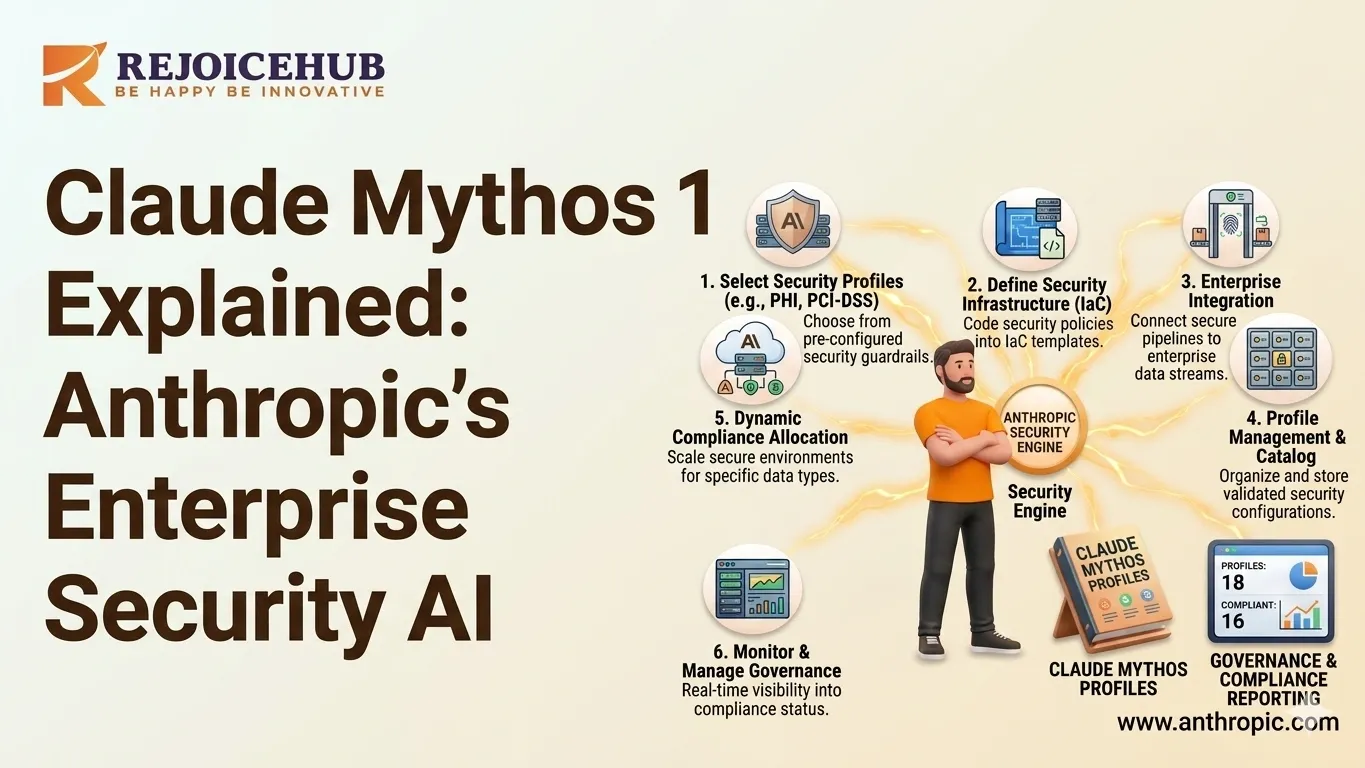
AI adoption is speeding up so fast that businesses kinda can barely keep pace with it. Still, as more orgs move from tests and "small pilots" to full-scale deployment, there's one thing that keeps showing up again and again in boardroom talk: "Is this AI actually safe to use?"
Anthropic has always framed safety as a core principle, not like some added feature later. With Claude Mythos 1, that idea turns into something more tangible, and it's built with enterprise environments in mind. If you're evaluating where this fits in your broader AI adoption roadmap for enterprise, this model deserves a close look.
So, from compliance-heavy sectors like finance and healthcare to fast-moving SaaS teams that are scaling quickly, companies are paying attention to what this model is promising, and maybe what it's avoiding too.
In this post, we'll walk through what Claude Mythos 1 is, why people are calling it a security-first AI model, how it measures up to GPT-5 in the enterprise context, and what all of it means for your business in 2025 and beyond.
What Is Claude Mythos 1?
Claude Mythos 1 is basically Anthropic's enterprise-minded AI model, built with a security-first architecture at its foundation. And yeah, unlike those general-purpose AI systems made to be extra flexible for consumer use, Claude Mythos 1 is purpose-built for the kind of reality you get in enterprise spaces where data sensitivity, regulatory compliance, and governance aren't really optional, like, at all.
So, what is Claude Mythos 1 actually about? If you zoom in on the core, it's about giving enterprises a powerful large language model, but one that won't make you pick one thing over another, capability versus safety. That's the promise.
Most AI deployments, they don't flop because the model isn't smart enough. They tend to fail because businesses can't control what comes out, can't meaningfully audit decisions, and can't guarantee sensitive data stays in the place it's supposed to stay. Claude Mythos 1 is Anthropic's response to that specific headache.
Explained in plain terms, it's an AI model where safety layers, constitutional guardrails, and enterprise data protections are baked in from day one. Not added later as an afterthought, kind of tacked on, like "we'll deal with it after" and then never fully do.
Why Claude Mythos 1 Is Called a Security-First AI Model
1. Constitutional AI and Safety Layers
Anthropic made Claude using something called Constitutional AI (CAI), which is kind of an approach where the model is trained to look at what it is about to say, then cross-check it against a list of agreed principles before it responds.
In practice, this means:
- The model is less likely to produce harmful, misleading, or non-compliant outputs
- Safety is enforced through alignment training, not just content filtering
- Enterprises get more predictable, auditable AI behaviour
For the Claude Mythos 1 security thing, it is explained that the model doesn't just block bad results in a reactive way. Instead, it is trained to think about safety in advance, like proactively. And yeah, that is a real difference, especially when your AI is drafting legal documents, summarising financial data, or handling customer queries at scale.
This style of AI alignment helps a lot to lower the chance of outputs that might create legal liability or cause reputational damage, which is still one of the top concerns for enterprise decision-makers. It's also a core reason why more businesses are rethinking custom vs off-the-shelf AI software when building secure internal systems.
2. Enterprise Data Protection
Data leakage is one of those most cited blockers to enterprise AI adoption, as it really keeps teams stuck. Claude Mythos 1 is made with workflows that support, in a more grounded way:
- Data isolation: keeping organisational data from bleeding into shared model training
- Privacy-first processing: minimizing unnecessary data retention
- Governance-ready outputs: logs, audit trails, and explainability features that compliance teams can actually use
For businesses in regulated industries, this is not just a nice-to-have thing. It's more like a requirement, and yeah, you can't really avoid it. Claude Mythos 1's data protection architecture is designed to plug into existing secure enterprise workflows, so businesses don't have to bend their security posture just to get AI benefits. Instead of changing everything, it fits in kind of naturally, like in a practical sense.
3. Compliance and Risk Management
Secure enterprise AI is not only about stopping data leaks, but it's also about running inside these messy, tricky regulatory frameworks and all the attendant rules. You know, the whole compliance thing, where everything has to behave in a pretty exact way.
Claude Mythos 1 addresses this with features and guardrails relevant to:
- Healthcare: HIPAA-aligned processing, avoiding protected health information exposure
- Finance: Outputs that respect fiduciary responsibility and avoid unqualified financial advice
- Legal and enterprise operations: Reduced hallucination rates on factual and legal content
The Claude Mythos 1 security architecture acknowledges that enterprises don't just need a capable model; they need one that helps them stay on the right side of their regulators.
Claude Mythos 1 vs GPT-5 for Enterprise Security
This is the comparison that most enterprise buyers are running right now. Like, here's a straightforward breakdown, not a perfect one, but it gets the idea across.
| Feature | Claude Mythos 1 | GPT-5 |
|---|---|---|
| Safety Architecture | Constitutional AI (built-in alignment training) | RLHF + content filters (reactive) |
| Hallucination Control | Strongly reduced via alignment methodology | Improving, but still inconsistent on complex facts |
| Data Governance | Enterprise-first; isolation and audit support | Available via Azure OpenAI; requires additional config |
| Explainability | Higher outputs are more attributable and traceable | Moderate, less transparent reasoning |
| Compliance Focus | Core design principle | Available as an add-on enterprise feature |
| Enterprise Readiness | Purpose-built for enterprise deployment | Strong, but primarily optimised for versatility |
| Safety Guardrails | Constitutional AI + safety layers | RLHF + moderation API |
| Customization | System prompts + enterprise fine-tuning | Fine-tuning, function calling, Assistants API |
The bottom line is, when you are looking at the best secure AI model for enterprises, the main differentiator comes down to philosophy, kind of more than anything else. GPT-5 is a very capable general-purpose model, and the enterprise features are layered on top.
Meanwhile, Claude Mythos 1 really begins with a security-first approach, then it expands the actual capability from there, like step by step, not the other way around.
For Claude vs GPT-5 security, both are competitive but honestly, enterprises in super regulated industries, or where there are strict governance requirements, might find Claude Mythos 1's foundational approach easier to sell to the compliance and legal teams. For a deeper side-by-side, the Claude Mythos vs GPT-5.5 enterprise AI security comparison breaks this down further from a practical deployment standpoint.
Enterprise Use Cases for Claude Mythos 1
1. Internal AI Assistants
One of the top ROI uses is deploying Claude Mythos 1 as an internal knowledge assistant. Teams can ask questions about internal docs, SOPs, HR policies, and operational handbooks, and generally get solid answers without the idea of the data getting exposed outside.
The security layer really matters too, because employees get quick and accurate responses without IT having to worry that sensitive information is being handled in an unsafe way.
2. AI Agents and Workflow Automation
Claude Mythos 1's architecture is pretty suited for AI agents for business automation, meaning autonomous systems that can deal with multi-step chores or workflows, like:
- Lead qualification and CRM updates
- Contract review and flagging
- Automated report generation
- Invoice processing and accounts payable workflows
Since the model is set up for governance-compatible outputs, enterprises can deploy these agents with a bit more confidence that they won't end up creating compliance issues mid-workflow.
If your business is looking at AI agent development, this is pretty much the kind of groundwork that makes agentic automation workable at scale. RejoiceHub focuses on crafting tailored AI agents on secure, enterprise-ready foundations like, if that's the direction you are headed, we should talk.
3. Financial and Legal Compliance
Finance and legal teams are among the most AI-cautious, and to be honest, for good reason. Claude Mythos 1 has a reduced hallucination rate, plus a compliance-aware design, so it's a stronger fit for:
- Contract summarisation and clause extraction
- Regulatory change monitoring and impact analysis
- Financial report drafting and review
- Risk flagging in due diligence workflows
The key is that outputs can be audited, traced, and reviewed which is what regulated industries require before trusting AI in critical workflows. This is especially relevant given how AI is transforming financial services across both front-office and back-office functions.
4. Customer Support AI
Claude Mythos 1 kinda can power customer-facing support systems that need to hold onto the brand voice, accuracy, and compliance all at once. For SaaS companies doing subscription billing, say you get an AI that gives wrong details about refund policies, it's not merely annoying; it can become a real liability.
The safety layers in Claude Mythos 1 help keep customer-facing responses within set guardrails, while also managing to deliver the speed and personalisation modern customers want. For a closer look at what that looks like end-to-end, the AI customer support automation guide covers practical deployment patterns worth reviewing.
Limitations and Challenges Enterprises Should Know
Any honest evaluation of Claude Mythos 1 kind of has to mention what it still doesn't solve, even when it feels like it helps. Hallucinations still show up. No current LLM wipes them out 100%. Claude Mythos 1 lowers the risk thanks to its alignment training, but teams at enterprises should still put in a human-in-the-loop review for anything high stakes, no matter what.
Also, governance isn't something the model just "handles" for you. It gives you tools and an architecture that can support governance, but it does not replace the policies, the processes, and the oversight your organisation needs to set up internally. AI governance is more like a strategy, not a feature you can buy, install, and walk away from. Understanding the enterprise infrastructure gaps that still affect AI agent deployments is a good place to start when planning for this.
And implementation complexity is real, not marketing-speak. Deploying a secure enterprise AI system isn't a one-click operation. Getting Claude Mythos 1 into existing workflows, data systems, and security infrastructure takes planning, practical technical skill, and ongoing monitoring, not just a fast trial.
Cost is another thing. Enterprise AI at this level, with this kind of security and capability, tends to be more expensive than those off-the-shelf tools. Businesses really should run a realistic ROI analysis before they commit.
Finally, it may not match every situation. If your work is highly exploratory, creative, or loosely defined, it might not benefit as much from Claude Mythos 1's security-first constraints. Picking the right model for the right job is still critical.
What Claude Mythos 1 Means for the Future of Enterprise AI
The launch of Claude Mythos 1 signals something important, kinda like the whole AI industry is maturing past that "move fast and figure out safety later" phase or whatever, you know.
Enterprises are now increasingly asking for governance-first AI adoption. Meaning safety, compliance, and explainability are prerequisites, not just optional upgrades, and honestly they treat it that way from day one. Claude Mythos 1 is one of the clearest signals yet that big AI providers are responding to that demand, sooner rather than later.
What this means practically:
- Secure automation ecosystems will become the standard, not the exception
- Compliant AI agents will unlock deployment in industries that have been waiting on the sidelines healthcare, legal, finance, government
- AI ROI conversations will shift from "what can it do?" to "what can it do within our risk tolerance?"
Businesses that build strategic AI foundations now will have a significant competitive advantage over those that wait. If you're wondering where to begin structurally, learning how to build an AI agent stack for business gives a practical framework for getting the architecture right from the start.
The enterprises that end up winning in this next phase won't only be the ones with the most AI tools. They'll be the ones who put together AI systems the right way with security, governance, and scalability baked in from the very beginning.
That's a pretty big implementation hurdle. And it's exactly in that spot where having the right partner really makes the difference between a solid AI transformation and just an expensive experiment.
Conclusion
Claude Mythos 1 kinda signals a real change in the way enterprise AI gets rolled out and it's not just about models, security and compliance are treated as the core foundation, not like add-on things you patch in later, you know.
For startup founders, SaaS operators, and enterprise decision-makers, the opportunity is absolutely there. But the complexity comes along too. To properly assess safe AI adoption, shape the right architecture, and even craft AI agents that behave reliably inside your governance framework, you can't simply start by picking a model and calling it done.
It requires the right implementation strategy.
At RejoiceHub, we help businesses build custom AI agents and automation systems on secure, enterprise-ready foundations. Whether you're exploring your first AI deployment or scaling an existing system, our team can help you move forward responsibly with the speed your business needs and the security your stakeholders require.
Ready to implement AI agents the right way? Talk to the RejoiceHub team about building your secure AI automation strategy.
Frequently Asked Questions
1. What is Claude Mythos 1, and how is it different from other AI models?
Claude Mythos 1 is Anthropic's enterprise-focused AI model built with security and compliance as its base, not an afterthought. Unlike general-purpose models, it uses Constitutional AI training, so safety is built in from the start, making it a stronger fit for regulated industries and sensitive business workflows.
2. How secure is Claude Mythos 1 for business use?
Claude Mythos 1 is designed with data isolation, privacy-first processing, and audit-ready outputs. It keeps your company data from leaking into shared model training and supports governance workflows. For teams in healthcare, finance, or legal, that kind of built-in structure makes a real difference in day-to-day AI use.
3. What does Constitutional AI mean in Claude Mythos 1 security explained?
Constitutional AI means the model checks its own responses against a set of agreed safety principles before replying. Instead of just blocking bad outputs after the fact, Claude Mythos 1 is trained to think about safety before responding. This makes its behaviour more predictable and easier to audit across enterprise workflows.
4. Is Claude Mythos 1 better than GPT-5 for enterprise security?
Both are strong, but they take different paths. GPT-5 layers enterprise features on top of a general-purpose model. Claude Mythos 1 starts with a security-first foundation and builds capability from there. For businesses with strict compliance needs, Claude Mythos 1's foundational approach is often easier to justify to legal and compliance teams.
5. What industries benefit most from using Claude Mythos 1?
Healthcare, finance, legal, and SaaS companies get the most value from Claude Mythos 1. These industries deal with sensitive data and strict regulations, so having an AI that supports HIPAA-aligned processing, reduces hallucinations on factual content, and produces auditable outputs makes actual deployment far less risky and more practical.
6. Can Claude Mythos 1 be used to build AI agents for workflow automation?
Yes, Claude Mythos 1 works well for AI agents handling multi-step tasks like contract review, lead qualification, invoice processing, and report generation. Because it produces governance-compatible outputs, businesses can run these automated workflows without constantly worrying about compliance issues popping up mid-process or creating unexpected liability.
7. What are the limitations of Claude Mythos 1 that enterprises should know about?
Claude Mythos 1 reduces hallucinations but doesn't eliminate them, so high-stakes outputs still need human review. It also doesn't replace your internal governance policies. Implementation takes real planning, and the cost is higher than that of basic tools. Running an honest ROI analysis before committing is genuinely worth doing before you roll it out.