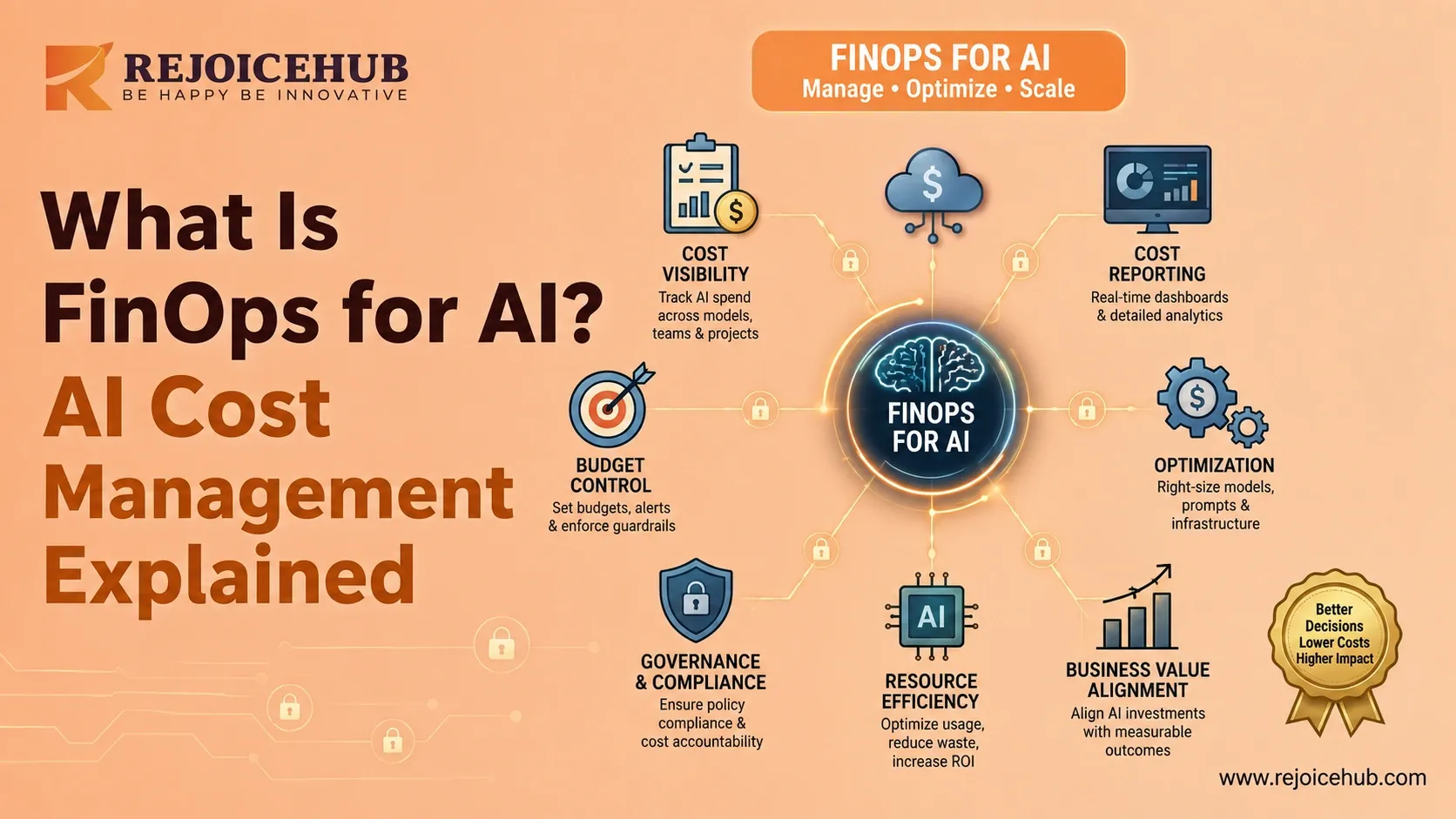
AI adoption is accelerating faster than most finance teams can track it. LLM API usage, token consumption, AI agents, GPU infrastructure, and multiple overlapping AI models mean spending can scale in ways a monthly cloud invoice never could. This is exactly why FinOps for AI exists: a framework for understanding, allocating, forecasting, optimizing, and connecting AI spending to real business value.
AI can create business value quickly but without visibility into tokens, models, infrastructure, and usage, AI spending can outpace budgets before anyone notices. This guide breaks down what FinOps for AI actually means, how it works in practice, and what founders and SaaS leaders should do about it in 2026.
Key Takeaways
-
FinOps for AI applies financial accountability principles to token, model, and GPU spending.
-
AI costs are harder to predict than cloud costs because pricing varies by model, task, and usage pattern.
-
The discipline connects cost data to business outcomes not just to lower invoices.
-
Agentic AI workflows are pushing FinOps toward real-time, task-level cost tracking.
What Is FinOps?
FinOps stands for Financial Operations, but it's not simply accounting or cost-cutting. It's a collaborative discipline that brings finance, engineering, product, operations, and business teams together to make technology spending transparent and value-driven.
What does FinOps mean?
At its core, FinOps means treating cloud and technology spend as a shared responsibility rather than a line item finance manages alone. Engineers who provision resources, product teams who ship features, and finance teams who report on budgets all work from the same cost data.
The FinOps Foundation describes the discipline as evolving beyond public cloud toward broader technology value management, covering SaaS, data centers, and now AI infrastructure.
Why is FinOps important?
FinOps matters because it turns technology spending from a black box into a managed, forecastable input to the business. In practice, it delivers:
-
Cost visibility knowing exactly where money is going, down to the team or feature.
-
Accountability the people who generate cost also see and own it.
-
Forecasting predictable budgets instead of end-of-month surprises.
-
Optimization continuous tuning of usage against price and performance.
-
Better technology decisions choosing tools and architectures with cost built into the evaluation.
-
Business value tying every dollar spent back to an outcome.
What Is FinOps for AI?
FinOps for AI is the practice of applying FinOps principles to AI workloads, usage, infrastructure, and spending so organizations can understand costs, forecast demand, optimize resources, and connect AI investment with business value. It extends traditional cloud FinOps to cover the unique cost structures of large language models, inference, and autonomous AI agents.
Unlike a fixed cloud subscription, AI spend can shift dramatically week to week as usage patterns, model choice, and agent behavior change which is why it needs its own set of practices.
Why AI costs are different
Traditional cloud FinOps deals with relatively predictable compute, storage, and network pricing. AI introduces several new variables:
| Cost Driver | Why It's Different |
|---|---|
| Token-based pricing | Cost scales with input/output length, not fixed instance hours |
| Different model pricing | Every model (and every provider) prices tokens differently |
| Inference costs | Cost recurs on every single request, not just at training time |
| Training/fine-tuning costs | Large, upfront, and hard to predict without benchmarking |
| GPU/compute costs | Scarce capacity drives volatile, sometimes surge-based pricing |
| Agentic workflows | One "task" can trigger dozens of hidden model calls |
| AI SaaS subscriptions | Layered on top of raw API usage, easy to lose track of |
| Multiple AI vendors | Spend is fragmented across providers with different billing units |
The FinOps Foundation specifically notes that AI spending can cross cloud providers, AI companies, SaaS platforms, data centers, and startup AI vendors making it far more fragmented than classic cloud spend.
Expert insight: Teams that treat every AI feature as "just another API call" routinely underestimate cost by 3–5x once agentic loops, retries, and multi-model pipelines enter production. Modeling cost per workflow not per API endpoint from day one is what separates teams with predictable AI budgets from teams that get an unpleasant invoice in month three. This is a pattern we see often when advising founders on AI agent development at RejoiceHub.
Why Is FinOps for AI Important?
FinOps for AI matters because AI spending grows non-linearly: usage that looks trivial in a demo can balloon once real users, real data, and autonomous agents are involved. Without a framework, teams discover cost problems only after the invoice arrives.
1. Control unpredictable AI spending
AI usage can grow rapidly as applications move from experimentation to production. A prototype calling an LLM a few hundred times a day can jump to millions of calls once it ships and each of those calls carries a token cost that compounds with scale.
2. Improve AI cost visibility
Effective FinOps for AI tracks cost at multiple levels simultaneously:
-
Cost per model
-
Cost per request
-
Token consumption (input vs. output)
-
Cost per user
-
Cost per feature
-
Cost per AI agent or task
Without this granularity, a single expensive feature or misbehaving agent can silently eat an entire month's AI budget.
3. Connect cost with business value
Traditional cost management asks: "How much did our AI cost?" Modern FinOps for AI asks a better question: "How much business value did we generate from that AI spend?"
This shift matters because it reframes AI cost conversations from "cut spending" to "spend where it returns the most." Modern FinOps increasingly emphasizes value-based technology decisions rather than blanket cost reduction and teams that adopt this mindset tend to invest more confidently in AI, not less.
Accelerate Your Workflows with Custom AI
Book a free consultation session with RejoiceHub. We'll map out a tailored automation roadmap for your company.
How Does FinOps for AI Work?
FinOps for AI works as a continuous loop, not a one-time audit: usage is tracked, costs are attributed, spending is forecast, workloads are optimized, and results are measured against business value. Each stage feeds the next.
AI Usage → Cost Data → Attribution → Forecasting → Optimization → Business Value
1. Track AI usage and costs
Start by instrumenting everything: tokens consumed, API calls made, which model handled each request, GPU hours used, inference volume, and any dedicated AI infrastructure. If you can't see it, you can't manage it.
2. Allocate costs
Once usage is tracked, attribute spending to the teams, products, customers, AI agents, features, or business units that generated it. This is what turns raw cost data into accountability.
3. Forecast AI spending
Use historical usage and workload patterns to project future costs. Seasonal traffic, new feature launches, and planned agent rollouts should all feed the forecast not just last month's average.
4. Optimize AI workloads
Optimization is where FinOps for AI pays for itself. Common levers include:
-
Choosing the right model for the task (not always the most powerful one)
-
Reducing unnecessary tokens in prompts and responses
-
Prompt optimization and compression
-
Caching repeated or similar requests
-
Batch processing where real-time response isn't required
-
Model routing to send simple queries to cheaper models
-
Infrastructure optimization (right-sizing GPU allocation, reserved capacity)
5. Measure AI ROI
Finally, track outcome-based metrics: cost per task, cost per customer, and cost per successful outcome not just total spend. This closes the loop back to business value.
Key Takeaway: FinOps for AI isn't a single dashboard it's a workflow that runs continuously across engineering, product, and finance, with optimization and ROI measurement as ongoing steps, not annual reviews.
Who Created FinOps?
FinOps as a formal discipline emerged from the FinOps Foundation, part of the Linux Foundation, which was established to bring structure and shared standards to cloud financial management. Practitioners at companies managing large cloud bills including early contributors from Adobe, Atlassian, and other cloud-native enterprises helped codify FinOps into a repeatable practice with defined principles, personas, and a maturity model that the industry now uses as a common reference point.
6 FinOps Principles Applied to AI
The FinOps Foundation maintains six core principles, updated as part of the 2025 Framework revision. Here's how each applies directly to AI spending.
| # | FinOps Principle | Applied to AI |
|---|---|---|
| 1 | Teams need to collaborate | Finance, engineering, product, and AI teams share responsibility for token and model costs |
| 2 | Business value drives technology decisions | AI spending should support measurable outcomes, not just capability |
| 3 | Everyone takes ownership | Teams understand the cost of the AI systems and agents they build and use |
| 4 | FinOps data should be accessible, timely, and accurate | AI cost data must be available at useful granularity down to the request |
| 5 | FinOps should be enabled centrally | A central team provides governance, tooling, and model-pricing standards |
| 6 | Take advantage of variable costs | Use AI/cloud elasticity intelligently rather than over-provisioning GPU capacity |
Common mistake: Treating principle #6 as "always use the cheapest model." In practice, the goal is matching model cost to task complexity overpaying for simple classification tasks and underpaying (with poor results) on complex reasoning tasks are both FinOps failures.
Benefits and Best Practices of FinOps for AI
Key benefits
-
Better AI cost visibility across teams and products
-
Reduced unnecessary spending on oversized models or redundant calls
-
Improved forecasting for budget planning
-
Better model selection based on cost-to-performance data
-
Greater accountability across engineering and product teams
-
Improved AI ROI measurement
-
More scalable AI infrastructure as usage grows
-
Faster financial decision-making with real-time data
Best practices
-
Set AI budgets per team, product, or feature
-
Track token usage at the request level
-
Monitor cost anomalies with automated alerts
-
Use cost allocation tags across models and vendors
-
Review model performance vs. cost regularly, not just at launch
-
Automate anomaly alerts instead of relying on monthly invoice reviews
-
Measure unit economics (cost per task, per customer, per outcome)
RejoiceHub angle: AI-agent systems should measure cost at the workflow or task level, not only at the provider invoice level. An agent that completes a customer support ticket might make five separate model calls across two vendors the invoice shows a total, but only workflow-level tracking shows which step is expensive and why. This is the approach we build into every AI agent development engagement.
What Is the Future of FinOps?
FinOps is moving from cloud-only cost management toward AI-native, agentic cost governance where spend is tracked and controlled in real time at the individual agent-task level, not just the monthly bill level.
The evolution looks roughly like this:
Cloud FinOps → Cloud+ → FinOps for AI → AI-native / Agentic FinOps
Current FinOps direction is increasingly focused on AI value, token economics, and automation. The FinOps Foundation's latest materials specifically highlight FinOps for AI, token economics, and Agentic FinOps as emerging focus areas for practitioners.
Expect FinOps to increasingly include:
-
Automated cost optimization built into AI platforms
-
AI-powered anomaly detection for spend spikes
-
Token economics as a standard budgeting unit
-
AI-agent cost controls with per-task spending limits
-
Real-time cost visibility instead of monthly reporting
-
Cost-aware architecture decisions made at design time
-
Automated model selection and routing based on live pricing
Google Cloud leaders have also highlighted the importance of more granular cost data, anomaly detection, standardized billing formats like FOCUS, and using generative AI itself to make FinOps data easier for nontechnical stakeholders to understand.
How do agentic payments work and why FinOps needs to track them
As AI agents move from answering questions to taking actions booking services, making purchases, or triggering downstream API calls some of those actions carry their own transaction costs. Agentic payments let an AI agent initiate a payment or spend against a budget autonomously, within pre-set limits and approval rules, rather than requiring a human to click "confirm" each time.
Key benefits of agentic payments for FinOps teams include:
-
Real-time spend caps per agent or per task
-
Automatic audit trails for every agent-initiated transaction
-
Faster reconciliation since spend is tagged at the source
-
Reduced manual approval overhead for low-risk, high-volume actions
This is precisely why "Agentic FinOps" is emerging as its own category cost governance now has to account for AI systems that can spend money, not just consume compute. Teams exploring this should also look at how agentic commerce is reshaping transaction-level cost tracking.
FinOps for AI vs. Traditional Cloud FinOps
| Dimension | Traditional Cloud FinOps | FinOps for AI |
|---|---|---|
| Pricing unit | Compute hours, storage GB | Tokens, requests, GPU hours |
| Predictability | Relatively stable | Highly variable by model and prompt |
| Vendor sprawl | Moderate (1–3 clouds) | High (multiple LLM providers + SaaS) |
| Granularity needed | Team/project level | Request/agent/task level |
| Optimization levers | Reserved instances, right-sizing | Model routing, caching, prompt tuning |
| Emerging risk | Idle resources | Runaway agentic loops |
Conclusion
FinOps for AI isn't simply about reducing AI bills. The real goal is visibility + accountability + optimization + business value a framework that lets startups and SaaS teams scale AI usage confidently instead of reactively.
Businesses building AI agents, generative AI applications, and AI automation need cost-aware architecture from the beginning, not bolted on after the first surprising invoice. As agentic workflows and token-based pricing become the norm, teams that adopt FinOps for AI early will make faster, more confident decisions about which models, agents, and workflows are actually worth the spend.
Building an AI solution and want to keep its infrastructure and model costs under control? Explore RejoiceHub's AI agent development services or book a call with our team to discuss your AI project's cost architecture before you scale.
Frequently Asked Questions
1. What is FinOps for AI in simple terms?
FinOps for AI is the practice of managing, tracking, and optimizing spending on AI systems, including tokens, model usage, and GPU infrastructure, using the same collaborative, value-driven principles as traditional cloud FinOps. It helps teams understand exactly where AI dollars go and whether that spend is generating business value.
2. What is FinOps and why is it important?
FinOps (Financial Operations) is a discipline that brings finance, engineering, and product teams together to manage cloud and technology spending transparently. It's important because it turns unpredictable technology costs into forecastable, accountable line items tied to business outcomes rather than surprise invoices.
3. What does FinOps mean for a startup with a small AI budget?
For startups, FinOps means setting token budgets early, tracking cost per feature from day one, and choosing models based on cost-to-performance rather than raw capability. Even a lightweight FinOps practice can prevent AI costs from outpacing revenue as usage scales.
4. What are the 6 principles of FinOps?
The six FinOps principles are: teams need to collaborate, business value drives technology decisions, everyone takes ownership, FinOps data should be accessible and timely, FinOps should be enabled centrally, and organizations should take advantage of variable cost models. Each applies directly to AI token and model spending.
5. Who created FinOps?
FinOps was formalized by the FinOps Foundation, part of the Linux Foundation, with contributions from practitioners at major cloud-native companies who needed a shared standard for managing cloud costs. That same foundation now maintains guidance specific to FinOps for AI.
6. What is the future of FinOps for AI?
The future of FinOps is moving toward AI-native and agentic cost governance, real-time, task-level spend tracking, automated model routing, and cost controls built directly into AI agents, rather than monthly cloud bill reviews.
7. How do agentic payments affect AI cost management?
Agentic payments allow AI agents to initiate spending autonomously within set limits, which means FinOps teams need transaction-level tracking, not just API-usage tracking. This is becoming a core part of "Agentic FinOps" as more AI systems take direct action rather than just generating responses.