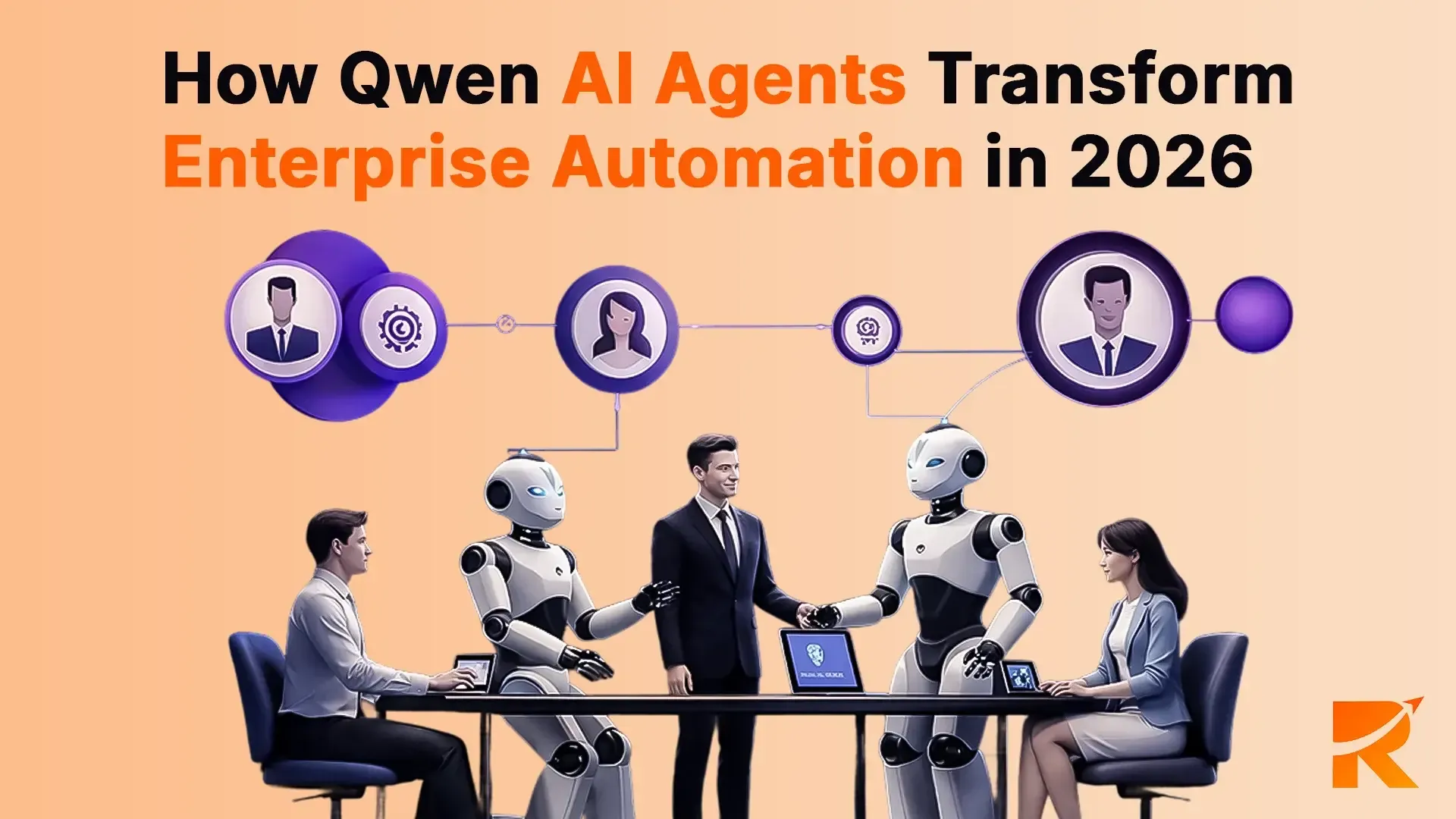
The definition of "automation" used to require users to create a rule that software programs would execute until users needed to make changes. It provided benefits yet remained unstable as a system. The entire workflow system failed when a website button changed its position or a new spreadsheet column appeared.
The current situation involves a large-scale development. Enterprises are moving beyond their initial automated systems. Enterprises seek systems that possess independence, which enables them to operate independently through their capacity to think, learn, and solve problems without human intervention. AI agents perform that function as their primary purpose.
The name Qwen currently dominates discussions among board executives and technology teams throughout the globe. Qwen, which Alibaba Cloud created, has become one of the most advanced and economical agentic AI platforms that will be accessible in 2026. Qwen AI agents have already transformed team operations across various industries, including finance, HR, logistics, and sales.
I will explain everything to you through basic English, which I will use to divide the information into separate sections.
What Are Qwen AI Agents?
Before we proceed with the transformation process, we need to establish our understanding of the specific concepts under discussion.
An AI agent is not a chatbot. A chatbot provides answers to inquiries. An AI agent performs tasks. The system establishes a goal and determines the necessary steps to achieve it, which it accomplishes through software and tools until it presents a completed product to users without requiring any manual input from them.
Understanding the difference between an AI agent vs AI chatbot makes it clear why agents are far more powerful for business use. A chatbot functions as a person who provides information while an AI agent works as a professional helper who accomplishes tasks for clients.
Qwen AI agents come with three core capabilities that make them especially powerful for business use:
- Autonomous execution — the agent acts without needing constant human input
- Multi-step reasoning — it can break a complex goal into smaller tasks and handle each one
- Tool usage — it can interact with software, APIs, databases, and apps just like a human would
It is different and appealing. They never just answer your questions, but they do the hard work.
Why Qwen AI Agents Are Transforming Enterprise Automation
1. From Manual Workflows to Autonomous Execution
Most enterprise workflows today require extensive copy-pasting and manual verification and worker transitions between tasks. The process begins when someone downloads a report which they format in Excel and then send through email to a manager for approval. Does this situation seem familiar to you?
Qwen AI agents bring complete transformation to existing processes. The system can execute complete work processes from initiation to completion. A Qwen-powered agent can automatically extract data from multiple sources to create a formatted financial report which it will validate against established regulations and distribute to designated recipients at predetermined times throughout each day.
Understanding what AI automation truly means helps clarify why this shift matters it's not just about speed, but about eliminating the human effort required for repetitive, rule-based tasks entirely.
2. Multi-Agent Collaboration
The first thing which shocked me at my first encounter with Qwen research surprised me because I discovered that Qwen operates multiple agents through simultaneous execution. The system has the capability to execute multiple agents at the same time who each work on different components of an extensive project.
The business intelligence process begins with an agent who collects research while the second agent performs data analysis and the third agent creates the final report. The three agents operate simultaneously while they exchange their findings with each other according to a system that functions like a well-coordinated team.
This method of multi-agent teamwork enables organizations to finish complex business operations which previously demanded several days of work within a time frame that can last from several hours to just a few minutes.
3. Cross-App Automation (No More Switching Tools)
The most challenging aspect of enterprise work occurs because employees need to switch between different tools. Your sales team operates within customer relationship management software. Your finance team uses spreadsheets for their work. Your customer support team uses a ticketing system for their operations. The system requires someone to transfer data manually between all three platforms.
The solution to this problem exists through Qwen AI agents. Businesses looking to automate workflows with AI agents can connect all their required software applications seamlessly without requiring human resources to establish connections between different software platforms.
This decreases your team's time requirements for every week while it simultaneously protects against mistakes that occur during manual data entry.
4. Multimodal Intelligence
Qwen demonstrates its strongest capability through its capacity to process different data formats. The system handles more than just textual information. Qwen can process images, audio, and video as well.
This development provides businesses with opportunities which did not exist before. An agent could review scanned invoices, extract the data, cross-reference it with your accounting system, and flag discrepancies. Another system can transcribe a meeting recording and produce a summary. A third system can examine product images to determine their compliance with quality standards.
Your organization requires only one AI system which can process all these formats instead of needing five separate tools for each data type. The solution requires a single advanced platform.
5. Cost-Efficient Automation at Scale
The main issue which needs discussion now is cost. Many enterprises hesitate to adopt AI because they fear massive bills. Qwen was specifically designed to be more cost-efficient than many comparable models on the market.
The system provides high performance capabilities while costing much less than several competing products. Exploring the benefits of AI for business reveals just how significant the ROI can be when enterprise-level intelligence is available at accessible pricing making full-scale automation a realistic goal for organizations of all sizes.
Real Enterprise Use Cases of Qwen AI Agents
Let us get down to the brass tacks. Here is a broad spectrum of examples of what businesses are essentially doing with Qwen.
1. Customer Support Automation
A Qwen agent can handle incoming support tickets, understand the customer's issue, pull up their account information, craft a helpful response, and escalate only the truly complex cases to a human agent. Businesses exploring AI customer support automation are already seeing improved response times, reduced operational expenses, and increased customer satisfaction.
2. Sales and Lead Generation
Sales teams waste their time because they work on leads which never result in sales. A Qwen AI agent can qualify leads through its analysis of user behavior and company information and historical data patterns. Your sales representatives dedicate their time to selling activities instead of lead organization tasks.
3. Finance and Reporting
The process of monthly financial reporting required financial analysts to work for multiple days to complete their tasks. A Qwen-powered finance agent can extract financial data from various systems to perform calculations while creating visual reports that it automatically delivers to stakeholders without needing human intervention. The role of artificial intelligence in finance is expanding rapidly, and automated reporting is one of the clearest early wins.
4. HR and Recruitment
The process of screening hundreds of resumes creates extreme difficulty. Qwen AI agents have the ability to read and evaluate candidates while they schedule interviews and manage onboarding documents and send first contact emails. The HR department of your organization spends its time establishing connections with candidates instead of managing administrative tasks.
5. Supply Chain Automation
Supply chains are complex, fast-moving, and full of variables. A Qwen agent can monitor inventory levels, predict shortfalls, coordinate with suppliers, plan logistics routes, and adjust schedules in real time — tasks simply too large and fast for humans to manage alone.
Qwen AI vs Traditional Automation (RPA)
If you are currently using robotic process automation tools, here is an honest comparison:
| Feature | Traditional RPA | Qwen AI Agents |
|---|---|---|
| Flexibility | Low breaks on change | High adapts readily |
| Learning | Rule-based | Adaptive |
| Execution | Limited to scripts | Fully autonomous |
| Integration | Manual setup | Cross-platform |
The short version: traditional RPA follows scripts. Qwen AI agents think. When something unexpected happens, RPA breaks. Qwen adapts. That difference matters enormously in real-world business environments.
Benefits for Enterprises
Agents achieve substantial productivity improvements through their capacity to execute repetitive tasks. The automatic data analysis and reporting system creates a faster decision-making process. Companies achieve lower operational costs because their employees spend less time executing manual work. AI technology eliminates copy-paste errors which human operators make when they become fatigued.
More than 290,000 companies throughout the world currently use Qwen AI technology. The research represents extensive testing which demonstrates that the solution has achieved its target of becoming a widely used product.
Challenges and Risks to Consider
I want to be straight with you Qwen AI agents are powerful, but they are not magic.
Most enterprises show their greatest concern for data privacy. The AI agent needs access to your CRM system and your financial system and your email system which creates a security risk because it combines multiple sensitive data sources into one location. You need to establish clear data governance policies which must exist before you begin your deployment.
Deep system access means that if an agent is compromised or misconfigured, the blast radius could be large. Any deployment requires your organization to implement proper access controls and monitoring and sandboxing.
Agents also excel at structured, repeatable tasks but experience difficulty when faced with completely new and confusing situations. The first stage of a project requires human oversight to operate effectively.
You also need to consider regulatory compliance requirements which depend on your business sector. AI systems that make decisions must follow laws which apply to finance and healthcare and human resources. You need to contact your legal team at the beginning of the process.
The Future of Enterprise Automation with Qwen
The present display of our work demonstrates impressive results, but our upcoming work in the coming years will deliver even greater achievements. Analysts describe progress toward an agentic AI enterprise model a business structure that depends entirely on AI-powered systems to operate across multiple departments.
People will not be completely replaced, but the system will process all tasks that require repetitive work and complex actions, which enables employees to concentrate on their creative work and relationship development. Companies should treat AI employees as their solution to handling standard job duties, while they depend on AI systems to make operational choices, and they use AI-driven systems to create customer experiences that reflect each customer's unique needs based on their past interactions with the company.
The companies that start building this infrastructure now will achieve a major first mover advantage because they will test new ideas, learn from their experiments, and develop their operations. The ones that wait will be scrambling to catch up.
How Your Business Can Start with Qwen AI Agents
You can start your work without experiencing any stressful difficulties. The key is to begin with a specific use case, prove the value, and then expand.
RejoiceHub helps businesses achieve their specific operational objectives. We provide services that include custom AI agent development for your operational needs, workflow automation solutions which connect your existing systems, and enterprise AI integration services which meet your security, compliance, and scaling requirements.
At RejoiceHub we assist you with your project development process from initial concept to final production. Your business can immediately start developing its automated processes.
Conclusion
The transition from automated systems to autonomous systems constitutes an actual existing process. Qwen leads this transition by providing companies with a flexible and multimodal platform that delivers high power at a low cost. The organization has established strong operational use cases for its various departments which include customer support, finance, HR, and supply chain management.
The situation contains obstacles that must be addressed. Powerful technological systems always present users with challenges. The enterprises that plan their strategies through clear objectives and effective governance systems will achieve success when they select appropriate business partners.
AI agents will bring about significant changes to the future of business automation. The transformation is currently underway. The question is whether your company will join the initial group of businesses or whether you will need to spend time to reach that position.
Companies can obtain a permanent market lead because the time for building real business advantage has arrived.
Frequently Asked Questions
1. What are Qwen AI agents and how are they different from chatbots?
Qwen AI agents don't just answer questions; they complete tasks on their own. A chatbot tells you something. A Qwen agent goes and does it. It can break goals into steps, use software tools, and finish entire workflows without anyone guiding it along the way.
2. How do Qwen AI agents help with enterprise automation?
They replace slow, manual workflows with fully autonomous execution. Instead of someone downloading a report, formatting it, and emailing it around, a Qwen agent handles the whole chain data pulling, formatting, validation, and delivery automatically and on schedule.
3. Can Qwen AI agents work with multiple software tools at once?
Yes, that's one of their biggest strengths. Qwen agents can connect to your CRM, spreadsheets, ticketing systems, and more at the same time. No more switching tabs or manually copying data between platforms. Everything talks to everything through one intelligent system.
4. What industries are using Qwen AI agents in 2026?
Finance, HR, sales, customer support, and supply chain teams are already using Qwen in real operations. It handles recurring tasks like reporting, lead qualification, invoice processing, resume screening, and inventory monitoring across all these industries at once.
5. How is Qwen AI different from traditional RPA tools?
Traditional RPA breaks the moment something changes on screen. Qwen AI agents adapt. They reason through unexpected situations instead of failing on them. Think of RPA as following a fixed script and Qwen as someone who reads the situation and figures out what to do next.
6. Is Qwen AI cost-effective for mid-size businesses?
Yes. Qwen was built with cost-efficiency in mind and is notably cheaper than many comparable AI platforms. Businesses that need automation at scale, not just a single workflow, get enterprise-level performance without the price tag that usually comes with it.
7. What does multi-agent collaboration mean in Qwen?
It means multiple AI agents run at the same time, each handling a different part of a large task. One agent gathers data, another analyzes it, a third writes the report all working in parallel and sharing results. This cuts hours or days of work down to minutes.
8. Can Qwen AI agents process images, audio, and video?
Yes. Qwen handles more than just text. It can read scanned invoices, transcribe meeting recordings, and check product images for quality issues. This multimodal ability means one platform replaces what would otherwise need five separate specialized tools.
9. What are the main risks of using Qwen AI agents in business?
The main concerns are data privacy, security, and regulatory compliance. Since agents access sensitive systems like CRM and finance tools, a misconfiguration could have wide impact. You need clear access controls, data governance rules, and legal review before deploying — especially in regulated industries.
10. How do Qwen AI agents improve customer support operations?
A Qwen agent reads incoming support tickets, checks the customer's account, writes a helpful reply, and only passes truly complex cases to a human. This cuts response times, lowers support costs, and keeps customers happier without adding headcount to your support team.
11. How can HR teams use Qwen AI agents for recruitment?
Qwen can screen resumes, rank candidates, schedule interviews, send initial emails, and manage onboarding paperwork, all without HR staff doing any of it manually. This frees your team to spend time actually talking to candidates instead of drowning in admin tasks.
12. How should a business start with Qwen AI agents?
Start small. Pick one clear, repeatable problem like monthly reporting or lead qualification and automate that first. Once it works well, expand from there. Beginning with a focused use case helps you prove value quickly and build confidence before scaling across departments.
13. What is the future of enterprise automation with Qwen AI?
The goal is a fully autonomous enterprise where AI handles repetitive and complex operations across every department. Humans focus on creativity and relationships while agents handle the rest. Companies building this infrastructure now will have a serious advantage over those who wait.