AI-enabled search isn't an add-on anymore; it has become critical to the operation of modern businesses. Traditional search engines were designed to serve people scanning through search results. However, as business processes become increasingly reliant on automated AI agents, the latter cannot meet current demands.
It is not surprising that Perplexity Search as Code has started gaining traction among developers and AI enthusiasts. By allowing developers to integrate search capabilities into their apps via APIs and SDKs, the technology makes it easier than ever before to build an application that relies on automated AI agents. If you're new to this space, it helps to first understand what AI agents are and how they work before diving deeper into Search as Code.
Let us delve into the concept of Perplexity Search as Code, its key principles and features, and discuss its impact on the business world.
What Is Perplexity Search as Code?
Definition
Perplexity Search as Code is a programmatic way of using AI-driven search within software applications, workflow systems, and even robots, but without any need for a person to operate the search function.
As opposed to having a user type in a query through a search box, your code communicates queries to the Perplexity AI search engine, gets answers, and acts on those answers. In simple terms, it's a search you can write, automate, and scale like any other piece of software.
Why Perplexity Created It
Perplexity came up with this concept as the conventional search architecture had limitations that made it inadequate for the AI-first process.
Conventional search engines generate results based on links provided. It requires human interpretation and synthesis of such data to be effective. However, in the construction of AI agents for business automation that have to operate on their own based on knowledge at hand, there is no place for such a system to be of any relevance.
Search As Code makes it possible for the developer community to integrate the power of Perplexity in generating cited answers into their programs.
How Perplexity Search as Code Works
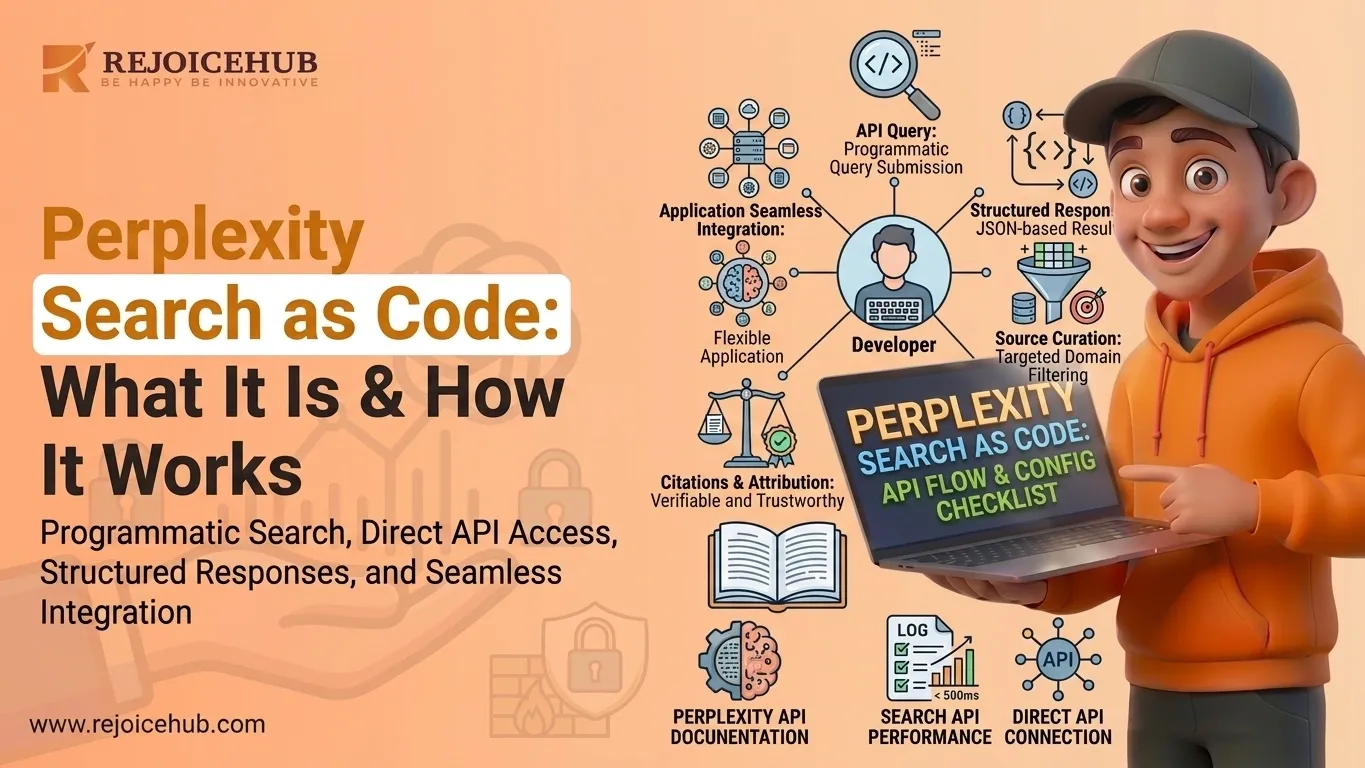
At a high level, Perplexity Search as Code follows a four-stage pipeline that turns a raw query into actionable, structured intelligence.
-
Query Processing
The query that is issued by your app to the Perplexity API isn't simply passed on as a keyword. Instead, the underlying process recognizes the actual intention behind the issued query in terms of its context and scope, as well as the type of response being sought.
That's how Perplexity is distinguished from the typical keyword searches. The query layer accounts for natural language and subsequent context as well as research-based questions.
-
Retrieval Layer
Once the query is processed, Perplexity's retrieval layer scans the web and indexed sources in real time. It doesn't rely on a static snapshot of the internet it fetches current, live information relevant to the query.
This matters enormously for business use cases where outdated information could lead to bad decisions.
-
AI Reasoning Engine
The retrieved content doesn't go straight to the output. It passes through Perplexity's AI reasoning engine, which evaluates sources, cross-references information, resolves conflicts between sources, and builds a coherent understanding of the topic.
This is what separates Perplexity from a simple "search and summarize" tool. Understanding what LLM agents are can help clarify how this reasoning layer fits into broader AI architectures.
-
Response Generation
Finally, the system generates a structured, grounded response complete with citations, source references, and optionally formatted output (JSON, markdown, plain text) depending on what your application needs.
The full workflow looks like this:
Your App / Agent ↓ API Query ↓ Query Processing (intent analysis) ↓ Retrieval Layer (live web data) ↓ AI Reasoning Engine (synthesis) ↓ Structured Response (with citations) ↓ Your App / Agent takes action.
This pipeline runs in seconds and can be called thousands of times programmatically — making it the backbone of truly intelligent, information-aware AI systems.
Key Perplexity AI Developer Tools and Features
-
Search APIs
The search abilities of Perplexity come across in the form of well-defined and neat REST APIs that make it easy for developers to query. These allow queries, set depths of search, restrict domains or timestamps, and get responses.
These are easy to implement in a technical setup, irrespective of whether one uses Python, Node.js, or non-coding workflow solutions such as n8n or Make.
-
LLM Integration
One of Perplexity's most powerful features for developers is its ability to combine live retrieval with large language model reasoning in a single API call. You don't need to chain a separate retrieval system with a separate LLM Perplexity handles both.
This dramatically simplifies architecture for teams building RAG (Retrieval-Augmented Generation) pipelines or knowledge-grounded AI assistants.
-
Real-Time Information Retrieval
Unlike static knowledge bases, Perplexity searches the live web. This means your AI agents have access to information published today news, pricing changes, product releases, regulatory updates not just what was indexed six months ago.
For business applications in fast-moving industries, this is a game-changer.
-
Structured Responses
Perplexity can return answers in structured formats, making it easy to parse and use the output downstream in your application. Instead of receiving a wall of text, you can get clean, citation-backed responses your code can act on directly.
-
Agent Support
Perplexity's API is designed with agentic use cases in mind. It supports multi-turn queries, follow-up context handling, and can be integrated into agent frameworks like LangChain, AutoGPT, and custom orchestration systems.
This makes it a natural fit for building AI agents that need to research, verify, and reason about real-world information. To better understand how these systems are structured, exploring agentic AI workflows provides valuable context.
Accelerate Your Workflows with Custom AI
Book a free consultation session with RejoiceHub. We'll map out a tailored automation roadmap for your company.
Search as Code vs Traditional Search Engines
Here's a direct comparison to illustrate why Search as Code represents a fundamentally different approach:
| Feature | Traditional Search Engines | Perplexity Search as Code |
|---|---|---|
| Primary User | Human browsing results | AI agents and applications |
| Output Format | List of links | Synthesized, cited answers |
| Automation | Manual only | Fully programmable via API |
| Real-Time Data | Varies (often cached) | Live web retrieval |
| AI Integration | Bolt-on or none | Native, built-in reasoning |
| Response Structure | Unstructured HTML pages | JSON/structured text |
| Scalability | Limited by UX | API rate limits only |
| Use in Workflows | Not designed for it | Core use case |
| Context Handling | None | Multi-turn, contextual |
Bottom line: Traditional search was built for humans. Search as Code was built for machines. If you're building AI agents, the choice is obvious.
Why Search as Code Matters for Agentic Search Architecture
The rise of AI agents changes everything about how software accesses information. Search as Code isn't just a developer convenience it's foundational infrastructure for the agentic era.
-
AI Agents
AI agents are computer programs that are goal-oriented, and can act and make decisions without necessarily being supervised by human operators. In order for these agents to achieve anything useful, they need relevant, up-to-date information.
Perplexity as Search-as-Code allows such agents to have access to live information about the world through a process similar to what a human employee would use to Google some information.
-
Autonomous Research
With Search as Code, you can build agents that conduct multi-step research tasks autonomously. An agent can search for a topic, receive a grounded answer, identify gaps in that answer, search again, and synthesize findings all without human involvement.
This is the foundation of autonomous research workflows that used to require entire teams of analysts.
-
Workflow Automation
When search becomes a programmable step in a workflow, entirely new automation patterns become possible. Imagine a pipeline that monitors competitor pricing, searches for industry news each morning, and automatically generates a briefing for your sales team no human required. This is precisely the kind of outcome that becomes possible when you automate workflows using AI agents.
At RejoiceHub, we design and build exactly these kinds of intelligent automation workflows for businesses that want to move faster with less manual effort.
-
Multi-Agent Systems
The most advanced AI architectures today involve multiple specialized agents working together. One agent might handle customer communication, another handles data analysis, and another handles research.
Search as Code gives every agent in your system access to the same high-quality, real-time information source making multi-agent systems more coherent, accurate, and capable.
Real-World Use Cases of Perplexity Search as Code
1. Enterprise Knowledge Search
Large organizations sit on vast amounts of internal data but they also need to combine that with external intelligence. Search as Code enables enterprise systems that blend internal knowledge bases with live web research, giving employees and AI assistants richer, more complete answers.
2. AI Assistants
Product teams are building AI assistants that can answer complex, current questions not just retrieve static FAQ responses. Perplexity's API makes it possible to build assistants that actually know what's happening in the world right now. Understanding the difference between AI agents and AI assistants can help teams decide which approach fits their product goals.
3. Customer Support
Support agents powered by Search as Code can answer product questions, check real-time availability or status, and pull in relevant documentation all within a single conversational turn. The result is faster resolution times and fewer escalations to human agents.
4. Market Research
Instead of paying analysts to manually compile market reports, businesses are using AI agents powered by Search as Code to continuously monitor competitors, track industry trends, and surface relevant signals automatically.
If you're exploring this for your business, RejoiceHub can build a custom market research AI tool tailored to your industry.
5. Internal AI Agents
Some of the most valuable use cases are internal: agents that help operations teams stay on top of regulatory changes, agents that support sales with real-time competitive intelligence, or agents that keep HR informed of labor law updates.
These aren't futuristic businesses are building them today, using APIs like Perplexity's as the information backbone.
Conclusion
Perplexity Search as Code represents a genuine shift in how AI systems access and use information. By making search programmable, real-time, and AI-native, it removes one of the biggest bottlenecks in building truly capable AI agents: access to current, reliable knowledge.
The key benefits are clear:
- Real-time information for AI agents that can't afford to work from stale data
- Structured, citation-backed responses that are actually usable by downstream systems
- Seamless integration into any tech stack or agent framework
- Scalability that matches the demands of production AI systems
As agentic AI architectures mature, Search as Code will move from "interesting capability" to "table stakes." The businesses that adopt it now will have a meaningful head start in building AI systems that are faster, smarter, and more autonomous than their competitors'.
Frequently Asked Questions
1. What is Perplexity Search as Code?
Perplexity Search as Code is a way to add AI-powered search directly into your apps or automated systems using an API. Instead of a human typing a query, your code sends the search request, gets a smart answer back, and acts on it all without any manual steps.
2. How does Perplexity Search as Code actually work?
It follows four steps: your app sends a query, Perplexity figures out the intent, pulls live web data, and then returns a clear, cited answer. The whole process takes seconds and can run automatically thousands of times, making it great for AI agents and business workflows.
3. What makes Perplexity Search as Code different from Google Search?
Google Search gives you a list of links meant for humans to read through. Perplexity Search as Code gives your app a ready-to-use, summarized answer with sources. It is built for machines and automation, not for someone sitting at a browser scrolling through results.
4. What are the key Perplexity AI developer tools available?
Perplexity offers clean REST APIs, real-time web retrieval, LLM reasoning built in, and structured response formats like JSON. It also supports multi-turn queries and connects easily with agent frameworks like LangChain making it one of the more complete Perplexity AI developer tools out there right now.
5. Can I use Perplexity Search as Code without deep coding knowledge?
Yes, you can. Perplexity's API works with tools like n8n or Make, which are no-code or low-code platforms. If you know basic workflow automation, you can start integrating Perplexity search into your processes without writing complex code from scratch.
6. What are the real-world uses of Perplexity Search as Code?
Businesses use it for things like customer support bots, market research agents, internal knowledge tools, and competitor tracking. Any situation where your system needs current, reliable information without a human doing manual research is a good fit for Perplexity Search as Code.
7. Why do AI agents need Perplexity Search as Code?
AI agents need up-to-date information to make good decisions. Perplexity Search as Code gives them live web access the same way a human would search Google except it is fully automated. Without this, agents would rely on outdated training data, which leads to wrong or incomplete results.