The capabilities of AI agents have been improving every month. Unfortunately, while deploying several AI agents into one organization's operations, these AI agents cannot share their knowledge in a consistent manner.
One agent has an important piece of information, but another agent in the very same pipeline does not know it, as there are no standards for transferring knowledge between them.
This is precisely the reason why Google has developed Open Knowledge Format (OKF), a new format for knowledge sharing between AI agents.
In this guide, we will tell you everything about the OKF format, its operation, its importance for your company, and the difference from other AI standards like MCP. If you are a startup founder, CTO, or enterprise owner, understanding what AI agents are and how OKF fits into their ecosystem will give you a real competitive advantage.
What Is Open Knowledge Format (OKF)?
Definition of OKF
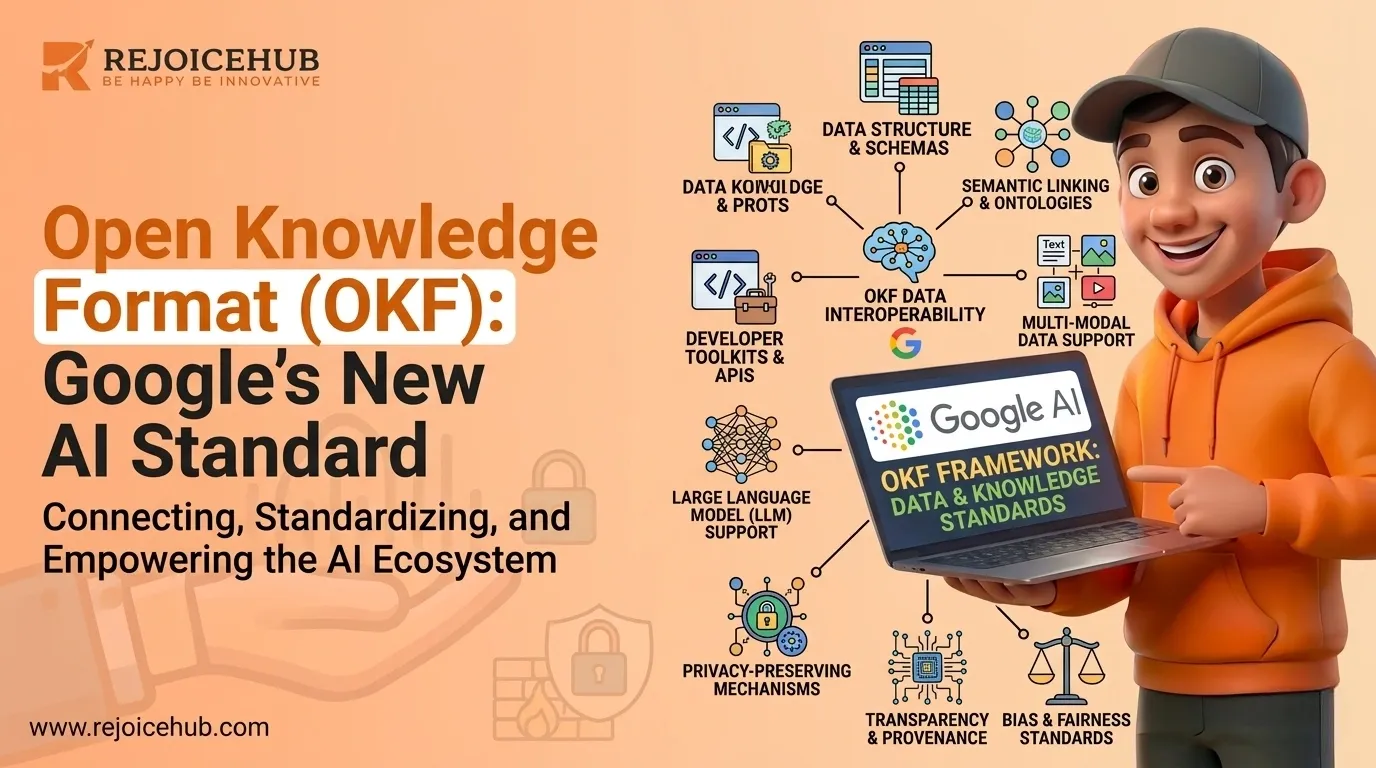
Open Knowledge Format (OKF) is a standardized framework introduced by Google that defines how AI agents structure, store, and share knowledge. Simply put, OKF enables AI agents to share data in a lingua franca that maintains accuracy and contextual integrity during the process.
It is like a common format for documents just like how PDF helped us share files across different applications, OKF helps us share knowledge across different AI models.
Quick Definition (Featured Snippet): The Open Knowledge Format (OKF) is the standard format developed by Google to facilitate the exchange of structured knowledge between AI systems. Through OKF, multi-agent systems can effectively exchange knowledge without any loss of data.
Why Google Created OKF
There was a realization by Google about the increasing challenge being experienced in terms of integration of AI in the business environment, in regard to the absence of a common knowledge base.
The problem was that all AI developers had different proprietary knowledge structures and hence agents that could not interact effectively; communication from one agent to another was prone to distortion, truncation, or even loss.
OKF is Google's solution to the problem of fragmentation in AI.
The Problem It Solves
Without OKF, AI agent ecosystems face three core challenges:
- Context loss: When one agent hands off a task to another, critical context often gets dropped
- Data inconsistency: Different agents interpret the same information in different ways
- Integration overhead: Developers spend an enormous amount of time building custom connectors between agents
OKF addresses all three by providing a unified knowledge schema that every agent can read, write, and interpret the same way.
How AI Agents Use Open Knowledge Format
1. Knowledge Sharing Between Agents
In a multi-agent workflow, individual agents specialize in specific tasks one might handle research, another analysis. For these agents to work efficiently, they need to hand off what they know to the next one without losing precision.
OKF builds structured "knowledge packets" essentially well-formatted containers of information that agents can pass back and forth reliably.
2. Structured Information Exchange
OKF enforces data consistency. In the process of generating an insight or collecting information, OKF makes sure that whatever the AI agent does is always presented in a format that can be easily understood by any other agent that follows.
This is especially valuable in complex agentic AI workflows where:
- Customer data needs to be passed from a sales AI agent to a support AI agent
- Research summaries need to be handed from an analysis agent to a content generation agent
- Financial data processed by one agent needs to be validated by a separate compliance agent
3. Multi-Agent Collaboration
OKF reaches its strength here because it facilitates coordinated multi-agent systems where agents can operate in parallel while keeping themselves synchronized on the knowledge they have at any one time.
Rather than agents depending on each other in a sequential manner, OKF lets agents communicate about their knowledge in an asynchronous fashion.
Looking to build AI agents that work together intelligently? RejoiceHub specializes in custom multi-agent AI development. Let's talk about your use case.
Key Benefits of Open Knowledge Format
1. Better Interoperability
OKF helps ensure interoperability among AI agents built for business developed using varying platforms, models, or architectures. Your agent running on an OpenAI system can easily collaborate with your agent running on a Google Gemini system without requiring any intermediary software.
This is huge for enterprise AI stacks utilizing best-of-breed systems from multiple vendors.
2. Improved Accuracy
When knowledge is consistently structured, agents make better decisions. Less opportunity exists for misunderstandings, omission of context, or hallucinations due to insufficient transfer of knowledge.
Improved accuracy translates into reduced errors, fewer reviews, and more faith in your automated AI processes.
3. Scalability
OKF was designed to be an enterprise-level solution. If you need 3 agents or 300 agents, the knowledge structure remains the same, which makes expanding your AI capabilities incredibly easy without needing a complete rearchitecture.
You can add additional agents to your business processes without having to rebuild the knowledge architecture from scratch.
4. Faster Development Cycles
Developers do not have to create data pipelines for each pair of agents anymore; OKF offers a standardized method that cuts down on integration from weeks to days.
This is especially relevant for start-ups and SaaS companies working on AI-powered application development.
5. Reduced Costs
Less custom integration effort + fewer mistakes + shorter development time = less overall cost to deploy AI.
Companies that use OKF early on will definitely see a reduction in development and operational costs associated with AI applications.
Accelerate Your Workflows with Custom AI
Book a free consultation session with RejoiceHub. We'll map out a tailored automation roadmap for your company.
Open Knowledge Format Use Cases
1. Customer Support AI Systems
Typically, large businesses use more than one support agent for things like billing, tech support, and escalations. With OKF, all these support agents exchange information about customers seamlessly.
If a customer contacts the escalation agent, that agent is fully aware of the complete interaction history of the customer without having to repeat themselves or start from scratch. This is a key reason why AI customer support automation is rapidly gaining traction in enterprises.
2. Healthcare AI Applications
The transfer of information in the healthcare sector becomes critical since the lives of patients may depend on it. OKF provides opportunities for exchanging information between diagnostic agents, scheduling agents, and compliance agents regarding the health condition of the patient.
3. Finance and Risk Analysis
Typically, several agents need to perform analysis such as market analysis, risk analysis, and regulatory analysis within a financial AI system. OKF helps these agents exchange their analysis results instantly.
4. Enterprise Workflow Automation
OKF is the glue for organizations looking to automate end-to-end business workflows with AI agents. Starting from lead generation to contract generation to customer onboarding, the agent performing one step in the process can share exactly what the next agent in the process requires.
Ready to automate your business workflows with AI agents? RejoiceHub builds enterprise-grade AI agent systems tailored to your specific operations. Book a free consultation.
Open Knowledge Format vs. MCP (Model Context Protocol)
One of the most common questions we see: How does OKF compare to MCP?
Key Differences
| Feature | Open Knowledge Format (OKF) | Model Context Protocol (MCP) |
|---|---|---|
| Primary Purpose | Structured knowledge exchange between agents | Connecting AI models to external tools and data |
| Focus | What agents know and how they share it | What agents can do and what they can access |
| Introduced By | Anthropic | |
| Best For | Multi-agent knowledge workflows | Tool use, API integrations, data retrieval |
| Interoperability | Agent-to-agent knowledge sharing | Model-to-tool connectivity |
When to Use Each
Use OKF when:
- You're building multi-agent systems where agents need to share rich knowledge
- Your workflow involves complex knowledge handoffs across agent boundaries
- You need consistent context preservation across long agent chains
Use MCP when:
- You want your AI agent to connect to external APIs, databases, or tools
- You're building an agent that needs real-time data retrieval capabilities
- You want to extend what your AI agent can do with third-party services
To understand MCP in more depth, read our detailed guide on what the Model Context Protocol is and how it works.
Can They Work Together?
Absolutely, and that's the exciting part.
Tool connectivity is provided by MCP and enables agents to connect to other tools or systems, whereas OKF ensures the proper structure of the knowledge exchanged between the agents based on their experience in these systems. They are complementary protocols rather than competing.
In the future, the most advanced AI agent systems will use both: MCP to gain access to tools and OKF for knowledge exchange.
Why Open Knowledge Format Matters for the Future of AI Agents
1. Multi-Agent Ecosystems Are the Future
Collaborative networks of AI agents are genuinely transformative. As businesses move from single-agent implementations to full multi-agent ecosystems, the need for standardized knowledge exchange becomes non-negotiable. OKF is the foundation that makes a truly intelligent, collaborative AI network possible.
2. Accelerating Enterprise AI Adoption
One of the major stumbling blocks for adopting enterprise AI has been integration difficulty. When each AI solution needs custom integration to connect with other systems and processes, it becomes increasingly expensive and risky to implement.
OKF solves this problem. With a universal knowledge model, enterprises can deploy AI agents without a dedicated ML team — rolling out new AI solutions into existing processes quickly and easily, with minimal expense and risk.
3. Standardized AI Collaboration
We are now entering an age where combining AI agents from different firms with different architectures is necessary to create a cohesive AI system. OKF is the protocol that enables this.
Like the internet, which needs TCP/IP to facilitate intercommunication between different computers, the AI agent ecosystem needs protocols like OKF to facilitate collaboration among different agents.
Firms that understand and adopt OKF early will gain a meaningful architectural edge over their competitors.
Conclusion
As AI agents become more capable and interconnected, the standards that govern how they exchange knowledge are becoming just as important as the models themselves. Google's Open Knowledge Format (OKF) addresses one of the biggest challenges in multi-agent AI by enabling reliable, structured knowledge sharing across agents built on different platforms, architectures, and AI models.
For businesses, this means lower integration costs, reduced implementation complexity, and more accurate collaboration between AI systems. Rather than building custom integrations for every workflow, organizations can adopt a common knowledge format that improves interoperability and long-term scalability.
Frequently Asked Questions
1. What is Open Knowledge Format (OKF) in simple terms?
Open Knowledge Format, or OKF, is a standard created by Google that helps AI agents share knowledge in a clean, consistent way. Think of it like a universal file format, just like PDFs work across different apps, OKF works across different AI systems.
2. Why did Google create the Open Knowledge Format?
Google noticed that AI agents built on different platforms couldn't share information properly. Data would get lost, misread, or cut off during handoffs. OKF was built to fix that fragmentation problem by giving all agents one common structure for exchanging knowledge without losing accuracy.
3. How does OKF help AI agents work together?
OKF creates what you can think of as "knowledge packets," neatly structured bundles of information that one agent can pass to another. This means agents don't lose context mid-workflow. A research agent can hand off findings to an analysis agent without anything getting dropped or misread.
4. What is the difference between OKF and MCP?
OKF, made by Google, focuses on how AI agents share knowledge with each other. MCP, made by Anthropic, focuses on connecting AI agents to outside tools and APIs. They solve different problems. In fact, many advanced AI systems will use both MCP to access tools and OKF to exchange what they learned.
5. What are the main benefits of using Open Knowledge Format for businesses?
OKF helps businesses cut down on custom integration work, reduce AI errors, and scale agent systems faster. When knowledge is structured consistently, agents make better decisions. Businesses also spend less time fixing miscommunication between agents, which lowers development and operational costs overall.
6. What industries can benefit most from OKF?
Customer support, healthcare, finance, and enterprise workflow automation can all benefit from OKF. Any business using more than one AI agent in a process like passing customer data from a sales agent to a support agent will get more accurate, faster results when agents share knowledge through OKF.
7. Is Open Knowledge Format the same as MCP or a replacement?
No, OKF is not a replacement for MCP. They work differently and actually complement each other well. MCP handles tool connectivity, letting agents access APIs and databases. OKF handles knowledge sharing, ensuring that what agents learn from those tools is passed along correctly to the next agent in the workflow.