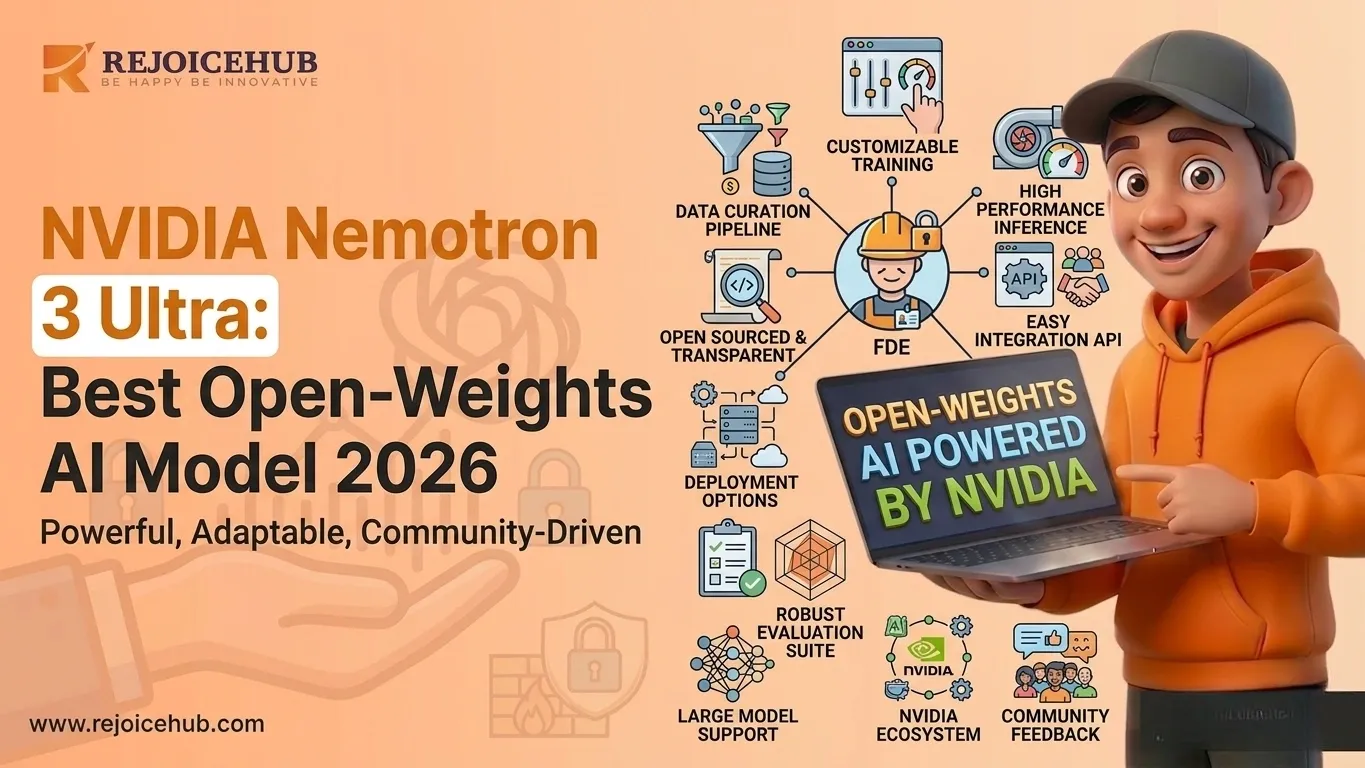
The AI model landscape is changing way faster than it has before. Every few months, some breakthrough sort of resets what we think is possible, and 2026 really isn't different. One of the releases everyone seems to be talking about this year is NVIDIA Nemotron 3 Ultra; it's a huge open-weight AI model, and it's already drawing a lot of attention from both developers and enterprise folks.
If your business is looking into AI agents, automation, or custom AI solutions, NVIDIA Nemotron 3 Ultra is something you probably want to understand early on. In this guide, we'll go over what it actually is, how it works in practice, how it stacks up against the competition, and why it matters for your business in 2026.
What Is NVIDIA Nemotron 3 Ultra?
NVIDIA Nemotron 3 Ultra is kind of the most powerful open weights AI model from NVIDIA, it was unveiled at Computex 2026, in Taipei on June 1, 2026. It's a 500–550 billion parameter model, built for deeper reasoning, tricky coordination, and agentic AI tasks, while still staying open to weights fully. That part means developers and companies can reach it, alter it, and roll it out on their own infrastructure, rather than depending on some third-party setup.
Featured Snippet Answer
NVIDIA Nemotron 3 Ultra is an open-weight large language model (LLM) with roughly 500–550 billion parameters, made by NVIDIA, and it was launched at Computex 2026. For sure, it sits at the top of the US open-weights AI rankings, with an Intelligence Index score of 48, and it manages about 300+ tokens per second, plus it is aimed at tricky reasoning, coding, and kind of independent AI agent applications.
NVIDIA, as expected, built Nemotron 3 Ultra to make itself more than a chipmaker, more like a full-stack AI platform company, really. The model is at the top of a three-tier Nemotron 3 set right there with the slimmer Nano variant and the mid-range Super model, which has 120B parameters and was launched in March 2026.
NVIDIA Nemotron 3 Ultra Features
1. Open-Weights Architecture
Unlike closed proprietary models from OpenAI or Anthropic, Nemotron 3 Ultra has fully open weights. This means:
- Developers can download and run the model on their own hardware
- Businesses can fine-tune it on proprietary datasets without sending data to a third party
- It's deployable across clouds, on-premises data centers, and edge devices
- Compatible with popular open frameworks like vLLM, SGLang, Ollama, and llama.cpp
This level of access is a game-changer for startups and enterprises that need control over their AI stack without vendor lock-in.
2. Advanced Reasoning Capabilities
Nemotron 3 Ultra's standout feature is its ability to handle complex multi-step reasoning and planning. Unlike earlier models that excel at simple Q&A, Nemotron 3 Ultra can:
- Break down complex problems into sub-tasks
- Execute agentic workflows with minimal human intervention
- Handle long-context reasoning with up to 1 million token context windows
- Score 48 on the Artificial Intelligence Index, the highest of any US-built open model
This reasoning depth makes it particularly valuable for AI agents that need to plan, execute, and iterate on tasks autonomously.
3. Enterprise-Ready Performance
Speed and cost matter at scale. Nemotron 3 Ultra delivers on both:
- 300+ output tokens per second: among the fastest in its class
- 5x higher throughput compared to previous Nemotron versions
- ~30% lower costs for agentic AI tasks vs. leading alternatives
- Uses latent mixture-of-experts (MoE) architecture, activating only ~55B of its 550B parameters per task, which means efficiency without sacrificing power
For enterprise teams running high-volume AI workloads, these numbers translate directly to infrastructure savings.
4. Developer-Friendly Ecosystem
NVIDIA has built Nemotron 3 Ultra with developers in mind. It supports:
- NVIDIA NIM microservices for rapid deployment on any GPU-accelerated system
- Fine-tuning workflows that let teams adapt the model to specific domains
- Integration with NVIDIA AI infrastructure, including data centers, cloud platforms, and edge devices
- Open training data and recipes, not just weights, for full reproducibility
Whether you're building a RAG pipeline, a customer support agent, or a code assistant, Nemotron 3 Ultra fits directly into modern AI development stacks.
How NVIDIA Nemotron 3 Ultra Works
1. Large Language Model Foundation
At its core, Nemotron 3 Ultra is kind of a hybrid Mamba-Transformer model, stitched together with a mixture-of-experts (MoE) setup. It's said to carry around 500–550 billion total parameters, but only about 55 billion active parameters get used per token, so you end up with roughly 90% sparsity. That's the reason it feels snappy even though the whole thing is absolutely enormous.
2. Training and Fine-Tuning Process
NVIDIA trained the Nemotron 3 family using NVFP4 (NVIDIA Floating Point 4-bit) training techniques combined with latent MoE. This allows:
- More efficient training runs on NVIDIA GPU clusters
- Reduced memory footprint per inference request
- High throughput without proportional increases in compute cost
Fine-tuning the model for domain-specific tasks follows standard supervised fine-tuning (SFT) and reinforcement learning from human feedback (RLHF) workflows.
3. Reasoning and Inference Mechanism
Here's a simplified look at how Nemotron 3 Ultra processes a complex query:
- Input received: the model takes in a prompt (text, code, instructions)
- Routing layer activates: the MoE router selects the most relevant expert networks (~55B parameters) for the specific task
- Context window processing: with up to 1M tokens of context, the model retains long conversation history or document contents
- Multi-step reasoning: the model breaks down complex tasks into sub-goals and plans steps
- Output generation: produces output at 300+ tokens per second, enabling real-time applications
- Agent loop (for agentic use cases): the model iterates, self-corrects, and calls external tools or APIs to complete multi-step tasks
4. Integration with NVIDIA AI Infrastructure
Nemotron 3 Ultra is natively optimized so it can run on NVIDIA GPUs from H100s in the data center, all the way to edge-capable hardware. In practice, enterprises can roll it out via a few routes, like:
- NVIDIA NIM microservices (that are containerized and API-compatible)
- Cloud platforms, such as AWS, Azure, GCP, through NVIDIA AI Enterprise
- On-premises GPU clusters using vLLM or TensorRT-LLM
NVIDIA Nemotron 3 Ultra vs Other AI Models
-
Nemotron vs GPT-5
GPT-5 (OpenAI's proprietary flagship) scores around 57 on the Artificial Intelligence Index, more like 9 points ahead of Nemotron 3 Ultra. Though GPT-5 is a closed model, you can't really fine-tune it on private data, you can't peek at the weights, and you can't run it on your own infrastructure either. In contrast, Nemotron 3 Ultra gives you transparency, customizability, and long-horizon savings, but you do pay with a bit of a capability gap.
-
Nemotron vs Claude
Anthropic's Claude lands around 57 on that same index, more or less, pretty close to GPT-5. Claude stays a closed setup, though, so usage is tied to Anthropic's API only. Nemotron 3 Ultra, on the other hand, feels more open for developers who are putting together production-level systems where data privacy matters a lot or where you want custom-tuning.
-
Nemotron vs Gemini
Google's Gemini family (closed) kind of also takes the lead on those intelligence benchmarks. But when teams are building on open infrastructure, Nemotron 3 Ultra really, genuinely outpaces any matching open-weights model in the US. Like, its closest US rival, Gemma 4 31B, only lands at 39 on the Intelligence Index, and that's a 9-point gap, which is kind of huge.
-
Open-Weights vs Closed Models
| Feature | NVIDIA Nemotron 3 Ultra | GPT-5 / Claude / Gemini |
|---|---|---|
| Access Model | Open-weights | Closed API only |
| Fine-tuning | Full control | Limited or none |
| Data Privacy | On-premises capable | Data sent to vendor |
| Intelligence Index | 48 (US #1 open) | ~57 (proprietary) |
| Speed | 300+ tokens/sec | Varies by provider |
| Cost per inference | ~30% lower than alternatives | Variable, often higher at scale |
| Vendor Lock-in | None | High |
| Context Window | 1M tokens | Varies |
Bottom line: If you need the absolute highest intelligence score and don't care about data privacy or customization, closed models still lead. If you need control, customization, and cost efficiency at scale, Nemotron 3 Ultra is the strongest US option available today.
Real-World Use Cases for Businesses and Developers
1. AI Agents
Nemotron 3 Ultra is kind of purpose-built for autonomous AI agents those systems that plan, execute, and keep iterating on harder tasks. The whole vibe is that it can run more on its own than usual. Some example use cases are below:
- Research agents that go searching, then synthesize the findings, and just report on their own
- Operations agents that manage workflows across more than one tool or service, quietly coordinating the steps
- Sales agents who qualify leads, draft outreach, and also log the CRM information, all without you constantly jumping in
So if you're trying to build custom AI agents for your business, RejoiceHub focuses on designing and deploying exactly these kinds of systems.
2. Customer Support Automation
With 1M token context and with pretty strong instruction following, Nemotron 3 Ultra can power next-generation customer support bots that, kind of, remember full conversation and case history and also resolve complex multi-step support issues without going to escalation too fast (unless you need it).
They can integrate with ticketing systems, product databases, and CRMs too, sort of like tying everything together in one place. Compared to older models, that cost reduction per inference means you're able to manage far higher support volumes without budget increases that scale in the same way.
3. Software Development
Nemotron 3 Ultra really shines in code generation, debugging, and technical documentation. Development teams can use it for things like auto-generating boilerplate code and unit tests, or doing a calmer review and refactor of legacy codebases.
It can also craft API documentation straight from source code and in general, power internal developer copilots without sending proprietary code out to third-party APIs.
4. Enterprise Knowledge Systems
Organizations sitting on vast internal document libraries can build RAG (Retrieval-Augmented Generation) pipelines on Nemotron 3 Ultra to:
- Answer employee questions from internal wikis and policy documents
- Summarize long reports and contracts
- Build searchable knowledge bases from unstructured data
The 1M token context window is especially valuable here; it can ingest and reason across entire documents without chunking overhead.
5. Industry-Specific AI Solutions
Because Nemotron 3 Ultra supports full fine-tuning on proprietary data, it's well-suited for regulated industries where data cannot leave your environment:
- Healthcare: Clinical decision support, medical documentation
- Legal: Contract analysis, case research, compliance monitoring
- Finance: Risk modeling, earnings analysis, regulatory reporting
- Manufacturing: Predictive maintenance, supply chain optimization
Why NVIDIA Nemotron 3 Ultra Matters in 2026
The launch of Nemotron 3 Ultra feels like more than just another single-model release. Like, it kinda points at something larger, for how AI is gonna move in 2026 and past that point too. And here's why it matters, honestly.
The open AI ecosystem is maturing, pretty noticeably. With more than 50 million downloads of the Nemotron 3 family already logged before the Ultra launch, open-weight models aren't just some weird side preference for developers anymore. They're turning into a legit enterprise choice, the kind that people actually sign off on.
Enterprise adoption is speeding up. A bunch of businesses that used to just default to closed API providers are now leaning toward open models, mainly because they get better leverage over cost, compliance, and customization. Understanding AI adoption levels and where your business sits on that roadmap is increasingly important.
Next-wave AI innovation, in practice, will be built on open foundations. The researchers, the startups, and the enterprises stacking on top of open-weights models right now are already shaping the training data, the fine-tuning methods, and the tooling that will basically set the pace for AI's next chapter, even if nobody calls it that yet.
Conclusion
NVIDIA Nemotron 3 Ultra is, as of 2026, one of the most powerful open-weight AI models that has been built in the United States. It comes in with something like 500–550 billion parameters, a 48-point Intelligence Index score, and around 300+ tokens per second, plus roughly 30% lower inference costs compared with other options. So, it feels less like marketing and more like a real jump toward accessible, enterprise-ready AI that people can actually use.
But really, it's the bigger idea behind it. This is basically the shape of the next phase of AI rollout: open, customizable, cost-efficient, and not stuck behind a vendor dependency. In other words, you can tune it for your workflows instead of just accepting what someone else ships.
The question isn't really whether open-weights AI will turn into the enterprise standard; it's whether your business will be ready when that moment shows up.
Frequently Asked Questions
1. What is NVIDIA Nemotron 3 Ultra?
NVIDIA Nemotron 3 Ultra is a massive open-weights AI model with around 500–550 billion parameters. It was launched at Computex 2026 and is currently the most powerful US-built open-weight AI model, designed for complex reasoning, coding, and AI agent tasks.
2. How is NVIDIA Nemotron 3 Ultra different from GPT-5 or Claude?
GPT-5 and Claude are closed models, meaning you cannot access their weights or run them on your own servers. NVIDIA Nemotron 3 Ultra is fully open-weights, so businesses can fine-tune it, keep data private, and avoid being locked into any single vendor.
3. What are the main features of NVIDIA Nemotron 3 Ultra?
Key features include a 1 million token context window, 300+ output tokens per second, a 48-point Intelligence Index score, and open-weights access. It also uses a mixture-of-experts setup that keeps costs around 30% lower than most competing AI models.
4. How does NVIDIA Nemotron 3 Ultra work?
It uses a hybrid Mamba-Transformer model with a mixture-of-experts (MoE) design. Even though it has 550 billion total parameters, only about 55 billion are activated per task. This makes it fast and cost-efficient while still handling very complex, multi-step reasoning tasks.
5. What businesses or industries can benefit from NVIDIA Nemotron 3 Ultra?
Healthcare, legal, finance, and manufacturing teams benefit the most since they deal with sensitive data. It also works well for customer support, software development, and internal knowledge systems where full data control and custom fine-tuning are important requirements.
6. Is NVIDIA Nemotron 3 Ultra free to use?
The model weights are openly available, so developers can download and run it at no licensing cost. However, running it at scale requires serious GPU infrastructure, like NVIDIA H100s, which does carry real hardware or cloud compute costs depending on your setup.
7. Why is NVIDIA Nemotron 3 Ultra considered the best open-weights AI model in 2026?
It scores 48 on the Intelligence Index, the highest of any US open-weights model right now. Its closest open rival, Gemma 4 31B, scores only 39. Add in the speed, low inference cost, and full customization options, and it stands clearly ahead of other open alternatives.