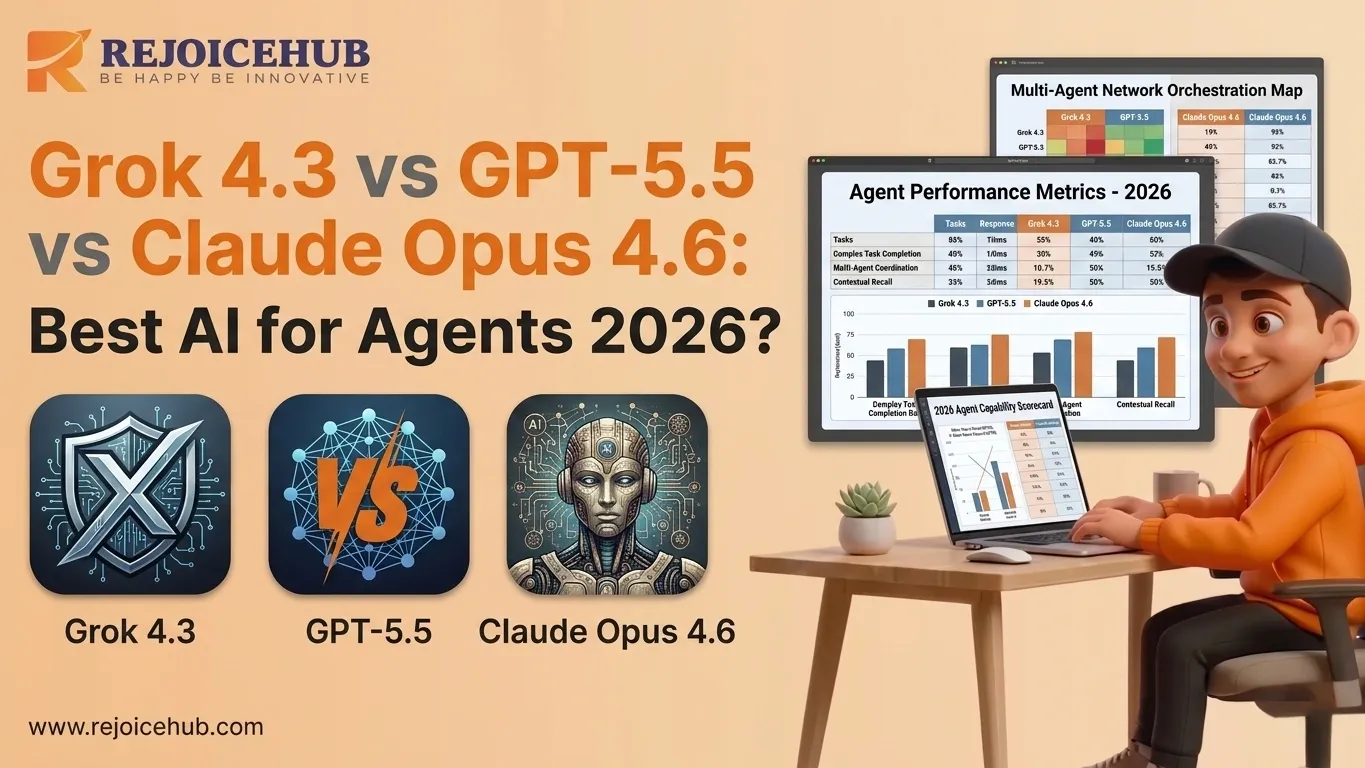
AI agents function as current technologies that businesses use to replace their existing software-as-a-service workflows. From automating customer onboarding to running multi-step sales pipelines, businesses in 2026 are deploying AI agents at scale.
The problem occurs when organizations select the wrong AI model because this decision leads to budget waste, system failures, and team members experiencing frustration.
The three models dominating enterprise AI agent development right now are Grok 4.3, GPT-5.5, and Claude Opus 4.6. Each one brings something different to the table and picking the right one depends on your specific workflow, budget, and business goals.
In this guide, we break down the Grok 4.3 vs. GPT 5.5 vs. Claude Opus 4.6 comparison specifically for agentic workflows, covering performance, tool use, enterprise use cases, and a decision framework to help you choose.
If you're looking for the short version:
- GPT-5.5: Best overall for complex agentic workflows. Strongest reasoning, tool-use, and function calling.
- Claude Opus 4.6: Best for safety-critical and long-context workflows. Ideal for compliance, legal, and document-heavy agents.
- Grok 4.3: Best for real-time and speed-sensitive agents. Strong for social data and fast-response applications.
At-a-Glance Comparison Table {#at-a-glance-comparison-table}
| Feature | Grok 4.3 | GPT-5.5 | Claude Opus 4.6 |
|---|---|---|---|
| Best For | Real-time apps & speed | Complex reasoning & tools | Safety & long context |
| Multi-step Reasoning | Good | Excellent | Excellent |
| Tool Use / Function Calling | Evolving | Best-in-class | Strong |
| Context Window | 128K | 256K+ | 200K |
| Latency | Fastest | Moderate | Moderate |
| Enterprise Safety | Moderate | High | Highest |
| Cost Efficiency | High | Moderate | Moderate |
| Real-time Data Access | Yes (X/Twitter) | Limited | No |
| Ecosystem Integrations | xAI / X platform | OpenAI / Azure | Anthropic / AWS |
Model Overview: Grok 4.3 vs GPT-5.5 vs Claude Opus 4.6 {#model-overview-grok-43-vs-gpt-55-vs-claude-opus-46}
1. Grok 4.3 — Built for Speed and Real-Time Intelligence
The current version of xAI includes Grok 4.3 as its newest model. The implementation provides quick data processing for immediate data streaming, which makes it suitable for monitoring news updates, social media trends, and ongoing market changes.
Grok demonstrates its best performance through reduced latency times. The system provides fast responses through Grok 4.3, which enables users to maintain their normal work processes while needing only basic reasoning capabilities.
- Strengths: Speed, real-time data, cost efficiency
- Limitations: Function calling still maturing, less enterprise documentation
2. GPT-5.5 — The Power Player for Complex Agents
The current optimal standard for performing tasks through agentic systems is OpenAI's GPT-5.5. The model serves as the primary resource for developers who create AI agents for business automation that require multiple steps and multiple tools to operate because it features an extended context window and advanced tool capabilities, and its established function-calling API.
The system serves as the primary selection for enterprise AI automation initiatives because it offers complete Azure integration together with its strong developer community.
- Strengths: Tool use, reasoning, ecosystem, structured outputs
- Limitations: Higher cost at scale, slightly slower than Grok
3. Claude Opus 4.6 — The Enterprise Safety Champion
The design of Anthropic's Claude Opus 4.6 system centers around providing safe and dependable enterprise operations. The system provides an unmatched 200K context window, which enables efficient handling of document-intensive tasks, while its Constitutional AI training ensures maximum safety for operations in environments that require compliance with regulations.
For organizations that use AI agents in healthcare, legal, finance, and other regulated sectors, the most secure option available is Claude Opus. To understand more about what makes agentic AI powerful in regulated industries, see our guide on what is agentic AI.
- Strengths: Safety, long context, nuanced reasoning, reliability
- Limitations: No real-time data, higher latency than Grok
Performance Comparison for Agentic Workflows {#performance-comparison-for-agentic-workflows}
The actual measurement of a model's performance on multi-step tasks shows better results than its raw benchmark scores which are used in agentic workflows. The following section shows how each model performs on the essential metrics that determine their true performance.
1. Multi-Step Reasoning
Multi-step reasoning serves as the fundamental requirement for any agentic workflow because the model needs to create a plan, divide tasks into smaller components, and perform those tasks in order while maintaining its understanding of the complete project.
GPT-5.5 excels here. It consistently maintains task context across long chains, handles mid-task corrections well, and adapts when tools return unexpected outputs.
Claude Opus 4.6 is equally strong in reasoning, especially when the context is long or nuanced. Its safety guardrails also prevent it from making costly errors mid-task.
Grok 4.3 handles simpler chains well, but complex multi-hop reasoning tasks can trip it up — especially when tool outputs need dynamic re-planning.
2. Task Chaining and Memory Handling
Real-world AI agents don't run one task; they execute multiple tasks through their entire operational chain. The process begins with CRM data retrieval, which leads to data analysis and email writing, followed by activity scheduling and activity tracking.
- GPT-5.5 performs best in long task chains, maintaining task state cleanly across calls.
- Claude Opus handles memory well within a single session, but requires careful context management across sessions.
- Grok 4.3 is better suited for short, fast task chains rather than complex multi-stage pipelines.
3. Real-World Example: Booking + CRM + Email Automation
Imagine an AI sales agent that:
- Identifies high-intent leads from your CRM
- Schedules a follow-up call
- Drafts a personalized email
- Logs everything back to the CRM
- GPT-5.5 completes this 4-step chain reliably with proper function definitions.
- Claude Opus handles the drafting and reasoning steps with high accuracy but needs tighter tool definitions.
- Grok 4.3 can handle this if the CRM and email tools are well-structured, but may need more error handling built in.
Need a custom AI sales agent? RejoiceHub builds production-ready AI agents tailored to your CRM and sales stack.
Tool Use & Function Calling Capabilities {#tool-use--function-calling-capabilities}
For AI agents, tool use isn't optional it's everything. The model must reliably call APIs, parse outputs, handle errors, and continue the workflow. This is where the models diverge significantly. Learn more about how AI agents automate workflows at the infrastructure level.
1. GPT-5.5 — The Tool-Use Standard
The function-calling system of GPT-5.5 reaches its highest development stage. The system allows simultaneous tool operation while producing JSON-formatted results, and it effectively manages exceptional situations. The OpenAI API documentation provides complete information that enables developers to create software applications more efficiently.
- Supports parallel function calls in a single step
- Strong structured output enforcement
- Best documentation and community support
2. Claude Opus 4.6 — Reliable but Deliberate
Claude's tool use produces accurate results because it works reliably and produces precise outputs. The system shows high caution because it requires additional information before proceeding with its tasks. The system's cautious behavior serves as an essential function that benefits companies that require enterprise-grade solutions.
- Strong with structured document parsing and extraction tools
- Conservative behavior reduces costly mistakes
- Ideal for workflows that interface with compliance tools
3. Grok 4.3 — Still Evolving
Grok 4.3's function-calling capabilities are improving rapidly, but as of 2026 it still lags behind GPT-5.5 and Claude in maturity and reliability. The deployment of production agents needs to include more error handling measures.
- Best paired with simple, well-defined APIs
- Not recommended for complex multi-tool orchestration yet
RejoiceHub's AI agent development team has built agents on all three models. We can help you choose and implement the right stack for your workflow.
Enterprise Use Cases: Which Model Fits Your Business? {#enterprise-use-cases-which-model-fits-your-business}
| Use Case | Recommended Model | Why |
|---|---|---|
| CRM + Email Automation | GPT-5.5 | Best tool-use accuracy, structured outputs |
| Compliance & Legal AI | Claude Opus 4.6 | Highest safety, 200K context window |
| Real-time Social Monitoring | Grok 4.3 | Native access to X platform data |
| Multi-agent Orchestration | GPT-5.5 | Strong function calling & task chaining |
| Document Analysis | Claude Opus 4.6 | Long context + nuanced reasoning |
| Customer Support Copilot | GPT-5.5 / Grok 4.3 | Speed + tool use balance |
| Internal Knowledge Agent | Claude Opus 4.6 | Safe, reliable, long context |
-
Sales & Marketing Automation → GPT-5.5
The team requires AI agents that work with Salesforce and HubSpot and email tools to handle outreach, follow-up, and reporting tasks. The system function-calling system, together with its wide range of API connections, establishes itself as the optimal solution for automating sales tasks. Explore how AI is transforming marketing for sales-driven businesses.
-
Compliance, Legal & Finance → Claude Opus 4.6
Claude Opus 4.6 provides the safest solution for industries that require contract review, legal research, and financial reporting because its design prioritizes safety and its 200,000-word context capacity. You can also explore AI applications in finance to understand where these capabilities matter most.
-
Real-Time Monitoring & Social Intelligence → Grok 4.3
Grok 4.3 provides the best solution for your business needs because it can monitor brand sentiment and track competitor activities and respond to real-time news updates through its native connection to the X platform and its quick data processing capability.
-
Customer Support Automation
For businesses looking to deploy AI customer support agents, both GPT-5.5 and Grok 4.3 offer strong options depending on whether the priority is accuracy or speed.
RejoiceHub has delivered AI automation solutions for SaaS companies across all three categories. Get a free consultation to find the right model for your business.
How to Choose the Right AI Model for Agent Development {#how-to-choose-the-right-ai-model-for-agent-development}
Not sure which model fits your project? Ask yourself these four questions:
1. What's your primary use case?
- Complex reasoning & automation → GPT-5.5
- Safety-critical or document-heavy → Claude Opus 4.6
- Real-time data or social intelligence → Grok 4.3
2. What's your budget?
- Cost-sensitive at scale → Grok 4.3 (most affordable)
- Mid-range with broad use cases → GPT-5.5
- Enterprise-grade with compliance needs → Claude Opus 4.6
3. How important is latency?
- Low latency required → Grok 4.3
- Latency not critical → Claude Opus or GPT-5.5
4. What's your existing tech stack?
- Already on Azure/Microsoft → GPT-5.5 (native Azure OpenAI integration)
- AWS-native → Claude Opus 4.6 (available on Amazon Bedrock)
- X/Twitter data workflows → Grok 4.3
If you're planning to build a full agentic system, it helps to understand how to build an AI agent stack for your business before committing to a single model.
Quick Rule of Thumb: Start with GPT-5.5 for most agentic workflows. Switch to Claude Opus if safety or context depth is critical. Use Grok when speed or real-time data is the priority.
Conclusion {#conclusion}
The comparison between Grok 4.3, GPT-5.5, and Claude Opus 4.6 shows that no single model achieves victory in every testing category.
GPT-5.5 functions as the best overall solution for both complex agentic workflows and enterprise automation processes.
The safest and most effective solution for safety and compliance requirements as well as extended-duration tasks is Claude Opus 4.6.
Grok 4.3 offers organizations the most effective solution because it enables their real-time agents to operate at high speeds while incurring low operational costs.
The winning strategy for most businesses? Use the right model for the right job — and design your AI agent architecture to be model-agnostic where possible. You can also explore the best AI agents for business automation to see how leading companies are putting these models to work today.
Ready to Build Your AI Agent?
If you're looking to build a custom AI agent using GPT-5.5, Claude Opus, or Grok RejoiceHub can help. We design, build, and deploy production-ready AI agents tailored to your business workflows.
Visit rejoicehub.com to explore our AI agent development services or schedule a free consultation with our team.
Frequently Asked Questions
1. Which is the best AI model for agentic workflows in 2026?
GPT-5.5 is the top pick for most agentic workflows in 2026. It handles complex reasoning, multi-step task chaining, and tool use better than most models. Claude Opus 4.6 is the safest choice for compliance-heavy work, while Grok 4.3 wins on speed and real-time data.
2. How does Grok 4.3 compare to GPT-5.5 and Claude Opus 4.6 for AI agents?
Grok 4.3 is the fastest and most cost-efficient of the three. GPT-5.5 leads in tool use and reasoning, making it better for complex agents. Claude Opus 4.6 offers the largest context window and the highest safety standards. Each model has a clear strength depending on your use case.
3. What is the best LLM for enterprise automation in 2026?
GPT-5.5 works best for most enterprise automation tasks thanks to its strong function calling and Azure integration. If your business deals with legal, finance, or compliance workflows, Claude Opus 4.6 is the safer and smarter option with its 200K context window and Constitutional AI training.
4. Which AI model is best for tool use and function calling?
GPT-5.5 leads in tool use and function calling. It supports parallel tool calls, enforces structured JSON outputs, and has the best developer documentation. Claude Opus 4.6 is reliable but more cautious. Grok 4.3 is still catching up and works best with simple, well-defined APIs.
5. Is Claude Opus 4.6 good for autonomous AI agents?
Yes, Claude Opus 4.6 is a strong choice for autonomous agents that work with long documents, compliance rules, or sensitive data. Its 200K context window and safety-first design make it reliable for regulated industries. However, it does not support real-time data access, which limits certain use cases.
6. How do I choose the right AI model for my agent development project?
Start by asking what your agent needs to do. If it needs complex reasoning and tool use, go with GPT-5.5. If safety and long documents are the priority, pick Claude Opus 4.6. If you need fast responses or real-time social data, Grok 4.3 is the right fit. Budget and existing tech stack also matter.
7. Can I use Grok 4.3 for production-level AI agent workflows?
Grok 4.3 can work for production workflows that are speed-sensitive or rely on real-time X platform data. However, its function-calling features are still maturing. For complex multi-tool agents, GPT-5.5 or Claude Opus 4.6 are safer bets. Grok works best with simple, well-structured API setups right now.