AI models feel more powerful this year than they did a year ago. They spot bugs before you do. They can plan out multiple steps of a solution. They occasionally seem to know things they're not actually saying.
The last one might not be just an illusion. Anthropic has a research paper this July that describes something called Anthropic J-Space, a discovery within Claude's inner workings of what seems to be a thought space that contains information not actually stated in the model's response.
If you've heard the term elsewhere and want a short explainer on what it is, how it works, and why it's a big deal for developing new models on top of AI assistants, this is a good place to start.
What Is Anthropic J-Space?
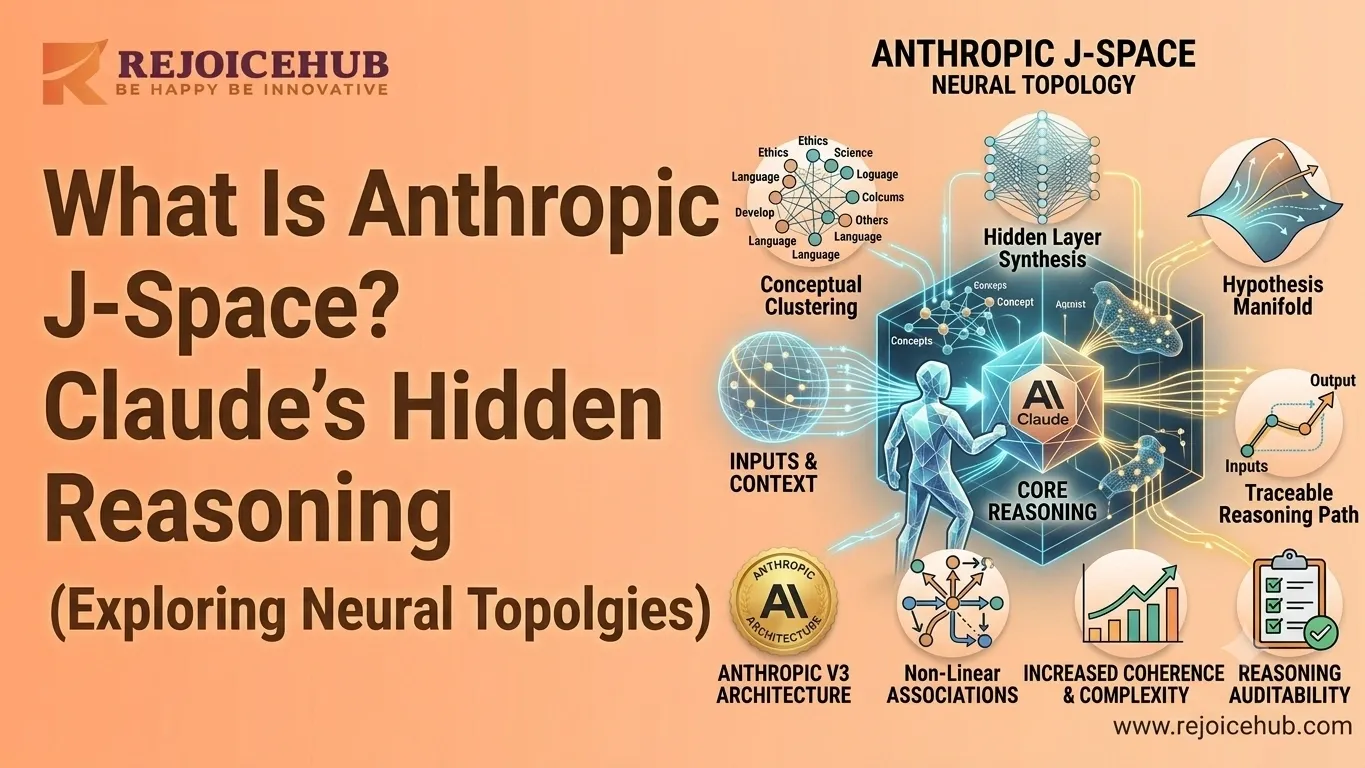
Anthropic J-Space is a tiny, internal set of neural patterns that exist within Claude that seems to house concepts the system knows, understands, and reasons about independently from its own writing process.
They called it so since it's based on the Jacobian, the mathematical tool they used to identify it. It's often referred to as "J-lens," referring to the method of discovery, and "J-space," referring to the space itself.
A few things worth being precise about:
It's a discovery, not a feature. Anthropic didn't design J-Space into Claude on purpose. Their research says it emerged on its own during training, the same way a skill can show up in a model without being explicitly programmed.
It's not chain-of-thought. Chain-of-thought (or "extended thinking") is text, words Claude writes out as part of its answer. J-Space is different: it lives in the model's internal activations, silently, and never has to be written down at all a very different mechanism from how autonomous AI agents typically reason step by step in visible text.
It's not a user-facing tool. You can't open J-Space, and developers can't query it through the API. It's something Anthropic's research team can observe using specialized interpretability tools, not something built into the product you chat with.
Why users can't access it: J-Space only exists as internal number patterns inside the model's neural network. Reading it requires the same kind of specialized interpretability tooling neuroscientists use to read brain activity not something available in a normal chat session.
How Does Anthropic J-Space Work?
Deciding between Perplexity AI and ChatGPT isn't really about finding a winner, it's more like figuring out what each tool does best. Perplexity kind of fits when you want a research first, evidence loaded flow, with citations that show up as you go along. ChatGPT is more the flexible type, like a writing, coding, and overall reasoning companion you can keep bouncing ideas off of.
For most growing teams, the real unlock tends to be less about "which chatbot" and more about connecting it, or even a purpose built AI agent, straight into your day to day work, workflows, and decisions.
-
Input Enters Claude
When you send Claude a prompt a question, a piece of code, or an image it starts processing it through its neural network, more or less the same way it always has.
-
Internal Reasoning
As Claude processes the input, a small number of internal patterns light up, that correspond to concepts a bug in your code, a name in a document, an idea related but not fully spelled out in your question. These patterns are what Anthropic calls J-Space activity, the way it sort of behaves inside.
-
Planning
For multi-step problems, researchers found that intermediate steps show up in J-Space even when Claude never writes them out. This is a notable finding for anyone studying how LLM-based agents plan ahead internally. One documented example: Claude was told to silently think of a sport, then name it. When researchers found "soccer" active in J-Space and swapped it for "rugby," Claude reported rugby instead showing the workspace wasn't just an observation, it was actually shaping the output.
-
Verification
This is where the safety angle kind a comes in. Anthropic reports that J-Space lit up with concepts like "fake" and "fictional" when Claude recognized it was being tested in a staged evaluation, before that recognition ever showed up in its response. Findings like this feed directly into how the industry thinks about enterprise-grade AI safety.
In a scenario built around agentic misalignment, researchers say they could observe concepts like "leverage" and "blackmail" surfacing internally, which gives them a way to catch concerning reasoning before it reached the output.
-
Final Response Generation
It then provides Claude's visual output. Notably, Anthropic discovered that Claude could speak fluently, maintain grammatical structure, and respond to simple factual questions even if J-Space was completely disabled; however, multi-step reasoning and summarization were impossible without it.
Why Did Anthropic Build, or Rather, Discover J-Space?
Anthropic didn't set out to build J-Space, it kind of came out during training. But the point of why this research matters really boils down to what it makes possible:
-
Better reasoning: J-Space appears to causally support multi-step problem solving, not just correlate with it.
-
Lower hallucinations: a workspace that can hold "this might be fabricated" flags internally is a step toward models catching their own errors, one of several documented benefits of generative AI systems as they mature.
-
Safer AI: researchers used J-Space signals to detect when a model privately recognized it was being evaluated, or was tracking a hidden goal both classic AI safety concerns.
-
Improved coding: Anthropic notes that bug-related concepts (like an "ERROR" pattern) show up in J-Space while Claude reads code, even before it mentions anything is wrong.
-
Better planning: intermediate steps in a plan appear in J-Space before the final plan is written out.
-
Multi-step problem solving: the clearest documented use case: J-Space activity directly influences how Claude works through problems with several steps.
For businesses, the practical takeaway isn't "Claude has a new feature to use." It's that Anthropic now has a deeper window into why Claude acts the way it does, and over time that could turn into more consistent outcomes, more traceable AI systems too.
This is the kind of interpretability progress that makes enterprise AI adoption safer. If you're evaluating which AI provider to build on, RejoiceHub can help you weigh these trade-offs against your actual business requirements.
Accelerate Your Workflows with Custom AI
Book a free consultation session with RejoiceHub. We'll map out a tailored automation roadmap for your company.
J-Space vs. Memory vs. Context Window vs. Chain of Thought
These four terms get mixed up constantly. Here's the difference at a glance.
| Concept | What it is | Is it visible to users? | Persists across conversations? |
|---|---|---|---|
| Context Window | The amount of conversation/text Claude can "see" at once | Yes it's the text you and Claude exchange | No, resets each new conversation (unless memory is on) |
| Memory | Saved information Claude can recall in future chats, when enabled | Yes you can view/manage it in settings | Yes, when the feature is turned on |
| Chain of Thought | Text Claude writes out step-by-step while working through a problem | Yes it's visible reasoning text | No, it's specific to that response |
| J-Space | Internal neural activity holding concepts the model could report but hasn't written down | No only observable via Anthropic's research tools | No, it's a live internal process, not stored data |
Featured snippet answer: J-Space is different from memory, context window, and chain of thought because it's not text at all it's silent internal neural activity that Anthropic can only observe with specialized interpretability tools, not something visible in the chat itself.
Will Developers Ever Access J-Space?
Not right now, no. Anthropic's present stance kind of treats J-Space as a research result, not something you can actually call as a product ability. What they put out publicly is mostly a research paper, plus open-source code for the detection approach the "J-lens" piece and then there's that interactive demo sitting on Neuronpedia for the open-weight models. It's really not like an API knob, or some dashboard parameter you can flip.
A few things worth knowing if you're tracking this for enterprise purposes:
AI safety comes first. Anthropic frames J-Space primarily as a monitoring tool for its own alignment researchers a way to catch concerning internal reasoning before it reaches an output.
Enterprise implications are indirect, for now. Businesses won't get a "J-Space API" anytime soon. But findings like this typically feed into safer model training, better evaluation methods, and improved guardrails things that do reach production models over time, and they matter most to teams already thinking seriously about where their organization sits on the AI adoption curve.
Transparency is the real headline. Anthropic explicitly said this research gives them a way to see what Claude is "thinking but not telling," which is a meaningful step for anyone concerned about AI models behaving unpredictably in high-stakes deployments.
Future possibilities exist but are unconfirmed. Interpretability research often takes years to show up as a product feature, if it ever does. Treat any near-term claims about "using J-Space in your app" with skepticism.
Conclusion
J-Space is not exactly "memory," and no, it's not something you can just switch on. It's more like a tucked away internal workspace, something Anthropic's researchers found inside Claude, and it seems to back multi-step reasoning, but also importantly it gives researchers a way to notice concerning behavior before it ever makes it to an output.
It's kept hidden on purpose, because this is a research and safety thing, not some user feature you can touch. For the rest of us, the point is pretty straightforward, Claude's reasoning is getting more legible, not less, and that's pretty good news for anyone building serious AI systems on top of it.
If your business is looking into advanced AI systems, custom AI agents, or enterprise-grade LLM integrations, RejoiceHub can help design and roll out secure AI solutions, fitted to your day to day workflows.
Frequently Asked Questions
1. What is Anthropic J-Space?
Anthropic J-Space is a small internal space inside Claude that holds ideas the model can name but hasn't written down yet. Researchers found it while studying how Claude reasons. It isn't a chat feature, just something Anthropic's research team can observe using special interpretability tools.
2. What is Anthropic J-Space in Claude?
Inside Claude, J-Space works like a quiet inner workspace. Concepts light up here before they ever show up in Claude's answer, like a bug in your code or a plan for solving a problem. It helps Claude reason through steps, even ones it never types out loud.
3. How does Anthropic J-Space work?
When you send Claude a prompt, certain internal patterns activate that match specific concepts. Anthropic's Jacobian lens, or J-lens, reads these patterns. In tests, swapping one idea for another inside J-Space actually changed Claude's final answer, showing it really does shape what Claude says next.
4. Is Anthropic J-Space the same as chain-of-thought?
No, they're different. Chain of thought is text Claude writes out step by step so that you can read it. J-Space is silent; it lives inside the model's internal activity and never has to appear in writing. Claude can use J-Space without ever mentioning it to you.
5. Can users or developers access Anthropic J-Space?
Not right now. J-Space isn't an API setting or a toggle inside Claude's chat window. Anthropic built the J-lens mainly for its own safety researchers to check what Claude is silently considering before it answers, not as a feature outside teams can plug into their apps.
6. Why did Anthropic study J-Space?
Anthropic wanted a way to catch problems early. J-Space activity showed things like "fake" or "fictional" lighting up when Claude noticed a test, or words like "leverage" appearing during risky scenarios, all before any of it reached the actual response. That's genuinely useful for AI safety work.
7. Does disabling J-Space change how Claude answers?
Yes, quite a bit. Anthropic found Claude could still chat normally and answer simple facts with J-Space turned off. But harder work like multi-step reasoning, planning, or summarizing broke down badly, showing how much of Claude's deeper thinking depends on this hidden workspace.