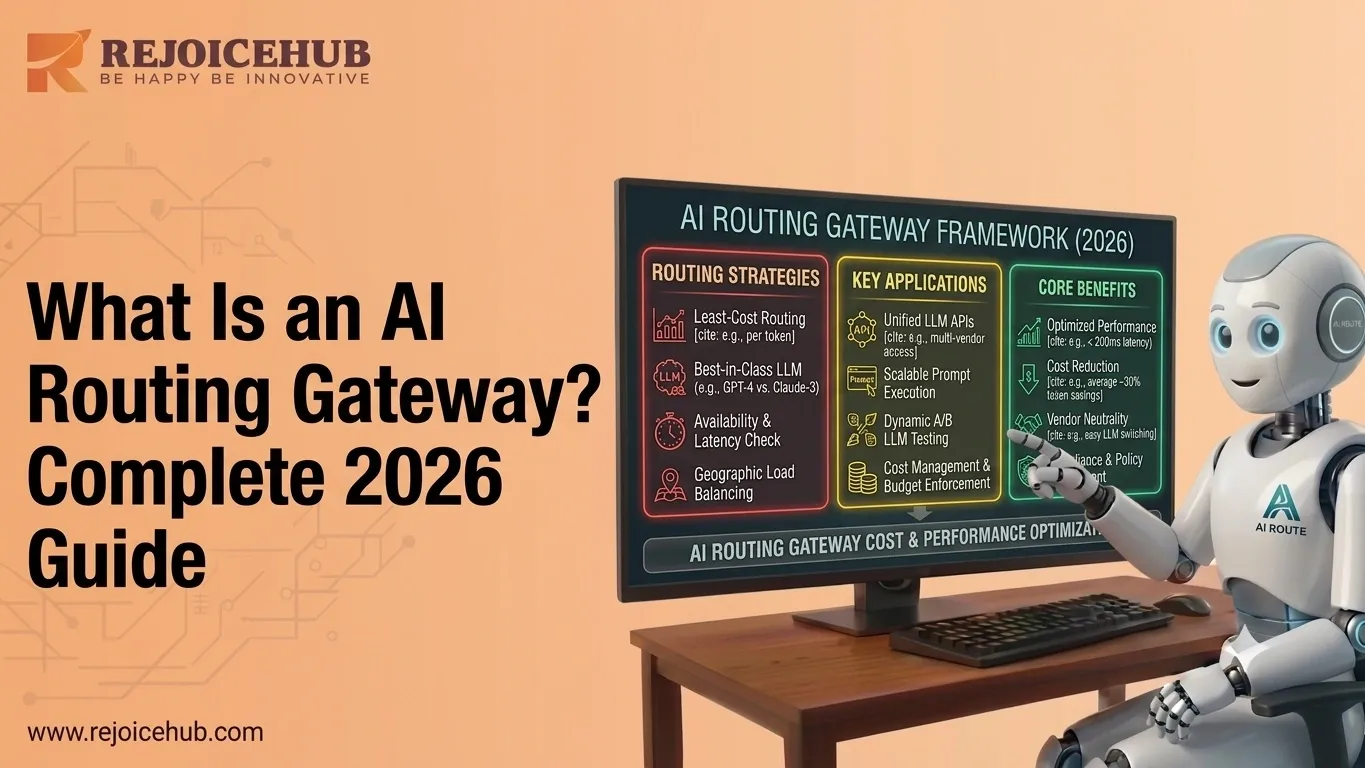
If your team uses more than one AI model GPT, Claude, Gemini, Llama, or a mix- you've likely encountered the problem of each provider having different costs, capabilities, and uptime. Picking one model means choosing between specific tradeoffs.
This is where an AI routing gateway comes in.
In this guide, you'll learn what an AI routing gateway is, how it works, what multi-provider model routing means for your business, and how an enterprise AI routing solution like OmniRoute helps companies reduce costs and increase performance.
By the end of this guide, you'll know how to think about routing as a critical part of your AI infrastructure.
The Rise of Multiple LLM Providers
Two years ago, most companies used a single AI provider. Today, that's rare.
Businesses now commonly run:
OpenAI's GPT models for general reasoning Anthropic's Claude models for long-context and safety-sensitive tasks Google's Gemini for multimodal work Open-source models like Llama or Mistral for cost control
Each provider updates pricing, rate limits, and model versions constantly. Relying on one vendor means every outage, price hike, or deprecation directly hits your product.
The Challenge of Choosing the Right AI Model
No single model wins at everything. A model that's excellent at code generation might be slower or pricier for simple customer support replies.
Common challenges teams face:
- Cost mismatch using an expensive frontier model for simple tasks
- Latency issues one provider is slow during peak hours
- Vendor lock-in your whole product breaks if one API goes down
- Quality drift a model update changes output quality overnight
Manually managing all of this writing custom logic to switch providers, tracking costs across dashboards, handling failovers becomes a full-time engineering job, which is one of the reasons more teams are relying on structured frameworks to measure AI ROI before scaling their model usage.
Why Routing Matters for Cost and Performance
In routing logic, the key difference is that instead of baking in one model into your product, you route each request through some routing logic that decides on the fly which model to use.
The result:
Simple queries go to cheaper, faster models Complex reasoning goes to premium models If a provider goes down, traffic automatically shifts elsewhere You pay for the right level of intelligence, not a flat premium rate every time
This isn't a "nice to have" anymore for companies running AI at scale, it's often the difference between a profitable AI feature and a costly one. Techniques like prompt caching can further reduce API costs when paired with smart routing decisions.
Introducing AI Routing Gateways and OmniRoute
An AI routing gateway sits between your application and multiple LLM providers, intelligently directing each request to the best model available.
OmniRoute is a dynamic, multi-provider routing layer that allows enterprises to manage costs, latency, and reliability across multiple models without having to re-engineer their systems for each new model that emerges.
In the sections ahead, you'll learn:
What an AI routing gateway actually is and how it differs from a regular API gateway How routing decisions get made behind the scenes What multi-provider model routing looks like in practice How OmniRoute's architecture works Enterprise benefits and implementation best practices
What Is an AI Routing Gateway?
An AI routing gateway is a kind of software layer which helps to route your request to the most appropriate model supplier considering several variables e. g. , price, performance, quality and availability.
Instead of making requests to the AI providers directly and disturbing them, your application will be sending the request to the gateway which will be the one to decide which provider is the most suitable for your needs.
Purpose
The core purpose of an AI routing gateway is to remove the guesswork (and manual engineering) from using multiple AI models. It handles:
Model selection Cost control Failover and redundancy Performance monitoring
Key Components
A typical AI routing gateway includes:
| Component | Function |
|---|---|
| Request analyzer | Reads intent, complexity, and context of each request |
| Routing engine | Applies rules or ML-based logic to pick a model |
| Provider connectors | Standardized integrations with each LLM API |
| Monitoring layer | Tracks latency, cost, and error rates in real time |
| Fallback system | Reroutes traffic if a provider fails or slows down |
Accelerate Your Workflows with Custom AI
Book a free consultation session with RejoiceHub. We'll map out a tailored automation roadmap for your company.
How It Differs from Traditional API Gateways
A traditional API gateway routes requests based on fixed criteria such as URL path, authentication, rate limits, etc. An AI routing gateway analyzes the request and determines the most appropriate API based on the complexity of the request and the desired balance between accuracy and cost.
Enterprise Benefits
For enterprises, this means:
One integration point instead of managing five provider APIs Consistent uptime even if one vendor has an outage Centralized cost visibility across all AI spend Easier compliance and governance across models, which ties directly into broader AI agent governance and verification frameworks enterprises are now expected to maintain
How AI Routing Gateways Work
Every incoming request is evaluated for:
- Task type (simple Q&A vs. complex reasoning vs. code generation)
- Required context length
- Latency sensitivity
- Historical cost/performance data for similar requests, an approach closely related to what's often called context engineering in AI systems
1. Intelligent Model Selection
Based on that analysis, the routing engine picks a model using a mix of:
- Predefined rules ("route all summarization tasks to Model A")
- Real-time performance data ("Model B is currently slower reroute")
- Cost thresholds ("stay under $X per 1,000 requests")
2. Response Optimization
Once a model responds, the gateway can:
- Validate output quality
- Retry with a different model if the response fails quality checks
- Cache common responses to reduce repeat costs
3. Continuous Monitoring
The system constantly tracks:
- Latency per provider
- Error rates
- Cost per request
- Output quality scores
This feedback loop is what makes routing "intelligent" rather than static — decisions improve over time based on real data.
Simplified routing workflow:
User Request │ ▼ [ Request Analyzer ] → classifies task type, complexity, urgency │ ▼ [ Routing Engine ] → checks rules + live provider performance │ ▼ [ Selected Model: GPT / Claude / Gemini / Open-source ] │ ▼ [ Response Optimizer ] → validates quality, retries if needed │ ▼ [ Monitoring Layer ] → logs cost, latency, accuracy for next decision │ ▼ Final Response to User
Multi-Provider Model Routing Explained
-
What It Is
Multi-provider model routing is the practice of distributing AI requests across two or more LLM providers based on defined criteria rather than depending on a single vendor for every request.
-
Why Organizations Use Multiple LLMs
- Specialization different models excel at different tasks
- Risk reduction no single point of failure
- Negotiating leverage avoiding total dependency on one vendor's pricing
- Speed routing to whichever provider currently responds fastest
-
Vendor Failover
If Provider A experiences downtime or a rate-limit spike, the gateway automatically shifts requests to Provider B often within milliseconds, and without any code changes on your end. This kind of resilience is increasingly built into modern multi-agent systems that depend on multiple models working together.
-
Cost Optimization
Not every task needs your most expensive model. Multi-provider routing lets you send:
High-stakes, complex tasks → premium models Routine, high-volume tasks → cheaper or open-source models
This alone can cut AI spend significantly for high-traffic products, which is why understanding the true cost of building and running AI agents matters before scaling any deployment.
-
Quality-Based Routing
Some gateways continuously score model outputs and route future similar requests to whichever model is currently performing best adjusting automatically as models get updated.
OmniRoute Explained
1. What OmniRoute Is
OmniRoute is a multi-provider AI routing system built to give enterprises one unified layer for managing traffic across multiple LLMs without locking them into a single vendor.
2. Core Architecture
OmniRoute is built around three layers:
- Ingestion layer receives and standardizes requests from any application
- Decision layer the dynamic routing engine that selects the optimal model
- Provider layer normalized connectors to major LLM APIs and open-source models, similar in spirit to - - how AI agent orchestration platforms coordinate multiple tools and models under one system
3. Dynamic Routing Engine
Unlike static rule-based routers, OmniRoute's engine continuously adjusts based on:
- Live latency and cost data
- Historical model performance for specific task types
- Custom business rules (e.g., "never send customer PII to Provider X"), which reflects the growing emphasis on data privacy considerations for AI executives
4. Performance Optimization
OmniRoute reduces average response time by routing around slow or overloaded providers automatically, and reduces cost by matching task complexity to the cheapest capable model.
5. Enterprise Use Cases
- Customer support platforms routing simple tickets to a low-cost model and escalations to a premium one
- SaaS products blending multiple models to control margins as usage scales
- Regulated industries enforcing which models can process sensitive data, a concern that overlaps heavily with enterprise AI agent security best practices
Enterprise Benefits of AI Routing Gateways
| Benefit | How It Helps |
|---|---|
| Lower AI costs | Match request complexity to the cheapest capable model |
| Better latency | Route around slow or overloaded providers in real time |
| Higher reliability | Automatic failover prevents downtime from a single vendor |
| Scalability | Add new models/providers without rebuilding your stack |
| Governance | Centralized control over which models can be used, and when |
| Security | Enforce data-handling rules per provider (e.g., no PII to certain APIs) |
For growing SaaS companies, this translates directly into better margins on AI-powered features something that matters a lot once usage scales past a few thousand users, and it's worth running a business AI readiness assessment before committing to a full routing architecture.
Best Practices for Implementing AI Routing
If you're planning to adopt an AI routing gateway, keep these practices in mind:
- Define clear routing policies decide upfront which task types map to which models, and under what cost ceilings.
- Monitor models continuously track latency, error rates, and output quality per provider, not just uptime.
- Track cost per request, not just total spend this reveals which task types are quietly expensive.
- Build fallback strategies for every provider assume any single vendor can go down, and plan the reroute in advance.
- Apply security controls per provider not all models should receive the same data; enforce this at the routing layer.
- Use performance analytics to refine routing rules over time routing should get smarter as you collect more data, not stay static, an approach that mirrors broader AI process automation strategies enterprises are adopting.
Conclusion
AI routing gateways help organizations intelligently distribute AI requests across multiple models to improve performance, reduce costs, and increase reliability. As enterprises adopt more AI providers, solutions like OmniRoute and multi-provider routing become essential for scalable, future-ready AI infrastructure.
Instead of betting your entire product on one AI vendor, a routing layer lets you use the right model for the right task automatically, and at scale. If you're evaluating specialists to help implement this, it's worth reviewing trusted MCP consulting partners who understand both the routing and integration layers involved.
Looking to build scalable AI infrastructure? RejoiceHub can help you design and implement intelligent AI routing, multi-model orchestration, and enterprise AI solutions tailored to your business needs.
Frequently Asked Questions
1. What is an AI routing gateway?
An AI routing gateway is a software layer that sits between your app and multiple AI providers like GPT, Claude, or Gemini. It picks the best model for each request based on cost, speed, and quality, so you don't have to choose just one provider.
2. How does an AI routing gateway work?
It works by checking each request first. The gateway looks at how complex the task is, then sends it to the model that fits best. Simple tasks go to cheaper models, while harder ones go to premium models, and if a provider fails, it switches automatically.
3. What is multi-provider model routing?
Multi-provider model routing means your requests are shared across different AI providers instead of relying on just one. It lets you use GPT for reasoning, Claude for long context, or Gemini for images, so you always get the right model for the right job.
4. Why do enterprises need an AI routing gateway?
Enterprises use an AI routing gateway to avoid vendor lock-in, cut down costs, and keep systems running even if one AI provider goes down. It also gives teams one place to track spending and performance across every model they use, saving time and effort.
5. How does AI model routing work?
AI model routing works by analyzing each request for intent and complexity, then applying rules or smart logic to choose the right model. It also tracks cost, speed, and errors in real time, so the system keeps improving how it picks a model.
6. What is the difference between an AI routing gateway and a regular API gateway?
A regular API gateway routes traffic based on fixed rules like URL or rate limits. An AI routing gateway is smarter; it looks at the actual request, checks its complexity, and picks the AI model that gives the best balance of cost and accuracy.
7. How does AI routing help reduce costs?
AI routing cuts costs by sending easy tasks to cheaper models and reserving the expensive ones for harder tasks. Instead of paying a high flat rate for every request, you pay only the amount each task really needs.