APIs have become the fundamental technology in the present-day connected digital world, mainly in software development and online services. For instance, APIs are the unnoticeable force behind numerous interactions people engage in each day, from booking a flight to getting weather updates on their mobile phones.
Consequently, gaining insight into APIs has turned out to be a must for everyone dealing with technology, business, or digital creativity. This all-inclusive guide takes you through the API, what it is, how it works, its different types, and most importantly, the reason for its being so crucial in our digital environment.
Quick Summary
An API (Application Programming Interface) is a collection of protocols that permits the interactions and data exchanges between various software applications. Consider it a courier service that collects requests, informs the system what you want, and delivers the response.
APIs are the way that developers use to incorporate third-party services, have access to data, and create powerful applications that do not need to be built from scratch. This article discusses API basics, different types, main advantages, and even real-life cases where their revolutionary effect on technology is illustrated.
What is an API?
An API, or Application Programming Interface, acts as a connector among software applications with differing purposes. It describes the ways and formats of data that can be utilized by applications to make requests and send information to each other.
Thinking of ordering food at a restaurant: the waiter receives your order from you, goes to the kitchen, and comes back with your meal. Similarly, an API sends your request to a system and retrieves the necessary data or service, then returns it to your application in a format suitable for use.
What Does API Stand For?
API is short for Application Programming Interface. Dissecting this term gives us an insight into the real functionality of APIs. The term "application" is representative of any software that performs a definite task, be it a mobile application, a web service, or a desktop software program.
The term "programming" signifies the coding and the commands that are provided by the developers in order to construct these applications. "Interface" indicates the place where two different systems meet and have a mutual interaction.
How Do APIs Work?
Now we'll discuss the working procedure of the API that can help you to easily understand what the API describes and the working terminology that can also be useful for beginner to advanced users.
-
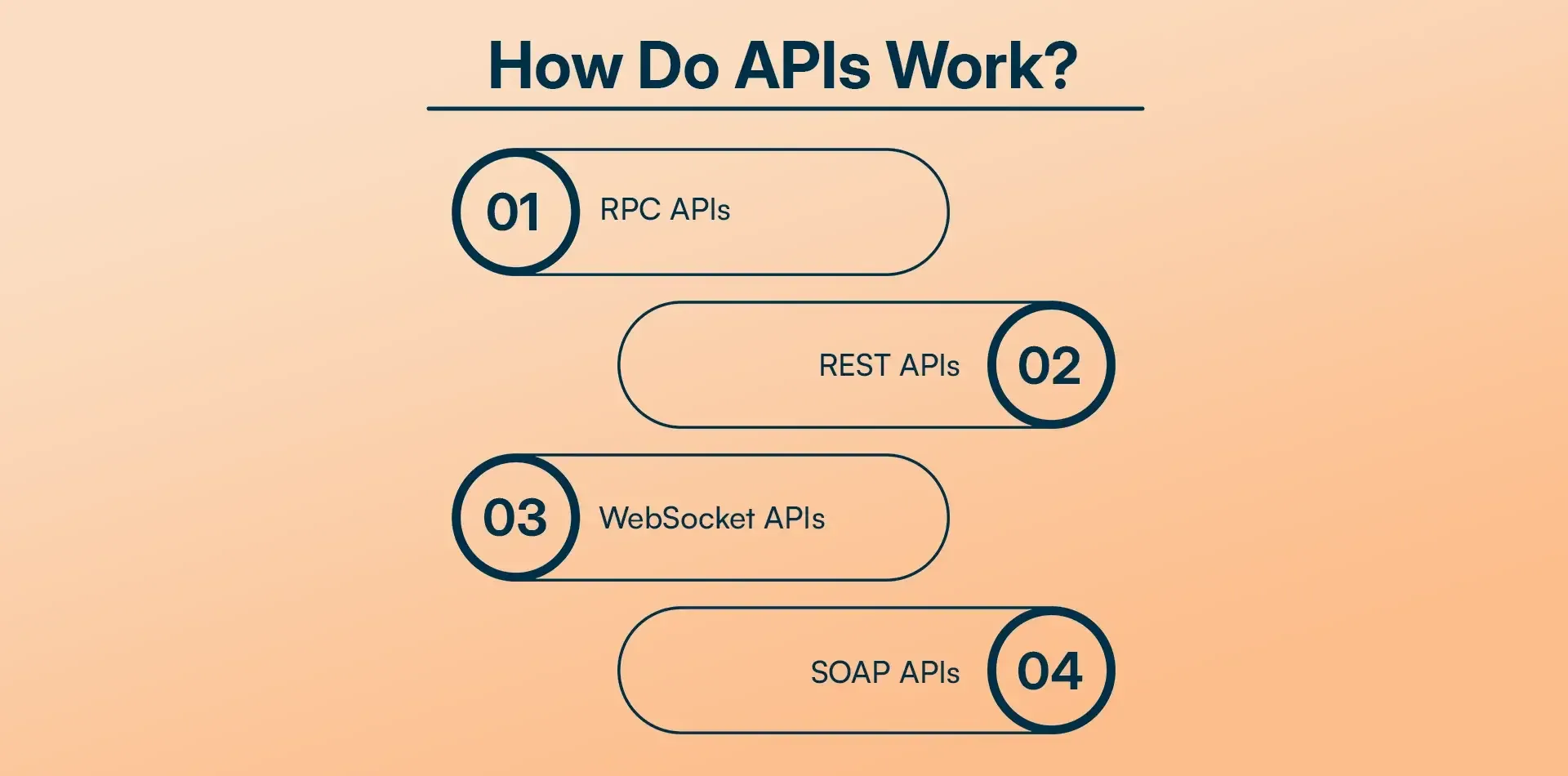
RPC APIs
RPC (Remote Procedure Call) APIs give an infrastructure for conducting operations or functions on remote servers as traditional local ones without any hiccups. The client who issues an RPC call will have the request wrapped and dispatched to the server for function execution, and subsequently, the server will return the output. This technique creates the sensation of doing the work on a single computer despite all the machines being together in distributed computing.
-
REST APIs
Representational State Transfer APIs, or simply REST APIs, have been the most preferred API architecture for a long time, and they are the ones that are mostly used in the background of the web services that you access daily. The standard HTTP actions, such as GET, which is used for fetching data; POST for creating new resources; PUT for updating the existing ones; and DELETE for removing the resources, are the basic operations applied in these systems.
-
WebSocket APIs
The WebSocket APIs facilitate quick, bi-directional interaction between server and clients through a single, continuous link. In contrast to classic APIs that need multiple requests to ascertain if there are any updates, WebSockets keep an open connection that allows immediate transfer of information both ways. The use of this durable connection results in a significant reduction of both overhead and latency.
-
SOAP APIs
SOAP (Simple Object Access Protocol) APIs are characterized by XML-based messaging protocols as the means of communication between systems and the structure of information that they exchange. They adhere to very strict standards along with error handling, security, and transaction support, which all together make them very dependable for critical applications. The SOAP specification is so detailed that it can guarantee uniformity and familiarity across different implementations.
Different Types of APIs
APIs can be categorized into different classes depending on their availability and target users, with each class playing a separate role in the technology ecosystem. Knowing about these categories is helpful for companies to figure out the API strategy that is most aligned with their business objectives.
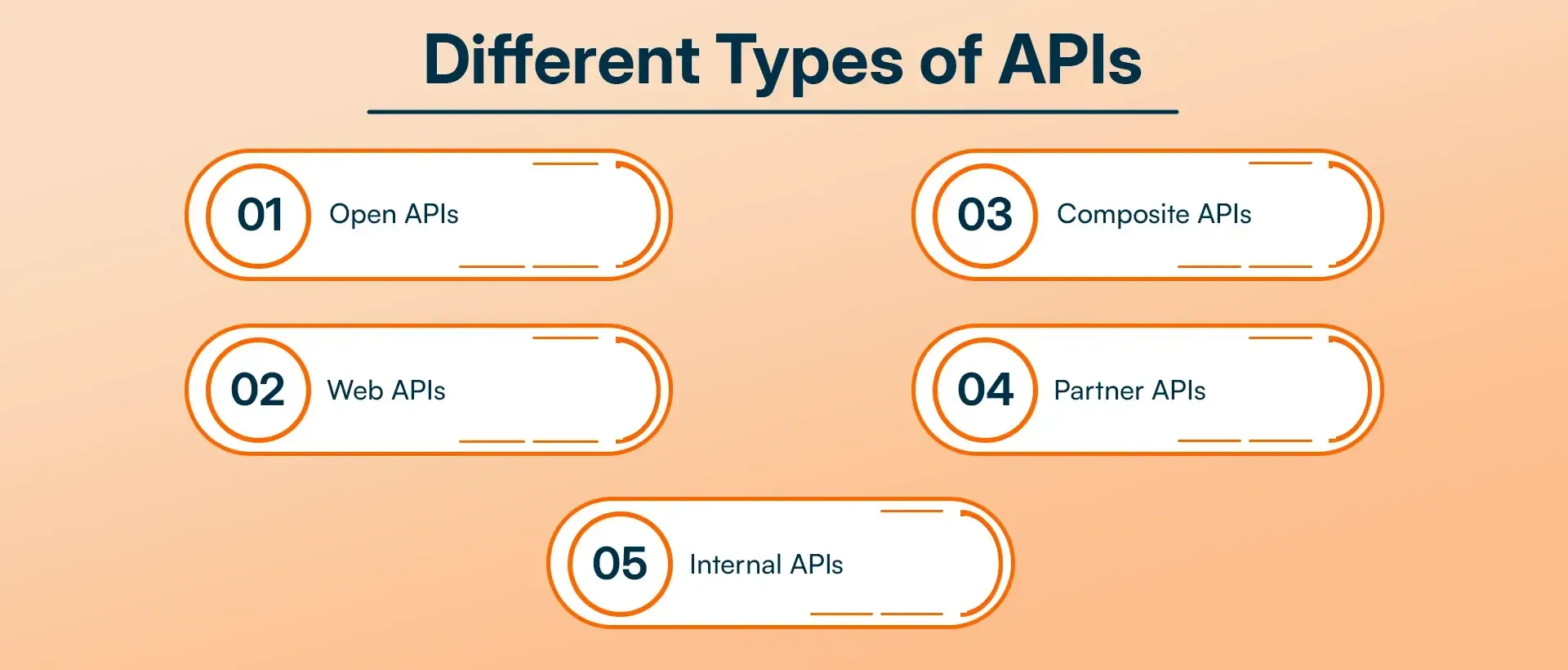
1. Open APIs
Open APIs, or public APIs, are accessible with very few limitations to outside developers. By doing so, companies such as Google, Twitter, and weather services are not only promoting innovation but also getting their platforms to reach wider. Often, developers can get access to these APIs through simple registration, which is usually free or has very liberal free tiers allowing considerable usage before any fees are incurred.
2. Web APIs
Web APIs are used through the internet using HTTP protocols, so they are not tied to any specific platform and can be easily accessed through any device or programming language that can perform HTTP requests. By allowing the frontend user interfaces to communicate with the backend servers, they are the ones who are operating the modern web applications, thus taking care of everything from simple data fetch to intricate business logic processing.
3. Composite APIs
Composite APIs integrate numerous API requests, thus making a single one that solves one of the most significant performance problems in distributed systems. Developers can perform multiple operations via one call that combines all the needed data at once, instead of making several separate requests to different endpoints requiring multiple network round-trips.
4. Partner APIs
Partner APIs are intentionally partnered with certain business partners through negotiated agreements, thus establishing controlled environments that manage the trade-off between openness and security. They do not have public access; however, they are not as strictly controlled as internal APIs. They would rather occupy a point that allows for the implementation of strategic business relationships. Companies are able to use partner APIs to make B2B integrations easier and also for joint value creation.
5. Internal APIs
Internal Application Programming Interfaces (APIs), or private APIs, are only meant for intra-organizational use, linking various internal systems, services, and teams. They allow departments and projects to share data efficiently and reuse functions across the board. Internal APIs speed up the development process by enabling teams to use the existing capabilities instead of creating common functionalities from scratch again and again.
Also Read: What Is Vibe Coding? Benefits, Limitations & Best Practices
Key Benefits of API
APIs deliver transformative advantages that extend far beyond simple system integration, fundamentally changing how organizations build and deliver digital products. They've become strategic assets enabling digital transformation, competitive differentiation, and entirely new business models.
-
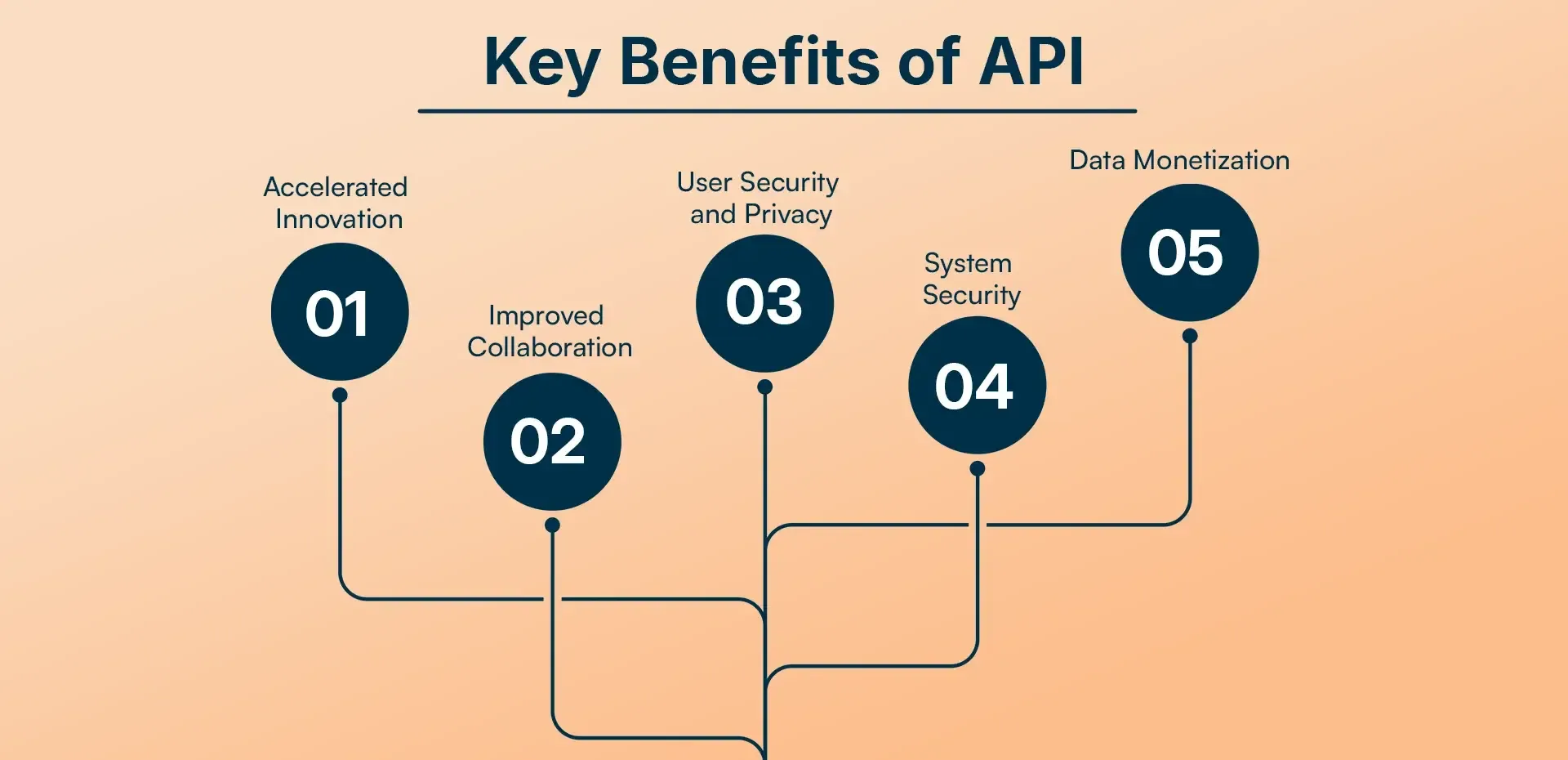
Accelerated Innovation
The use of APIs greatly enhances the development process by offering functionalities already made that the developers can easily integrate instead of taking the whole process of weeks or months to build the functionalities from the ground up. The development teams use APIs that are already in place for services like payments, authentication, maps, analytics, and many more. This practice enables the teams to direct their resources to the unique features that set their products apart instead of using them for the development of common capabilities that the market already has.
-
Improved Collaboration
Through clear contracts that specify how different systems communicate with one another, APIs eliminate the barriers that exist between various teams, departments, and even companies. They make it possible for parallel development, where the different teams can simultaneously work on their own components while still ensuring that everything will fit together.
-
User Security and Privacy
Today's APIs utilize strong authentication and authorization methods that not only secure user information but also allow major integrations to take place. OAuth, API keys, and token-based authentication techniques are some of the security measures put in place to ensure that only the right users and apps have access to delicate data. Through APIs, very detailed permission management is provided to users; thus, they can selectively share particular data with third-party apps without revealing the whole account or profile.
-
System Security
APIs grant monitored entry points into the systems, thus considerably lessening the areas vulnerable to attacks in comparison with methods such as direct database access. Along with that, they apply several security measures like authenticity checks to establish who you are, permissions checks to allow or not allow you, data scrambling to keep information confidential, and validation of the input to block requests that are harmful. This layered security strategy guarantees that the security of the system is not reliant on one single method.
-
Data Monetization
APIs are one of the new revenue streams, which sell customer-accessible data and functionalities as products ready for programmatic access. Organizations monetize APIs in different ways, such as subscription tiers, pay-per-use pricing, freemium approaches with premium features, transaction fees, etc. This way, data assets are turned into high-margin recurring revenue sources, as the cost of distribution is very low.
Best Examples of API
Real-world API applications demonstrate their versatility and transformative impact across virtually every industry. These examples show how APIs enable seamless experiences, connect diverse systems that were never designed to work together, and power innovations that have become integral to daily life.
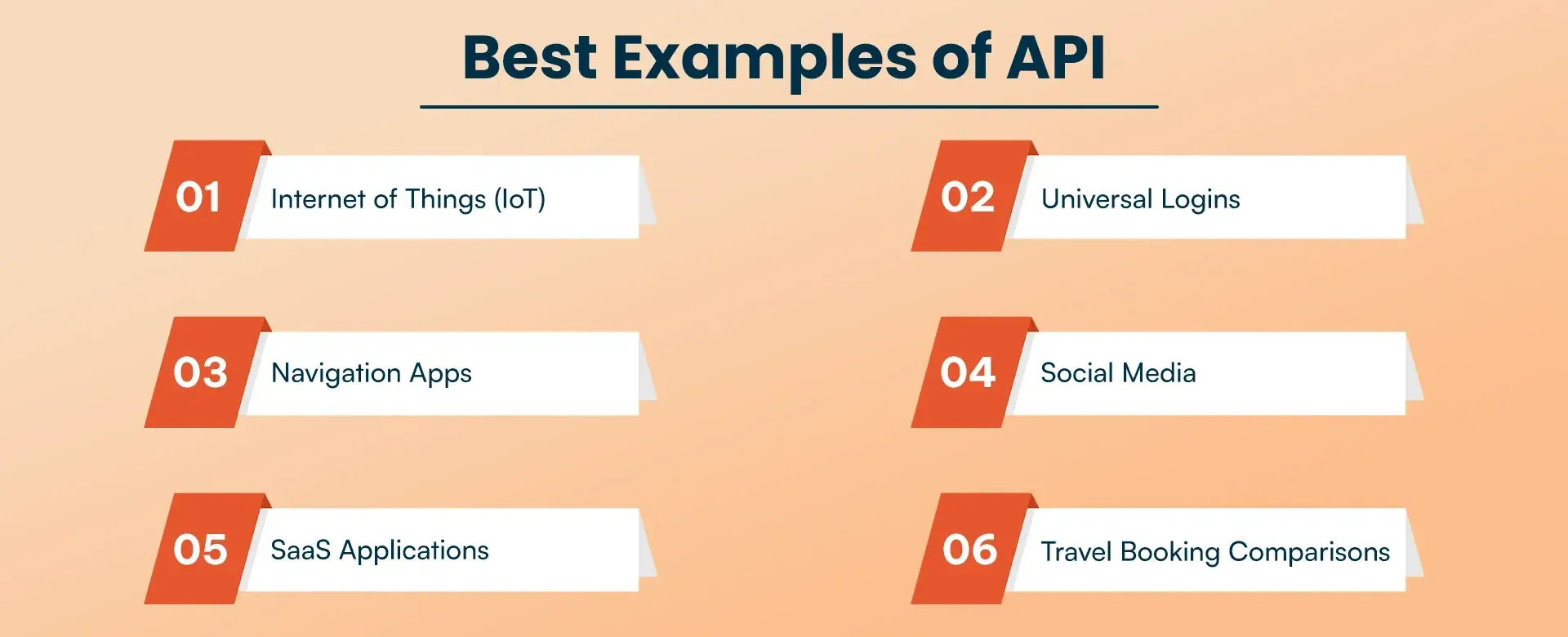
1. Internet of Things (IoT)
APIs are the first and foremost components in the communication and data-sharing of IoT devices among the networks of sensors, actuators, and control systems. Smart thermostats, fitness trackers, and home security systems are some examples of IoT that utilize APIs to transfer sensor data from their local environments to the cloud for processing, analysis, and storage. Mobile applications act as a bridge for users to access this information, as these apps are enabled by APIs to communicate with cloud services to fetch device status, view historical data, and send control commands.
2. Universal Logins
The buttons 'Sign in with Google' or 'Continue with Facebook' found on various sites throughout the internet can do so through OAuth APIs that provide universal authentication across websites and apps. Users do not have to create separate accounts with different passwords for each website, but instead, they use their trusted providers' existing credentials.
3. Navigation Apps
Google Maps and other similar navigation apps open up large-scale APIs to developers who use them in numerous applications and websites across sectors. These APIs allow geocoding to change addresses into coordinates, route calculation with traffic and road conditions taken into account, the provision of real-time traffic updates, the details of a place, including reviews and pictures, and elevation data.
4. Social Media
The social media platforms have made available a wide range of APIs, which offer content sharing, authentication, and data access, among other things, and these have become the mainstay for the entire ecosystem of third-party applications. Through the use of Twitter APIs, tweeting is made possible along with accessing user timelines, searching historical data, and even analyzing trends and sentiments.
5. SaaS Applications
The dependence of Software-as-a-Service platforms on APIs for integration is so high that they become no more than business tools. A perfect example is CRM systems like Salesforce, for instance, and project management software like Asana, along with communication tools like Slack, which all have powerful APIs that facilitate the automation of workflows and data sharing.
6. Travel Booking Comparisons
Using APIs to access inventory systems in real-time, travel comparison websites bring together flight alternatives, hotel occupancy, and car rental fees from different suppliers. For example, APIs from airlines and hotels are simultaneously being queried by Skyscanner, Kayak, and Booking.com, and showing the results in seconds, which would take hours to collect manually. These API orchestration techniques allow the platforms to manage millions of searches each day while still adhering to the rate limits and optimizing the response times.
Conclusion
APIs have changed the way software applications communicate with each other, thus allowing the connected digital experiences, which we now consider a normal part of our lives, to happen.
For businesses looking to adopt or scale these capabilities, RejoiceHub plays a key role by helping companies implement robust API strategies that enhance digital performance and interoperability. Understanding the concept of APIs, how they work, and the different categories they fall into is now essential for anyone involved in technology or business.
Frequently Asked Questions
1. What is a PI in simple terms?
An API is like a waiter in a restaurant, it takes your request to the kitchen (the system) and brings back what you ordered (the data). It's essentially a messenger that allows different software programs to talk to each other and share information safely and efficiently.
2. What are the most common types of APIs?
The most common types include REST APIs, which are lightweight and flexible; SOAP APIs, which are secure and reliable for enterprise use; RPC APIs for simple function calls; and WebSocket APIs for real-time communication. REST APIs dominate modern web development due to their simplicity and scalability.
3. Why do developers use APIs?
Developers use APIs to save time, avoid reinventing the wheel, and access powerful functionality without building everything from scratch. APIs enable rapid development, reduce costs, ensure reliability through tested services, and allow development teams to focus on unique product features that differentiate their offerings.
4. Are APIs secure?
Well-designed APIs implement multiple security layers, including authentication, encryption, authorization, and input validation. However, security depends entirely on proper implementation and ongoing maintenance. Organizations must follow best practices, conduct regular security audits, use API gateways, and keep systems updated to maintain strong security.
5. Can anyone use an API?
It depends on the API type. Open APIs are publicly available with minimal restrictions, though they usually require registration. Partner APIs require business agreements and specific authorization. Internal APIs are restricted to organization members. Most APIs require access keys for tracking and security, with usage often subject to rate limits and terms of service agreements.