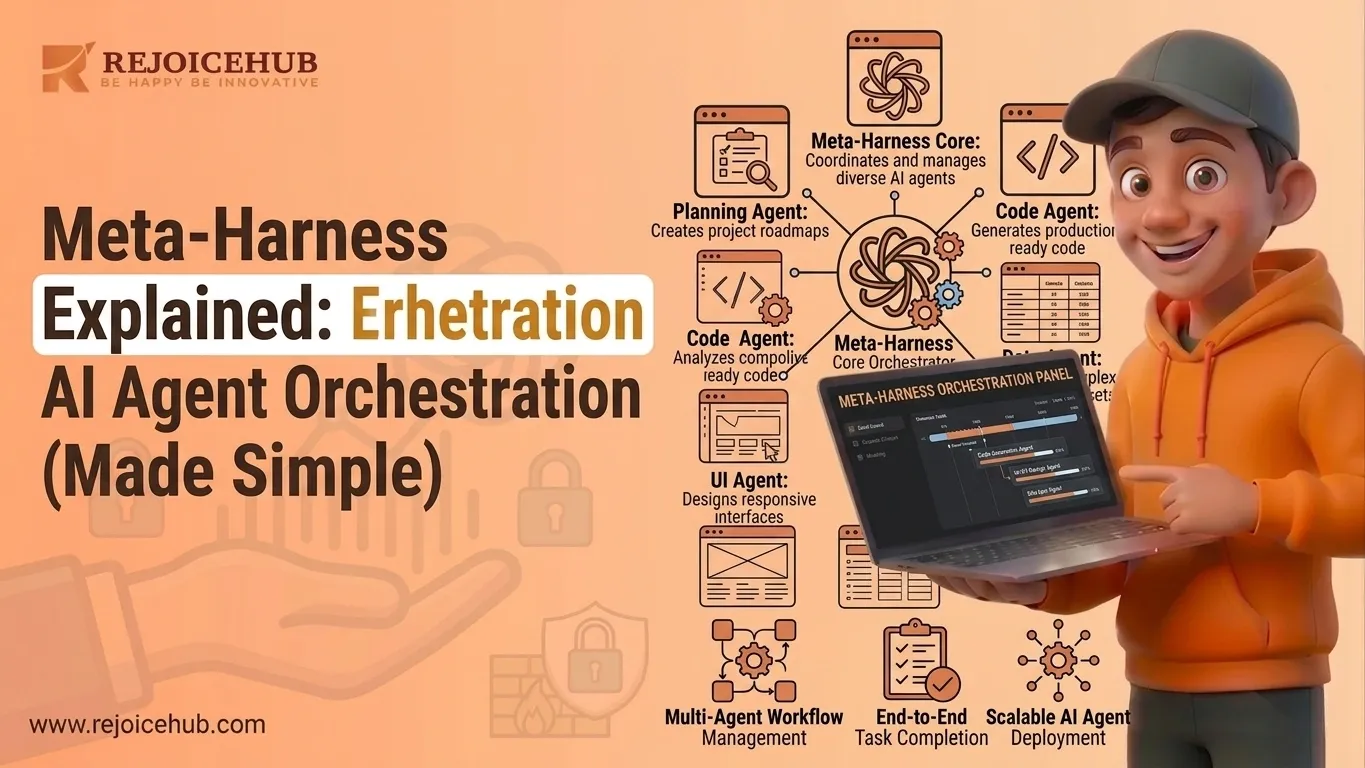
AI agents aren't some futuristic story anymore; they are actually running inside real businesses right now. Like automated customer support and also clever data pipelines, companies across the USA are deploying these AI agents to deal with stuff that is complex and multi-step. If you want to understand the bigger picture of how this technology is evolving, it helps to first look at what AI agents actually are and how they work in business.
But then again, the issue is that coordinating multiple agents gets messy. Once you've got five, ten, or fifty agents running at the same time, each one with its own tools, its own memory, and its own decision logic, it all kinda falls apart quickly. That's pretty much why Meta-Harness is getting traction as the go-to AI agent orchestration layer for enterprise teams, you know.
In this post, you'll see what Meta-Harness is, how it runs under the hood, how it measures up against other frameworks, and why it might end up being the default infrastructure layer for AI-powered businesses.
What Is Meta-Harness?
Meta-Harness is basically an AI agent orchestration framework, meant to coordinate, run, and improve multiple AI agents at the same time inside one unified system, sort of like a whole team that doesn't get lost.
Think of it like this: if single AI agents are employees, then Meta-Harness is the operations manager. It assigns tasks, handles shared resources, watches the progress, and makes sure everything stays in sync with some kind of business goal. You know, aligned, but not in a stiff way.
More precisely, Meta-Harness works like an operating system for AI agents. Just as an OS manages processes, memory, and I/O across a computer, Meta-Harness manages agent coordination, shared memory, tool access, and workflow execution across an AI ecosystem.
Why does it exist?
As organizations scale their AI agent deployments for business automation, three core problems emerge:
- Coordination failures: Agents duplicate work or contradict each other
- Context loss: Agents don't share memory, so context is lost between steps
- Governance gaps: There's no visibility into what agents are doing or why
Meta-Harness was built to solve all three. It gives teams a single control layer to orchestrate multi-agent workflows, enforce policies, and scale with confidence.
How Meta-Harness Works
1. Agent Coordination
At the core of Meta-Harness, there is an intelligent coordination engine that sort of decides who should take which task, in what order, and with what level of urgency.
Instead of letting the agents run on their own, Meta-Harness treats them like a real group. The coordinator hands out roles as things change, depending on the agent capabilities, the current workload, and what the task actually needs, kinda like how a project manager might spread responsibilities across a team.
2. Shared Memory
One of the biggest weaknesses of standalone AI agents is memory. Without a shared memory layer, agents lose context between tasks, which leads to repetitive work and inconsistent outputs.
Meta-Harness introduces a shared memory store accessible to all agents in the ecosystem. This means:
- Agent A's research findings are instantly available to Agent B
- Historical context persists across sessions
- Agents build on each other's outputs instead of starting from scratch
3. Tool Management
Different agents often need different tools, like a web scraper, a database query engine, an email sender, or a CRM API. Without some orchestration, each agent ends up handling its own tool connections, and that makes redundancy show up fast and also increases security risks.
Meta-Harness provides a centralized tool registry. Agents ask for tools through the orchestration layer, so the system handles authentication, rate limiting, and access control all in one spot. This is closely related to how the Model Context Protocol standardizes tool access for AI systems.
4. Decision Routing
Not every task should just land on the same agent, you know. Meta-Harness has intelligent decision-routing capabilities that evaluate incoming work and send it to the most fitting agent, based on specialization, current availability, and performance history.
So it helps dodge bottlenecks and makes sure the right agent is always doing the right job.
5. Workflow Automation
Meta-Harness allows teams to define multi-step workflows where agents hand off tasks automatically. These workflows can be conditional, parallel, or sequential, giving businesses the flexibility to model complex real-world processes. To get a deeper sense of how these kinds of agentic AI workflows are structured, it's worth understanding the design patterns behind them.
6. Simple Workflow Example
Here's how a B2B sales team might use Meta-Harness:
- Trigger: New lead enters CRM
- Research Agent pulls company data, LinkedIn profile, and recent news
- Scoring Agent evaluates the lead against the ICP criteria using shared memory
- Personalization Agent drafts a tailored outreach email using the lead context
- QA Agent reviews the draft for tone and compliance
- Send Agent delivers the email via the tool registry's email connector
All five agents run under one orchestration layer, coordinated, context-aware, and fully auditable.
How Is Meta-Harness Different from Traditional AI Frameworks?
The AI agent tooling space is crowded. Here's how Meta-Harness compares to the most widely used alternatives:
| Framework | Primary Use Case | Multi-Agent Support | Shared Memory | Tool Management | Governance & Auditing |
|---|---|---|---|---|---|
| Meta-Harness | Enterprise multi-agent orchestration | Native | Built-in | Centralized | Full visibility |
| LangChain | Chaining LLM calls and tools | Limited | Manual setup | Per-agent | Minimal |
| CrewAI | Role-based agent teams | Yes | Basic | Per-agent | Limited |
| AutoGen | Conversational multi-agent | Yes | Basic | Manual | Limited |
| Semantic Kernel | Enterprise LLM integration | Plugin-based | Plugin-based | Plugin-based | Partial |
| Manual Orchestration | Custom-built pipelines | High effort | Custom build | Custom build | Very limited |
Key advantages of Meta-Harness:
- Purpose-built for orchestration: not retrofitted onto an LLM chaining tool
- Enterprise governance: audit trails, role-based access, and policy enforcement built in
- Centralized control: one layer manages all agents, tools, and memory
- Scalability by design: adding new agents doesn't require rewiring the entire system
LangChain and CrewAI are excellent for getting started with individual agents or small teams. But when you're scaling to production-grade, multi-agent systems, the gaps become costly in engineering time, debugging effort, and operational risk.
Accelerate Your Workflows with Custom AI
Book a free consultation session with RejoiceHub. We'll map out a tailored automation roadmap for your company.
Benefits of AI Agent Orchestration
Whether you're a startup founder or an enterprise CTO, orchestration delivers measurable value across every AI initiative.
-
Better Scalability
Without orchestration, adding a new agent often means rebuilding integrations from scratch. With Meta-Harness, new agents plug into an existing framework, scaling your AI capabilities without scaling your technical debt. This is especially relevant as the AI agent infrastructure market continues to mature and enterprise demands increase.
-
Faster Execution
Parallel agent coordination means the stuff that would take hours when done one after another can get wrapped up in minutes. In a way, Meta-Harness makes it possible for real concurrent running across the agent groups, so the time until you see output drops pretty fast.
-
Reusable Workflows
Define a workflow once, then reuse it across client departments or various use cases. With Meta-Harness, workflows are treated like templates, so your sales automation workflow can be remapped for onboarding, support, or operations with only minor changes.
-
Reduced Complexity
Managing ten separate agent environments is a DevOps nightmare. Meta-Harness consolidates tool connections, memory layers, and agent configs into a single system, dramatically reducing operational overhead. Teams looking to deploy AI agents without a dedicated ML team will find this especially valuable.
-
Improved Governance
Enterprise buyers and compliance teams need visibility. Meta-Harness provides full audit trails for every agent action — every tool call and decision is logged, traceable, and reportable. This is non-negotiable for regulated industries like finance, healthcare, and legal.
-
Enterprise Readiness
Meta-Harness is designed for production deployments, not just prototypes. It includes role-based access control, environment separation (dev/staging/prod), and SLA-aware routing, making it suitable for large-scale enterprise rollouts.
Why Meta-Harness Could Become the Standard AI Layer
Several converging trends are pushing AI orchestration from "nice to have" to "must have" infrastructure.
1. The Rise of Enterprise AI
Major enterprises are no longer experimenting with AI they're embedding it into core workflows. As AI moves from pilot projects to mission-critical systems, the need for reliable, governed orchestration grows exponentially. Meta-Harness is positioned to serve exactly this need. Understanding how to build an AI agent stack for business is increasingly becoming a core competency for technology leaders.
2. Multi-Agent Ecosystems Are Becoming the Norm
Single-agent systems have a limited scope. The most powerful AI applications such as autonomous research, end-to-end sales automation, and intelligent operations require teams of specialized agents working together. Orchestration is the connective tissue that makes these ecosystems functional.
3. AI Governance Is No Longer Optional
Regulatory pressure around AI accountability is increasing across the USA and globally. Businesses need to demonstrate that their AI systems operate within defined boundaries, with explainable decisions and auditable outputs. Meta-Harness's built-in governance layer addresses this directly.
4. Future AI Architecture Favors Modularity
The direction of AI development is modular smaller, specialized models and agents that do one thing extremely well. An orchestration layer like Meta-Harness enables businesses to mix and match the best agents for each task, rather than being locked into a monolithic system. This mirrors the broader shift discussed in the comparison between AI agents and traditional SaaS tools.
As these trends mature, the companies that invest in orchestration infrastructure today will be positioned to scale faster, more safely, and at lower cost than competitors who build point solutions.
If you're planning to scale AI agent systems for your business, now is the right time to evaluate your orchestration strategy before technical debt accumulates.
Conclusion
AI agents are getting to be a competitive necessity, somehow, and deploying them without orchestration is sort of like leading a crew without a manager. It gets messy, is not too efficient, and it does not scale well, you know? Meta-Harness is the coordination layer that multi-agent setups actually require if they want to run reliably even at enterprise scale.
It includes shared memory that everyone can use, centralized tool handling, more thoughtful decision routing, and governance that is built in from the start. So it tackles the main issues that usually hold AI rollouts back.
Before you scale your AI efforts, take a moment and evaluate your orchestration approach. A solid foundation makes each agent feel sharper, pushes every workflow along quicker, and makes each deployment more defensible.
Looking to build scalable AI agent solutions? Explore RejoiceHub's AI Agent Development Services to design secure, enterprise-ready multi-agent systems tailored to your business.
Frequently Asked Questions
1. What is Meta-Harness, and what does it do?
Meta-Harness is an AI agent orchestration framework that helps coordinate multiple AI agents working together. It handles task assignment, shared memory, tool access, and workflow automation from a single central layer, so your agents work as a team rather than in isolation.
2. How is Meta-Harness different from traditional AI frameworks?
Unlike tools like LangChain or CrewAI that were built for single-agent or small-team use, Meta-Harness is purpose-built for enterprise multi-agent orchestration. It includes built-in shared memory, centralized tool management, and full governance, which other frameworks require you to build manually.
3. What does AI agent orchestration actually mean?
AI agent orchestration means managing multiple AI agents so they work together without conflicts. Instead of each agent running on its own, an orchestration layer like Meta-Harness coordinates tasks, shares context between agents, and keeps everything aligned toward one business goal.
4. Who should use Meta-Harness for their AI agent setup?
Any business running more than one or two AI agents will benefit from Meta-Harness. It's especially useful for enterprise teams in sales, operations, or customer support where multiple agents need to hand off tasks, share context, and follow consistent rules without constant manual oversight.
5. What are the main benefits of using AI agent orchestration?
The biggest benefits include faster task execution through parallel agents, reusable workflows, reduced operational complexity, and better governance. With Meta-Harness, you're not rebuilding integrations every time you add a new agent; everything plugs into one existing, scalable system.
6. Can Meta-Harness work with tools like CRMs or email platforms?
Yes. Meta-Harness includes a centralized tool registry where agents can request access to external tools like CRMs, email senders, and database APIs. It handles authentication and rate limiting in one place, so you don't have separate tool connections scattered across different agents.
7. Is Meta-Harness suitable for regulated industries like finance or healthcare?
Absolutely. Meta-Harness was built with enterprise governance in mind. Every agent action, tool call, and decision is logged and traceable. This makes it a strong fit for regulated industries where businesses must show that their AI systems operate within clear, auditable boundaries.