What if you could handle 10 jobs simultaneously without needing 10 employees?
This is what Anthropic's new release of Claude Opus 4.8 dynamic workflows achieves for us.
Claude Opus 4.8 is not just another version of an improved AI tool. It introduces a completely new workflow process by enabling users to utilize parallel subagents to complete various tasks within a project faster than ever before.
If you're a startup founder, SaaS team member, or operations manager this is for you.
In this article, we'll explore the concept of parallel subagents in detail, understand how they operate in practice, and discuss their importance in the future.
What Is Claude Opus 4.8? A Quick Overview
Claude Opus 4.8 is Anthropic's most capable AI model to date, designed specifically for complex, multi-step reasoning and autonomous task execution.
What makes it different from previous versions?
- Extended thinking: It reasons through problems before responding
- Tool use: It can browse the web, write code, and call APIs
- Multi-agent support: It can spawn and coordinate parallel subagents
- Higher accuracy: Significantly fewer errors on complex tasks
This isn't just a chatbot upgrade. It's the foundation for AI workflow automation at scale.
What Are Parallel Subagents? (Simple Explanation)
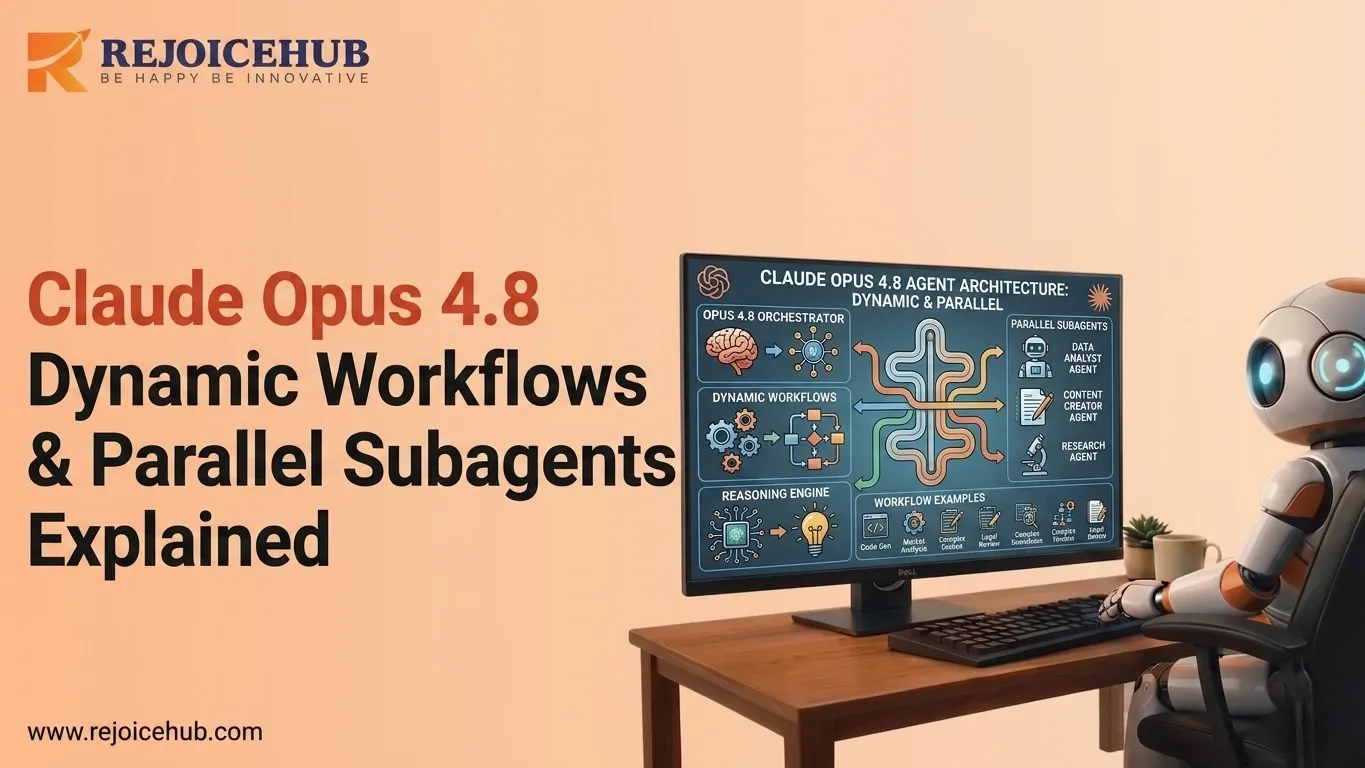
Here's the key concept: instead of doing one thing at a time, Claude Opus 4.8 can create multiple AI subagents that work simultaneously.
Imagine it being like a project manager that:
- Gets a huge task
- Splits it up into little bits
- Gives each bit to another person
- Brings together everything
It's just what the AI sub-agents do in Claude Opus 4.8.
Traditional AI Workflow vs. Dynamic Workflow
| Feature | Traditional AI | Claude Opus 4.8 Dynamic Workflows |
|---|---|---|
| Task execution | Sequential (one at a time) | Parallel (many at once) |
| Speed | Slower | Significantly faster |
| Complexity handled | Medium | High |
| Agent coordination | None | Built-in |
| Real-world use | Chatbot-style replies | End-to-end project execution |
What Are Parallel Subagents? A Plain-English Explanation
Here's the concept in simple terms.
Traditionally, AI models work sequentially one task, then the next, then the next. Like a single employee working through a to-do list.
Parallel subagents change that entirely.
When Claude Opus 4.8 receives a complex task, it:
- Breaks it into subtasks: each discrete piece of work
- Spins up individual subagents: one per subtask
- Runs all subagents simultaneously: in parallel, not sequentially
- Synthesizes the results: combining outputs into a unified final deliverable
The metaphor that fits best: it's like having a senior team lead who can instantly delegate work across an entire department — and get everything back in hours instead of days.
How Parallel Subagents Work in Real Projects
Let's get practical. Here's how multi-agent AI systems powered by Claude Opus 4.8 handle real-world scenarios.
Example 1: Content Marketing Team (SaaS Company)
The Assignment: Create 10 SEO blog articles for the week.
If using no AI sub-agents:
- Just one writer working on one article at a time
- That takes days or weeks to complete
When using 12 parallel Claude Opus 4.8 sub-agents:
- Sub-agent 1: Research keywords for all 10 articles
- Sub-agents 2–11: Write 10 articles simultaneously
- Sub-agent 12: Edit and proofread all articles together
Output: Finish all 10 articles in hours, not weeks.
Example 2: Sales Operations (B2B Startup)
The Task: Qualify 500 inbound leads and personalize outreach emails.
With dynamic AI workflows:
- Subagent A: Pulls lead data from CRM
- Subagent B: Researches each company simultaneously
- Subagent C: Scores each lead based on ICP criteria
- Subagent D: Writes personalized email drafts for top leads
Result: What used to take a team of 5 people a full week takes hours — with consistent quality.
Example 3: Software Development (Engineering Team)
The Task: Build a new feature, write tests, and document the code.
With Claude Opus 4.8:
- Subagent 1: Writes the core feature code
- Subagent 2: Writes unit tests in parallel
- Subagent 3: Generates documentation simultaneously
All three happen at the same time. Your dev team reviews and ships faster.
Top Industry Use Cases for Parallel Subagents in 2026
Here's where forward-thinking businesses are deploying AI agent workflows right now:
-
Marketing & Content
These marketing campaigns are being run through the utilization of AI agents for marketing, which are able to perform many campaigns at the same time in emails, social media, SEO, and other paid advertising spaces. Such agents can also create product descriptions and localize content according to various geographic locations.
-
Sales & Revenue Operations
AI is making the sales process easier by automatically enriching the customer's profile, rating prospects, and finding valuable customers. It is possible to personalize ABM efforts and craft customized proposals for customers through the use of AI and real-time data.
-
Customer Support & Success
Businesses are utilizing AI customer support automation to manage their support processes effectively. The AI agent is able to classify tickets, write the first response, look for missing information within the knowledge base, and determine whether a customer is at risk of leaving by analyzing their activity.
-
Legal, Compliance & Finance
For financial and legal processes, AI agent processes support activities like contract reviews, risk detection, and compliance verification in various legal frameworks. These agents further automate financial reporting and data validation activities, leaving humans to deal with more critical decision-making.
-
Product & Engineering
Product and engineering teams use AI agents to accelerate development workflows by generating feature documentation, release notes, and technical summaries. These agents can also synthesize user research findings, automate quality assurance processes, and summarize bug reports, helping teams ship products faster with better visibility across projects.
Why Dynamic AI Workflows Matter for Your Business
Here's the business case plain and simple.
1. Speed = Competitive Advantage
Your competitors are still working linearly. Parallel subagents let you compress timelines dramatically. A project that takes 3 days sequentially might take 4 hours with dynamic workflows.
2. Cost Savings Without Sacrificing Quality
Replacing repetitive, high-volume tasks with AI agent workflows for business reduces the need for large teams on execution tasks. This frees your human team for strategy, relationships, and creative work the things AI can't replicate.
3. Scalability on Demand
Need to process 10,000 customer support tickets? Analyze 200 contracts? Generate 50 personalized proposals? Multi-agent AI systems scale instantly. No hiring, no onboarding, no burnout.
4. Consistency Across Tasks
Human teams vary in quality. AI subagents follow the same instructions every time resulting in consistent, repeatable outputs at scale.
Key Use Cases for Parallel Subagents in 2025
Here's where businesses are seeing the most ROI:
- Marketing automation: content creation, social scheduling, SEO analysis
- Sales enablement: lead research, CRM enrichment, email personalization
- Customer support: ticket triage, response drafting, escalation routing
- Legal and compliance: contract review, risk flagging, document summarization
- Finance operations: invoice processing, expense categorization, reporting
- Product development: user research synthesis, feature documentation, QA support
If you're looking to build a custom AI agent for your business, RejoiceHub specializes in designing multi-agent AI systems tailored to your workflows.
What Makes Claude Opus 4.8 Better Than Other AI Agents?
Other AI tools do exist. What makes Anthropic Claude unique for agentic workflows?
-
Superior Reasoning Before Taking Action
Opus 4.8 Claude uses extensive reasoning planning before acting. This minimizes mistakes in complex workflows.
-
In-Built Safety and Robustness
Since Anthropic aims to build responsible AI tools, Opus 4.8 Claude makes fewer mistakes such as hallucinations and unintended actions when operating independently.
-
Seamless Integration with Other Tools
Opus 4.8 Claude integrates well with API calls, databases, web browsers, and coding environments making it one of the best AI agents for business automation available today.
-
Transfer of Context Across Sub-agents
Sub-agents can pass information among themselves. They do not operate in isolation from the bigger picture.
How to Get Started With AI Workflow Automation
Step 1: Identify High-Volume, Repetitive Workflows
Begin by identifying tasks that consume significant time and follow predictable patterns. Common examples include data entry, report generation, customer support routing, and content processing. These workflows typically offer the fastest return on investment because they require minimal decision-making and can be automated efficiently.
Step 2: Map the Subtasks
Break the workflow into smaller, clearly defined steps. Analyze how information moves through the process and identify where decisions are made. Each independent step can potentially be assigned to a dedicated AI subagent, making the overall workflow easier to automate and optimize.
Step 3: Define Inputs and Outputs
Clearly specify the information each subagent receives and the expected result it should produce. Well-defined inputs and outputs reduce errors, improve consistency, and make it easier to monitor performance. The more precise the instructions, the more reliable the automation will be.
Step 4: Build, Test, and Iterate
Start with a small pilot project rather than automating an entire business process at once. Measure key metrics such as time savings, accuracy, and user satisfaction. Use the results to refine your workflow, address bottlenecks, and gradually scale AI automation across additional processes.
Key Challenges to Keep in Mind
Parallel subagents are powerful but they're not magic. Here's what to watch for:
- Coordination complexity: More agents = more coordination logic needed
- Cost management: Parallel API calls increase token usage
- Quality control: You still need human review for high-stakes outputs
- Security: Agents with tool access need proper permission scoping
Working with an experienced AI development partner can help you avoid these pitfalls from day one.
Conclusion
Claude Opus 4.8 dynamic workflows are not just something of the future; these dynamic workflows are already enabling organizations to automate complicated business operations using parallel AI agents.
Companies implementing these dynamic workflows sooner than their competitors are benefiting from faster processing speeds, greater efficiency, improved scalability, lower costs, and constant output quality.
The true competitive edge in AI business automation will be gained by companies that can successfully implement these dynamic workflows as soon as possible.
Frequently Asked Questions
1. What is Claude Opus 4.8, and how is it different from other AI models?
Claude Opus 4.8 is Anthropic's most advanced AI model built for complex, multi-step tasks. Unlike older AI tools that work one step at a time, it can run multiple subagents at once, think through problems before acting, use tools like web browsing, and handle full end-to-end project execution.
2. What are parallel subagents in Claude Opus 4.8?
Parallel subagents are smaller AI workers that Claude Opus 4.8 creates to handle different parts of a task at the same time. Instead of doing everything one by one, it splits the work, runs all pieces together, and then combines the results much like a team working on one project.
3. How do dynamic workflows help businesses save time?
Dynamic workflows let multiple AI subagents work on different tasks at the same time. A project that would normally take 3 days working step by step can now finish in a few hours. This gives businesses a clear speed advantage over competitors still using traditional, linear AI tools.
4. Which industries can benefit most from Claude Opus 4.8 parallel subagents?
Industries like marketing, sales, customer support, legal, finance, and software development benefit the most. Teams use subagents to run campaigns, qualify leads, review contracts, handle support tickets, and write code all at the same time, with consistent quality and much less manual effort.
5. Is Claude Opus 4.8 safe to use for automated business workflows?
Yes. Anthropic built Claude Opus 4.8 with safety as a priority. It makes fewer errors like hallucinations, compared to other AI agents. It also plans before acting, which reduces mistakes. That said, human review is still recommended for high-stakes outputs like legal documents or financial reports.
6. How do I get started with AI workflow automation using Claude Opus 4.8?
Start by picking one high-volume, repetitive task in your business. Break it into smaller steps, define what each subagent needs as input and output, then run a small test. Measure time saved and quality, fix what's not working, and slowly roll it out to more workflows.
7. What are the challenges of using parallel subagents in real projects?
The main challenges include managing coordination between agents, higher API costs from running multiple calls at once, and making sure outputs are reviewed for quality. Agents with tool access also need proper security settings. Starting small and working with an experienced AI partner helps avoid these early-stage problems.