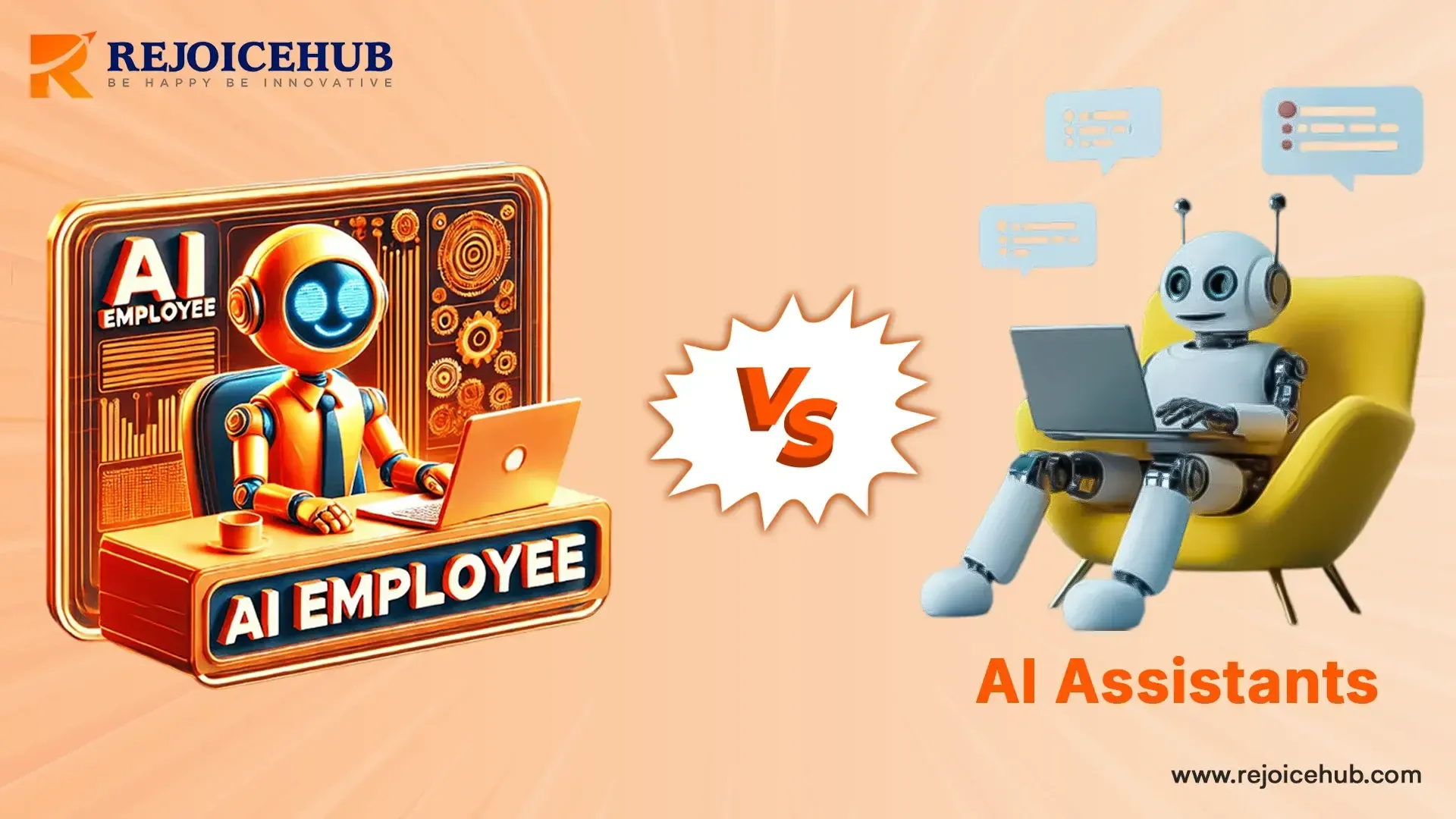
The current state of artificial intelligence makes its terminology genuinely difficult to navigate. Business owners, startup founders, and tech teams alike struggle daily when terms like AI employees, AI assistants, AI agents, and automation tools get lumped together into one indistinct mass. This confusion is more than a minor inconvenience choosing the wrong tool can result in wasted budget and missed growth opportunities.
This article will give you a clear understanding of what AI employees are, how they differ from AI assistants and automation tools, and why that distinction matters for your business in 2026.
What Are AI Employees?
The AI employee functions as a digital coworker that can perform tasks independently. It's an AI system capable of recognizing objectives, breaking them down into actionable steps, and executing those steps from start to finish without needing a human to guide it along the way.
An authentic AI employee:
- Performs work activities independently of human supervision
- Manages multiple complex work processes simultaneously
- Analyzes situations and makes context-appropriate decisions
- Handles unexpected events as they arise
- Operates continuously, 24/7, without breaks, sick days, or overtime
Autonomous is the defining word here. AI employees don't just assist they act. That's what sets them apart from every tool that came before.
What Are AI Assistants?
AI assistants are the most familiar form of artificial intelligence for most people. Tools like ChatGPT, Google Gemini, Microsoft Copilot, and Siri fall into this category, and they've genuinely transformed how people work.
But AI assistants are fundamentally reactive. They:
- Require a human to initiate every interaction
- Operate only when prompted
- Deliver a response, then wait for the next input
- Stop completely when you stop engaging
Think of an AI assistant as an advanced calculator. It delivers exceptional value but only once you press the button. You remain in control of every step. That's a feature for personal productivity, but a ceiling for business scale.
AI Employees vs AI Assistants: The Key Differences
Here's a direct breakdown of how these two categories actually compare no fluff.
1. Autonomy
This is the core distinction. An AI assistant waits to be asked. An AI employee takes initiative, acting on goals without waiting for tasks to be assigned one by one.
2. Decision-Making
AI assistants can suggest options, draft responses, and create plans then they pause and wait for your input. An AI employee evaluates situations, weighs variables, and selects a course of action autonomously.
3. Use Cases
AI assistants shine for personal tasks: writing, quick research, content summarization, and brainstorming. AI employees are built for business process automation lead generation, customer support, operations, onboarding, data management, and any workflow that needs to scale.
4. Scalability
An AI assistant can help you draft ten emails a day. What happens when you need 10,000 emails written, sent, and tracked? An AI assistant still requires a human operator at every step. An AI employee handles that entire operation and scales with your business no additional headcount required.
Full Comparison Table
| Feature | AI Employees | AI Assistants | Automation Tools |
|---|---|---|---|
| Autonomy | High acts independently | Low needs human prompts | None fixed rules only |
| Decision-Making | Makes context-aware decisions | Suggests options only | Executes predefined logic |
| Learning Ability | Learns and adapts over time | Limited context memory | No learning capability |
| Use Cases | Sales, support, operations | Drafting, summarizing, Q&A | Data entry, scheduling |
| Scalability | Scales across tasks & teams | Scales with user effort | Scales within fixed rules |
| Human Input Needed? | Minimal after setup | Required for each task | Required at setup only |
| Best For | Business automation & growth | Personal productivity | Repetitive fixed workflows |
The takeaway is straightforward: the right tool depends entirely on your goals. AI assistants are excellent for individual productivity. AI employees are built for business growth.
AI Employees vs Automation Tools: Why This Matters
The comparison between AI employees and traditional automation tools deserves more attention than it typically gets. Many people group AI and automation together as if they're the same thing they're not.
Traditional automation tools like Zapier, Make, and basic RPA (Robotic Process Automation) operate on fixed, predefined rules. Input X always produces output Y. They run on a predetermined track, reliably and fast until you need to go somewhere that track doesn't reach.
AI employees operate differently. They're guided by goals, not rigid rules. They can execute tasks their designers never explicitly mapped out and adapt when conditions change. If automation tools are trains on fixed tracks, AI employees are smart vehicles with GPS capable of reaching the destination even when the route is unpredictable.
Static rule-based systems that worked well in 2015 are running into hard limits in 2026. Organizations now need systems that are both adaptive and intelligent. AI employees represent the next evolution of automation more flexible, more capable, and built for complexity.
AI Agents for Business Automation: How Companies Are Using AI Employees Today
AI agents for business automation are no longer theoretical. Real companies from startups to enterprise organizations are actively deploying AI employees across their operations. Here are the most impactful use cases.
-
Customer Support
This is where AI employees show some of their most dramatic results. An AI system handles all first-line support: answering questions, resolving standard issues, processing refunds, and modifying orders all without human involvement. Edge cases get escalated automatically to the right specialist. The outcome is faster response times, lower costs, and higher customer satisfaction.
-
Lead Generation and Sales
AI sales agents can identify new opportunities, send personalized outreach, qualify interest, handle objections, and book appointments all autonomously. Your human sales team focuses on what they do best: building relationships and closing deals.
-
Operations and Internal Workflows
Behind the scenes, AI employees are quietly transforming operations at companies of all sizes. They track project progress, flag upcoming delays before they become problems, process invoices, handle vendor communications, manage HR onboarding paperwork, and coordinate between departments.
The repetitive, time-consuming operational work that used to consume hours of someone's day now runs automatically and accurately.
What unites all of these use cases? AI employees allow organizations to move faster and do more work that would previously have required a much larger team.
RejoiceHub enables businesses to design custom AI systems that exactly match their organizational processes and operational workflows building intelligent agents that handle sales, support, and operations end-to-end.
The Future of Work with AI Employees (2026 and Beyond)
We're in a genuinely transformational moment. The market is moving toward AI-first companies organizations structured from the ground up to let artificial intelligence handle core operations while a lean human team focuses on high-value decisions.
A company that required 50 employees in 2020 can now operate effectively with 10, using AI employees to handle the rest. This isn't speculation Y Combinator, one of the world's most respected startup incubators, is already predicting a future where small founding teams build entire companies with AI workers as core team members.
For existing businesses, this doesn't mean mass layoffs. It means amplifying the people you already have. A marketer who previously spent hours managing campaign metrics can hand that work to an AI employee and dedicate their full attention to creative strategy.
The organizations that learn to build and operate AI systems effectively will have a meaningful and compounding competitive advantage. The businesses that wait will find it increasingly difficult to keep pace.
Conclusion
AI assistants are exceptional productivity tools responsive, helpful, and capable of making individual work significantly more efficient. But they require a human to drive every step.
AI employees are autonomous systems that run business operations, make operational decisions, and scale activity without constant human supervision.
The distinction between AI employees vs. AI assistants isn't just a technical classification it's a business strategy question. Choosing the wrong tool means either leaving growth on the table or spending budget on something that never moves the needle.
Understanding the difference is the first step to choosing correctly.
Frequently Asked Questions
1. What is the difference between AI employees and AI assistants?
AI assistants wait for you to give them a task — they only work when you ask. AI employees work on their own without needing constant input. They handle full business workflows, make decisions, and keep running even when you're not watching. That's the biggest difference between the two.
2. Can AI employees replace human workers completely?
Not exactly. AI employees handle repetitive, time-consuming tasks so your human team can focus on more important work. Think of it as giving your staff a tireless helper. A 10-person team with AI employees can do the work of a much larger one without burning out.
3. What are AI agents for business automation?
AI agents for business automation are smart systems that run tasks like lead generation, customer support, and operations all without needing a human to manage every step. They assess situations, make decisions, and adjust when things change. That's what separates them from basic automation tools.
4. How are AI employees different from automation tools like Zapier?
Tools like Zapier follow fixed rules if X happens, do Y. They break when something unexpected comes up. AI employees are different. They can handle new situations, adapt to changes, and make judgment calls. It's the difference between a train on a fixed track and a car with GPS.
5. What tasks can AI employees handle in a business?
AI employees can manage customer support, process invoices, handle HR onboarding, send follow-up emails, track project timelines, and qualify sales leads. Basically, any task that's repetitive, process-heavy, or needs to run 24/7 is a great fit for an AI employee in your business.
6. Are AI assistants useful for small businesses?
Yes, AI assistants are very useful for small business owners who need quick help with writing, research, or answering questions. But they require you to be involved at every step. If you want something that runs on its own and scales with your business, you'd need an AI employee instead.
7. What does it mean when an AI employee works autonomously?
It means the AI sets its own tasks, works through them step by step, and finishes the job without you having to guide it the whole way. You give it a goal, and it figures out how to get there. That level of independence is what makes it an AI employee, not just a tool.
8. How do AI employees help with lead generation and sales?
AI employees can find new prospects, send personalized outreach messages, handle common objections, and even book meetings all without a salesperson doing it manually. Your human sales team only steps in to close the deal. It saves time and keeps your pipeline full around the clock.
9. Is ChatGPT an AI employee or an AI assistant?
ChatGPT is an AI assistant. It's great for drafting content, answering questions, and brainstorming ideas, but it only works when you're actively using it. It doesn't run tasks on its own or manage business workflows. For that, you'd need a purpose-built AI employee or AI agent system.
10. What is the future of AI employees in 2026 and beyond?
AI-first businesses are already happening. Small founding teams are building companies with AI employees doing the heavy lifting. Businesses that learn to work with AI employees now will have a real edge. Those that wait will likely struggle to keep up with competitors who have already made the shift.
11. How much human input do AI employees need after setup?
Very little. Once an AI employee is set up and trained on your business processes, it handles most tasks on its own. You may need to review outputs occasionally or handle edge cases, but the day-to-day running happens without you having to be involved in every single step.
12. What is the difference between AI employees vs AI assistants in terms of scalability?
An AI assistant scales with your effort more tasks means more of your time. An AI employee scales with your business goals. Need to send 10,000 emails, handle 500 support tickets, or run multiple workflows at once? The AI employee does it without needing more headcount on your side.
13. Which is better for business growth, an AI employee or an AI assistant?
For real business growth, AI employees win. They run independently, handle complex workflows, and don't need constant supervision. AI assistants are better for personal productivity tasks. If your goal is to scale operations, reduce costs, and grow faster, an AI employee is the smarter long-term choice.