
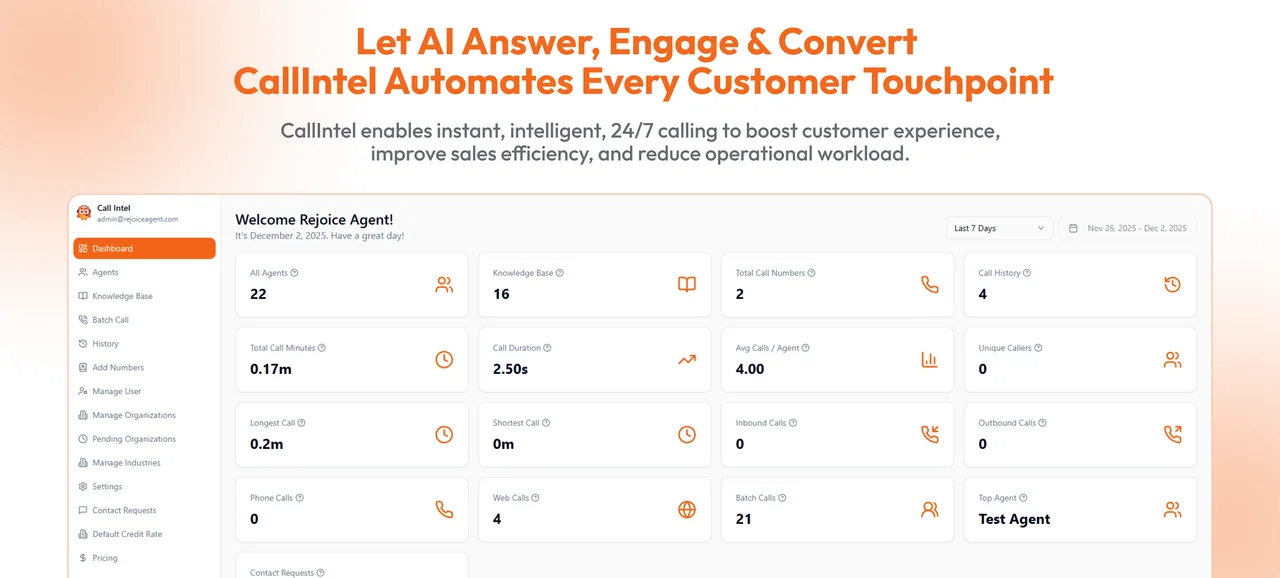
Context
A voice agent that works in a demo and one that answers a real phone call are different systems. The second needs carrier trunks, turn-taking that holds up over lossy audio, isolation of agents and knowledge per tenant, scheduling and batching for outbound work, and enough telemetry that a call which went badly can be reconstructed afterwards. CallIntel is the platform layer for that problem: not one agent, but the machinery to build, run and observe many of them across tenants and channels.
What we built
Backend API
Control plane: tenants, agents, knowledge bases, scheduled and batched calls, billing.
Voice worker
Owns the live call leg — audio in, turn detection, model, audio out — with bench and eval suites of its own.
Web app
Where tenants configure agents and watch calls in progress.
Mobile app
Companion app; Dart is 85% of the repository by the languages API.
WhatsApp channel
A second channel into the same agents, separate from telephony.
Content and documentation
Marketing content out of a CMS; a docs site the API contract is published against.
Architecture
The system is split along the line that matters in voice — a control plane and a media plane. The control plane is an async FastAPI service: SQLAlchemy over asyncpg, Alembic migrations, Celery on Redis for batch and scheduled calls, pgvector for per-tenant knowledge retrieval, Argon2 and TOTP on the auth path. The media plane is a separate LiveKit worker that owns the live call and nothing else. Turn detection is treated as a swappable component rather than a setting: the worker carries four independently pinned requirement sets (pipecat, rnnoise, smart-turn, VAD) and ships with its own bench/ and evals/ directories, so a change to the turn model can be measured rather than argued about. Telephony is not single-vendor — Twilio and Plivo sit behind the same API alongside LiveKit, and the earlier generation of the backend already separated three carrier managers and three model bridges, so provider substitution was a design assumption rather than a later retrofit. Observability was wired at the start: OpenTelemetry API and SDK with FastAPI, SQLAlchemy and httpx instrumentation exporting over OTLP, alongside Prometheus metrics, Sentry and structlog. It all lives in one pnpm/turbo monorepo — 11 apps and 6 shared packages, including Python and TypeScript SDKs so internal apps and external integrations consume the same contract — with terraform/, kubernetes/, docker/, caddy/ and backup/ checked in beside the application code.
Stack
- Backend API
- Python
- FastAPI
- async SQLAlchemy + asyncpg
- PostgreSQL
- Alembic
- Voice worker
- Python
- LiveKit
- webrtcvad
- google-genai
- Web app
- React
- @livekit/components-react
- Supabase (SSR + JS)
- TanStack Query
- Mobile app
- Flutter / Dart
- SDK ^3.12.0
- WhatsApp channel
- Python
- FastAPI
- FastMCP
- Selenium
- Content and documentation
- Strapi 5.31.0
- Mintlify (MDX)
- Integrations
- LiveKit — real-time media transport for the live call leg
- Twilio and Plivo — carrier telephony behind a single API
- OpenAI and Google Gemini — model providers
- Supabase — auth and Postgres for the web surfaces
- pgvector — retrieval over per-tenant knowledge bases
- Stripe and Razorpay — two payment providers, not one
- Shopify — a dedicated app and API surface
- OpenTelemetry, Prometheus and Sentry — traces, metrics and errors
Scale
Counts that can be re-derived from the same repositories. Nothing here is a business result — a repository cannot evidence one.
- 699 commits across 10 repositories; the monorepo alone accounts for 592.
- 11 apps and 6 shared packages in the monorepo.
- 4 independently pinned voice-pipeline requirement sets.
- 40 entries under docs/, and 4 CI workflows.
Where the evidence stops
- No business outcome is claimed, because none is evidenced by a repository.
Evidence
Each statement above, and the artefact it was read from. The client cannot be named, so the sources are given instead.
699 commits across 10 repositories.
Sourcesum of history.totalCount on each repository's default branch; the monorepo alone accounts for 592
The monorepo holds 11 apps and 6 shared packages.
Sourceapps/ and packages/ tree listing in the CallIntel monorepo
Telephony and media dependencies: livekit-api >=1.1.0, twilio >=9.10.9, plivo >=4.60.1.
Sourceapps/api/pyproject.toml
4 voice pipeline variants, each an independently pinned requirement set.
Sourceapps/voice-worker/requirements-{pipecat,rnnoise,smart-turn,vad}.txt
Operational documentation runs to 40 entries under docs/, including ARCHITECTURE, TENANCY, OBSERVABILITY, CAPACITY, DR_PLAN, SECRET_ROTATION and PENTEST_RUNBOOK.
Sourcedocs/ tree listing in the monorepo
4 CI workflows — CI, Security, SAST and an OpenAPI check.
SourceGitHub Actions badges in the monorepo README
Engagement span: 2025-10-16 → 2026-08-10, still active.
Sourcefirst and last commit dates across the CallIntel repositories, via the commits API
Related capability