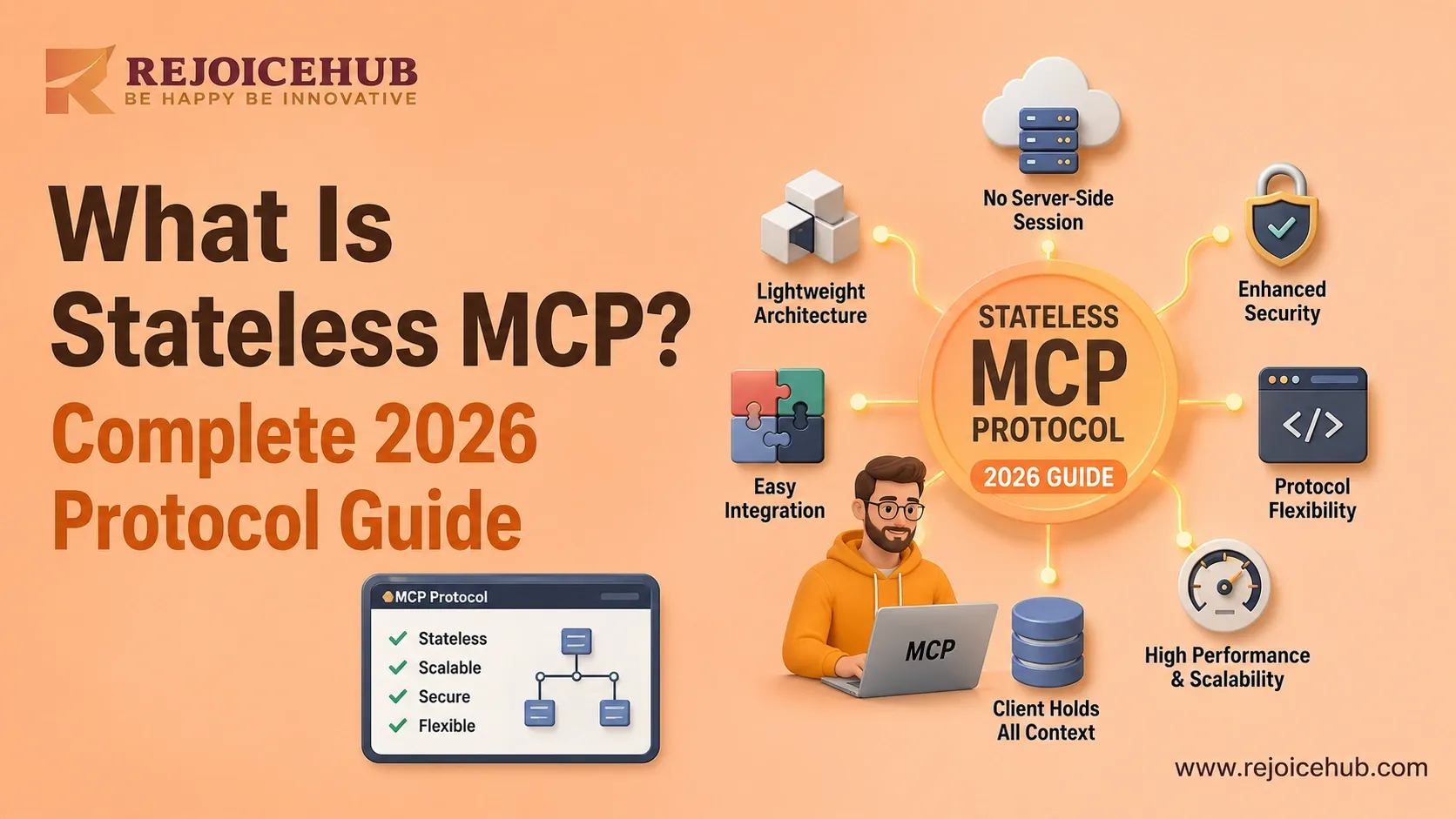
 If you're building AI agents, integrating tools into an LLM workflow, or evaluating infrastructure for enterprise AI, you've probably run into the term Stateless MCP. It's one of the most important architectural shifts in the Model Context Protocol (MCP) ecosystem heading into 2026, and it directly affects how scalable, secure, and cost-efficient your AI agent deployments will be.
In short: Stateless MCP is a design pattern where an MCP server processes every client request independently, without storing session data or conversation memory between calls. Each request carries everything the server needs to respond; nothing is remembered afterward.
In this guide, you'll learn what Stateless MCP means, why the protocol moved in this direction, how a stateless MCP server actually works, how it compares to stateful MCP, and how enterprises are using it in production today.
What Is Stateless MCP?
Direct answer: Stateless MCP is an implementation of the Model Context Protocol where the server treats every incoming request as a brand-new, self-contained transaction. No session state, memory, or context is stored on the server between requests; the client (or a middleware layer) supplies whatever context is needed each time.
Definition of Stateless Model Context Protocol
The Model Context Protocol is an open standard that lets AI applications (like Claude, Cursor, or a custom enterprise agent) connect to external tools, data sources, and APIs in a structured way. In its original design, many MCP servers kept a persistent session open with the client tracking conversation state, authentication context, and tool history in memory.
Stateless Model Context Protocol removes that persistent session layer. Instead of the server "remembering" who you are and what you asked last time, every call includes its own authentication, context, and parameters. The server does its job and forgets everything the moment it responds.
What Is a Stateless MCP Server?
A stateless MCP server is an MCP server instance that:
-
Processes each request independently, with no shared memory between calls
-
Doesn't rely on in-memory session objects tied to a specific server instance
-
Can be replaced, restarted, or duplicated without losing any client context
-
Treats authentication and context as part of the request payload, not server memory
This is the same principle that powers most modern REST APIs and serverless functions, and it's why stateless MCP servers fit so naturally into cloud-native infrastructure.
Key Takeaway: Stateless MCP doesn't mean "no memory at all" it means memory lives outside the server (in a database, vector store, or the client itself), not inside a single running process.
Why Did the Model Context Protocol Become Stateless?
Direct answer: MCP moved toward statelessness because stateful sessions created real production problems at scale — sticky sessions, memory leaks, difficult failover, and infrastructure costs that grew faster than usage. Stateless design solves these by making every server instance interchangeable.
The Challenges With Stateful MCP
Teams running stateful MCP servers in production ran into recurring issues:
-
Session management overhead every open session consumes server memory and must be tracked, expired, and cleaned up
-
Scalability limits load balancers need "sticky sessions" to route a client back to the exact server holding their state, which defeats the purpose of horizontal scaling
-
Infrastructure complexity stateful servers can't be freely killed, restarted, or auto-scaled without risking lost context
-
Memory synchronization running multiple instances means state has to be synced across them, adding latency and failure points
Why Stateless MCP Wins
Stateless MCP solves these problems directly:
-
Better cloud compatibility any instance can serve any request, which is exactly how load balancers, containers, and serverless platforms are designed to work
-
Easier horizontal scaling spin up 10 more instances during peak load with zero coordination overhead
-
Simpler deployment no session replication, no shared memory cluster, no sticky routing rules
-
Lower operational overhead fewer moving parts means fewer things that break at 2 a.m.
For a startup or SaaS team shipping AI agents into production, this isn't a theoretical benefit it's the difference between an integration that survives a traffic spike and one that falls over.
How Does Stateless MCP Work?
Direct answer: In Stateless MCP, the client (or an orchestration layer) packages the full context authentication, parameters, and any relevant history into every request. The server executes the tool call or query, returns a response, and discards everything. No step depends on the server "remembering" anything from before.
The Request Lifecycle
-
Client sends a request including any required context or tokens
-
Context travels with the request not stored server-side beforehand
-
MCP server processes the request validates, authenticates, and routes it
-
Tool execution the server calls the relevant tool, API, or data source
-
Response returned the result goes straight back to the client
-
Session ends the server retains nothing once the response is sent
Stateless MCP Architecture
A typical stateless MCP setup includes these components:
-
Client the application or agent initiating the request (e.g., an AI assistant)
-
AI Application / Orchestrator assembles context and manages the conversation on the client side
-
Stateless MCP Server executes requests without holding session state
-
Tool Layer the connected tools, functions, or business logic
-
External APIs / Data Sources CRMs, databases, SaaS platforms, internal systems
-
Response returned to the client, with any needed memory persisted externally (e.g., in a database) rather than on the server
Key Takeaway: In stateless architecture, "memory" doesn't disappear it just moves from the server's RAM to a durable, external store the client controls. This is what makes multi-instance scaling safe.
Accelerate Your Workflows with Custom AI
Book a free consultation session with RejoiceHub. We'll map out a tailored automation roadmap for your company.
Stateful vs Stateless MCP: Full Comparison
Direct answer: Stateful MCP keeps session and conversation data on the server between requests, which works well for small, low-traffic deployments. Stateless MCP treats every request independently, which is better suited to enterprise-scale, cloud-native, and multi-agent systems.
| Feature | Stateful MCP | Stateless MCP |
|---|---|---|
| Session Storage | Yes, server-side | No, external or client-side |
| Scalability | Medium | High |
| Complexity | Higher | Lower |
| Cloud-Native Fit | Limited | Excellent |
| Request Handling | Session-based | Independent per request |
| Infrastructure Cost | Higher | Lower |
| Reliability | Moderate (single point of memory failure) | High (interchangeable instances) |
| Performance at Scale | Good | Better |
| Best For | Small teams, prototypes, single-server tools | Enterprises, AI agents, distributed systems |
Which One Should You Use?
-
Enterprises running AI agents across regions or high-traffic products should default to stateless MCP it matches how modern cloud infrastructure (Kubernetes, serverless, containers) already operates.
-
AI agents that need to scale unpredictably (customer support bots, coding assistants, workflow automation) benefit from stateless design because agent load is rarely constant.
-
Small internal tools or single-user prototypes can still use stateful MCP the added complexity isn't worth it at low volume.
In 2026, stateless MCP is the recommended default for any production-grade, customer-facing, or enterprise AI deployment.
What Are the Benefits of Stateless MCP?
Direct answer: Stateless MCP improves scalability, reliability, security, and cost efficiency by removing the server's dependency on retained memory making it a natural fit for cloud-native and serverless AI infrastructure.
-
Faster scaling new instances join instantly with no state to replicate
-
Improved reliability no single server holds critical session data that can be lost
-
Better fault tolerance if one instance fails, another handles the next request seamlessly
-
Easier deployment rolling updates and redeploys don't disrupt active sessions
-
Lower infrastructure costs fewer dedicated resources needed for session persistence
-
Better security posture no lingering session data sitting in server memory to be exposed
-
Cloud-native architecture works naturally with load balancers and auto-scaling groups
-
Kubernetes-friendly pods can be killed and replaced without losing client context
-
Serverless compatibility functions that spin up per request don't need to "remember" anything
Key Takeaway: The benefits of stateless MCP compound at scale. A five-user prototype won't notice the difference a production agent handling thousands of concurrent sessions absolutely will.
Real-World Enterprise Use Cases
Direct answer: Stateless MCP is already powering AI coding assistants, enterprise support agents, and SaaS integrations that need to scale unpredictably without infrastructure headaches.
AI Coding Assistants: Tools like Cursor, Claude Code, and GitHub Copilot rely on MCP-style connections to pull in file context, run tools, and query external systems often across distributed, ephemeral compute environments where statelessness keeps things fast and predictable.
Enterprise AI Agents
-
Customer support automation handling thousands of simultaneous conversations
-
Internal knowledge search across company documents and wikis
-
HR automation for onboarding, policy lookups, and approvals
-
Finance automation for reconciliation, reporting, and audit workflows
-
Cross-department workflow automation
SaaS Integrations: CRM, ERP, Slack, Notion, and Jira integrations built on MCP benefit from stateless design because these tools are called intermittently and unpredictably exactly the traffic pattern statelessness is built for.
At RejoiceHub, we've seen firsthand that clients who move from ad-hoc, stateful integrations to properly architected stateless MCP infrastructure cut both latency and infrastructure spend, while making it far easier to add new AI agents without re-architecting the backend.
Best Practices for Building Stateless MCP Servers
Direct answer: Building a reliable stateless MCP server means designing every request to be self-sufficient, secure, and idempotent with no assumption that the server remembers anything from a previous call.
-
Keep every request self-contained include all necessary context in the payload
-
Avoid server-side session storage push persistence to a database or client-managed store
-
Use authentication tokens securely short-lived, scoped tokens rather than long sessions
-
Validate every request never assume prior validation still holds
-
Design idempotent APIs repeated identical requests should produce the same safe result
-
Monitor request performance track latency and error rates per request, not per session
-
Optimize context size send only what's needed to control token and payload costs
-
Implement logging and observability since there's no session to trace, per-request logging becomes essential
Common mistake: teams often bolt statelessness onto an existing stateful codebase without removing hidden in-memory caches this creates subtle bugs where behavior differs across server instances. A proper stateless redesign audits every place state might be quietly stored.
Common Challenges and Limitations
Stateless MCP isn't free of trade-offs:
-
Larger request payloads since context travels with every call, requests can grow heavier
-
Context management the client or orchestrator now owns the job of assembling context correctly
-
Token usage repeated context in each request can increase LLM token costs if not optimized
-
Latency considerations fetching external context per request can add overhead versus an in-memory session
-
Security considerations context and credentials in transit must be encrypted and scoped carefully
-
Long-running workflows multi-step processes need external state tracking (a database or workflow engine) since the server itself won't hold it
None of these are dealbreakers they're design considerations that a well-planned AI agent architecture accounts for from day one.
Conclusion
Stateless MCP represents one of the most significant maturity steps for the Model Context Protocol heading into 2026. By removing server-side session dependency, it solves the scalability, reliability, and cost problems that held back earlier stateful implementations.
For enterprises building AI agents, coding assistants, or SaaS integrations, stateless MCP architecture isn't just a technical preference; it's the foundation for dependable, cloud-native AI infrastructure that can grow with real business demand.
If your team is planning or scaling an MCP-based AI agent deployment, RejoiceHub's AI Agent Development and AI Integration services can help you design a stateless architecture built for production from day one. Book a free consultation to talk through your MCP or AI agent roadmap.
Frequently Asked Questions
1. What is Stateless MCP?
Stateless MCP is a version of the Model Context Protocol where the server doesn't retain session data between requests. Each request is processed independently, with all needed context supplied by the client, making the server easier to scale and deploy across distributed cloud infrastructure.
2. What is a Stateless MCP server?
A stateless MCP server is an instance that handles each incoming request on its own, without relying on memory from previous calls. Any instance can process any request, which allows teams to scale horizontally, replace failed instances, and deploy updates without disrupting active users
3. Why did MCP become stateless?
The shift happened because stateful MCP servers struggled with sticky sessions, memory synchronization across instances, and scaling limitations. Stateless design removes these bottlenecks, making MCP servers compatible with modern cloud-native, containerized, and serverless infrastructure.
4. How does Stateless MCP work?
Each client request includes all necessary context, authentication, parameters, and history. The MCP server validates the request, executes the required tool or API call, returns a response, and discards everything once the response is sent, with no data persisted server-side.
5. What is the difference between Stateful and Stateless MCP?
Stateful MCP stores session and conversation data on the server between requests, which suits small, low-traffic tools. Stateless MCP treats every request independently, offering better scalability, lower infrastructure costs, and stronger reliability for enterprise-grade AI agent deployments.
6. What are the benefits of Stateless MCP?
Key benefits include faster horizontal scaling, improved fault tolerance, lower infrastructure costs, simpler deployments, and stronger security since no session data lingers in server memory. It's also naturally compatible with Kubernetes and serverless environments.
7. Is Stateless MCP better for AI agents?
Yes, for most production use cases. AI agents often experience unpredictable, bursty traffic, and stateless MCP servers can scale up or down instantly without losing context, making them a better fit than stateful designs for customer-facing or enterprise agents.