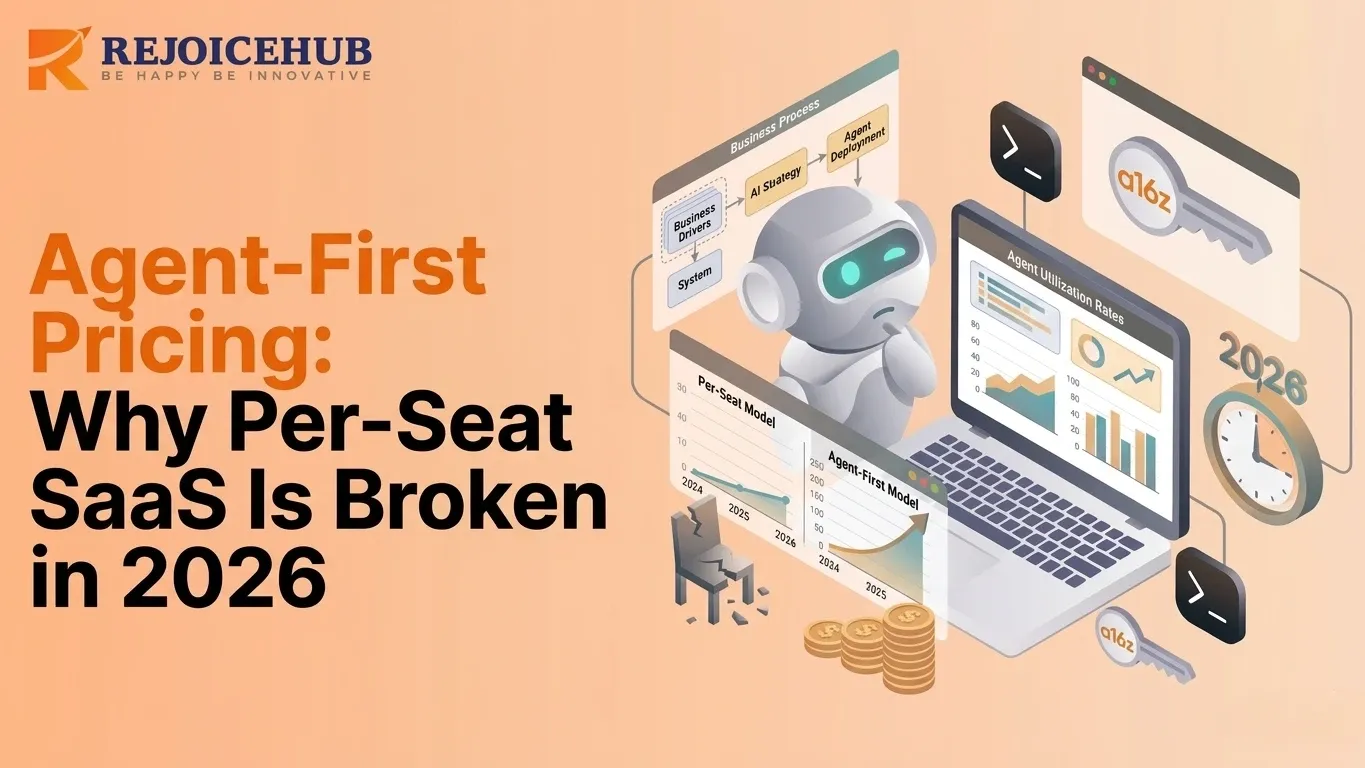
SaaS pricing models have failed to adapt to the current work patterns that exist in 2026. Most software vendors continue to charge by the seat because they have not changed their pricing model since AI agents began performing tasks that previously needed entire departments to complete work. The situation creates an actual problem.
The per-seat pricing model worked correctly because every user required system access to perform their tasks through manual work. But when an AI agent can process 10,000 invoices overnight, reply to customer queries in real time, or qualify sales leads 24/7, who exactly is the "user" you're paying for?
Agent-first pricing provides a solution to this problem. The new model that this system creates establishes a cost system that connects actual value delivered to the automation period.
Our guide will explain all aspects of agent-first pricing together with the reasons why per-seat SaaS pricing creates problems and the methods which leading businesses use to adopt new pricing systems and their impact on your financial results.
What Is Agent-First Pricing?
Agent-first pricing is a billing model that calculates costs based on AI agent activities, their completed tasks, and resulting outcomes, and the resources they utilized, instead of determining costs through the number of human users who access the software.
The Core Idea
Traditional SaaS solutions measure their success through their active user base. Agent-first pricing thinks in terms of units that users complete their work. An AI agent operates without a human user status because it does not access system dashboards through login.
The system operates by executing workflows while it processes data to produce output. The pricing model, which treats it as a human seat charge, operates like a factory charge which calculates costs based on its workers instead of its manufactured products.
What Agent-First Pricing Is Based On
- Tasks: Pay per action completed (emails sent, records processed, tickets resolved)
- Outcomes: Pay for measurable results (leads qualified, revenue recovered, time saved)
- Usage: Pay based on compute or API calls consumed by agents
Most agent-first models use one or a combination of these dimensions. The pricing structure of the product expands together with business growth instead of requiring changes to the organizational structure.
Why Per-Seat SaaS Pricing Is Broken
The question isn't whether per-seat pricing is flawed it clearly is. The real question is: why are so many companies still using it?
The situation exists because companies maintain their existing systems. The current pricing model, which charges per user, creates expensive challenges for companies that use AI automation.
1. It Limits Scalability
The per-seat pricing system requires you to increase your team size by 100 percent or purchase additional licenses if you want to double your output capacity. The system does not provide scalable solutions because it leads to rising costs, which increase at a fixed rate. The assumption gets completely invalidated by the presence of AI agents.
One deployment system can manage the same amount of work that normally needs multiple human workers. The software vendor charges you per user, which results in two problems: you pay for "phantom seats" that nobody needs, and your agents face limitations.
2. It Doesn't Reflect Real Usage
Most per-seat tools are actively used by only 20–30% of licensed users on any given day. The rest? The unused licenses are consuming financial resources.
Agent-first pricing aligns cost with actual consumption. You only pay for agents when they are operating. The system applies volume-based pricing which increases costs according to actual usage.
3. It Penalizes Automation
The more you automate your work process, the more your per-seat pricing system becomes ineffective for your business. You can test the system by using an AI agent for business to replace a support team that requires ten members. You need no extra seats, yet your vendor demands you to pay the same amount because of their established revenue expectations. The model fails to match your actual business requirements because it operates for a different purpose.
Theoretical issues demonstrate how per-seat pricing systems fail, but these problems create actual barriers which lead AI-first companies to waste millions through improper expenditure.
4. It's Misaligned with Business Outcomes
The software charges the same price for each user regardless of its actual effectiveness for your business. The system operates independently of your payment amount to determine the benefits.
The system requires payment only when agents achieve successful performance. The system requires no payment when agents fail to deliver successful outcomes. This type of financial structure creates a partnership between CFOs and their organizations, which helps them work together effectively.
Agent-First vs. Per-Seat Pricing: A Side-by-Side Comparison
| Dimension | Per-Seat Pricing | Agent-First Pricing |
|---|---|---|
| Cost Structure | Fixed cost per user/seat | Pay per task, outcome, or usage |
| Scalability | Grows with headcount | Scales with automation not people |
| Value Alignment | Often misaligned | Directly tied to business outcomes |
| Automation Support | Penalizes automation | Built for AI-agent workflows |
| Flexibility | Rigid annual contracts | Flexible, usage-driven billing |
| ROI Visibility | Hard to quantify | Clear metrics: tasks completed, outcomes delivered |
Bottom line: Per-seat pricing was built for a world where humans did all the work. Agent-first pricing is built for a world where AI does most of it.
AI-Driven Pricing Models in 2026
Multiple pricing models have emerged because organizations now implement agent-first operational methods. The following models are becoming increasingly popular.
1. Usage-Based Pricing (UBP)
You pay for what you use API calls, compute hours, messages processed. It's the simplest form of agent-aligned pricing and works well for infrastructure-level tools.
- Best for: Developer platforms, data pipelines, communication APIs
- Examples: OpenAI's API, Twilio, Cloudflare Workers
- Benefit: No wasted spend on idle capacity
2. Outcome-Based Pricing
You only pay when the AI delivers a specific, measurable result a lead qualified, a ticket resolved, a transaction processed. The model needs clear KPIs to function properly, yet it provides optimal incentive alignment between parties.
- Best for: Sales automation, customer support AI, revenue intelligence tools
- Benefit: Vendor and buyer share the same success metrics
3. Hybrid Models
A majority of enterprise AI deployments in 2026 resort to hybrid approaches a charge for the platform, and then one for the use or effect tied to agent activity.
- Best for: Companies with predictable base workloads plus variable AI automation
- Benefit: Balances cost predictability with scalability
SaaS pricing trends in 2026 show an established pattern which links operational expenses to the value delivered. The current dominant revenue model for SaaS companies through fixed per-seat contracts will soon fade away because customers want services that charge according to their actual usage.
How to Build an Agent-First Pricing Strategy
Remember, the agent-pricing model generally involves a deal size 10 times higher than the per-seat pricing approach. If you factor in some conversion rate and learn that some of the seats would be empty on a specific day, you already understand the cost-per-lead for prospects, which is costing you.
Step 1: Identify Your Automation Workflows
You should identify all areas within your operations where agentic AI workflows currently operate or have the potential to create a significant impact. Common choices typically include:
- Customer support ticket triage and resolution
- Lead scoring and qualification in your CRM
- Invoice processing and accounts payable automation
- Content generation, personalization, and distribution
- Data enrichment and reporting pipelines
Each of these represents an actual instance of agent activity and a possible pricing anchor.
Step 2: Define Measurable Outcomes
The implementation of agent-first pricing requires you to assess the actual performance of your agents. Your team needs to create a definition for this together with you.
- What does "success" look like for each workflow?
- How will you track it in your platform, your CRM, or a dashboard?
- What's the dollar value of each completed task or outcome?
Without measurable outcomes, you can't price fairly for you or your customers.
Step 3: Map Pricing to Value Delivered
Once you know your outcomes, build a pricing structure that reflects them:
- Task-based: $X per invoice processed, email sent, or ticket resolved
- Outcome-based: $X per qualified lead, revenue recovered, or deal influenced
- Tiered usage: Base rate for up to N tasks/month, with overage pricing above that
Don't overcomplicate it. The best agent-first pricing models are simple enough that buyers understand them immediately.
Step 4: Test, Learn, and Iterate
The process begins with testing a pilot program or product category. The next step requires you to assess customer response together with their churn patterns and the effect on revenue, then improve the results.
The essential performance indicators that need monitoring include cost-per-outcome, net revenue retention, and customer ROI. Your organization needs to develop an effective pricing structure for AI-powered business automation that continuously adjusts according to the increased intelligence of your agents and the evolving demands of your clients.
Real-World Examples of Agent-First Pricing in Action
This is more than just theory firms across industries are actually translating this principle into operation.
-
AI-First SaaS Companies Leading the Charge
The Intercom Fin AI Agent now operates under a pricing structure that requires customers to pay for each support ticket that gets resolved instead of charging them according to their agent count. The result: clearer ROI for buyers, stronger retention for Intercom.
HubSpot AI tools now have usage and content volume requirements which determine access to their features instead of only depending on user tiers. As AI takes on more marketing responsibilities, seat-based pricing becomes a decreasing portion of their business model.
Salesforce developed its Agentforce platform to charge customers based on the number of conversations that AI customer support agents manage instead of using traditional seat licensing, which applies to customer-facing automation.
-
Lean Teams Scaling Revenue Without Adding Headcount
A fintech startup uses AI agents to automate customer onboarding — performing document reviews, ID checks, and KYC checks — enabling them to complete onboarding within four hours instead of four days. The vendor charges fees based on the number of verified applications instead of charging for each user.
The startup achieved 1,000 percent growth in monthly onboardings from 500 to 5,000 without needing to employ extra compliance staff. The combination of outcome-based pricing and automated systems demonstrates its effectiveness.
-
Automation Replacing Seats Not Just Augmenting Them
A marketing agency eliminated its complete email quality assurance team of six members by implementing an AI automation solution that performs checks on copy, links, compliance flags, and send-time optimization. The company now charges for every 1,000 emails they examine, which costs them only 10 percent of their former payroll expenses while their production capabilities have increased three times. The organization does not require any workstations because all tasks are completed without human involvement.
Why This Matters for Your Business
Your business operations will experience real growth due to the agent-first pricing model, which provides measurable advantages.
-
Predictable, justifiable spend: Your software expenses become predictable and justifiable when you eliminate payments for unoccupied seats and shift to paying for completed work. Finance teams can trace every dollar to a specific outcome.
-
Clearer ROI story: The agent-first pricing model creates a better understanding of return on investment because it requires pricing transparency. You know what your agents are doing, how much each task costs, and what value it generates. That's a clean ROI story you can take to any stakeholder.
-
Competitive advantage: Companies that get pricing right on their AI investments can afford to scale automation faster than competitors still tied to headcount-linked costs. The next three to five years will show that market leaders use their compounding advantage to maintain their position over market followers.
Conclusion
The transition from per-user software-as-a-service billing to agent-first pricing systems represents a complete transformation of software valuation methods. The new AI agents perform all tasks including lead qualification, ticket resolution, document processing, and content creation so their performance should not be evaluated using human-based pricing methods.
The current system creates problems because it directs spending in the wrong way, restricts business growth potential, and results in lost investment returns.
The solution to this problem exists in agent-first pricing. The system establishes a relationship between your expenses and the benefits you receive by linking costs to specific tasks, their results, and system usage. The companies that figure this out early and build their AI automation strategies around it will have a durable competitive edge going forward.
Frequently Asked Questions
1. What is agent-first pricing?
Agent-first pricing is a billing model where you pay based on what AI agents actually do: tasks completed, outcomes delivered, or resources used, instead of paying for the number of human users logged into the software. It's built for businesses running AI-powered workflows.
2. Why is per-seat SaaS pricing broken?
Per-seat pricing made sense when humans did all the work. Now AI agents can handle thousands of tasks without ever logging in. Paying for seats they don't need wastes money and punishes companies for automating well. It simply doesn't match how modern teams operate.
3. How is agent-first pricing different from per-seat pricing?
Per-seat pricing charges a fixed cost per user, no matter how much or how little they do. Agent-first pricing charges based on actual work done, tasks, outcomes, or usage. It scales with your automation, not your headcount, giving you better cost control and clearer ROI.
4. What are the main types of AI-driven pricing models in 2026?
The three main types are usage-based pricing (you pay per API call or compute hour), outcome-based pricing (you pay per result, like a resolved ticket or qualified lead), and hybrid models that combine a base platform fee with variable usage charges on top.
5. Which companies are already using agent-first pricing?
Intercom now charges per resolved support ticket instead of per agent seat. Salesforce Agentforce bills based on AI-managed conversations. HubSpot ties feature access to usage volume. These companies are proving that outcome-linked pricing works at scale for real businesses.
6. Why is per-seat SaaS pricing outdated for AI workflows?
AI agents don't log in, browse dashboards, or take lunch breaks. Charging for seats they don't use is like paying factory rent based on worker count, not output. As automation grows, per-seat pricing becomes more expensive and less relevant to your actual business results.
7.. How do I build an agent-first pricing strategy?
Start by mapping your automated workflows. Then define what "success" looks like for each one. Build pricing around measurable outcomes, cost per task, per lead, or per resolution. Keep it simple enough that buyers understand it right away, then test and improve over time.
8. What are the SaaS pricing trends to watch in 2026?
In 2026, more SaaS companies are shifting to usage-based and outcome-based pricing. Fixed per-seat contracts are losing ground as customers demand billing that reflects actual value. Hybrid models are growing fast, especially for enterprise AI tools handling large, variable workloads.
9. Can small businesses benefit from agent-first pricing?
Yes, absolutely. Small teams can use AI agents to punch above their weight, handling support, onboarding, or marketing at scale without hiring. Agent-first pricing means they only pay for what gets done, making it much easier to manage budgets while growing through automation.
10. What metrics should I track with agent-first pricing?
The most important ones are cost-per-outcome, net revenue retention, and customer ROI. You should also track task completion rates and agent uptime. These numbers tell you whether your pricing model is working and where to adjust it as your AI workflows get smarter.
11. Will agent-first pricing replace per-seat SaaS pricing completely?
It's heading that way, especially for AI-heavy tools. Per-seat pricing won't disappear overnight, but it will shrink as more platforms shift to usage and outcome models. Companies that make the switch early will have a real cost and scaling advantage over those still paying for empty seats.