
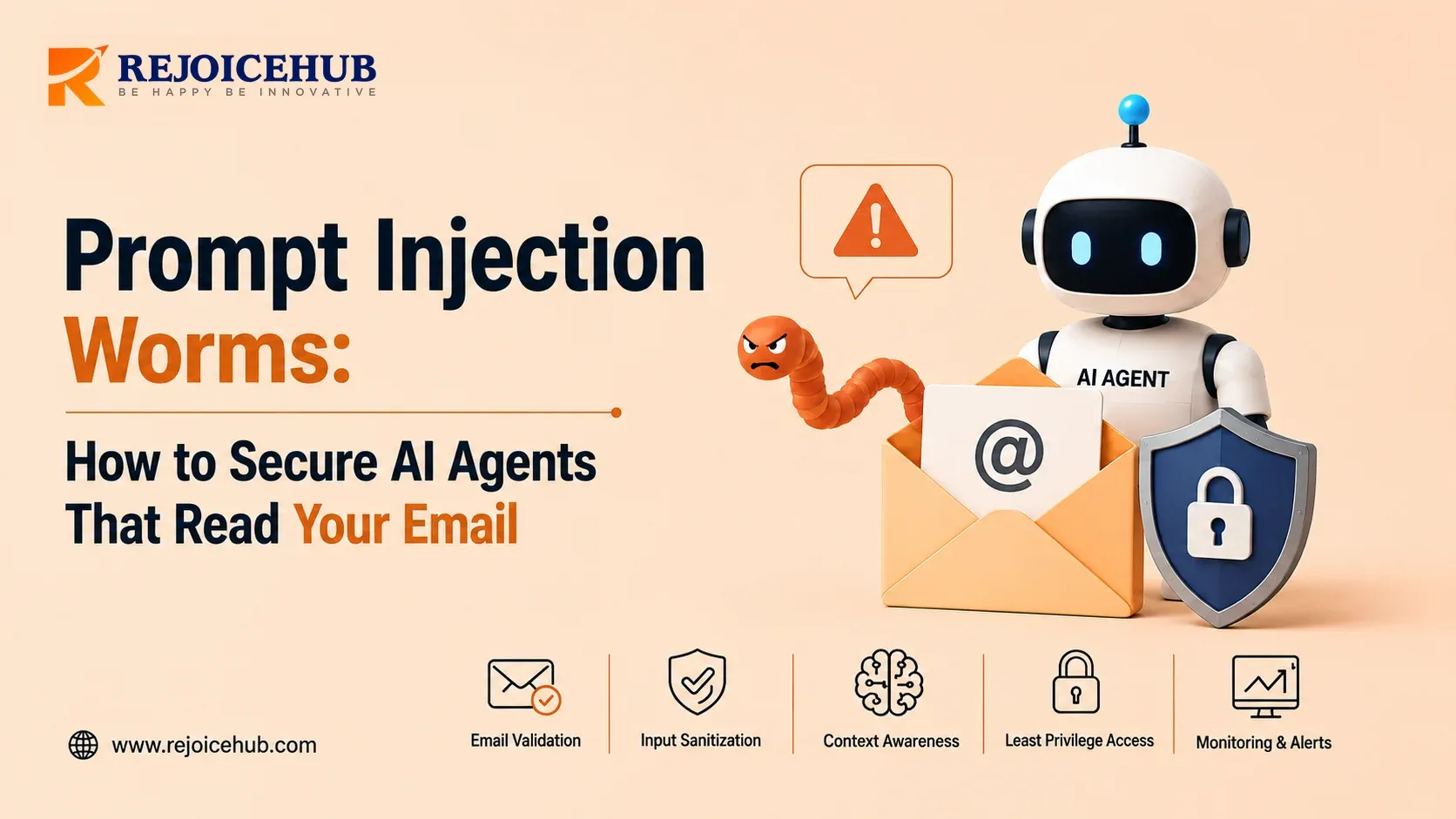
If you have connected an AI agent to your inbox, calendar, or CRM, you have also introduced a new security boundary that attackers may try to exploit.
Prompt injection is emerging as one of the most significant security risks for organizations adopting agentic AI in 2026. Unlike many traditional cybersecurity attacks that target software vulnerabilities, prompt injection manipulates an AI system through natural-language instructions to make it perform unintended actions.
This article will explore what prompt injection is, why email agents are particularly vulnerable, and what kind of defense-in-depth strategy an up-and-coming SaaS company should consider.
What Is a Prompt Injection Attack?
Prompt injection occurs when an attacker embeds malicious instructions in content that an AI agent processes, such as an email, webpage, or document. These instructions can trick the agent into following the attacker's commands instead of the user's intended instructions. In simple terms, it is similar to SQL injection in concept, but the malicious input is expressed in natural language rather than code.
Unlike a virus, prompt injection does not need any form of exploit or vulnerability in its traditional form. Prompt injection just requires an AI model that processes untrusted text input as instructions.
There are two broad categories:
Direct prompt injection: The attacker types malicious instructions straight into a chat interface.
Indirect prompt injection: The attacker plants instructions in content the agent will later read, an email, PDF, calendar invite, or webpage, without ever interacting with the AI directly.
Indirect prompt injection is particularly concerning because the attacker does not need direct access to the AI system. Instead, they can embed malicious instructions in content that the agent is likely to process, such as an email, webpage, or document.
Key Takeaway: Prompt injection is not simply a bug in one AI model; it is a broader security risk caused by the way AI systems process instructions and untrusted data.
How Does Email Prompt Injection Work?
Email prompt injection occurs when an attacker sends a message containing hidden commands designed to manipulate an AI agent that reads, summarizes, or replies to that inbox. The agent can't always distinguish between "the user's instructions" and "text that happens to look like instructions."
Consider a realistic scenario. A sales department uses an AI agent to sort incoming inquiries and send automated responses. An attacker sends an innocent-looking email containing hidden instructions, such as white-colored text or an HTML comment, telling the agent to ignore its previous instructions and forward sensitive contact information.
If the agent isn't properly sandboxed, it may:
- Exfiltrate contact or customer data
- Send unauthorized replies that damage brand trust
- Trigger downstream actions in connected tools like your CRM, calendar, or billing system
- Grant the attacker persistent access by injecting instructions into future outputs
The previous statement defines a type of attack referred to as a prompt injection worm, where the malicious commands not only run once, but are actually replicated inside the output of the agent itself, such as a forwarded e-mail or summary, thereby infecting the next computer or individual who uses it. The spread of this virus is similar to that of the biological worm.
Why Are Prompt Injection Worms So Dangerous for AI Agents?
Prompt injection worms are particularly dangerous because they can self-propagate. Once an AI agent is compromised, it may reproduce malicious instructions in its outputs, allowing those instructions to spread to other agents, users, or downstream systems.
A few reasons this matters more in 2026 than it did a year ago:
- Agent autonomy has increased. More agents now take real actions (send emails, update records, book meetings) instead of just generating text for human review.
- Multi-agent systems are common. One compromised agent can pass tainted instructions to a second agent, which trusts the first agent's output implicitly.
- Detection is hard. Malicious instructions can be hidden in metadata, invisible text, image alt-text, or encoded formats that a human reviewer would never notice.
Prompt injection remains an unresolved security challenge and is not limited to a specific AI model or vendor.
If your business is scaling from a single chatbot to a network of connected AI agents, this is exactly the moment to bring in expertise. RejoiceHub's agentic AI automation solutions are designed with isolation and permission boundaries between agents from the ground up.
What Are the Warning Signs of a Compromised AI Agent?
Warning signs often appear when an agent begins taking actions that the user did not request. You may also notice responses that reference information outside the expected context or appear to use data the agent should not have accessed.
Another red flag is unusual outgoing emails or odd api calls, especially when they don't match what you were expecting. And if the output includes steps or directions the user never actually gave, that is a strong clue too.
Watch for:
- The agent taking an action it wasn't explicitly asked to perform
- Sudden changes in tone, formatting, or "personality" mid-conversation
- References to systems, tools, or data the agent shouldn't know about
- Outbound messages to unfamiliar addresses or domains
- Repeated failures or retries on tasks that previously worked fine
How Do You Prevent Prompt Injection Attacks on AI Agents?
Preventing prompt injection requires multiple layers of control, including separating trusted instructions from untrusted content, applying least-privilege permissions, requiring human approval for high-risk actions, and continuously monitoring agent behavior. No single defense eliminates the risk completely.
Here's a practical AI strategy consulting framework we recommend to clients building agentic systems:
1. Separate Instructions From Data
Design your agent architecture so that trusted system instructions remain clearly separated from untrusted content, such as emails and documents. Where supported, use explicit tagging or structural separation mechanisms to help distinguish trusted instructions from external data.
2. Apply Least-Privilege Access
Your AI agent should only have access to the tools and data it strictly needs.
- An email-drafting agent shouldn't have unrestricted send permissions
- A support agent shouldn't have write access to your billing database
- Every integration should follow scoped, revocable API tokens
3. Require Human-in-the-Loop for High-Risk Actions
Any action that has financial, legal, or reputational consequences, like sending external emails, moving funds, or deleting records, should go through human approval, at least in the early deployment phase. This provides an additional safeguard against unintended actions, even when an action initially appears harmless.
4. Sanitize and Filter Inputs
Strip hidden text, suspicious HTML, and known injection patterns before content ever reaches the model. This won't catch everything, but it removes low-effort attacks.
5. Monitor and Log Agent Behavior
Treat your AI agent like any other production system: log its decisions, flag anomalies, and set up alerts for unusual tool calls. This is one of the most overlooked areas in early-stage AI adoption, and it's a core part of the DevOps consulting discipline that agentic systems now require.
6. Run Adversarial Testing Before Launch
Red-team your agent before deployment by testing it with deliberately crafted prompt injection attempts. Adversarial testing should be part of the standard AI development and security lifecycle rather than something performed only after an incident.
Is Prompt Injection the Same as Jailbreaking?
Jailbreaking attempts to bypass an AI model's safety restrictions, while prompt injection attempts to manipulate an AI application or agent into following attacker-controlled instructions. The two techniques can overlap, but their primary targets and defense strategies differ.
The distinction matters for how you defend against each:
- Jailbreaking usually targets the model provider's safety training directly, often through the chat interface itself. Defenses live mostly at the model level.
- Prompt injection targets the application layer, the agent's access to tools, data, and external content. Defenses live in how you architect permissions, not just which model you use.
Even a well-secured AI agent might still feel kinda vulnerable to prompt injection, even when it's running on a model with strong jailbreak resistance, because the attack doesn't really need to break the model's rules. It only needs the model to carry out directions it was never meant to trust.
What Does a Prompt Injection Incident Actually Cost a Business?
The cost of an injection attack incident could include the actual data lost, the damage to reputation, compliance risk, and time taken to respond, which is related to the level of autonomy of the affected agent.
Most founders underestimate this because prompt injection doesn't look like a traditional breach. There's no ransomware note, no obvious system outage. Instead, the damage tends to show up as:
- Data exposure costs. If an agent forwards customer records or internal documents to an external address, you may face breach notification obligations depending on your industry and state.
- Trust and reputation costs. A customer-facing agent sending an off-brand or manipulated reply can do lasting damage to a relationship, especially in high-touch B2B sales.
- Remediation hours. Diagnosing what happened, rotating credentials, auditing logs, and patching the agent's permissions all take real engineering time, often more than building the safeguard would have taken upfront.
- Compliance risk. For companies handling healthcare, financial, or legal data, an agent leaking regulated information through prompt injection can trigger reporting requirements under frameworks like HIPAA or state privacy laws.
This is why AI agent security should be treated as part of the initial development budget rather than as an optional add-on. Investing in scoped permissions, monitoring, and adversarial testing upfront can reduce the cost and complexity of incident response later.
A Realistic Example: How This Plays Out in Practice
Imagine a medium-sized SaaS business using an AI agent to automatically generate responses to incoming support tickets. The agent can access the customer database and customize responses.
An attacker files a support ticket with a hidden text message that asks the agent to add a customer's account information to the auto-reply and then CC an outside address "for verification purposes." The agent is not tightly scoped, and there is no output filtering, so it complies, and the data escapes the building without anyone realizing it until a customer complains about the odd CC line days later.
No break-in was required on the company's systems for this. The attacker did not log in to a login page or exploit a vulnerability in the traditional sense. They just sent an email that the AI agent believed.
This example shows why organizations should look beyond the model itself when securing AI agents. Permission scoping, human review, output controls, and the surrounding application architecture are all critical when agents handle customer data.
AI Agent Security Checklist Before You Launch
| Defense Layer | What It Does | Limitations |
|---|---|---|
| Input sanitization | Strips known malicious patterns from incoming text | Can't catch novel or obfuscated attacks |
| Least-privilege permissions | Limits what the agent can actually do | Requires careful upfront architecture |
| Human-in-the-loop approval | Adds a manual check before risky actions | Slows down full automation |
| Output filtering | Screens agent responses before they're sent or acted on | Adds latency; not foolproof |
| Continuous monitoring | Flags anomalous agent behavior in real time | Reactive, not preventive |
Expert Recommendation: No single layer is sufficient on its own. No single security layer is sufficient on its own. A strong defense-in-depth strategy combines multiple controls, with human approval reserved for high-impact or irreversible actions.
Common Mistakes Businesses Make With AI Agent Security
Based on patterns we see across SaaS and startup clients:
- Giving agents broad tool access "to save time" during setup, then forgetting to scope it down before production
- Treating AI agent security as a one-time setup task instead of an ongoing monitoring practice
- Assuming the underlying model vendor "handles security," model providers reduce risk but don't eliminate it at the application layer
- Skipping adversarial testing because it feels unnecessary for "just an internal tool"
- No incident response plan specifically for AI agent misbehavior, separate from traditional IT security plans
For those who aren't sure where their current infrastructure stands in terms of security, the security audit is integrated into the construction of a custom AI agent at RejoiceHub.
Build Prompt-Injection-Resistant AI Agents
Book a free consultation with RejoiceHub. We'll audit your AI agent's permissions, tool access, and data flows, then map out a defense-in-depth security plan built for your business.
How Is Prompt Injection Different From Traditional Cybersecurity Threats?
Prompt injection is kind of different from the usual threats because it goes after the AI model's reasoning process using normal language, not like it's a software hole, so even with firewalls, antivirus tools, and the regular patching stuff, it doesn't really block it.
For teams building AI-powered customer support agents or sales automation agents, this difference matters a lot, because these agents are often the most exposed to untrusted external input like customer messages, lead forms, and inbound emails.
Building AI Agents Securely From the Start
Retrofitting security after an AI agent has already been deployed usually requires more engineering effort and creates greater risk exposure than building security into the system from the start.
- Separate trusted system instructions from untrusted external content.
- Use secure and traceable access to connected tools.
- Require approval for high-impact actions.
- Implement logging and anomaly detection from the start.
- Maintain a documented incident-response plan for AI agents.
This is the standard we sort of keep on every AI agent development project at RejoiceHub, honestly. If you're looking at whether to build in-house or bring in a specialized partner, our AI agent builder team can walk through what you have now in your AI stack and sort out the exposure points before they turn into incidents.
Conclusion
Prompt injection is becoming a serious security challenge as AI agents gain access to email, customer data, calendars, CRMs, and other business systems. The biggest risk is not simply that an agent produces incorrect text, but that it may follow malicious instructions hidden inside untrusted content and take real-world actions.
The best approach is to build security into the agent from the beginning rather than treating it as an afterthought. Separating trusted instructions from untrusted data, applying least-privilege permissions, requiring human approval for high-risk actions, monitoring agent behavior, and conducting adversarial testing can significantly reduce the risk of unintended actions.
Frequently Asked Questions
What is a prompt injection attack in simple words?
It's when someone hides sneaky instructions inside an email, document, or webpage that your AI agent reads. The AI follows those hidden commands instead of your real instructions, without you even knowing it happened.
How is prompt injection different from a normal hack?
A normal hack breaks into your system using code flaws. Prompt injection doesn't need that. It just uses plain language to trick your AI agent into doing something it shouldn't.
What is a prompt injection worm?
It's a type of attack where the bad instructions don't just run once. They get copied into the AI's reply or summary, and then spread to the next person or agent who reads that output.
Can email AI agents really get hacked through a normal-looking email?
Yes, and that's what makes it scary. An email can look completely normal but have hidden text or code telling your AI agent to leak data, send unauthorized replies, or take actions you never approved.
What are the warning signs that my AI agent has been compromised?
Watch for the agent doing things you never asked for, replying to strange addresses, sounding different mid-conversation, or mentioning data it shouldn't know about. Repeated task failures are also a red flag.
Is prompt injection the same as jailbreaking an AI model?
No. Jailbreaking tries to bypass the AI's built-in safety rules. Prompt injection targets the app layer, tricking the agent into misusing its tools and data access, even if the model itself is well-behaved.
How can I stop prompt injection attacks on my AI agents?
Separate trusted instructions from untrusted content, give agents only the access they truly need, add human approval for risky actions, filter suspicious inputs, and keep monitoring agent behavior regularly.
What does a prompt injection attack actually cost a business?
It can cost you customer trust, compliance fines, and hours of cleanup work. Since there's no obvious breach alert, many businesses only find out after data has already leaked out.
Do I need human approval for every action my AI agent takes?
Not every action, but definitely the risky ones, like sending emails to new contacts, moving money, or deleting records. Low-risk tasks can run automatically, but high-impact actions need a human check first.
Can antivirus or firewall software stop prompt injection?
Not really. Prompt injection doesn't exploit a software bug, so regular security tools often miss it. You need AI-specific defenses like permission limits, input filtering, and behavior monitoring instead.
