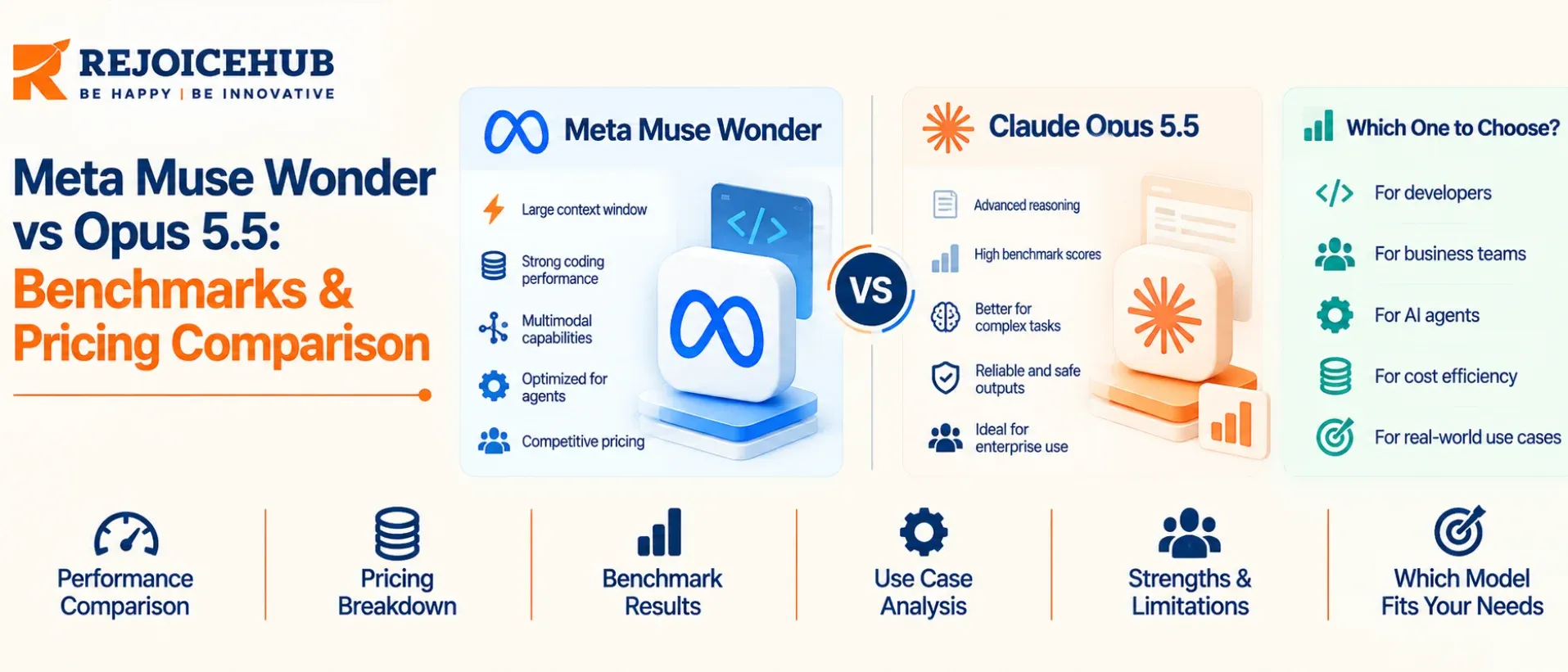
Meta's new frontier model landed October 12, 2026, and its price tag formed engineers' first impressions.
The Meta Muse Wonder costs the same as Claude Opus 5.5 at the same cached-token rate. So the question that must be asked is not "is Wonder good?" But "what do I get for the same money, and what do I give up?"
We spent our first day poring over model cards, cross-referencing Meta's plots to third-party data, and plotting the results to the workloads our client agents are actually running. Here is what stands and doesn't stand.
Quick Summary
Meta Muse Wonder (muse-wonder-1.0) is Meta Superintelligence Labs' first genuine frontier model. On independent testing, it lands close to GPT-6 Astra and a few points behind Claude Opus 5.5.
It is notably better than Opus 5.5 at admitting when it knows something, and it has strong scores on long-horizon coding and memory. It is notably worse on terminal-agentic coding and building programs from scratch.
Short answer to "Is Meta Muse Wonder better than Opus 5.5?" Not overall; Opus 5.5 wins the independent intelligence index and most coding rows.
Wonder wins on hallucination rate, memory recall, and a few long-running software and legal tasks. Pick one based on what your agent does all the time.
Key Highlights
- Same price, different strengths. Both models cost $4 / $20 per million input/output tokens, with $0.20 per million for cached input.
- Opus 5.5 leads on independent scores: Artificial Analysis Intelligence Index: Opus 5.5 at 57.6, Muse Wonder at 52.4.
- Wonder hallucinates far less: On AA-Omniscience, Wonder's hallucination rate is 26.5% versus 58.6% for Opus 5.5 (lower is better).
- Coding is split: Wonder leads on DeepSWE 1.1 (78.8% vs 74.2%) and SWE-Marathon (53.1% vs 46.3%). Opus 5.5 leads on Terminal-Bench 4.0 (59.6% vs 52.0%) and ProgramBench (70.5% vs 50.0%).
- The best Wonder isn't in the API: Muse Wonder Full, the stronger sibling, is only available through Muse Code subscriptions at $50 or $200 a month.
- Every headline number is max effort: Treat all of them as ceilings, not expectations for your production budget.
What Is Meta Muse Wonder?
Muse Wonder is a two-model family from Meta Superintelligence Labs called Muse Wonder and Muse Wonder Full. The company claims it is designed for personal and professional agentic work, such as managing a lease, an insurance claim, or shipping a working application.
It succeeds Muse Spark, which was a lighter, lower-latency model. Wonder is the heftier, upper-league launch that targets the top of the charts.
The reason this matters right now: Meta has been rebuilding its AI organization for about 14 months after Llama 4 received only lukewarm critical reception. Wonder is the first fruit of that effort that engineers are willing to consider a serious contender rather than a promising prospect.
Meta Muse Wonder Features
These are the capabilities that separate Wonder from a plain chat model:
- Active Memory: The model is trained to carry relevant facts about a user across conversations and retrieve them when a new task needs them. On Meta's own MemoryBench, which uses long chats seeded with distractors and facts that change midway, Wonder scores 85.6%, ahead of every model in Meta's comparison.
- Active Focus: When a task hits a wall, Wonder is trained to try another route, recover from errors, and keep going, while asking before doing anything consequential.
- Multimodal input: It accepts text, images, video, audio, and PDFs, and returns text only.
- Adjustable reasoning effort: Settings run from "minimal" to "max."
- 1M-token context: The window is 1,048,576 tokens with no long-context price premium.
- Lower hallucination: Artificial Analysis measures it making things up about half as often as Opus 5.5 when it doesn't know an answer.
Opus 5.5, for comparison, is Anthropic's current flagship Opus-tier model. It is listed with a 1M-token context window, up to 128K output tokens, and adaptive thinking that scales reasoning depth to task difficulty. Check Anthropic's documentation for current limits before you design around any of these figures.
Meta Muse Wonder Benchmark: Performance Benchmarks Compared
In order to better understand how these comparisons work, it's a good idea to note any differences in who actually ran the benchmarks. Meta has been using these numbers against Claude Fable 5.1, GPT-6 Astra, and Opus 5.5 on maximum settings in benchmarks for Wonder and Wonder Full, using third-party results where available and their own otherwise. The rows below represent the API model, Muse Wonder, not Wonder Full.
Independent numbers (Artificial Analysis)
| Benchmark | Muse Wonder | Opus 5.5 | Gap |
|---|---|---|---|
| Intelligence Index v4.3.2 (max) | 52.4 | 57.6 | Opus +5.2 |
| GDPval-AA (office task Elo) | 1770 | 1866 | Opus +96 |
| AA-Omniscience hallucination rate (lower is better) | 26.5% | 58.6% | Wonder better by 32.1 pts |
On the same index, Claude Sonnet 5.5 scores 56.0 and Fable 5.1 scores 53.4, so Wonder sits in the middle of the pack rather than at the top.
Meta's own numbers
| Benchmark | Muse Wonder | Opus 5.5 | Who leads |
|---|---|---|---|
| Personal Superintelligence Index | 54.3 | 55.2 | Opus (narrowly) |
| MemoryBench | 85.6% | 81.5% | Wonder |
| Harvey LAB-AA (legal agent work) | 10.0% | 4.2% | Wonder |
| AutomationBench-AA (business workflows) | 39.1% | 41.2% | Opus |
| DeepSWE 1.1 (long-horizon coding) | 78.8% | 74.2% | Wonder |
| SWE-Marathon (ultra-long projects) | 53.1% | 46.3% | Wonder* |
| Terminal-Bench 4.0 | 52.0% | 59.6% | Opus |
| ProgramBench | 50.0% | 70.5% | Opus |
How to read these numbers
Three caveats matter before you quote any of this to your board.
- Everything is max effort: Nobody has published Wonder at a normal effort level on a normal budget. Your real cost per task will differ from the benchmark conditions.
- Much of the agent data is first-party: Bloomberg noted that benchmark results can be engineered to look favorable and often diverge from real behavior. Meta did publish a model card on day one and Artificial Analysis's numbers broadly match Meta's chart, which is a good sign.
- The headline charts lead with Wonder: which you can't call from the API. Meta's own table also has Opus 5.5 ahead of even Full on Terminal-Bench, JobBench, HealthBench Pro, and ProgramBench.
If your agents are scored on how often they fabricate an answer, Wonder has a real advantage. If they are scored on shell-driven coding or building programs from nothing, Opus 5.5 is the safer pick today.
Meta Muse Wonder Pricing vs. Opus 5.5 Pricing
| Item | Muse Wonder (API) | Claude Opus 5.5 |
|---|---|---|
| Input (per 1M tokens) | $4 | $4 |
| Output (per 1M tokens) | $20 | $20 |
| Cached input (per 1M tokens) | $0.20 | $0.20 |
| Context window | 1,048,576 tokens | 1M tokens (listed) |
| Long-context premium | None | Confirm in Anthropic docs |
| Training-data discount (Contributor mode) | Not offered for Wonder | N/A |
A sanity check of what this means in practice. Let's say an agent run has 2M input tokens and 200K output tokens (a plausible long coding session but your use case may differ).
Both models are $8 for input plus $4 for output, around $12 before caching. Since the billing rate cards are the same, the real difference is in the number of tokens per task, not the price per token. A model that requires fewer retries or fewer tool calls is cheaper in practice.
Subscription access
Meta also sells access through products:
- Muse app: $20 or $100 per month for the personal agent tier that will run on Wonder.
- Muse Code: $50 (Power Usage) or $200 (Maximum Usage) per month. Wonder Full lives here and is not available through the API.
The pricing wrinkle worth noting
Meta's AI chief announced publicly that the API would be priced "meaningfully below" OpenAI and Anthropic. That is true against Fable 5.1 at $10 / $50. It isn't true against Opus 5.5.
And Claude Sonnet 5.5 scores higher than Wonder on Artificial Analysis's index at roughly half the price, according to Handy AI's launch analysis.
If cost-per-intelligence is your metric, Sonnet 5.5 is the comparison Meta's chart leaves out.
Meta Muse Wonder vs Opus 5.5 Comparison: Side by Side
| Dimension | Meta Muse Wonder | Claude Opus 5.5 |
|---|---|---|
| Overall independent score | 52.4 (AA Index) | 57.6 (AA Index) |
| Hallucination behavior | Much lower (26.5%) | Higher (58.6%) |
| Long-horizon coding | Stronger on DeepSWE, SWE-Marathon | Stronger on Terminal-Bench, ProgramBench |
| Memory across sessions | Purpose-trained (Active Memory) | Not a headline feature |
| Office-task performance | 1770 Elo | 1866 Elo |
| Pricing | $4 / $20 | $4 / $20 |
| API availability of top tier | Full is subscription only | Full model via API |
| Input types | Text, image, video, audio, PDF | See Anthropic docs |
| Ecosystem maturity | Brand new, launched Oct 12, 2026 | Established tooling and integrations |
The pattern is consistent. Opus 5.5 is the stronger general-purpose engine. Wonder is a specialist in memory and honesty about what it doesn't know, with credible long-running coding results.
Is Meta Muse Wonder Better Than Opus 5.5?
Not as a blanket statement. Here is a more useful way to frame it.
Choose Muse Wonder if:
- Your agents act on user data over many sessions and need to remember changing facts.
- A confident wrong answer is more costly to you than a refusal or a "not sure" (legal, compliance, finance review).
- You run very long coding or document-heavy jobs and have tested it on your own repo.
Choose Opus 5.5 if:
- Your agents drive terminals, build programs from scratch, or run multi-step business workflows.
- You want the highest independent intelligence score at this price tier.
- You need mature tooling, documentation, and enterprise integrations today.
Consider neither if budget is tight. Sonnet 5.5 and other mid-tier models deserve a look before you commit to a $4 / $20 rate card.
5 Things to Check Before Switching AI Models
Before switching to a new AI model, check its performance, cost, accuracy, availability, and privacy. Here are five important things to review.
1. Test the Model on Your Own Tasks
Published benchmark scores often use the highest effort setting. Test the model on your 50 most common tasks using the effort setting you can afford in production. This will help you understand how well it performs in real-world use.
2. Measure the Cost per Completed Task
Do not compare models only by their price per token. Check how many tokens, retries, and tool calls each task needs. These factors can affect your total API cost, even when the listed token prices are the same.
3. Check the Hallucination Rate for Your Use Case
The reported 26.5% figure comes from a general knowledge test. Your results may be different depending on your industry, data, and task type. Test the model with your own data to see how often it gives incorrect or unsupported answers.
4. Confirm API Access Before Choosing a Model
Check which model versions are available through the API. If your application depends on Wonder Full's benchmark results, remember that Wonder Full is not available through the API, according to the information provided. Make sure the version you want is accessible before planning your integration.
5. Review Data Privacy and Safety
Check the model's data handling rules, privacy terms, and safety reports before using it with sensitive information. Contributor mode is not available for Wonder through the API, and Meta's safety chart reports a 3.4% personal-information mishandling rate. Review these details to understand the risks before sending user or business data to the model.
How Each Model Wins: The Four Pillars of AI Agent Model Selection
When choosing an AI model for an AI agent, you need to look beyond benchmark scores. Reasoning, accuracy, coding skills, and memory all affect how well a model performs in real-world tasks.
Here is how Meta Muse Wonder compares with Opus 5.5 across four key areas.
1. Reasoning and General Intelligence
Opus 5.5 performs better on both Artificial Analysis (57.6 vs. 52.4) and GDPval-AA office tasks (1,866 vs. 1,770). These results suggest that Opus 5.5 may be a stronger choice for complex reasoning and office-related tasks.
Winner: Opus 5.5
2. Reliability and Factual Accuracy
Wonder has a hallucination rate less than half that of Opus 5.5 on the AA-Omniscience benchmark, according to the figures provided. This could make Wonder a better option for agents that need to provide accurate information and avoid making up facts.
Winner: Meta Muse Wonder
3. Coding and Tool Use
The results depend on the type of coding task. Wonder performs better on long-running software tasks, while Opus 5.5 scores higher on ProgramBench (70.5% vs. 50.0%) and leads by 7.6 percentage points on Terminal-Bench 4.0.
If your agent handles complex software projects, test both models on your actual workflows before choosing one.
Winner: Depends on the task
4. Memory and Personalization
Wonder was designed with memory and personalization in mind and leads on MemoryBench. However, because this is Meta's own benchmark, independent testing is needed to confirm how well these results hold up in real-world applications.
Winner: Meta Muse Wonder, pending independent verification
The Wider Landscape: Where Wonder and Opus 5.5 Sit
On Artificial Analysis, Wonder isn't in a two-horse race. It's right on GPT-6 Astra (52.7) and just behind Fable 5.1 (53.4). In sixth place, Sonnet 5.5 (56.0) and Opus 5.5 (57.6) take the prize. Wonder Full (55.8) is just slightly behind Sonnet 5.5.
That's the sort of result that you'd expect to see from an also-ran model a year ago.
It also means that, for most buyers, the practical shortlist is Opus 5.5, Sonnet 5.5 and Wonder, with the decision being driven by their workload, rather than branding.
At RejoiceHub we build agents on top of whichever model fits the job, and we have deployed across multiple providers. We have no interest in Meta winning or losing this comparison, but we do have one in you not locking a production architecture to a model that launched two days ago.
Conclusion
Muse Wonder is a valid frontier model, and Meta should be commended for its model card on day one.
However, at the same price as Opus 5.5, the numbers from independent tests show that Opus leads on the whole, but Wonder's margin is narrower and has specific advantages: few fabricated answers, strong memory, and good long-horizon coding results.
Don't choose a side from a launch-week chart. Run your own tasks at your own effort settings and compare cost per successful task. If you want a second opinion on this review, let me know.
Frequently Asked Questions
What is Meta Muse Wonder?
Meta Muse Wonder is a frontier AI model from Meta Superintelligence Labs, released on October 12, 2026. It is mainly built for personal and professional AI agent tasks and is available today through the Meta Model API and Muse Code.
Is Meta Muse Wonder better than Opus 5.5?
No, not overall today. Opus 5.5 scores higher on the independent Artificial Analysis index, 57.6 versus 52.4. Muse Wonder wins on hallucination rate and Meta’s own memory tests. Pick based on your own workload, since both models cost the same.
How much does Meta Muse Wonder cost?
Through the API, Muse Wonder costs $4 per million input tokens and $20 per million output tokens. Cached input is $0.20 per million. The Muse app plans cost $20 or $100 monthly, and Muse Code plans cost $50 or $200.
Is Opus 5.5 pricing the same as Meta Muse Wonder API pricing?
Yes, both models use the same rate card. Each charges $4 per million input tokens, $20 per million output, and $0.20 per million cached input. Since prices match, your cost depends on how many tokens each model needs per task.
What are the Meta Muse Wonder benchmark results?
Artificial Analysis gives Muse Wonder an Intelligence Index of 52.4 and a hallucination rate of 26.5%. Meta’s own tests show 78.8% on DeepSWE 1.1 and 85.6% on MemoryBench. On Terminal-Bench 4.0, it scores 52.0%, behind Opus 5.5, which scored 59.6%.