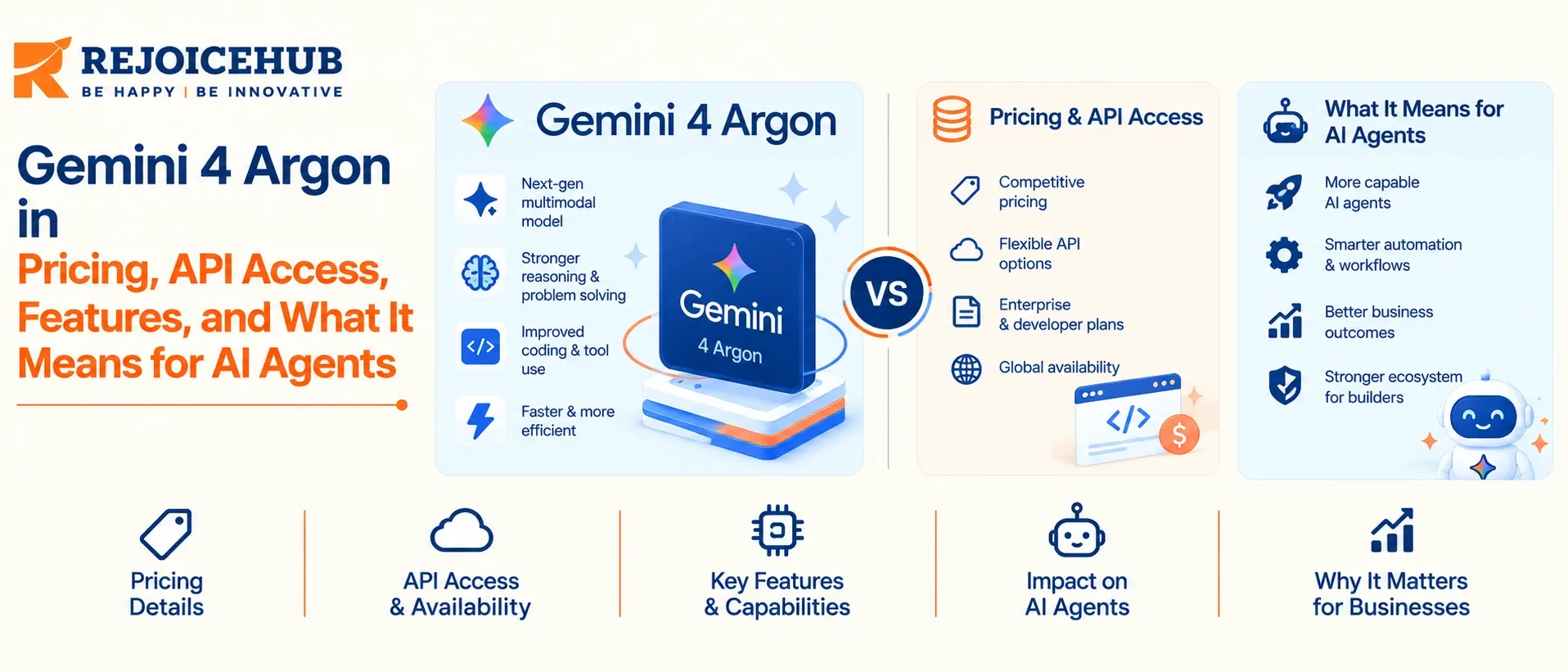
Three weeks ago, Gemini 4 Argon was only available to a tight group of qualified cybersecurity defenders. As of October 13th, however, any team with a paid Gemini API key or a Google Cloud project can take advantage of this new model.
It's hard to believe that there are still three questions haunting the release: what is the real context window size, what will the bill look like after November 30th, and will the benchmark table hold for my particular use-case?
We spent the day poring over Google's launch posts, the Gemini API model page, and Google Cloud's developer guide to answer these questions. Where they conflict with each other, we'll note that as well.
Quick Summary
- Gemini 4 Argon is Google's latest flagship reasoning model, unveiled on September 30, 2026, and available for paid API access and Google Cloud customers as of October 13.
- Focuses on long-horizon coding, finance/legal, and cyber defense workloads. Pricing starts at $2 per million input tokens and $10 per million output tokens through November 30, and then $4 and $20.
- Competitively priced compared to Claude Opus 5.5 and significantly lower than GPT-6 Astra by 60% on a list price basis.
- Independent benchmarks show Gemini 4 Argon is competitive with GPT-6 Astra and Claude Opus 5.5 on one metric, outperforming both on another. Pilot for extended document reasoning and long-horizon agents; do not adopt for production use cases.
Key Highlights
- Available now: Gemini API (paid tier), Google AI Studio, Google Antigravity, Google Cloud, and the Gemini app for AI Pro and Ultra subscribers
- **Model ID: gemini-4-argon
- Context window: 1,048,576 tokens, a unified input-plus-output limit
- Output: 65,536 tokens by default; up to 1,048,576 with long decode
- Price: $2 / $10 per 1M tokens until Nov 30, 2026; $4 / $20 after; cached input 95% off [Verified]
- Inputs: text, image, video, audio, PDF. Output: text only
- Guardrail: the public model blocks offensive cyber tasks such as pentesting [Verified]
- Biggest caveat: most benchmark numbers come from Google itself
What Is the Gemini 4 Argon Model?
Gemini 4 Argon is the first model in the Gemini 4 series, and the first Gemini flagship to use a codename instead of the Pro/Flash tiers. Google is positioning it for 'deep work': multi-step. The rollout was staged, which is why early articles contradict current ones:
| Date | What happened | Basis |
|---|---|---|
| Sept 30, 2026 | Announced; access limited to vetted defenders via the Fairwind Program | |
| Oct 13, 2026 | Available to all on Google Cloud, in the Gemini API (paid tier), AI Studio, and Antigravity | Google Cloud blog |
| Oct 13, 2026 | Added to the Gemini app for Google AI Pro and Ultra subscribers | |
| Nov 30, 2026 | Introductory pricing ends | Google Cloud blog |
If you read a launch-week post saying "no API yet," it was right on September 30 and is out of date now.
Gemini 4 Argon Features: What the API Actually Supports
Google's API documentation lists the supported surface area [Verified]:
| Capability | Status |
|---|---|
| Function calling, structured outputs | Supported |
| Thinking levels | Low, medium, high (MINIMAL is not supported) |
| Code execution, file search, URL context | Supported |
| Grounding with Google Search and Maps | Supported |
| Computer use | Supported (Preview) |
| Caching | Implicit only; explicit caching not supported |
| Image generation, audio generation, Live API | Not supported |
Two things stand out to builders. Firstly, there is no explicit caching, so you cannot pin a large prefix and control its lifetime; instead, you have to rely on implicit cache hits. Secondly, if you are migrating from Gemini 3.1 Pro, then you should remove any
MINIMALGoogle claims that Argon is the most resilient model to indirect prompt injection in Google, cutting the success rate in an internal benchmark of 15 adaptive attempts to 0.7%. Google has not demonstrated that number for its competitors in the post we have read, so it should be taken as a claim to test, not a guarantee.
Gemini 4 Argon Context Window and the 1M Output Limit
This is where most of the blog posts were wrong, so here we check the source.
Several outlets reported at launch that Google had not published an input window and that "1M" was only an output.
The Gemini API model page now has a context window of 1,048,576 tokens listed as a unified input-and-output limit, with a default max output of 65,536 tokens and up to 1,048,576 with long decode.
Read that again. A million-token output limit is possible only if your input is small, since they share a budget. You have to opt into long decode, as a default call will stop at 65,536 output tokens.
Why does output number matter? Google said Argon agents are migrating C/C++ to Rust, up to 800K+ lines for the Fuchsia Zircon kernel [Verified]. That is also the risk.
A model that can write 800,000 lines in one run produces a diff that no human reviews line by line. The bigger the output limit, the more your test suite and review gates matter.
Gemini 4 Argon Pricing and API Cost
Google's published rates [Verified]:
| Period | Input / 1M tokens | Output / 1M tokens | Cached input / 1M |
|---|---|---|---|
| Introductory (through Nov 30, 2026) | $2 | $10 | $0.10 [Our math] |
| Standard (from Dec 1, 2026) | $4 | $20 | $0.20 [Our math] |
Cached input is priced at 95% off the input rate [Verified]; the dollar figures are our arithmetic.
Worked example: Gemini 4 Argon API cost per task. Take an agent run that reads 200K tokens and writes 60K tokens. We chose these numbers; they are not a benchmark.
| Model | Input rate / Output rate | Cost for 200K in + 60K out |
|---|---|---|
| Gemini 4 Argon (intro) | $2 / $10 | $1.00 |
| Gemini 4 Argon (standard) | $4 / $20 | $2.00 |
| Claude Opus 5.5 | $4 / $20 | $2.00 |
| GPT-6 Astra (prompt ≤272K) | $10 / $50 | $5.00 |
A maximal 1M-token output costs $10 at intro pricing and $20 at standard pricing [Our math], before any input.
Three notes on cost that the sticker price hides:
- Verbosity changes the bill. Artificial Analysis reportedly measured $1.99 per average task for Argon, against $3.26 for GPT-6 Astra and $5.98 for Claude Opus 5.5, but also found Argon used more tokens than the median model to complete its index (110M vs 82M). Engadget independently reports Argon matching Astra's index score at 60% of the cost per task at current discounted prices.
- Thinking tokens bill as output. Third-party pricing guides say so. Confirm in your own billing console on the first day.
- Plan for the standard rate. The intro price ends in about six weeks. Budget at 4/20 and treat the discount as upside [Opinion].
We found no published long-context surcharge or batch discount for Argon, but pricing pages change; check Google's before you commit. By contrast, OpenAI charges GPT-6 Astra requests above 272K input tokens at $20 / $75 for the full request.
How to Use Gemini 4 Argon: Getting Started with API Access
You can also use Gemini 4 Argon through the Gemini Enterprise Agent Platform on Google Cloud or use Google Antigravity for AI-powered coding tasks.
Steps to Use the Gemini API
- Create an API key: Create a paid-tier API key in Google AI Studio. Gemini 4 Argon is not available on the free tier.
- Update the SDK: Use a supported version of Google's SDK for Python, JavaScript, or Go.
- Set the model name: Use
in your API request.gemini-4-argon - Choose a thinking level: Select low, medium, or high instead of
.MINIMAL - Test before launch: Run your own tests to check the model's accuracy and performance before using it in a live application.
Here is a basic Python example based on Google's SDK pattern. This code has not been tested, so verify it with your installed SDK version.
from google import genai

client = genai.Client()

response = client.models.generate_content(
    model="gemini-4-argon",
    contents="Review this function for race conditions: ..."
)

print(response.text)
For Google Cloud, configure the client with
enterprise=Truelocation="global"gemini-4-argon-cyber-permissiveGemini 4 Argon vs GPT-6 Astra vs Claude Opus 5.5
Specs first, because they are the easiest to verify:
| Gemini 4 Argon | Claude Opus 5.5 | GPT-6 Astra | |
|---|---|---|---|
| Released | Sept 30, 2026 [Verified] | Sept 22, 2026 | Sept 3, 2026 |
| Context window | 1,048,576 (shared in/out) [Verified] | 1M | 1,050,000 |
| Max output | 65,536 default; 1M long decode [Verified] | 128K | 128K |
| List price in/out per 1M | 2/10 intro, then 4/20 [Verified] | 4/20 | 10/50 |
Now performance. These are the figures that decide most evaluations, and they come with a warning: the first table is Google's own, compiled by a third party, and DataCamp noted that no one had reproduced it at launch.
| Benchmark (vendor-reported) | Argon | GPT-6 Astra | Opus 5.5 |
|---|---|---|---|
| DeepSWE v1.1 | 77.9% | 74.1% | 74.2% |
| Terminal-Bench 4.0 | 57.4% | 58.2% | 66.4% |
| FrontierSWE v2 | 55.0% | 65.5% | 62.3% |
| Vals Index | 68.9% | 63.1% | 67.0% |
Google itself states the DeepSWE v1.1 score of 77.9% and the Vals Index lead. The competitor columns and the other rows come from a secondary compilation:
Independent measures tell a more mixed story:
| Independent measure | Argon | GPT-6 Astra | Opus 5.5 |
|---|---|---|---|
| Artificial Analysis Intelligence Index | 52.6 | 52.7 | 57.6 |
| Artificial Analysis cost per task | $1.99 | $3.26 | $5.98 |
Argon looks strongest on long document-and-reasoning work and cost per task, and weaker on terminal-driven and large-codebase agent tasks, where Opus 5.5 and Astra lead on the numbers above. No single model wins every row. Pick by workload, not by headline.
Gemini 4 Argon vs Claude: Opus 5.5 matches Argon at standard list price, and the sources we read show it ahead on Terminal-Bench 4.0 and the Artificial Analysis index. Argon leads on DeepSWE and the Vals Index in Google's reporting [Verified]. Gemini 4 Argon vs GPT-6 Astra: near parity on the independent index, with Argon cheaper at list.
Gemini 4 Argon for Business: 6 Workloads Worth a Pilot
Google's own customer claims point at these. Each is a vendor or partner claim [Verified] unless noted, so run a pilot before you plan around it.
- Legal research and drafting. Harvey reports substantial gains over Gemini 3.1 Pro in its legal agent evaluations, including M&A and data privacy.
- Financial reconciliation and variance analysis. Google cites multi-step ledger reconciliation and spreadsheet formula work, and a Vals Index lead covering finance, coding, legal, and tax.
- Large codebase refactors. Google says its Chrome team finished an architectural refactor across hundreds of files in Chromium's 40-million-line codebase in weeks rather than months.
- Code optimization. Google reports Argon agents cut in-memory session prep time by 40% and sped cold imports by 21% in the open-source ADK, working overnight within automated test guardrails.
- Vulnerability remediation. Argon ties for first on CWE-bench v1 at 68% (vendor-reported). The public model blocks offensive tasks; defenders use tools like CodeMender or their own harness.
- Service-desk automation. ServiceNow reports roughly 20% better task success than Gemini 3.8 Flash in early access.
Gemini 4 Argon AI Agents: How We Would Put It in Production
Argon's selling pitch is a multi-step process that involves breaking down a work and checking its progress and then edits several documents at a time. Google claims they were trained to wait for approval before undertaking any irreversible actions. This behavior is a default at the model level, and we would not depend solely on it.
Our architecture recommendation [Opinion]:
- Put a model-agnostic gateway in front of it. Routing, logging, and policy should not change when you swap Argon for Opus or Astra.
- Build an eval set from your own tasks first. Run Argon, Opus 5.5, and Astra on 50 to 100 real tickets, documents, or pull requests. Score cost per accepted result, not cost per token.
- Scope tool permissions tightly. Read-only by default; write access per task, expiring.
- Require human approval for irreversible actions. Payments, deploys, deletions, external emails.
- Cap output length and diff size. Do not enable the 1M long decode in production until reviewers can handle what it produces.
- Test prompt injection yourself. Feed hostile content through every document, email, and web page the agent reads.
The same checklist applies to any frontier model. Argon's output limit just raises the stakes. If you are designing several agents that hand work to each other, our notes on multi-agent systems and AI governance and security cover the controls in more depth. Related reading: AI agent security checklist for SaaS CTOs.
Gemini 4 Argon Pros and Cons
Pros
- Introductory price of 2/10 is the lowest list price among the three flagships we compared
- Strong vendor-reported results on long-horizon coding, legal, finance, and business automation
- Accepts text, image, video, audio, and PDF in one model
- Output limit up to 1M tokens, 16x the previous 64K
- Broad availability from day one: API, AI Studio, Antigravity, Google Cloud, Gemini app
Cons
- Standard price from December 1 equals Claude Opus 5.5 and loses the cost edge [Verified/Reported]
- Most benchmark numbers are Google's own and not yet widely reproduced
- Behind Opus 5.5 on the Artificial Analysis index and Terminal-Bench 4.0
- Text-only output; no image generation, audio generation, or Live API
- No explicit caching; cost control relies on implicit hits [Verified]
- Public model blocks offensive security work, which limits red-team use
- Verbose token usage can erode the per-token discount
Should You Adopt Gemini 4 Argon Now? [Opinion]
| If your team... | Our suggestion |
|---|---|
| Runs document-heavy legal, finance, or research agents | Pilot Argon now, against your own eval set |
| Runs terminal-driven coding agents | Benchmark Argon against Opus 5.5 before moving |
| Is cost-sensitive at high volume | Model costs at the 4/20 rate, not the intro rate |
| Needs offensive security testing | Argon's public model is not the tool; look into the Fairwind route |
| Already runs on Google Cloud | Lowest-friction path; start in the Agent Platform |
Ready to move from model comparison to a working agent? RejoiceHub builds multi-model agent systems with the gateway, evals, and approval controls described above. Explore our AI agent development services or see how we handle AI integration
Conclusion
Gemini 4 Argon is a promising AI model with useful features for coding, reasoning, and business automation. Its introductory pricing makes it more affordable before December 1, 2026, but costs will increase after that date. While Google provides the strongest evidence about its capabilities, independent testing is still developing.
Before using it in your business, test the model on your own tasks, check its accuracy, and estimate costs using the standard pricing. Also, keep your system flexible enough to switch between AI models without rebuilding your entire application when better options become available.
Frequently Asked Questions
What is Gemini 4 Argon?
Gemini 4 Argon is Google’s new flagship reasoning model, released on September 30, 2026. It handles long coding, finance, legal, and security tasks. Since October 13, anyone with a paid Gemini API key or Google Cloud project can use it
How much does Gemini 4 Argon cost?
Gemini 4 Argon costs $2 per million input tokens and $10 per million output tokens until November 30, 2026. After that, the price moves to $4 and $20. Cached input gets a 95% discount, which helps when you reuse prompts.
What is the Gemini 4 Argon context window?
The Gemini 4 Argon context window is 1,048,576 tokens, shared between input and output. Default output is 65,536 tokens. Long decode can reach 1,048,576 output tokens, but only when your input stays small, so plan your prompt size before starting.
How do I use the Gemini 4 Argon API?
Create a paid API key in Google AI Studio, update your Google SDK, and set the model name to gemini-4-argon. Choose a low, medium, or high thinking level. Test it on your own tasks first, well before sending real traffic.
Is Gemini 4 Argon free to use?
No, Gemini 4 Argon is not on the free tier of the Gemini API, so you need a paid key. In the Gemini app, it is open to Google AI Pro and Ultra subscribers, both paid plans, since October 13.