
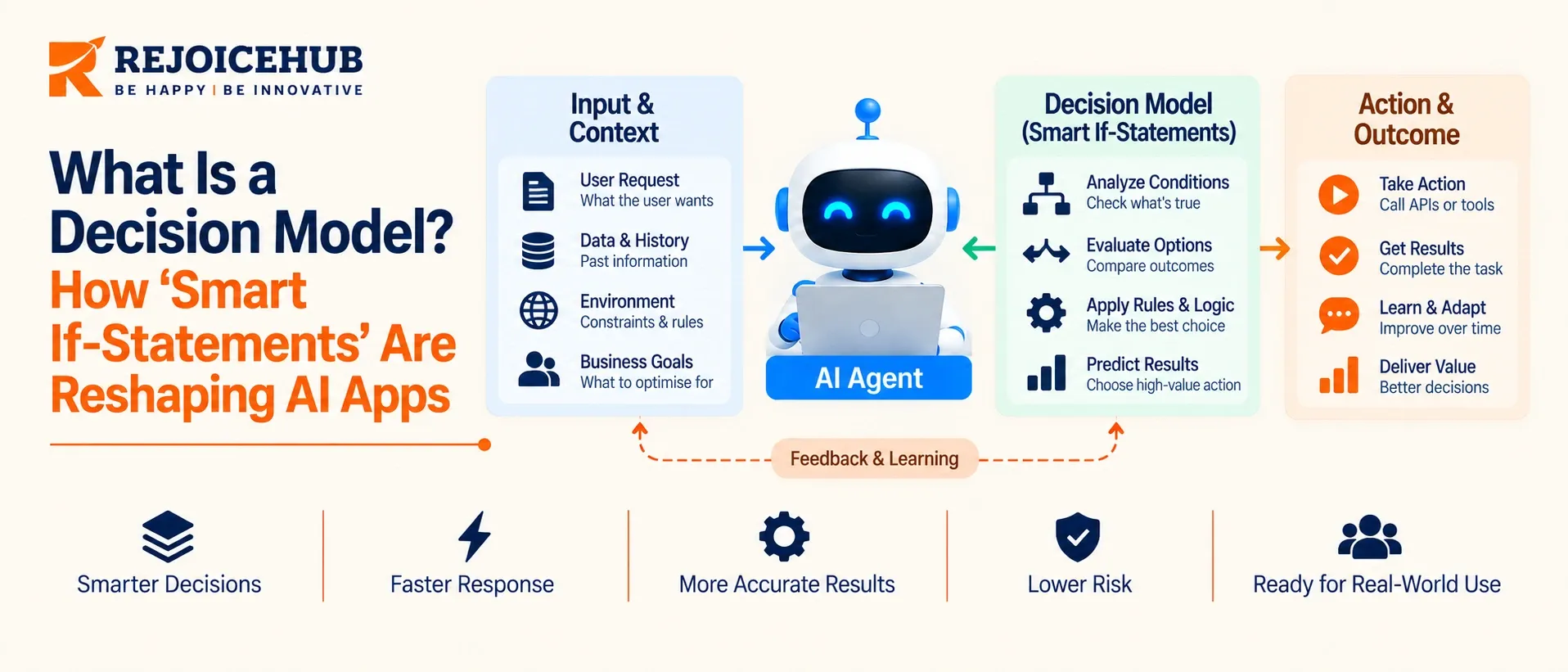
Your AI agent approves a refund it shouldn't have. The same request, sent twice, gets two different answers.
Your compliance lead asks which rule fired, and the honest answer is "the model decided."
That's the sort of failure that makes a decision model a hot idea for production AI these days.
Think of it as an old-school if-statement, but one that's structured and auditable enough to give your AI application a spine.
Quick Summary
A decision model is a precise description in machine-encoded form of how a decision gets made. It includes things like the inputs that contribute to a decision, the rules that get applied, the outputs that get produced, plus the logic that connects them.
In AI applications, it serves as a predictable layer alongside the LLM. The LLM interprets messy, unstructured input.
The decision model makes the call that has to be correct, consistent, and auditable.
Teams building decision-making systems in AI in 2026 are increasingly splitting up the work in this way as it reduces cost, latency, and compliance risk.
Key Highlights
- A decision model separates what gets decided from how a process runs, so business rules can change without redeploying code.
- The most widely used standard is DMN (Decision Model and Notation), built around decision requirements diagrams and decision tables.
- In a published 2026 evaluation, a deterministic control layer reached 100% policy compliance against 91% for the best LLM tested.
- A good AI decision engine uses the LLM for interpretation and deterministic rules for enforcement.
- Every decision becomes traceable: inputs, matched rule, output.
- Start small: pull one high-stakes decision out of your prompt and into a decision table.
Why Decision Models Matter for AI Apps in 2026
Early LLM applications embedded all the nuance of tone, policy, thresholds, and escalation paths within the prompt. This works well enough in demos, but in production, it drifts.
Agents are now calling tools, APIs and initiating real-world flows. A wrong answer is no longer an awkward conversation, but a wrongly issued refund, a mis-routed claim or an unauthorized data export.
Regulation and audit practice have also evolved. One 2026 guardrail overview notes that security and compliance audits now require evidence of runtime policy enforcement, rather than merely policy documents.
A block decision plus a log is evidence. A prompt that told the model to refuse is not.
Engineering teams have arrived at a consistent conclusion: that LLMs should be used to handle the flexible, human-like aspects of an interaction, while deterministic execution handles the more correctable and systematic elements.
A decision model is a way of building out that second half.
What Is a Decision Model?
A decision model is a formal description of a decision, including the data inputs, the logic used, and the outputs. It is expressed in a formalism understandable to both people and machines.
DMN (Decision Model and Notation), which was created by the Object Management Group (OMG), to formalize the representation of decision logic and separate it from the process. Business analysts can read the rules in it, and engineers can execute them.
In plain terms, a decision model is a smart if-statement. A naive if-statement lives inside application code and is hard to audit. A decision model gives you:
- Declarative rules: you describe the conditions and outcomes, not the control flow.
- Tabular logic: rules sit in a decision table, not buried in nested branches.
- Versioning and testing: each rule set can be tested and rolled back independently.
- Clear Explanation: the engine reports which rule matched and why.
Here is the shape of a small loan-triage decision table:
| Credit score | Debt-to-income | Document check | Decision |
|---|---|---|---|
| ≥ 720 | < 36% | Passed | Auto-approve |
| 660–719 | < 43% | Passed | Route to underwriter |
| < 660 | any | any | Decline with reason code |
| any | any | Failed | Request documents |
No model weights, no temperature setting. Same inputs, same output, every time.
Decision Models in AI: Where They Sit in the Stack
In AI applications, the decision model typically sits between the LLM and the action. The LLM reads a loan email, a support ticket or a contract and extracts structured fields and the decision model takes those fields and decides.
This pattern is now coming up in enterprise architecture discussions. One 2026 conference session talks about agents gathering context from documents and systems of record, assembling what the decision model needs, then invoking it as a skill for risk classification, giving a result that's deterministic and fully traceable.
That's the whole point behind an AI decision engine: letting the model interpret and rules decide.
Benchmark: Deterministic Rules vs LLM Decisions
The following table summarizes where the two approaches differ. The numbers on compliance and latency are from a single 2026 preprint evaluating a deterministic control plane against state-of-the-art LLMs. They should be treated as directional, as these numbers vary widely based on the workloads and implementations used.
| Dimension | LLM-only decision | Decision model/rules engine |
|---|---|---|
| Policy compliance (study result) | Best model tested: 91% | 100% |
| Latency | Milliseconds to seconds per call | Microsecond range in the study (~40.6 μs) |
| Inference cost per decision | Token cost on every call | Effectively zero |
| Consistency | Can vary from run to run | Identical output for identical input |
| Audit trail | Reconstructed after the fact | Native: inputs, matched rule, output |
| Handles unstructured input | Yes | No, needs structured fields |
| Change management | Prompt edits, re-testing | Edit a rule, version it, test it |
In the study, the best-performing model achieved 91% compliance, whereas the deterministic control plane achieved 100% with latency of approximately 40.6 microseconds, as opposed to millisecond scale for LLM systems.
The authors argue that certain governance functions may be better served by deterministic enforcement layers rather than relying on probabilistic reasoning.
The issue is not that LLMs are poor at making decisions, but that you shouldn't be paying for, or betting your life on, a probabilistic answer when a rule provides a proven one.
Decision Model vs LLM-Only: Which Fits Your AI Application?
You are not choosing one or the other. You are choosing a boundary.
| Use a decision model when... | Use the LLM when... |
|---|---|
| The rule is written in a policy, contract, or regulation | The input is free text, voice, or images |
| A wrong answer has legal or financial cost | The task is summarizing, drafting, or classifying intent |
| You must explain the outcome to an auditor | The "right" answer is subjective |
| Thresholds change often and need approval | Context needed is broad and unpredictable |
| Volume is high and per-call cost matters | Volume is low and flexibility matters |
A useful test: if you could write the rule on a whiteboard, it probably shouldn't live in a prompt.
6 Signs You Need a Decision Model for Your AI Application
- Your agent gives different answers to the same input. Variance is acceptable in a draft email and unacceptable in an eligibility check.
- Policy lives in a 3,000-word system prompt. Nobody can test it, diff it or approve changes to it.
- Compliance can't see which rule fired. Without a decision log, you can't answer "why was this denied?"
- Business users keep asking engineers to change thresholds. A decision table lets them propose changes in a reviewable format.
- LLM costs are climbing on repetitive decisions. Routing, tiering and eligibility checks rarely need a frontier model.
- You're adding tool-calling to production agents. Once an agent can act, you need an enforcement point between its intent and the action. Our AI strategy consulting team often starts here.
Core Building Blocks of an AI Decision Model
DMN provides a useful vocabulary even if you don’t adopt the standard.
A DMN model contains a Decision Requirements Diagram, which displays the model’s structure, and decision tables, which contain the business logic. The standard defines the following elements:
- Decision Requirements Diagram (DRD): A diagram that visualizes the decision structure, that is, the inputs and sub-decisions for each decision. This allows you to display decision relationships at a high level before diving into detail.
- Decision tables: They define rows (rules) and columns (conditions and actions). This element is the core of the AI decision model.
- Business Knowledge Models: The standard allows you to extract business logic and functions into separate building blocks for reusability. Here you can define various decision logic, such as a business rule for identifying a high-risk customer.
- Expression language: Decision tables use FEEL (Friendly Enough Expression Language), an open standard for writing rules in a human-readable format understandable by computers.
- Hit policy and conflict resolution: The hit policy defines how decision tables process conflicting rules.
Modern decision engines implement various policies, including priorities and resolution algorithms (first match wins, best match wins, etc.), thus allowing decision logic to be structured at three levels: enterprise, team, and application.
What a Production AI Decision Engine Includes
A production AI decision engine is more than a rules file. Plan for:
- A rules runtime that executes decision tables or compiled rules via API, WASM or embedded library.
- Input validation so malformed LLM output never reaches the rules.
- Decision logging that captures inputs, matched rules, outputs and downstream outcomes. Good governance depends on every decision being observable and attributable.
- Version control and testing with regression suites run on every rule change.
- Escalation paths for cases no rule covers, usually a human-in-the-loop queue.
- Integration points at the LLM gateway, the tool-call layer or the workflow engine, often delivered through AI integration services.
The Decision Model Landscape: Options Beyond RejoiceHub
There is no single correct tool, and the right choice depends on your stack.
- DMN-based engines such as Drools or Camunda's decision engine suit teams that want standard notation and business-user readability.
- Policy engines such as Open Policy Agent (OPA) use Rego and fit authorization and infrastructure policy well.
- Lightweight rule engines (JSON-based or Rust-based) suit high-throughput, low-latency cases.
- LLM guardrail frameworks such as NVIDIA NeMo Guardrails and Guardrails AI focus on input and output screening for model calls.
- Custom services work when rules are few and stable, but they sacrifice auditability if you skip the logging layer.
Where RejoiceHub fits: we design the architecture between these pieces, meaning which decisions go deterministic, how the agent invokes them, and how the audit trail is stored. We are tool-agnostic, and if your existing rules engine does the job, we'll build on it rather than replace it.
Architecture Pattern: LLM Proposes, Decision Model Disposes
The reference pattern for AI decision-making systems has five steps:
- Ingest. The LLM reads the unstructured input and extracts structured fields.
- Validate. A schema check rejects malformed or out-of-range fields before anything runs.
- Decide. The decision model evaluates the fields and returns an outcome with the matched rule ID.
- Act or escalate. The agent executes the approved action or routes to a human when no rule matches.
- Log. The full decision record goes to your audit store.
Layer your checks by cost. The practical advice in 2026 guardrail design is to stage them, running cheap deterministic detectors first and judge-model checks second. Done well, a deterministic check can also short-circuit the pipeline so a triggered input guardrail skips the LLM call entirely. That saves cost and keeps unsafe requests away from the model.
Security checklist for the decision layer:
- Treat LLM-extracted fields as untrusted input and validate type, range and enum.
- Never let model output edit the rules at runtime.
- Keep rule changes behind code review and approval.
- Log rule version with every decision for later replay.
- Test boundary values, not just the happy path.
For a deeper security walkthrough, see our guide on AI agent security and how decision layers fit into multi-agent systems.
Conclusion
Aim to codify decisions that must be right out of the prompt and into tested, versioned rules; you'll keep the LLM's flexibility where it helps and cut risk where it hurts.
Start with one decision: a refund threshold, a routing rule, or an eligibility check. Model it as a decision table, wire it in as a tool your agent must call, and measure the difference in consistency and cost.
Frequently Asked Questions
What is a decision model?
A decision model is a clear set of rules that shows how a decision gets made. It lists the inputs, the conditions, and the final outcome. Teams use it so similar cases always get the same answer every single time.
What is a decision model in AI?
In AI, a decision model is a rule layer that sits next to the AI model. The AI reads messy input, then the decision model applies fixed rules to pick the final outcome and records exactly which rule it used.
What are smart if statements?
Smart if statements are just decision models written as simple tables or rules instead of code. They work like normal if-then logic, but you can test them, version them, and read them without being a developer or touching any code.
How does an AI decision engine work?
An AI decision engine takes structured data, checks it against your rules, and returns a clear outcome. It also logs the matched rule. The AI model usually prepares the data first, and the engine makes the final call each time.
Is a decision model the same as a machine learning model?
No. A machine learning model learns patterns from past data and gives a probable answer. A decision model follows rules you wrote yourself. Many apps use both, with the ML model giving a score and the rules acting on it.
When should I use a decision model instead of an LLM?
Use a decision model when the rule is already written down and a wrong answer costs money or trust, like refunds, eligibility, or approvals. Use the LLM for messy free text, summaries, and judgment calls where answers can reasonably vary.
What is DMN in decision modeling?
DMN stands for Decision Model and Notation. It is a standard from the Object Management Group for drawing, sharing, and running business decisions. It uses diagrams and decision tables so business teams and engineers can both read the same rules.
Why do AI apps need a decision model?
AI apps need a decision model because LLMs can give different answers to the same question. A decision model keeps important choices consistent, easy to audit and explain, and cheaper to run, since it does not need a model call.
What are examples of AI decision-making systems?
Common real-world examples include loan approval tools, insurance claim routing, fraud detection checks, customer support ticket triage, and refund approval agents. In most of them, AI reads the incoming request first and then a decision model applies your business rules.
How do I add a decision model to an AI application?
Pick one simple rule-based decision currently buried in your prompt, such as a refund limit. Write it as a decision table, call it from your agent as a tool, log every result, and compare the output with the old results.
