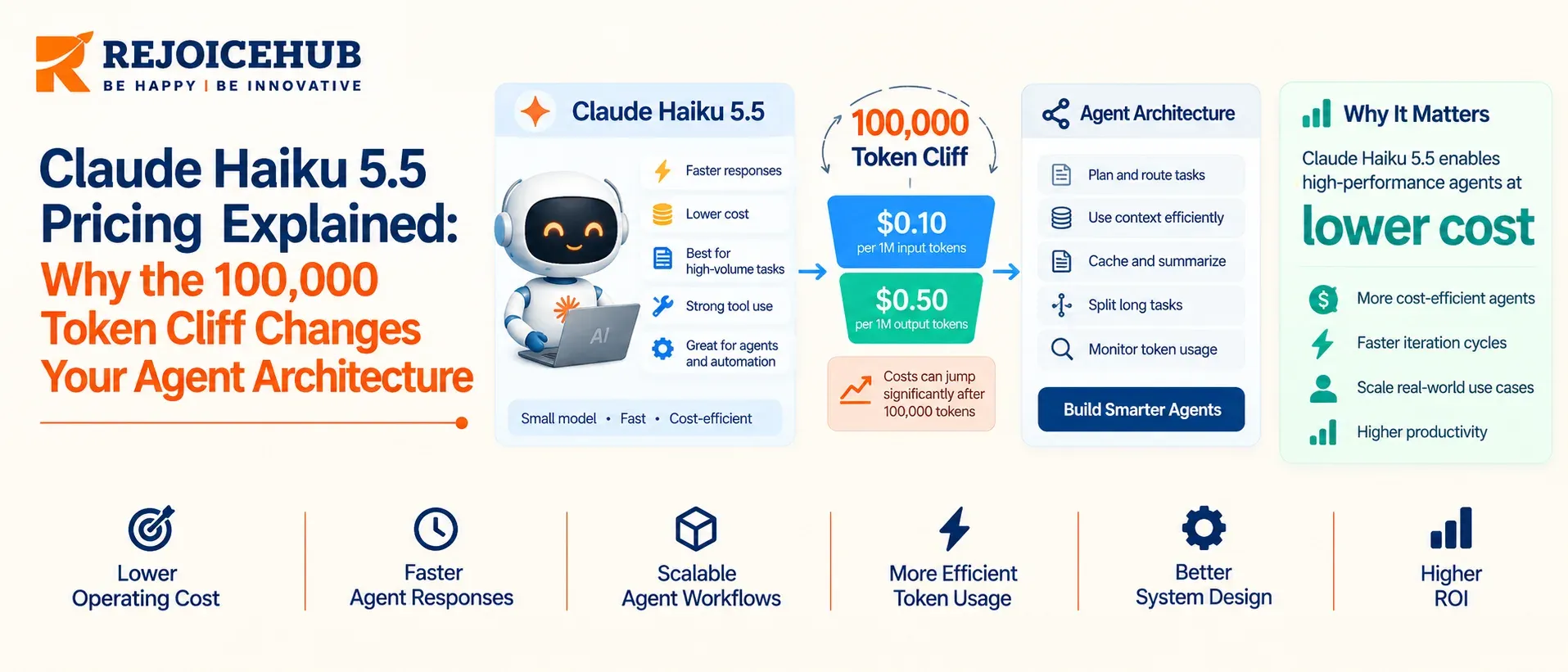
Your agent passes every test at 90,000 tokens of context. In production, a long tool result pushes a single request to 100,001 tokens and increases the per-token price of that request fivefold.
Nothing fails. Nothing warns. The invoice is the first place anyone sees an issue.
Claude Haiku 5.5 is the cheapest model Anthropic has shipped, and it is the first current Claude model to be priced by prompt length.
This guide covers the exact rates, the cost math at every context size, and the architecture changes that keep agents on the cheap side of the line.
Claude Haiku 5.5 Pricing: What Changed on October 7, 2026
Anthropic announced Claude Haiku 5.5 this morning (October 7, 2026, API model ID claude-haiku-5-5). Anthropic is positioning it as especially suitable for high-volume, low-latency applications that involve classification, extraction and routing.
Claude Haiku 5.5 has a 1M token context window and can deliver up to 128K output tokens, compared to 200K on Haiku 4.5.
The key announcement, however, is the price: $0.10 per million input tokens and $0.50 per million output tokens, versus a flat $1 and $5 for Haiku 4.5. That compares to a 90% reduction on the rate card. But three details in Anthropic's pricing documentation will determine whether you're actually able to realize it:
- The tier applies to the whole request. A prompt over 100,000 tokens is billed at the higher rate on every token, not only the tokens past the line.
- Cached tokens count toward the threshold. Prompt length includes cache reads and cache writes. A request over the line pays the higher price even when most of its prompt is a cache hit.
- The tokenizer counts more. Claude 4.7 and later models produce roughly 30% more tokens for the same text than Sonnet 4.6 and earlier, and that includes Haiku 5.5 versus Haiku 4.5.
On Anthropic's pricing page, Haiku 5.5 is currently the only model that has been carved out of the standard long-context rule. Claude 4.6-and-later models otherwise bill a 900K-tokens request at the same per-token rate than a 9K one. This is why "Claude Haiku 5.5 context window" and "Claude Haiku 5.5 100K token limit" are not the same question: the window size is 1M tokens. The 100K figure is a price threshold, not a limit.
Claude Haiku 5.5 API Pricing: The Full Rate Card
| Rate (per 1M tokens) | Prompt up to 100K | Prompt over 100K | Haiku 4.5 (flat) |
|---|---|---|---|
| Input | $0.10 | $0.50 | $1.00 |
| Output | $0.50 | $2.50 | $5.00 |
| Cache read (hit) | $0.01 | $0.05 | $0.10 |
| 5-minute cache write | $0.125 | $0.625 | $1.25 |
| 1-hour cache write | $0.20 | $1.00 | $2.00 |
| Batch API input | $0.05 | $0.25 | $0.50 |
| Batch API output | $0.25 | $1.25 | $2.50 |
A rate card hides the shape of the problem, so here is what one request costs as the prompt grows. Assumption: 1,500 output tokens per call, standard API, no caching.
| Prompt size | Haiku 5.5 cost per call | Sonnet 5.5 cost per call | Sonnet-to-Haiku ratio |
|---|---|---|---|
| 8,000 tokens | $0.00155 | $0.031 | 20x |
| 50,000 tokens | $0.00575 | $0.115 | 20x |
| 100,000 tokens | $0.01075 | $0.215 | 20x |
| 100,001 tokens | $0.05375 | $0.215 | 4x |
| 120,000 tokens | $0.06375 | $0.255 | 4x |
One additional token increases the price of a call from about 1 cent to about 5 cents, a 5x step. Haiku 5.5 is cheaper than Sonnet 5.5 on both sides of the line, but its advantage decreases from 20x to 4x.
Caching won't get you out. Take a 100,000-token request with 10,000 fresh and 1,500 output tokens.
That's 110,000 prompt tokens, so all rates fall into the higher tier: roughly $0.01375. Run the same shape at 90,000 prompt tokens (80,000 cached, 10,000 fresh) and it costs about $0.00255. Same hit rate in spirit, 5.4x more expensive. Caching reduces your cost on each side of the line. It doesn't shift the line.
Claude Haiku 5.5 vs Haiku 4.5 vs Sonnet 5.5 vs Opus 5.5: Which Model Fits Which Agent Step?
The decision is not "Haiku or Sonnet." It is which step of the agent gets which model, given how much context that step carries.
| Haiku 5.5 | Haiku 4.5 | ** Sonnet 5.5** | Opus 5.5 | |
|---|---|---|---|---|
| Input / output (per 1M) | $0.10 / $0.50 (over 100K: $0.50 / $2.50) | $1 / $5 | $2 / $10 | $4 / $20 |
| Cache read (per 1M) | $0.01 (over 100K: $0.05) | $0.10 | $0.10 | $0.20 |
| Context window | 1M | 200K | 1M | 1M |
| Max output | 128K | 64K | 128K | 128K |
| Batch input / output | $0.05 / $0.25 (over: $0.25 / $1.25) | $0.50 / $2.50 | $1 / $5 | $2 / $10 |
| Best fit | Narrow, high-volume steps | Legacy | General production | Planning, long-running work |
Two things: First, Anthropic themselves advertise Haiku 5.5 as being appropriate for narrowly focused tasks, and point to Sonnet 5.5 and Opus 5.5 for more complex agentic coding. Cheap does not mean interchangeable. Second, the math for migration being better than the rate card suggests is only true if you stay below the threshold. Because the new tokenizer counts about 30% more tokens, a prompt that was 77,000 tokens on Haiku 4.5 is about 100,000 tokens on Haiku 5.5.
Any agent whose Haiku 4.5 prompts would go above roughly 77K will cross the threshold on migration, without any changes to the code.
The tiering is also a vendor-specific choice. As per reports by MarkTechPost and Beam AI, GPT-6 Luna lists the same $0.10 / $0.50 base rate, but jumps to $0.20 / $0.75 only above 272K tokens, and Gemini 3.5 Flash-Lite is a flat rate. Check your current numbers on each vendor's pricing page, and compare on your own tasks, because token efficiency varies by model and effort setting.
7 Ways to Keep Claude Haiku 5.5 Agents Under the 100K Token Line
- Count tokens before you send. Add a pre-flight gate that measures the real prompt (system prompt, tool definitions, history, tool results) and routes or compacts when it passes a soft limit such as 75K. Section below has a sketch.
- Retrieve passages, not documents. Hand a subagent the three relevant sections of a filing, not the whole filing. A subagent that receives 120K tokens instead of 8K costs about 41 times more per call at 1,500 output tokens ($0.06375 vs $0.00155).
- Compact before the threshold, not after. Summarize older turns when the running prompt reaches roughly 75% of the line. Compaction is itself a Haiku 5.5 call, which is the kind of narrow summarization task the model is built for.
- Map-reduce long documents. A 400K-token document sent as one request costs $0.20 in input at the higher rate. Split it into five chunks of about 80K and the input costs $0.04, a 5x saving, plus a small reduce call. The trade-off is that cross-chunk reasoning is weaker, so use it for extraction and summarization, not for questions that need the whole text at once.
- Cap tool output. Tool results are the usual source of accidental growth. Return fields, not payloads. Truncate logs. Paginate search results. One unbounded API response can add 30K tokens to every later turn.
- Re-baseline after the tokenizer change. Re-measure p50 and p95 prompt sizes on Haiku 5.5 itself. Do not carry token counts over from Haiku 4.5.
- Watch retained reasoning. Beam AI reports that Haiku 5.5 keeps previous thinking blocks in context by default, so a long multi-turn subagent can drift over the line without receiving a large document. Check your own traces, and set effort deliberately, since higher effort generates more output tokens.
The Four Pillars of a Token-Aware Agent Architecture
The 100K tier does not call for a clever trick. It makes four existing engineering practices mandatory.
1. Context budgeting. Every model call gets a token budget that is enforced in code, the same way you enforce timeouts. The budget for a Haiku 5.5 step is below 100K by construction.
2. Tiered model routing. A stronger model plans and judges. Haiku 5.5 handles volume: extraction, classification, routing, summarization, compaction. In a multi-agent system, the cost of orchestrator output and hand-offs often exceeds the cost of the cheap workers. Keep briefs short and ask subagents for structured, minimal answers.
3. State outside the prompt. Long-lived memory belongs in a store the agent queries, not in an ever-growing transcript. This is where tool protocols such as MCP (Model Context Protocol) earn their place: the agent fetches what a step needs, when it needs it, instead of carrying everything forward.
4. Verification and observability. Cheap steps make wrong answers the expensive part. Log prompt tokens per call, alert when p95 for a step passes 80K, and add schema checks on subagent outputs. A second Haiku 5.5 verification pass on key fields costs a small fraction of the run.
What a Token-Cost and Agent Architecture Review Covers
When RejoiceHub reviews an agent system for cost exposure around a tiered model like Haiku 5.5, the deliverables are concrete:
- A per-step token profile: p50, p95 and max prompt size for every model call in the workflow
- A list of steps within 25% of the 100K threshold, ranked by call volume
- A routing map assigning each step to Haiku, Sonnet or Opus with a stated reason
- A compaction and retrieval design for the steps that grow across turns
- Pre-flight token gating and per-step cost dashboards, wired into your existing tracing
- A regression eval suite so a model swap on one step can be tested without touching the rest
- A migration checklist for the tokenizer change, effort settings, and refusal handling
Haiku 5.5 Billing Modes: Standard, Batch, Caching and Data Residency
Haiku 5.5 represents an excellent value within Claude's stack for subagent processing where brevity of prompts is a concern. It is not universally optimal.
Artificial Analysis (via Beam AI) benchmarks the model at 43 on the Intelligence Index at max effort, and 34 at a default medium effort versus 17 for Haiku 4.5 while generating approximately 8x more tokens in the former test, when using max context.
GPT-6 Luna and Gemini 3.5 Flash-Lite represent potential flat-rate competitors within the same general pricing bracket, with differing expectations regarding long-prompt context windows.
RejoiceHub is designed to be model-agnostic for multi-agent processing, and thus you should evaluate your specific use-case when selecting an option. If your steps routinely require context beyond 100K tokens which cannot be meaningfully chunked, a flat-rate competitor or Sonnet 5.5 would represent better value in many practical cases.
If your prompt lengths are shorter, Haiku 5.5 is exceptionally difficult to beat, and you should test both options on your specific data before committing to one.
How the 100K Cliff Changes an Agent Loop: A Worked Example
The best case scenarios are in loops where context builds on itself.
Imagine a single agent chatting with Haiku 5.5. Let's say there's a 10K token system prompt plus tool definitions. Plus another 4K tokens per turn for the results and messages from the tools called, 500 output tokens per turn, 30 turns, standard API, no caching, and no reasoning tokens (which would add to the output).
| Strategy | Turns over 100K | Total cost per session | Max prompt size |
|---|---|---|---|
| Append-only history | 8 of 30 (turns 23 to 30) | about $0.60 | 130K |
| Compact at turn 18 (82K prompt to a 3K summary) | 0 | about $0.15 | 61K |
A lot of the math here is just illustrative, using Anthropic's published pricing models. The main reason is to illustrate how these costs scale, since you'll want to measure what's driving your costs to reduce them.
In the 'append only' run, 22 turns under the line cost about $0.13 in total. The final 8 turns cost about $0.47. Eight of 30 turns, 27% of the calls, produce about 79% of the bill.
The compacted run costs roughly a quarter as much, because it never crosses. At 10,000 sessions a month, that is about $6,000 versus $1,500, from a change that adds one summarization call.
These numbers are illustrative and use Anthropic's published rates. Your multiplier depends on turn growth and output volume, which is why the first step is measurement.
Conclusion
Haiku 5.5 makes the cheap step cheap, and moves the risk of large cost surprises to the context size.
Treating 100K tokens as an architectural constraint and baking it into the code is how you get the savings Anthropic is advertising.
Ignore it and a single long tool call eats up most of your budget. Your next step is simple: measure your p95 prompt size per step this week.
Frequently Asked Questions
How much does Claude Haiku 5.5 cost per million tokens?
Claude Haiku 5.5 API pricing is $0.10 per million input tokens and $0.50 per million output tokens when your prompt is 100,000 tokens or less. Above that, the rates jump to $0.50 input and $2.50 output for the whole request.
What is the Claude Haiku 5.5 100K token limit?
It is not a hard limit. Claude Haiku 5.5 accepts prompts up to 1 million tokens, but the 100K mark is a price line. Past it, the whole request is billed at five times the usual rate for every token.
Does Claude Haiku 5.5 pricing change over 100K tokens?
Yes, it does. Claude Haiku 5.5 pricing over 100K tokens is $0.50 per million input and $2.50 per million output, five times the lower tier. The higher price applies to every token in that request, not only the extra ones.
What is the Claude Haiku 5.5 context window?
The Claude Haiku 5.5 context window is 1 million tokens, with up to 128K output tokens. That is a big jump from Haiku 4.5, which had 200K context. Just remember the price per token changes once a prompt passes 100K.
Do cached tokens count toward the Claude Haiku 5.5 100K token limit?
Yes. Anthropic counts cache reads and cache writes as part of prompt length. A request over 100K tokens pays the higher rates even if most of it is a cache hit, so caching alone cannot save you from the jump.