
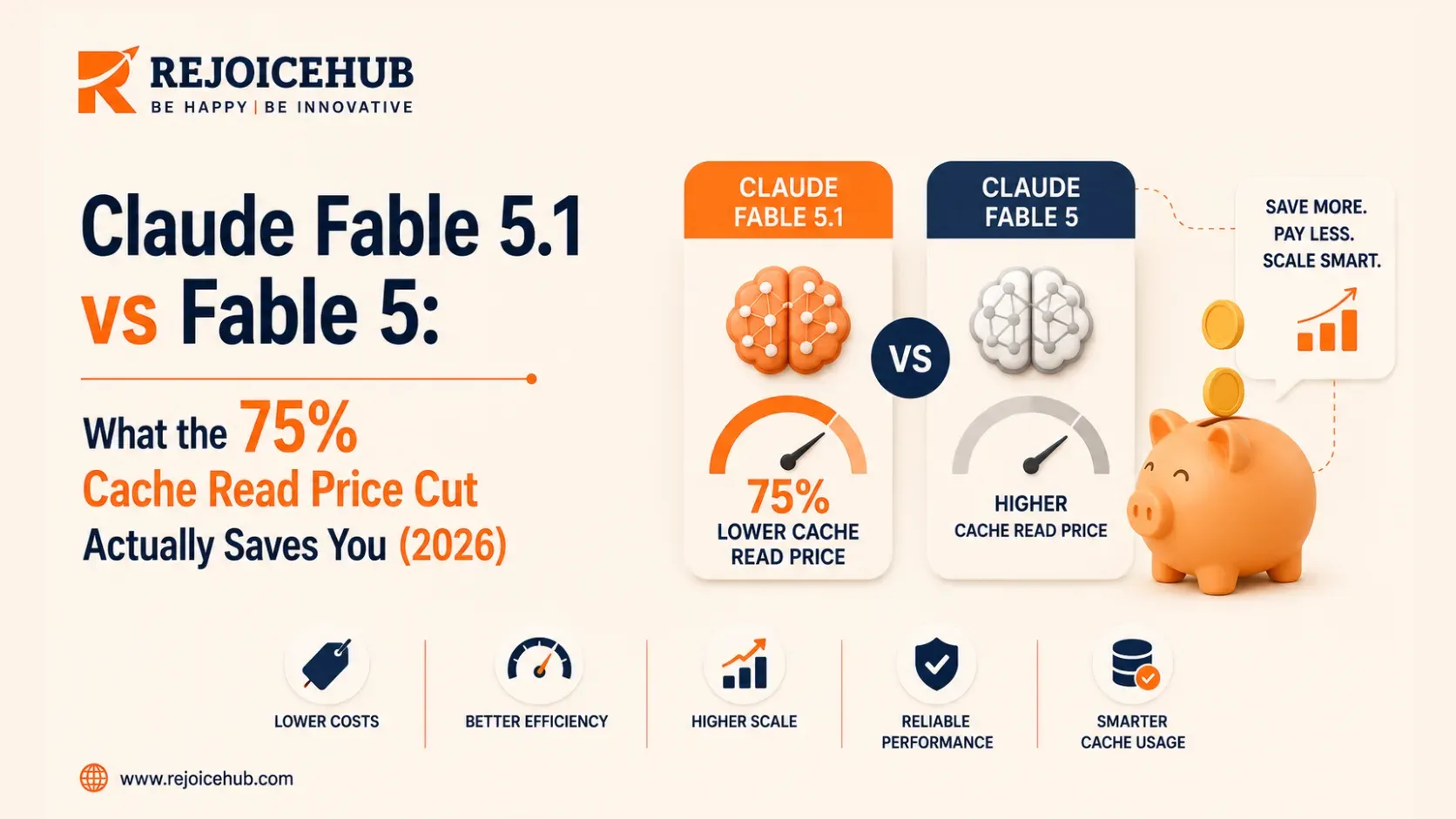
Anthropic released Claude Fable 5.1 on 2026-09-01, and the pricing tweak is a single line item: base rates stayed at $10/$50 per million input/output tokens (identical to Fable 5). The change was in cache reads: $1.00 down to $0.25 per million tokens (down 75%). For one shot completions, that's a rounding error, but for AI agents (the audience actually reading this) it's a significant improvement in unit economics since those typically spend the majority of their token budget on context you've already paid to process once: system prompts, tool schemas, retrieved documents, repo state, accumulated conversation history.
We're talking about Claude Fable 5.1 vs Fable 5 specifically in the context of these kinds of agentic workloads, not a general comparison of pricing for casual consumers.
The Numbers, Without the Marketing Framing
| Line item | Fable 5 | Fable 5.1 | Delta |
|---|---|---|---|
| Input tokens | $10 / M | $10 / M | 0% |
| Output tokens | $50 / M | $50 / M | 0% |
| Cache reads | $1.00 / M | $0.25 / M | −75% |
| Cache writes (5-min) | $12.50 / M | $12.50 / M | 0% |
| Cache writes (1-hour) | $20 / M | $20 / M | 0% |
| Batch input/output | $5 / $25 M | $5 / $25 M | 0% |
| US-only inference multiplier | 1.1x | 1.1x | 0% |
Every Claude model currently charges 10% of the base input rate for cache reads. Fable 5.1 breaks with that trend, since $0.25 against a $10 input rate is 2.5%, not 10%. This is not rounding, but a change in what Anthropic considers valuable input. Where they plan to use Fable 5.1 appears to be in long running agent conversations rather than single turn API calls, which matters most for teams doing serious generative AI development.
As a data point for those benchmarking against Opus 5, Fable 5.1's cache reads ($0.25/M) now undercut Opus 5's ($0.50/M) while the base input/output rates for Fable are double those of Opus 5. Caching heavy workloads will see models with a stated 2x input cost appearing to be less expensive than their paper claims.
What This Actually Does to an Agent's Bill
Anthropic's own figures, drawn from four weeks of internal usage across Claude Enterprise, Claude Code, and the API in August 2026, put realized savings at:
- ~25% for typical workloads
- Up to ~45% for highly agentic, cache heavy workloads
And you're talking about metered bill reductions, not list price, and the difference between 25% and 45% is explained by the cache hit ratio. Now if you're building multi agent systems, it's this ratio, not the headline discount, that determines the percentage of your token spend that currently consists of cached context versus fresh generation.
A few patterns worth checking against your own telemetry:
- Coding agents and repo aware assistants that re-send large portions of a codebase on every tool call sit at the high end of the savings range; this is close to the "highly agentic" profile Anthropic is describing. Teams running vibe coding style development workflows will notice this fastest.
- RAG pipelines with long, stable system prompts and retrieved document context that changes turn to turn but reuses a large static prefix will see solid gains, though less than the coding agent ceiling.
- Stateless, single turn API integrations, a form fill extraction endpoint, a one off classification call, see close to zero benefit. There's no cache to discount.
Get a Free Cache Hit Ratio & Agent Cost Audit
Book a free consultation with RejoiceHub. We'll review your caching strategy, orchestration layer, and effort tuning to show you exactly where Fable 5.1 can lower your bill.
Should You Migrate? A Framework, Not a Verdict
Skip the generic "yes, always upgrade" advice; this is a workload dependent call, and the two models are priced identically outside of caching, so there's no cost floor forcing your hand.
Migrate now if:
- Your agent architecture re-sends large, mostly static context on a majority of calls (system prompts, tool definitions, codebase state, long conversation history)
- You're already running at low or medium reasoning effort, where reported cost per task matches or beats Fable 5
- You have caching instrumented well enough to know your current hit ratio; if you don't know this number, get it before you model the savings
Hold off or test first if:
- Your workload is dominated by single turn or low context calls where caching contributes little
- You run at high/max effort by default and haven't validated output token volume against Fable 5's baseline
- You're mid cycle on infrastructure that's tightly coupled to Fable 5's current cost profile, and the migration itself carries engineering overhead that outweighs near term savings
Migration mechanics, for planning purposes:
- Model ID: claude-fable-5-1
- Fable 5 remains available as a legacy model at the same $10/$50 base rate; cache reads still at $1.00, so there's no forced cutover timeline
- Cache write pricing and minimum cacheable prompt length are unchanged, so existing API integration strategies transfer without a redesign
- Available on the Claude API, Amazon Bedrock, Google Cloud, and Microsoft Foundry
Why This Matters Beyond the Price Sheet
The interesting thing about this discount isn't the discount itself, but what it implies about where Anthropic believes the load will concentrate itself. To optimize the cache to input ratio for a flagship model is to bet that the highest value Claude Fable 5.1 traffic will be composed of long running agents rather than brief completions.
This hypothesis fits with the observations we're seeing from enterprise deployments more broadly: that the workloads delivering real ROI are those which incorporate persistent context, such as coding assistants or operations automation, rather than APIs designed around single interactions.
If you're trying to evaluate whether your current agent stack is architected to capture efficiencies at this level, or whether your caching strategy, orchestration layer, and effort tuning practices are failing to extract available cost reductions regardless of model choice, that's the sort of AI strategy consulting our team helps clients with when performing production level agent development.
Getting the unit economics of an AI integration right tends to be more important than whatever model underlies it at a given layer of abstraction.
Conclusion
Claude Fable 5.1 vs Fable 5 is not an upgrade in capabilities from a pricing perspective, but rather a significant reduction in the cost of re-using context through caching. The input and output tokens are priced the same as before, but the cost for reads from the cache decreased by 75%, which is an order of magnitude better than any other Claude model currently available.
Whether or not this is beneficial to your use case depends almost completely on your cache hit ratio and effort configuration, which may vary widely depending on your machine learning application. It is recommended to test both configurations and see which one performs better for your specific case, and if you need help with that devops consulting can be a good place to start.
Frequently Asked Questions
What is the main difference between Claude Fable 5.1 and Fable 5?
The only pricing difference is cache read cost. Input and output token rates stay the same at $10 and $50 per million tokens. Cache reads drop from $1.00 to $0.25 per million tokens, a 75% cut.
How much cheaper is Claude Fable 5.1 for AI agents?
Anthropic reports around 25% savings for typical workloads and up to 45% for highly agentic, cache heavy setups. The exact number depends on your cache hit ratio and how much context you reuse per call.
Does Claude Fable 5.1 cost more for input and output tokens?
No, input and output pricing is unchanged from Fable 5. It stays at $10 per million input tokens and $50 per million output tokens. Only the cache read rate was reduced.
Is Claude Fable 5.1 cheaper than Claude Opus 5?
On cache reads, yes. Fable 5.1 charges $0.25 per million cached tokens versus $0.50 for Opus 5. However, Fable 5.1's base input and output rates are still double what Opus 5 charges.
Who benefits most from the Fable 5.1 cache read price cut?
Coding agents, repo aware assistants, and RAG pipelines that reuse large static context benefit the most. Stateless, single turn API calls with little or no caching see almost no savings from this change.
What is the model ID for Claude Fable 5.1?
The model ID is claude-fable-5-1. It's available through the Claude API, Amazon Bedrock, Google Cloud, and Microsoft Foundry, so you can access it through whichever platform you already use.
Do I need to migrate from Fable 5 to Fable 5.1 right away?
No, there's no forced cutover. Fable 5 remains available as a legacy model at the same base rate. Migrate only if your workload has a high cache hit ratio and would actually benefit from the discount.
How do I know if my workload will save money with Fable 5.1?
Check your current cache hit ratio first. If a large share of your token spend comes from reused context like system prompts or repo state, you'll likely see meaningful savings on Fable 5.1.
Does the cache write pricing change with Fable 5.1?
No, cache write pricing stays the same. Both the 5 minute and 1 hour cache write rates are unchanged, so your existing caching strategy transfers over without needing a redesign.
What type of workloads see the least benefit from Fable 5.1?
Stateless, single turn API integrations like form fill extraction or one off classification calls see close to zero benefit. These workloads don't rely on cached context, so the discount doesn't apply to them.
