Think about no longer having to explain yourself whenever interacting with ChatGPT. No more telling ChatGPT about your project requirements, communication preferences, and business objectives every single time you have a conversation with the bot.
This is precisely what makes OpenAI Dreaming V3 one of the biggest updates to ChatGPT's memory features since the release of the bot. If you're already exploring how AI agents are transforming business automation, this innovation deserves your full attention.
Starting from June 4, 2026, OpenAI released Dreaming V3 to their Plus and Pro users in the USA, and Free and Go members will receive the update in the next few weeks. If you own a startup, use SaaS software, and explore using artificial intelligence automation in your business, this innovation will be of great benefit to your company.
Here's everything you should know about ChatGPT Dreaming V3.
What Is ChatGPT Dreaming V3?
ChatGPT Dreaming V3 represents OpenAI's most recent and innovative memory infrastructure, a behind-the-scenes process of automatic context synthesis based on a user's history of communications to build an ever-evolving, customized memory state of ChatGPT.
Whereas the previous version was characterized by "memory saving" that required a user to instruct the system on what exactly to store, Dreaming V3 operates independently.
It scans all previous years of conversations, recognizes what is still pertinent, filters out whatever has become irrelevant, and embeds the synthesized information into each new dialogue without your intervention.
The goal here is straightforward: instead of a conventional chatbot that is devoid of any continuity, ChatGPT should feel more like a prolonged interaction with a personal assistant that knows you well. Dreaming V3 is an essential building block in realizing this vision at scale.
How important is memory to AI? The fact of the matter is that without it, any AI-based conversation begins from scratch. Time is wasted on the repeated explanations of contexts. Consistency is impossible. Scalable personalization is out of reach.
How Does OpenAI Dreaming V3 Work?
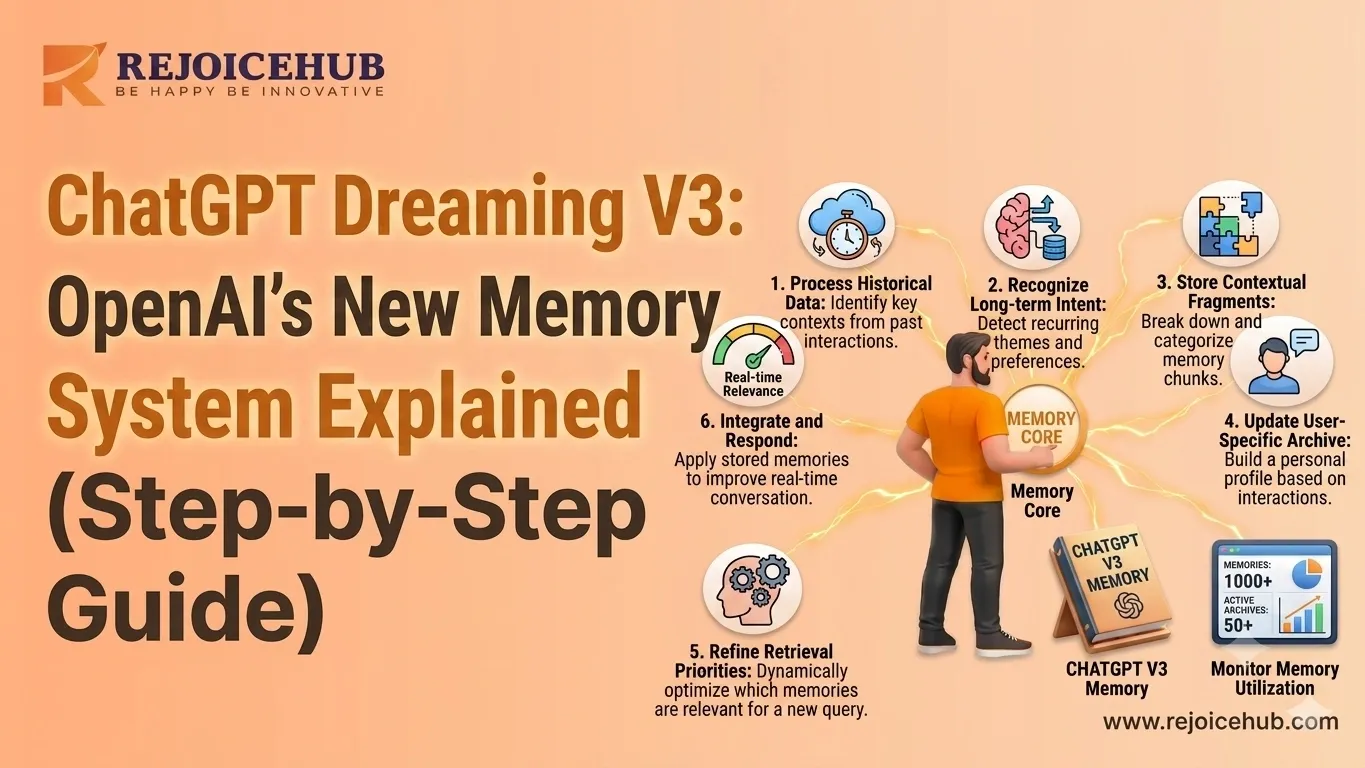
Dreaming V3 operates as a three-stage background process that runs continuously, even between conversations. Here's the step-by-step breakdown:
1. Memory Collection
ChatGPT gathers context not only from those things that you choose to save; rather, it gathers context from all of the things that you have shared through your chats, be it your preferences, your mode of communication, current projects you may have, your career aspirations, or food allergies.
2. Memory Organization
The data collected by you will be compiled into a comprehensive "memory state," which consists of details about yourself, your work, and how you prefer to communicate. The important thing is that the memory is not stored in the same data layer where the chat logs are found; instead, it is introduced into the prompt at the beginning of every new conversation.
3. Memory Retrieval
Since the chat has just begun, ChatGPT already possesses all of that synthetic context. Instead of presenting all of its information at once, ChatGPT will present only those aspects of the information that are relevant to the discussion.
4. Personalized Response
With the right context already available, ChatGPT delivers responses that feel tailored and contextually aware no repetition required.
The headline capability: temporal awareness. OpenAI's own example a memory reading "you're going to Singapore in July" automatically rewrites itself to "you went to Singapore in July 2026" after the trip ends shows just how self-maintaining this system is designed to be.
Key Features of ChatGPT Dreaming V3
-
Long-Term Memory
V3 dreaming is capable of spanning several years of timeline planning. It not only recalls your last discussion but also keeps track of your ongoing projects, developing tastes, and accumulated experience.
-
Personalized Conversations
The system builds a detailed picture of each user including communication style, job role, ongoing work, and past decisions so every interaction feels tailored rather than generic. This level of depth is what separates modern AI chatbots from traditional AI agents in a meaningful way.
-
Context Awareness
Memory isn't injected blindly. Dreaming V3 intelligently matches the right memories to the right conversations, so ChatGPT knows when your Singapore trip is relevant and when it isn't.
-
Reduced Prompt Repetition
This is the day-to-day game-changer for busy professionals. You stop re-explaining your business, your preferences, or your project brief every single time. The AI already knows.
-
Smarter AI Interactions With User Control
OpenAI paired Dreaming V3 with three important user-facing controls: a readable Memory Summary page showing what ChatGPT has synthesized, options to add, update, or delete remembered details, and settings for which topics ChatGPT should raise and when. Users who prefer the older manual saved-memories behavior can also switch back in settings.
Accelerate Your Workflows with Custom AI
Book a free consultation session with RejoiceHub. We'll map out a tailored automation roadmap for your company.
ChatGPT Dreaming V3 vs. Previous Memory Systems
Here's a clear look at how the new system compares to what came before:
| Feature | Saved Memories (Apr 2024) | Dreaming V0 (Apr 2025) | Dreaming V3 (Jun 2026) |
|---|---|---|---|
| Memory Source | Manual user input only | Chat history + saved list | Full chat history, autonomous |
| Factual Recall Accuracy | ~41.5% | ~67.9% | Significantly higher |
| Memory Freshness | Static, goes stale | Limited updates | Self-updating over time |
| Requires User Action | Yes | Partially | No |
| Scalability | Basic | Moderate | Enterprise-scale |
| Memory Storage | Conversation log | Conversation log | Separate data layer |
| User Controls | Toggle on/off | Basic | Summary page + topic controls |
| Personalization Depth | Surface-level | Moderate | Deep and contextual |
And then there is an evolutionary narrative here, beginning from a passive pad of paper, to a background process, and finally to a self-sustaining, autonomous memory system known as the first such one built by OpenAI.
Benefits of ChatGPT Dreaming V3 for Users and Businesses
Dreaming V3 isn't just a quality-of-life upgrade for individual users. For businesses building on or deploying AI systems, the implications are substantial.
-
Better Productivity
Teams that use ChatGPT for research, drafting, analysis, or communication stop wasting time on repetitive context-setting. The AI picks up where you left off every time.
-
Personalized Assistance at Scale
For SaaS companies deploying AI tools, personalized experiences no longer require complex engineering workarounds. Dreaming V3 handles the personalization layer automatically, reducing development overhead. Understanding how AI agents can automate your workflows becomes even more compelling when persistent memory is part of the equation.
-
Improved Customer Support
AI agents powered by persistent memory can recall a customer's history, preferences, past issues, and communication style making support interactions feel genuinely human and dramatically reducing resolution time.
-
Stronger AI Agents
For businesses building AI agents for sales, onboarding, or operations, Dreaming V3's memory architecture means agents can maintain continuity across sessions. A sales AI that remembers a prospect's objections from three weeks ago is far more effective than one starting from scratch each time.
-
Enhanced Business Automation
Workflow automation tools powered by agentic AI that integrate with ChatGPT can now leverage contextual memory to make smarter decisions. Think of an AI operations assistant that knows your team's preferred reporting formats, your current quarterly priorities, and your project timelines and applies that context automatically.
Privacy, Control, and the Future of AI Memory
With increased personalization comes some key questions around trust and data ownership.
OpenAI has already taken this into account. The user receives a transparent Memory Summary page detailing precisely what has been synthesized by the system. Memories can be edited, deleted, or overridden at any point. It is also possible to dictate which themes ChatGPT will proactively recall.
However, OpenAI has also admitted that this summary "may not be all that ChatGPT remembers", meaning that users should take an active interest in keeping track of their memory state, particularly when using ChatGPT in relation to sensitive business operations.
There is one security aspect to be aware of here: Given the fact that Dreaming V3 memories are input into the system prompt during inference, security professionals (namely, Tenable Research, November 2025) have highlighted the possibility of prompt injection attacks that can update persistent memory via third-party content. Businesses evaluating how generative AI can be applied in cybersecurity should keep this attack surface in mind.
OpenAI has recognized this surface, and businesses leveraging ChatGPT's API should do the same.
The Future of AI Memory
Dreaming V3 is a milestone, not a destination. The direction is clear:
- Persistent AI agents that maintain full context across months of interactions with customers, teammates, or workflows
- Personal AI assistants that genuinely understand you your goals, your constraints, your history
- Enterprise AI memory systems that remember institutional knowledge, team preferences, and project histories across entire organizations
The companies that start building on memory-aware AI infrastructure today will have a meaningful head start when these capabilities become standard.
Conclusion
This is an important step towards AI agents that can learn independently from scratch, without requiring any note management and manual interventions from users.
For ordinary people, it means no repetition but more personalized answers. For companies, it implies that the age of truly persistent AI agents has begun.
This is a strong tool, the consequences of which are great, and the competitive edge is obvious.
While memory systems for AI agents keep developing, those businesses that create intelligent AI agents for business use cases will definitely gain a competitive advantage in the future.
If you're exploring AI-powered automation, AI assistants, or custom AI agent development, RejoiceHub can help build solutions tailored to your business goals. Whether it's a memory-aware customer support bot, an intelligent sales assistant, or end-to-end workflow automation, our team specializes in turning the latest AI capabilities into measurable business outcomes.
Frequently Asked Questions
1. What is ChatGPT Dreaming V3?
ChatGPT Dreaming V3 is OpenAI's latest memory system that automatically learns from your past conversations. Unlike older versions, you don't need to manually save anything. It builds a personal memory of your preferences, projects, and habits and applies that context in every new chat session automatically.
2. How does OpenAI Dreaming V3 work?
OpenAI Dreaming V3 runs in the background across three stages collecting context from your chats, organizing it into a memory state, and retrieving only what's relevant for each new conversation. This memory is stored in a separate layer and gets injected into your chat prompt automatically, without any manual input needed.
3. What are the key features of ChatGPT Dreaming V3?
ChatGPT Dreaming V3 offers long-term memory, smart context awareness, reduced prompt repetition, and deep personalization. It also updates itself over time for example, "you're going to Singapore" becomes "you went to Singapore" after your trip. Users get full control through a Memory Summary page with edit and delete options.
4. What are the main benefits of ChatGPT Dreaming V3 for businesses?
Businesses save time because the AI already knows your preferences, team workflows, and project details. It improves customer support quality, makes sales AI agents more effective, and reduces development effort for personalization. Teams using ChatGPT for daily work will notice faster, more relevant responses right from the start of every conversation.
5. How is ChatGPT Dreaming V3 different from previous memory systems?
Older systems like Saved Memories required manual input and had limited accuracy of around 41.5%. Dreaming V0 improved things slightly. Dreaming V3 is fully autonomous, self-updating, stored in a separate data layer, and significantly more accurate. It works at enterprise scale and gives users much deeper control through topic settings and a readable memory summary page.
6. Is ChatGPT Dreaming V3 available to all users?
As of June 4, 2026, ChatGPT Dreaming V3 is available for Plus and Pro users in the USA. Free and Go plan users will get access over the next few weeks. If you're not seeing it yet, keep your app updated and check your memory settings it may roll out to your account very soon.
7. Is ChatGPT Dreaming V3 safe to use for sensitive business data?
OpenAI gives users a Memory Summary page to review, edit, or delete what's stored. However, since memories are injected into system prompts, security researchers have flagged potential prompt injection risks from third-party content. Businesses using the ChatGPT API should stay aware of this and monitor their memory state regularly for anything sensitive or unexpected.