
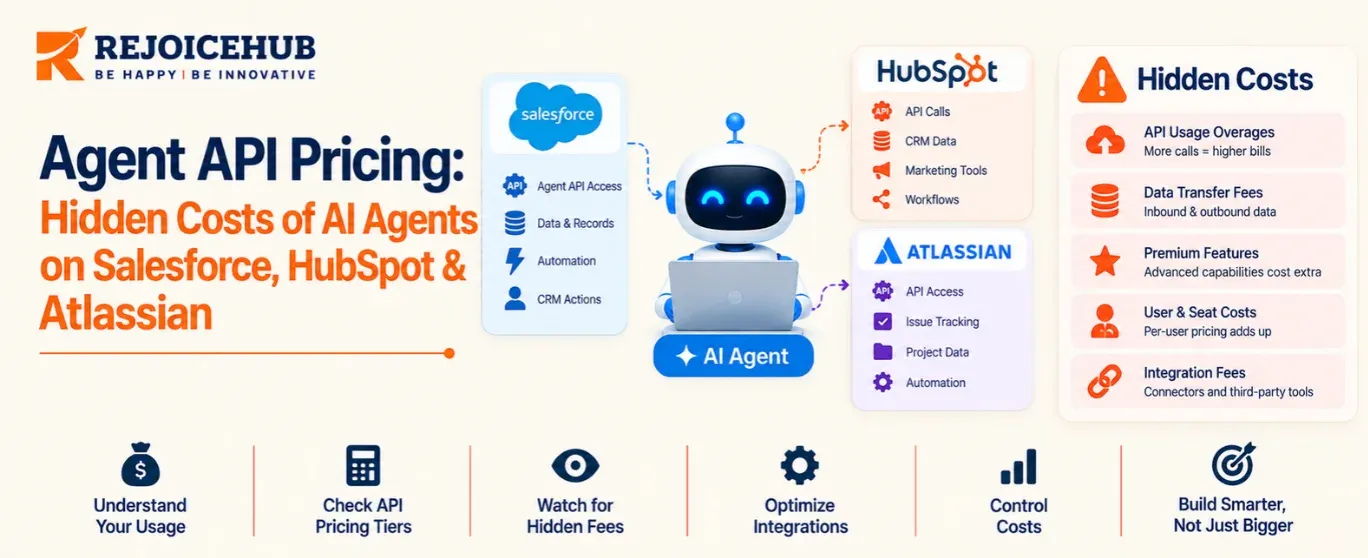
Agent API pricing has evolved from the simple per-seat licensing models to the ones based on the actions performed. Salesforce charges per action, HubSpot charges per conversation resolved, and Atlassian charges per credit spent and resolution. But each of these pricing models has its own hidden nuance that can make you pay much more than expected per resolved conversation. This article compares the actual rates with the ones you’ll be charged with and explains the math you need to perform to understand how much a conversation is worth to you.
Key Highlights
- Salesforce Agentforce: Flex Credits run $500 per 100,000 credits, 20 credits (about $0.10) per action, with a $2 charge per resolved Help Agent conversation.
- HubSpot Breeze: The Customer Agent has been outcome-based since April 14, 2026, at roughly $0.50 per resolved conversation (50 credits).
- Atlassian Rovo: Most usage-based meters start billing on December 3, 2026, and the new AI resolution meter charges $1.00 per fully resolved service inquiry.
- The break-even point: Salesforce's per-conversation and per-action models cross at roughly 20 actions per conversation.
- The usual surprise: Bills rarely blow up on the headline rate. They blow up on token multipliers, loops, shared credit pools, and loose definitions of "resolved."
Most vendor pricing pages will state the cost per one unit. What the finance team will review is the unit price, multiplied by the number of units that your agent will generate. In practice that figure is 3-5x higher than what is in the proposal.
Atlassian's billing switch is two months away, and HubSpot's repricing happened this spring. This guide will cover what each model costs, where the extra spend comes from, and how to cap it at a reasonable level.
Why Is AI Agent Pricing Changing in 2026?
Seat-based pricing assumes that a single human is using the software. Sales representatives, for example, make thousands of independent decisions for each sale. Vendors respond by metering consumption with different units.
Salesforce has changed its pricing model several times over the last few years: conversation-based pricing with the launch of Agentforce in October 2024, action-based Flex Credits in May 2025, and simultaneously operates three pricing structures. HubSpot and Atlassian are moving towards outcome-based pricing for their primary service agents.
The practical implication is that it is no longer possible to compare vendors on a single metric. The resolution cost for a particular $0.10 action, a $0.50, and the invocation cost for a 10-credit measure different things. You need to determine the cost per business outcome to compare.
Agent API Pricing Benchmarks: Salesforce vs HubSpot vs Atlassian
| Salesforce Agentforce | HubSpot Breeze | Atlassian Rovo | |
|---|---|---|---|
| Billing unit | Per action (20 credits) | Per resolved conversation (50 credits) | Per credit (10 for basic use); per resolution for CSM |
| Headline rate | ~$0.10 per standard action, ~$0.15 per voice action | $0.50 per resolved conversation; ~$1 per recommended lead | $0.01 per overage credit; $1.00 per CSM resolution |
| Credit price | $500 per 100k credits | $10 per 1,000 monthly, $9 annually | $10 per 1,000 overage credits |
| Included allowance | Free tier or edition bundle (varies) | ~500 / 3,000 / 5,000 credits on Starter / Pro / Enterprise | 25 / 70 / 150 credits per user per month on Standard / Premium / Enterprise (Jira or Confluence) |
| Rollover | No rollover | Shared pool | No rollover |
| Billing starts | Live | Live since April 2026 | December 3, 2026 |
If you want an independent view of how these meters map to your actual workflows before committing, our AI agent development team models this on real usage data, not vendor examples.
How Does Salesforce Agentforce Pricing Work?
Salesforce has the largest variety of pricing options including Flex Credits, Conversations, Help Agent resolutions, and per-user licenses. Salesforce doesn’t allow using Flex Credits and Conversations in the same org, so you should choose either one or the other.
The options concerning the number of per-user licenses add up to a list of perplexity. The Agentforce User License costs $5 per user per month, but it still depletes the credits in your pool.
The Agentforce 1 Editions start at $550 per user per month. The subscription includes an annual allotment of credits in a pool (the number ranges between 1M and 2.5M credits depending on the source). It also appears that credits in the Foundations come in a different range (between 100K and 200K). It is recommended to clarify this information with the official contract.
The token multiplier poses another difficulty. Salesforce considers any action comprising over 10,000 tokens as 6 x 1 action. Therefore, a 20,001 x token action would be charged 60 credits ($0.30) instead of 20 ($0.10). Knowledge-based prompts and large records in payload are two examples of such actions.
A worked example. Assume 50,000 conversations per month (an assumption for illustration):
- At 6 actions per conversation, Flex Credits cost 50,000 × 6 × $0.10 = $30,000/month.
- At 10 actions, the cost is $50,000/month.
- Under flat $2 conversation pricing, the same volume is $100,000/month regardless of actions.
Flex Credits dominate the market only if the agents exceed 20 actions on average per conversation daily. However, most buyers will not realize their actions/conversation ratio until months after the launch. This metric should be evaluated during the pilot period.
What Does HubSpot Breeze Pricing Include?
HubSpot's model is simpler, but it has some details that are not immediately obvious. The previous price for the Customer Agent was 100 credits (about $1.00) per conversation, regardless of whether the conversation actually resolved the issue; as of April 14, 2026 it will be 50 credits per resolved conversation.
| Agent / task | Credits | Cost |
|---|---|---|
| Customer Agent, per resolved conversation | 50 | $0.50 |
| Prospecting Agent, per recommended lead | 100 | $1.00 |
| Prospecting Agent, research task | 10 | $0.10 |
| Data Agent (beta), per response | 10 | $0.10 |
The definition problem. A conversation counts as resolved when the agent shares a content source or performs an action and no human handoff occurs within 72 hours, or when it qualifies a lead. Under that definition, a conversation can be billed as resolved even if the customer wasn't truly helped, as long as the AI returned a knowledge source. You pay for the agent's behavior, which is not the same as customer satisfaction.
A worked example. At 10,000 conversations a month and an assumed 65% resolution rate, you'd pay for 6,500 resolutions: 6,500 × $0.50 = $3,250. On a Professional plan, the 3,000 bundled credits cover only about 60 resolutions, so credits for roughly $3,220 of that bill are overage. Also note the seat floor: the Customer Agent requires a Service Hub Professional seat. The shared credit pool means one busy month, or a looping workflow, can drain credits other AI features depend on.
How Does Atlassian Rovo Pricing Work Under Usage-Based Billing?
Atlassian keeps its seat subscription and adds a consumption layer on top. Usage-based pricing adds a consumption layer to your plan, with a monthly included allowance for each meter.
For Rovo credits, the rules are:
- Basic features such as Quick Answer mode and basic agents use 10 credits per invocation, while premium features like Think Deeper and the Jira Coding Agent use a variable number depending on compute effort and output.
- Overage, if enabled, runs at $0.01 per credit. Extra usage is enabled by default and billed in arrears.
- Allowances pool across the organization, and unused credits don't roll over.
- Teamwork and Service Collections carry 250, 700 and 1,500 credits per user per month.
What the allowance really buys. Take 100 Jira Premium users, with 70 credits each. You can use 7,000 credits a month as a pool, which is 700 basic invocations across the entire org, or about 7 per user.
But if those users average 30 basic invocations each, you're talking 30,000 credits and 23,000 credits of overage, or $230 / month. That's easy to absorb. Deep research at 100 credits per request, or heavy agent use, scales that up easily.
Removing 100 Jira Premium seats would cut 7,000 credits of monthly allowance, making it a cost optimization lever by itself.
For service teams, Customer Service Management AI agent resolutions have no included allowance, bill $1.00 per resolution from December 3, 2026, and default to a 25,000-resolution monthly cap you can tune.
Native Platform Agents vs Custom Agents: Which Costs Less?
Many teams reach this decision after the first invoice.
| Factor | Native agent (Agentforce, Breeze, Rovo) | Custom agent on a model API |
|---|---|---|
| Cost model | Vendor-defined units, with margin | Token cost + orchestration + infra |
| Cost predictability | Low to medium (credits, actions, resolutions) | Medium (you control prompts and caching) |
| Data access | Native CRM/work graph | Via API/MCP integrations you build |
| Time to production | Weeks | Weeks to months |
| Switching cost | High (locked to vendor meters) | Lower |
| Best for | Agents living entirely inside one platform | Cross-platform workflows, high volume, strict cost control |
Native agents win at low volumes and within a single platform. Custom agents win large-scale, multi-system, and cost-per-action-transparent activities.
A typical hybrid approach would involve using native agents for simple intra-platform operations and a custom orchestration layer for the expensive inter-platform tasks. It is hard to say which solution is better in general because it depends heavily on the agent’s action count.
9 Hidden Costs of AI Agents on Platform Pricing
- Token and complexity multipliers. Heavy prompts convert one action into several billable ones, as in the 10,000-token Salesforce threshold above.
- Action granularity. A "simple" request can involve a lookup, a decision, a write, and a notification. That's four billable steps, not one.
- Retry and loop behavior. A mis-specified agent that retries failed steps burns credits with no business value. Build step limits.
- Escalated conversations. On per-action models you pay for the failed attempt, and then you pay a human to finish it.
- Loose resolution definitions. Per-resolution pricing is only as honest as the definition. Audit a sample of "resolved" tickets monthly.
- Shared credit pools. One agent or a runaway workflow can starve everything else drawing on the same pool.
- Non-rolling allowances. Included credits expire monthly, which pushes spend toward overage after a spike.
- Prerequisites and seat floors. Agents often require a minimum edition or seat tier, which is a cost the agent price doesn't show.
- Sandbox and testing usage. On Atlassian, sandbox AI interactions consume credits from your allowance. Salesforce discounts sandbox actions rather than waiving them.
Beyond platform fees, budget separately for integration work, evaluation tooling, prompt and knowledge maintenance, and security review. Those are real costs even when no vendor meter shows them.
The Four Pricing Meters Behind Every AI Agent Bill
Almost every platform maps to one of these.
- Per action: you pay for each step the agent takes (Salesforce Flex Credits). Costs track complexity and are hard to forecast.
- Per conversation: a flat fee per interaction (Salesforce Conversations). Predictable, but you overpay on simple chats.
- Per outcome: you pay only for resolved work (HubSpot Customer Agent, Atlassian CSM). This aligns incentives, and everything depends on the definition of "resolved."
- Per credit pool: a bundled allowance across features (HubSpot, Rovo). Easy to buy and hard to attribute.
When comparing vendors, convert each to cost per resolved business outcome using your own volumes.
How to Build Cost Governance Around Platform Agents
Treat agent spend like cloud spend. A workable architecture looks like this:
- Meter at the boundary. Route agent invocations through a gateway or logging layer so every action carries an agent ID, workflow ID, and team tag.
- Set budgets per agent, not per org. Alert at 50%, 80%, and 100% of the monthly allowance, and add a hard stop for non-critical agents.
- Cap steps per task. Limit retries and total actions per conversation to contain loops.
- Track cost per resolution. Compute total spend (credits + seats + human follow-up) divided by verified resolutions, sampling for false positives.
- Review monthly. Compare allowance consumption against forecast and rebalance seats or editions before renewal.
Pre-signing audit checklist: get the unit of consumption in writing, confirm how a resolution is counted, confirm whether overage is on by default, ask about rollover, and request a usage estimate on your workflows, not the vendor's sample.
What Should You Budget for AI Agent Deployment?
Consider a three-tier budget: for platform fees (credits, seats, editions), for build/integration (connectors, orchestration, evaluation), and for operations (monitoring, prompt and knowledge upkeep, security reviews). The teams that budget only the first tier are the ones that end up surprised.
RejoiceHub scopes engagements by typical workflows and volumes, rather than by a flat-rate card. A typical path starts with an audit of your current or projected agents’ usage, followed by a cost model for their native, custom, and hybrid alternatives, and a build/integration phase if the economics make sense.
Native platforms are frequently the right choice, and we’ll say so when they are. For custom and hybrid alternatives, our AI integration services and AI strategy consulting include cost modeling through production.
Governance is a critical consideration, and you’ll want to review our post on AI agent security for SaaS teams.
Conclusion
Consider a three-tier budget: for platform fees (credits, seats, editions), for build/integration (connectors, orchestration, evaluation), and for operations (monitoring, prompt and knowledge upkeep, security reviews). The teams that budget only the first tier are the ones that end up surprised.
RejoiceHub scopes engagements by typical workflows and volumes, rather than by a flat-rate card. A typical path starts with an audit of your current or projected agents’ usage, followed by a cost model for their native, custom, and hybrid alternatives, and a build/integration phase if the economics make sense.
Native platforms are frequently the right choice, and we’ll say so when they are. For custom and hybrid alternatives, our AI integration services and AI strategy consulting include cost modeling through production.
Governance is a critical consideration, and you’ll want to review our post on AI agent security for SaaS teams.
Frequently Asked Questions
What is agent API pricing?
Agent API pricing is the fee you pay for AI agent usage, charged by actions, conversations, resolutions, or credits instead of seats. One agent can do thousands of tasks, so vendors meter and bill what it actually does each month.
How much does Salesforce Agentforce cost?
Salesforce Agentforce Flex Credits cost $500 per 100,000 credits, and one standard action uses 20 credits, about $0.10. Help Agent conversations cost $2 each. Per-user licenses run from $5 to $550 per month, depending on the plan and add-ons included.
Is Salesforce Flex Credits cheaper than per-conversation pricing?
Flex Credits are usually cheaper when agents take fewer than about 20 actions per conversation. Above that, the flat $2 conversation price wins. Measure your real actions per conversation during a pilot, because most teams guess wrong at the start.
How much does the HubSpot Breeze Customer Agent cost?
HubSpot Breeze Customer Agent costs about $0.50 per resolved conversation, which is 50 credits at $10 per 1,000 credits. You pay only when it resolves a chat. You also need a Service Hub Professional plan or higher to use it.
What counts as a resolved conversation in HubSpot?
HubSpot counts a conversation as resolved when the agent shares a content source or completes an action and no human steps in within 72 hours. Qualifying a lead also counts. Ask HubSpot to confirm the exact rules before you budget.
When does Atlassian start charging for Rovo credits?
Atlassian starts billing for most usage-based meters, including Rovo credits, on December 3, 2026. Your plan includes a monthly credit allowance first. Check your current usage in Atlassian Administration now, so your first bill does not catch you off guard.
How many Rovo credits does each user get?
Jira or Confluence plans give 25, 70, or 150 Rovo credits per user monthly on Standard, Premium, and Enterprise. Collections give 250, 700, or 1,500. The credits pool across your organization and do not roll over to the next month.
Why do AI agent costs go above the estimate?
AI agent costs go up because of retries, loops, long prompts that count as several actions, and shared credit pools. Vague resolution rules add charges. Track actions per task in your pilot and plan for busy months, not average ones.
Are outcome-based AI agent prices always cheaper?
No. Outcome-based pricing means you pay only when the agent resolves something, which cuts the risk of paying for failures. But a loose definition of resolved can still bill you for chats that did not help. Audit sample tickets monthly.
Should I build a custom AI agent or use a platform agent?
Use platform agents for low volume work that stays inside one tool. Build a custom agent for high volume, work across several systems, or tighter cost control. Many teams mix both, so run the numbers on your action counts first.
