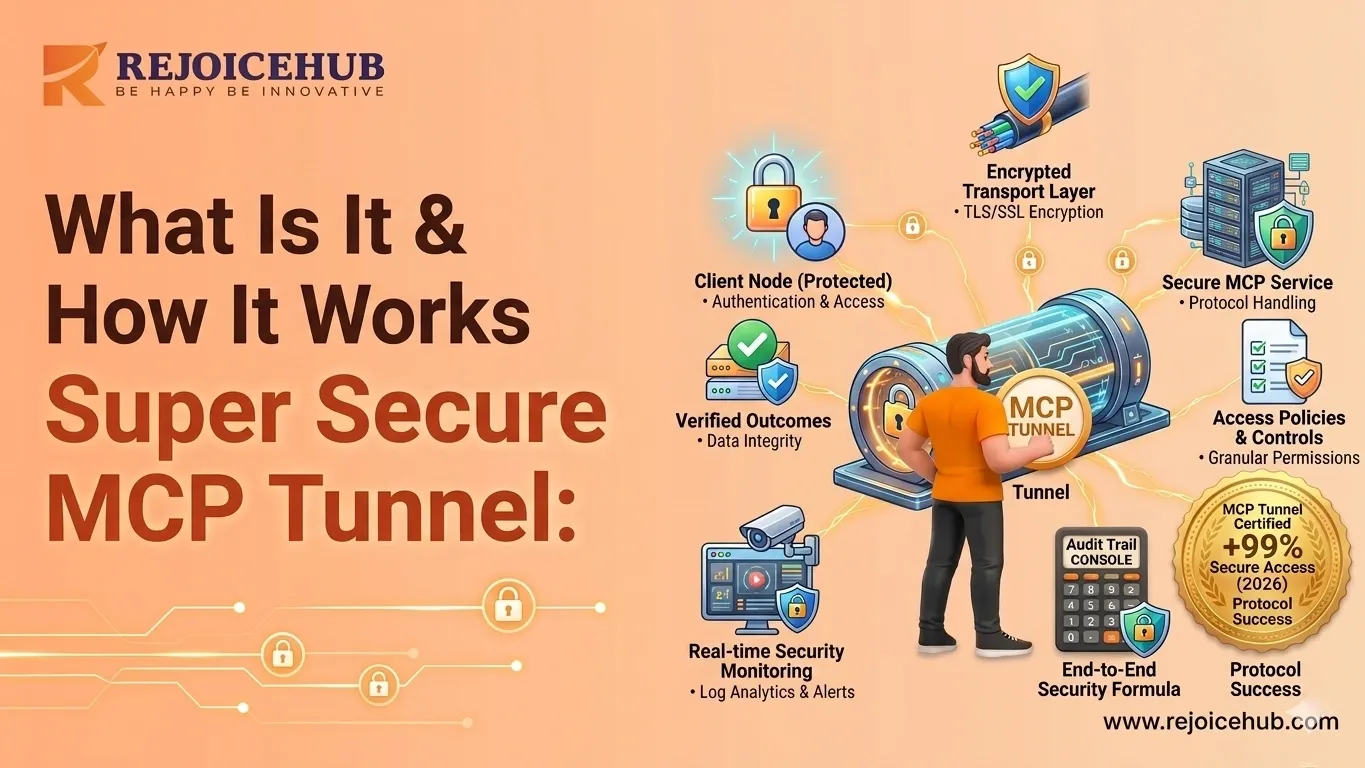
AI agents are increasingly becoming the foundation on which businesses operate, providing assistance to customers, streamlining business processes, and gathering live data from various enterprise resources. But as enterprises are increasingly incorporating AI agents into their infrastructure, another question is consistently surfacing: how to do so securely?
Introducing the Secure MCP Tunnel.
Anyone who has worked with developing and deploying AI agents will likely be familiar with the Model Context Protocol (MCP), an emerging standard for communicating with external applications and data sources from AI systems.
In this article, we explain what a secure MCP tunnel is, why you would want it, how the mechanism works internally, and what best practices enterprises follow when deploying it securely.
By the end of the read, you will understand how to incorporate private MCP servers into your AI infrastructure.
What Is a Secure MCP Tunnel?
Understanding MCP Servers
We'll begin by briefly explaining how an MCP server works before moving on to tunnels.
The Model Context Protocol (MCP) is the protocol used by an AI agent runtime to interface with other systems such as files, databases, APIs, and external software applications. MCP acts as a universal language that allows the AI to communicate with your system.
An MCP server typically exposes:
- Tools: functions the AI agent can call, like sending an email or querying a database
- Data sources: internal documents, CRMs, spreadsheets, or knowledge bases
- Agent interactions: structured requests and responses between the AI and your systems
Without MCP, every integration between an AI agent and a business tool would need custom, one-off code. With MCP, agents can plug into multiple systems using one consistent protocol.
Definition of a Secure MCP Tunnel
A Secure MCP Tunnel is an encrypted connection from the AI agent to a closed MCP server through which traffic passes privately, away from the public internet.
Think of it as the security wrapper protecting your AI agent from any contact with your systems.
A secure MCP tunnel typically provides:
- Encrypted connections so data can't be intercepted in transit
- Controlled access so only authorized agents and users can connect
- A private communication path that keeps your MCP server off the public internet entirely
So when people ask "what is a secure MCP tunnel," the short answer is: it's the security layer that makes MCP-based AI integrations safe enough for real business use.
Why Do AI Agents Need MCP Tunnels?
Security Risks Without a Tunnel
Running an MCP server without a secure tunnel is a bit like leaving your office door unlocked because you trust the neighborhood. It might work fine until it doesn't.
Common risks include:
- Public exposure: an unsecured MCP server can be discovered and probed by bad actors
- Credential leakage: API keys or tokens sent without encryption can be intercepted
- Unauthorized access: without proper authentication, anyone who finds the endpoint could potentially use it
These aren't hypothetical risks. As MCP adoption grows, security researchers running vulnerability scans have flagged exposed MCP endpoints as a real and increasing attack surface.
Enterprise Security Requirements
For startups, a security incident is costly. For enterprises, it can be existential.
Businesses adopting AI agents at scale need to think about:
- Compliance: frameworks like SOC 2, HIPAA, and GDPR often require encrypted data transfer and access logging
- Data privacy: customer and business data shouldn't pass through unprotected channels, a growing concern in data privacy for executives
- Governance: IT and security teams need visibility into what AI agents can access and when
This is exactly why "why do AI agents need MCP tunnels" is becoming such a common search; companies are realizing that connecting AI to internal systems isn't just a technical task, it's a security decision.
If you're looking to build a custom AI agent that integrates safely with your internal tools, working with experienced MCP consulting partners can help you design that architecture from day one instead of bolting security on after the fact.
Accelerate Your Workflows with Custom AI
Book a free consultation session with RejoiceHub. We'll map out a tailored automation roadmap for your company.
How Do Secure MCP Tunnels Work?
Authentication Layer
Every secure MCP tunnel starts with verifying identity, which usually involves:
- API Keys: simple tokens that verify a specific agent or service
- OAuth: a more robust standard for delegated, scoped access
- Service Identity: confirms the requesting agent is who it claims to be, tying back to broader non-human identities used across enterprise AI systems
Encryption Layer
Once identity has been verified, the actual data needs to be protected. This typically depends on:
- TLS (Transport Layer Security): the same encryption standard that secures HTTPS websites
- Secure transport protocols: ensuring data can't be read or modified while moving between the agent and the MCP server, a principle borrowed from secure DevOps pipeline best practices
Request Flow
Here's a simplified step-by-step of how a request actually moves through a secure MCP tunnel:
- The AI agent initiates a request: for example, asking to pull customer data from a CRM
- The tunnel authenticates the request, verifying the agent's identity and permissions
- The request is forwarded to the private MCP server through the encrypted tunnel
- The response is encrypted before being sent back
- The agent receives the result securely, without the underlying server ever being publicly exposed
This flow answers the common question "how do secure MCP tunnels work" in practical terms: authenticate first, encrypt everything, and never expose the server directly.
MCP Tunnel Architecture Explained
Core Components
A typical MCP tunnel setup includes five key components:
- AI Agent: the model or application initiating requests
- Tunnel Gateway: the entry point that manages encrypted connections and routing, often discussed alongside the broader concept of an MCP gateway
- Identity Layer: handles authentication, authorization, and permission scoping
- MCP Server: the private server hosting your tools and data
- Monitoring Layer: logs activity, flags anomalies, and supports auditing
Typical Architecture Diagram
The typical architecture is that the AI will not be connecting with the MCP server directly, but will send all requests through the Tunnel Gateway, where access is verified before relaying any messages to the secure server, all monitored by the Monitoring Layer, which ties into a broader AI agent governance and verification framework.
It is this hierarchy that constitutes the definition of "MCP tunnel architecture explained," because it is not software alone but an entire mechanism of authentication, encryption, and monitoring.
How MCP Tunnels Protect AI Communications
1. End-to-End Encryption
All messages exchanged between the AI agent and the MCP server are encrypted as soon as they leave the agent and until they are received and processed by the server, and vice versa.
2. Access Controls
Not all agents need to be granted access to all tools. Secure MCP tunnels provide fine-grained access permissions, similar to the controls used in sandboxed execution for enterprise AI agents, so a customer service agent has access to ticketing information only, while a finance agent can access billing information only.
3. Audit Logging
Every request and response can be logged, creating a clear trail of who accessed what, and when. This kind of logging draws on practices common in machine learning and cybersecurity, and is essential for compliance audits and incident investigations.
4. Network Isolation
By keeping the MCP server off the public internet and routing all traffic through the tunnel, businesses dramatically reduce their exposed attack surface and close some of the common enterprise AI infrastructure gaps that attackers look for.
Together, these four layers explain "how MCP tunnels protect AI communications": it's a combination of encryption, permissions, visibility, and isolation working together, not any single feature alone.
MCP Tunnel vs VPN vs API Gateway
A common point of confusion: isn't this just a VPN or API gateway? Not quite. Here's how they compare:
| Feature | MCP Tunnel | VPN | API Gateway |
|---|---|---|---|
| AI-Aware | Yes | No | Partial |
| Fine-Grained Access | Yes | Limited | Yes |
| Tool-Level Security | Yes | No | Limited |
| Auditability | High | Medium | High |
The most critical distinction is that the MCP tunnel has been specifically designed to support AI agents' communication. It can interpret tool commands, know about agent identities and context, unlike regular virtual private networks or API gateways, which were not created for this purpose.
However, it should be pointed out that in reality, most secure MCP tunnels use API gateway or VPN technologies at their core, and many teams weigh this against options like AWS-managed MCP servers versus custom integration before deciding on an approach.
Best Practices for Deploying Secure MCP Tunnels
If you're rolling out AI agents connected to private systems as part of your broader AI agent stack for business, here are the practices worth building in from the start:
- Zero Trust Architecture: never assume a request is safe just because it's "inside" your network; verify every connection
- Least Privilege Access: give each AI agent only the permissions it needs, nothing more
- Key Rotation: regularly rotate API keys and credentials to limit exposure if one is compromised
- Monitoring: continuously watch for unusual access patterns or failed authentication attempts
- Audit Trails: keep detailed, tamper-resistant logs for compliance and incident response
- Multi-Factor Authentication: add an extra verification step for human-initiated access to the tunnel itself
These practices aren't just theoretical; they reflect how security-conscious engineering teams are actually approaching MCP deployments today, as AI agent adoption accelerates across SaaS and enterprise environments.
Conclusion
Adoption of the technology has increased significantly, and there's a good reason: the integration of AI agents has become far easier thanks to MCP. However, ease is not everything.
With a secure MCP tunnel, it's easy to establish encryption, control access, and maintain full visibility into how your agents integrate with your private systems. If an enterprise takes its AI seriously as part of a broader enterprise AI guide, it cannot ignore this essential part of the technology infrastructure.
Governance, encryption, and monitoring are key components in ensuring that AI integration is truly secure.
Frequently Asked Questions
1. What is a secure MCP tunnel?
A secure MCP tunnel is an encrypted connection that lets AI agents talk to a private MCP server without going through the public internet. It keeps your data safe, blocks unwanted access, and makes sure only approved agents can use your tools and systems.
2. How do secure MCP tunnels work?
A secure MCP tunnel works in three steps. First, it checks the AI agent's identity. Then it encrypts every message sent between the agent and the server. Finally, it sends the request through a private path so the server is never exposed online.
3. Why do AI agents need MCP tunnels?
AI agents often connect to sensitive business tools like CRMs or finance systems. Without a tunnel, that connection can be exposed to hackers or unauthorized users. A secure MCP tunnel hides that connection, blocks unsafe access, and helps businesses meet compliance rules like SOC 2 or HIPAA.
4. What is MCP tunnel architecture?
MCP tunnel architecture has five main parts: the AI agent, a tunnel gateway, an identity layer, the private MCP server, and a monitoring layer. Together, these parts check identity, encrypt traffic, and watch for unusual activity so the whole connection stays safe.
5. How do MCP tunnels protect AI communications?
MCP tunnels protect AI communications using four layers: encryption, access control, audit logging, and network isolation. Messages stay encrypted in transit, agents only reach the tools they need, every action gets logged, and the server stays hidden from the public internet.
6. Is an MCP tunnel the same as a VPN?
No, an MCP tunnel is not the same as a VPN. A VPN protects general network traffic, but an MCP tunnel is built just for AI agents. It understands tool commands and agent identity, giving much finer control over what each agent can access.
7. What happens if an MCP server is not secured with a tunnel?
Without a tunnel, an MCP server can sit exposed on the public internet, where anyone could find and probe it. This raises the risk of leaked credentials, unauthorized data access, and compliance failures, which is why most businesses add a secure tunnel before going live.