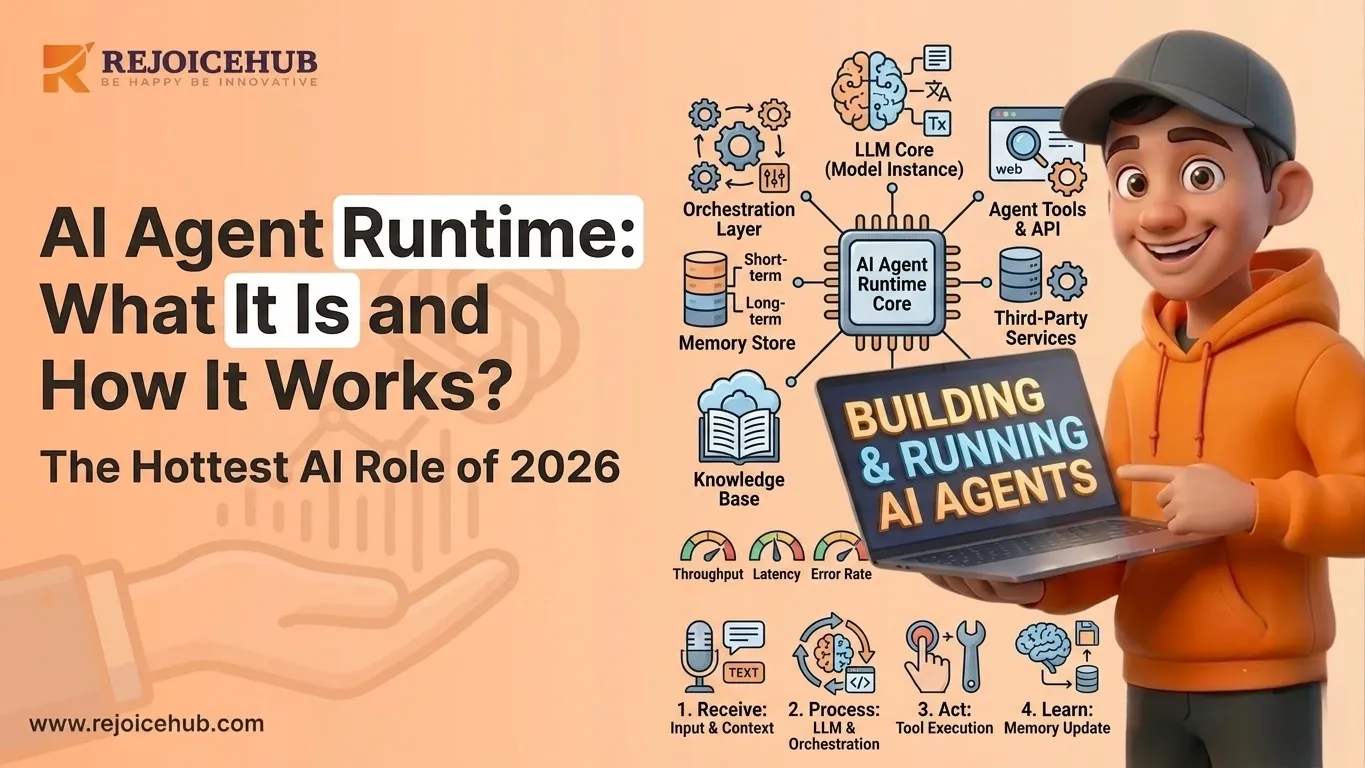
Many organizations can develop AI agents. Fewer organizations actually understand how to safely operate AI agents.
This represents a genuine challenge for many businesses. Modern AI agents are able to integrate directly with tools, APIs, databases, and customer interfaces.
Once an AI agent is capable of acting, it is no longer necessary to ask "is the agent able to perform the task?" but instead "what if the agent performs the task incorrectly?" This is when the AI agent runtime becomes critical.
An AI agent runtime is the operational platform responsible for executing, observing, and controlling an AI agent. Without it, even a well-thought-out AI agent may end up accessing unauthorized resources, releasing information, and making costly mistakes at high speeds.
In this guide, we will explain what an AI agent runtime is, how it works, what architectural considerations need to be taken into account, and what best practices exist around containment and sandboxing in order to create safe AI agents.
What Is an AI Agent Runtime?
Agent Runtime of an Artificial Intelligence is the software framework within which decisions made by the AI agent are implemented, which regulates the agent's ability to use resources as well as oversees their activities.
We can compare this notion with the difference between a cookbook and a kitchen. The decisions made by an agent or its model/brain define how it behaves, just like a cookbook does.
The agent runtime would be similar to the kitchen, which contains all the necessary equipment, implements necessary precautions, and observes the entire process lest everything catches fire.
Why AI Agents Need a Runtime
A standalone language model can only produce text. It cannot directly use APIs, search databases, or send emails. There must be something that bridges the gap between the language model's output and the real world. This is called the runtime.
Execution environment. The runtime provides the actual environment where code runs, tools are called, and tasks are completed. It manages memory, sessions, and the state of a multi-step task.
Resource management. Agents can loop, retry, or spawn sub-tasks. The runtime caps compute, time, and cost, so a single agent doesn't consume unlimited resources.
Tool access control. Every API, database, or system an agent touches is a potential risk. The runtime decides which tools an agent can use, under what conditions, and with what data.
In short, the runtime is what turns an experimental AI demo into a system you can actually trust in production.
How Does an AI Agent Runtime Work?
Most AI agent runtimes follow a consistent execution flow, regardless of the specific platform or framework behind them.
1. Input Processing
The user request, the trigger, or the event from another system is processed by the runtime. It validates the request, adds context information to the request (user identity, permissions, conversation context), and then makes it ready for reasoning.
2. Decision and Planning
The reasoner, usually implemented as a large language model, parses the request and formulates a strategy to achieve the goal. This could involve splitting up the task into subtasks, deciding what tool to invoke, or determining that more context is needed first.
3. Tool Execution
Here lies the true meaning of the term runtime. It performs the real execution, that is, making an API call, querying a database, performing a workflow, or writing to a file. Permission tests are carried out for each action before it can be performed.
4. Monitoring and Logging
All inputs, decisions, and actions are recorded. The runtime captures everything that the agent does, how it got there, and what it accomplished, producing the audit trail needed to debug, comply with regulations, and build trust in a live production environment.
The cycle of inputs, reasoning, execution, and monitoring can take place only once, for a single instruction, or several dozen times for a more elaborate multi-step business process. What ensures the integrity of each iteration of the cycle is the runtime.
AI Agent Runtime Architecture Explained
Under the hood, a production-grade AI agent runtime is built from several distinct components working together.
Core Components
-
Agent Engine: the reasoning core (usually an LLM) that interprets goals and decides on actions.
-
Memory Layer: stores short-term context (the current task) and long-term memory (past interactions, learned preferences).
-
Tool Layer: the connectors and APIs the agent is allowed to call, such as CRMs, payment systems, or internal databases.
-
Policy Layer: the rules engine that enforces what the agent can and cannot do, regardless of what it "wants" to do.
-
Monitoring Layer: logging, alerting, and observability tools that track agent behavior in real time.
Each layer has a single job. The agent engine thinks. The tool layer acts. The policy layer says no when needed. The monitoring layer watches everything.
Runtime vs Framework
People often confuse an "agent framework" with an "agent runtime." They're related but solve different problems.
| Aspect | Agent Framework | Agent Runtime |
|---|---|---|
| Purpose | Helps you build agent logic and workflows | Executes and governs the agent in production |
| Focus | Reasoning, prompting, orchestration patterns | Security, permissions, monitoring, scaling |
| Example concerns | How should the agent plan a task? | Should this agent be allowed to call this API right now? |
| When it matters | Development and prototyping | Live deployment and ongoing operation |
| Typical owner | AI/ML engineers | Platform, security, and DevOps teams |
A good analogy: the framework is the blueprint for a car. The runtime is the road, the traffic laws, and the seatbelt the things that keep it safe once it's actually driving.
AI Runtime Containment and Sandboxing Techniques
This is the part most teams underestimate until something goes wrong.
What Is Containment?
Contamination involves limiting precisely what the model is allowed to do, even if it is able to do more. Containment could involve allowing the model to access information on the customer database but not to delete it, for example, and writing an email but not sending it without permission.
Contamination doesn't involve a lack of trust in the model. Rather, it's about limiting the impact of a single failure.
What Is Sandboxing?
In sandboxing, containment is taken a bit further because this time, you have physically segregated the environment where your agent operates. Unlike before, when your agent would execute scripts or run tools from your production environment, now your agent will operate from within a separate container or virtual environment.
Any failures that might occur while running within the sandbox environment will not cause problems for your actual system because they cannot be executed from there.
Common Security Controls
Enterprises typically combine several layers of protection rather than relying on just one:
-
Permission boundaries: agents only get access to the specific data and actions required for their role, following the principle of least privilege.
-
API restrictions: rate limits, scope limits, and allow-lists define exactly which endpoints an agent can call.
-
Resource limits: caps on compute time, memory, and number of steps prevent runaway loops or high costs.
-
Network controls: agents are restricted to approved networks or endpoints, blocking unauthorized outbound connections.
Together, these controls answer the core security question for any AI deployment: if this agent goes wrong, what's the worst it could do? The right runtime makes that answer "very little."
Governance and Compliance for AI Agent Runtimes
Why Governance Matters
An ungoverned AI agent is a business liability, not a business asset. If an agent can access customer data, financial systems, or internal tools without oversight, it creates exposure to data breaches, regulatory violations, and reputational damage.
Governance is what turns "we have an AI agent" into "we have an AI agent we can defend in an audit." For regulated industries finance, healthcare, insurance this isn't optional.
Essential Governance Controls
-
Audit logs: a complete, tamper-resistant record of every action an agent took, when, and why.
-
Human approval workflows: checkpoints where high-risk actions (refunds, contract changes, data deletion) require human sign-off before executing.
-
Access management: clear, role-based rules over which agents can touch which systems and data.
-
Monitoring dashboards: real-time visibility for teams to track agent activity, flag anomalies, and intervene quickly.
Enterprise Best Practices
Well-established enterprises manage AI entities in the same manner as their own employees who have system access rights: trained with access rights, constantly monitored, and evaluated at regular intervals.
There is no "just in case" access allowed – only as much as necessary, depending on the role of the AI agent.
And if you need to develop your custom AI entity with governance built into it right from the start, RejoiceHub can offer you assistance in its design prior to any incident becoming a necessity.
Best Practices for Deploying AI Agent Runtimes
Here's a practical checklist for teams preparing to move an AI agent from prototype to production.
AI Runtime Deployment Checklist
-
Principle of least privilege: grant the agent only the data access and tool permissions strictly necessary for its task.
-
Continuous monitoring: track every action, decision, and tool call in real time, not just after the fact.
-
Human oversight: requires approval for high-stakes or irreversible actions, especially early in deployment.
-
Secure API management: use scoped API keys, rate limits, and rotating credentials for every integration.
-
Runtime auditing: regularly review logs and permissions to catch scope creep before it becomes a security gap.
-
Sandbox before production: test new agent behaviors in an isolated environment before granting live system access.
-
Define failure behavior: decide in advance what the agent does when it's uncertain, blocked, or encounters an error.
Most AI agent failures in production aren't model failures; they're missing guardrails. A runtime built around this checklist closes that gap before it becomes a headline.
Conclusion
The runtime layer is what makes all reliable and self-sovereign AI possible. It takes care of the mundane and crucial task of performing tasks, enforcing permissions, looking out for issues, and logging every action taken.
Containment and sandboxing minimize the possibility that a single error will cascade outwards. Governance keeps the whole operation compliant, auditable, and trustworthy as it grows.
If your company is prepared to put its AI agents into production and start making money off of them, this is an important layer to consider from the beginning.
Need secure AI agents for your business? Explore RejoiceHub's AI Agent Development and AI Automation services to build enterprise-grade AI solutions safely and at scale.
Frequently Asked Questions
1. What is an AI agent runtime?
An AI agent runtime is the system that lets an AI agent actually take action in the real world. It handles tool access, memory, permissions, and monitoring, so the agent can complete tasks safely instead of just generating text without any real control.
2. How does an AI agent runtime work?
It follows a simple loop. First, it takes in a request and adds context like user identity. Next, the AI decides what steps to take. Then it runs the actual tools or APIs needed. Finally, it logs everything so teams can track what happened.
3. What is the difference between an AI agent framework and an AI agent runtime?
A framework helps you build how the agent thinks and plans, mostly during development. A runtime is what controls the agent once it goes live, managing permissions, security, and monitoring. Think of the framework as the blueprint and the runtime as the road rules.
4. What is containment in an AI agent runtime?
Containment means limiting what an AI agent is allowed to do, even if it technically could do more. For example, an agent might read customer data but not delete it, or draft an email but not send it without approval. It limits damage from mistakes.
5. What is sandboxing in AI agent security?
Sandboxing means running an AI agent inside a separate, isolated environment instead of your live production system. If the agent makes a mistake or runs faulty code, the sandbox keeps the problem contained so your actual systems and data stay safe and unaffected.
6. Why is governance important for AI agents?
Without governance, an AI agent that can touch customer data or financial systems becomes a real risk to your business. Governance adds audit logs, human approval steps, and access rules, turning an unmonitored AI tool into one you can actually trust and defend in an audit.
7. What are the best practices for deploying an AI agent runtime?
Give the agent only the access it truly needs, watch its actions in real time, and require human approval for risky steps. Test new behavior in a sandbox first, use scoped API keys, and decide ahead of time how the agent should handle errors.