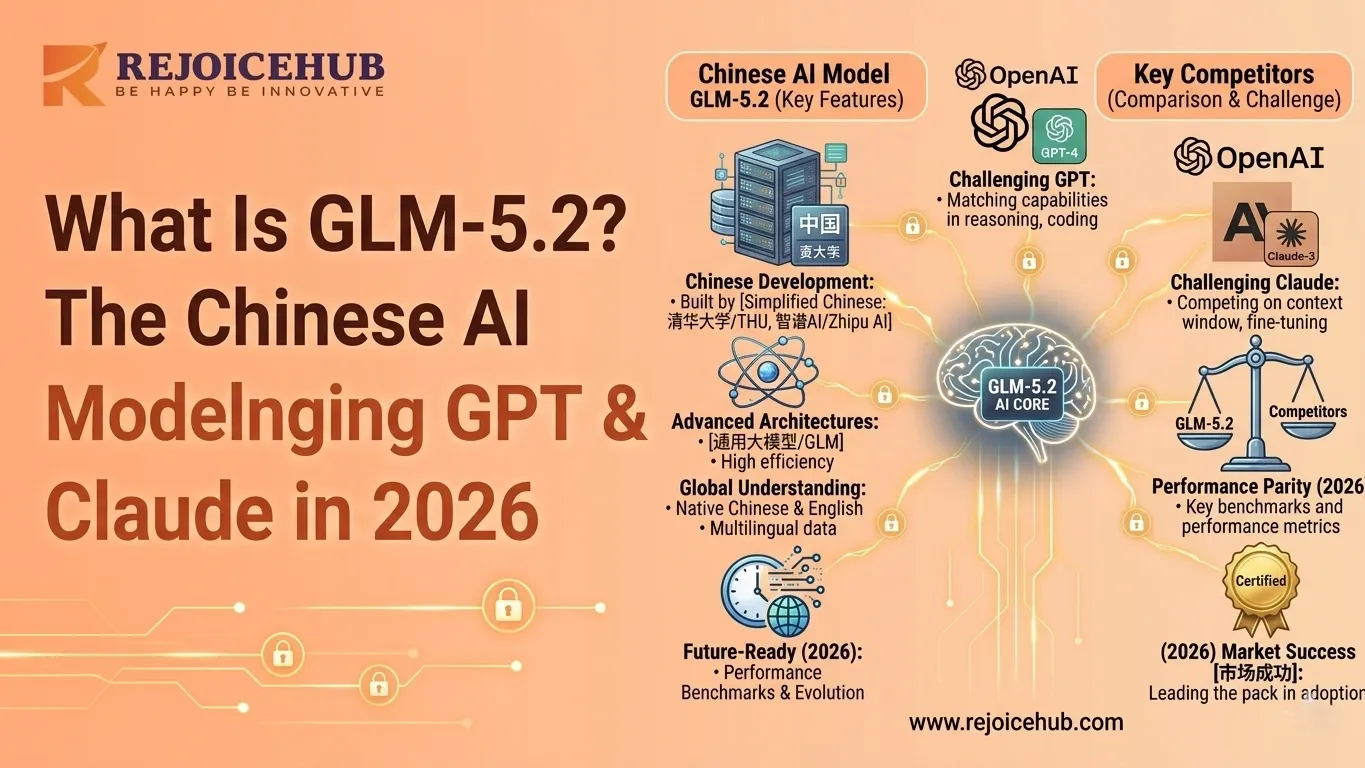
The AI race just got a major new contender and it's not from Silicon Valley.
While OpenAI and Anthropic have dominated AI headlines for years, Chinese AI labs are rapidly closing the gap. In June 2026, GLM-5.2 emerged as one of the most talked-about AI releases of the year outperforming GPT-5.5 on key coding benchmarks, offering a massive 1-million-token context window, and doing all of this as a free, open-source model. For startup founders, developers, and businesses exploring AI automation, GLM-5.2 isn't just another model to bookmark. It's a signal that the AI landscape is fundamentally shifting.
In this guide, you'll learn exactly what GLM-5.2 is, who built it, how it stacks up against GPT and Claude, and why it matters for your business in 2026.
What Is the GLM-5.2 AI Model?
GLM-5.2 is a 753-billion-parameter open-source large language model (LLM) developed by Z.ai (formerly Zhipu AI), released on June 13–16, 2026. It's engineered specifically for long-horizon autonomous coding, agentic task execution, and enterprise-scale AI workflows and it's available to download for free under an MIT license.
In plain terms: GLM-5.2 is China's most powerful publicly available AI model right now, and it performs at or near the level of the best closed-source models from OpenAI and Anthropic at a fraction of the cost.
What makes this release particularly significant is the timing. It arrived just as the U.S. government ordered Anthropic to restrict access to its top models for foreign users a geopolitical signal that AI access is becoming a new kind of competitive battleground. GLM-5.2 stepped directly into that gap.
For businesses and developers who rely on AI infrastructure, GLM-5.2 represents something new: frontier-level AI performance with full ownership, no vendor lock-in, and no geographic restrictions.
Who Developed GLM-5.2?
The Organization Behind GLM
GLM-5.2 was built by Z.ai, previously known as Zhipu AI a Beijing-based AI company founded in 2019 as a spinout from Tsinghua University, one of China's top technical universities.
The company has been developing the GLM (General Language Model) family since 2023, iterating rapidly. Their models have gone through multiple generations GLM-5, GLM-5.1, and now GLM-5.2 each time pushing the performance ceiling higher. GLM-5.1 had already topped the SWE-Bench Pro coding leaderboard before GLM-5.2 took things further.
Z.ai went public on the Hong Kong Stock Exchange in January 2026 at 116.20 HK dollars. After the GLM-5.2 launch, shares surged as much as 48 percent in a single day a sign of just how seriously markets are taking this release.
Vision for Open-Source AI
Z.ai's founder Jie Tang has positioned GLM-5.2 as a deliberate counterpoint to the trend of closed, restricted frontier AI. By releasing model weights under the MIT license with no usage restrictions and no regional locks the company is making a clear statement: powerful AI should be accessible to everyone, everywhere.
This vision resonates especially with businesses outside the U.S. that have faced disruptions from Western AI export controls. It's also a direct competitive play: enterprise pricing for GLM-5.2's coding plan starts at just $12.60/month roughly one-tenth the cost of Anthropic's premium Claude Code and Claude Max tiers. If you're curious how that stacks up in practice, our breakdown of Claude Code vs GitHub Copilot gives useful context on what premium coding AI actually costs businesses today.
Key Features of GLM-5.2
GLM-5.2 isn't just competitive on paper. Its features translate into real, practical advantages for businesses and developers building AI-powered products.
1. Advanced Reasoning
GLM-5.2 offers two selectable reasoning modes High and Max giving users direct control over the performance-speed tradeoff.
Max Mode pushes to peak logical depth, ideal for complex multi-step problem solving. It uses approximately 85,000 output tokens per task, making it suited for deep analysis and architecture planning.
High Mode cuts token usage roughly in half while sacrificing only a few benchmark points perfect for latency-sensitive production applications where speed matters.
This flexibility is something many closed models don't offer, and it gives developers a powerful lever for cost optimization at scale.
2. Coding Assistance
Coding is where GLM-5.2 truly shines. On SWE-bench Pro an industry-standard test of real-world software engineering ability GLM-5.2 scored 62.1, beating GPT-5.5 (58.6) and its own predecessor GLM-5.1 (58.4).
On FrontierSWE, a benchmark designed specifically for long-horizon task completion, GLM-5.2 hit 74.4% surpassing GPT-5.5 (72.6%) and finishing within one percentage point of Claude Opus 4.8 (75.1%).
For development teams, this means GLM-5.2 can meaningfully assist with full software engineering workflows, not just code snippets.
3. Agentic Capabilities
GLM-5.2 was built with autonomous, multi-step workflows in mind. Its architecture supports sustained agentic execution across hundreds of tool calls and iterative reasoning steps the kind of behavior needed for real AI agents, not just chatbots.
It integrates out of the box with popular agentic coding environments including Claude Code, Cline, OpenClaw, Kilo Code, Cursor, and more than 20 other platforms. On the Arena.ai Agent Arena leaderboard, GLM-5.2 holds the top spot among all open models.
4. Multilingual Support
Built on a foundation from Tsinghua University with global deployments in mind, GLM-5.2 supports both English and Chinese a key differentiator for companies operating across Asian and Western markets or building multilingual AI products.
5. Open-Source Availability
Perhaps the most business-critical feature: GLM-5.2's weights are available on Hugging Face under the MIT license. That means:
- No regional restrictions: any company, anywhere, can download and use it
- Full customization: fine-tune it on your own data
- Self-hosting: run it on your own infrastructure for data privacy and compliance
- No vendor dependency: you control your AI stack entirely
For enterprises worried about AI access disruptions or data sovereignty, this is a major selling point.
Accelerate Your Workflows with Custom AI
Book a free consultation session with RejoiceHub. We'll map out a tailored automation roadmap for your company.
How Does GLM-5.2 Compare to GPT and Claude?
Here's where it gets interesting. Let's look at how GLM-5.2 actually stacks up against the two biggest names in AI.
-
Reasoning Performance
On the Artificial Analysis Intelligence Index v4.1, GLM-5.2 scores 51 placing it ahead of DeepSeek V4 Pro (44), MiniMax-M3 (44), and Kimi K2.6 (43). It trails slightly behind the very top closed models like Claude Opus 4.8, but the gap is narrow.
On human-rated Arena.ai leaderboards which are considered hard to game GLM-5.2 ranks second on the Code Arena (1,595 points) and places ahead of Claude Opus 4.7 and Opus 4.8 on the frontend leaderboard. For a deeper side-by-side look, our comparison of Claude Opus 4.7 vs GPT-5.4 for developers covers how these closed models perform on similar benchmarks.
-
Coding Tasks
| Benchmark | GLM-5.2 | GPT-5.5 | Claude Opus 4.8 |
|---|---|---|---|
| SWE-bench Pro | 62.1 | 58.6 | 69.2 |
| FrontierSWE | 74.4% | 72.6% | 75.1% |
| Agent Arena Rank (Open Models) | #1 | N/A (Closed) | Restricted |
| Code Arena Rank | #2 Overall | — | Restricted |
GLM-5.2 beats GPT-5.5 on SWE-bench Pro and FrontierSWE. Claude Opus 4.8 still leads on SWE-bench Pro by about 7 points but it's a closed, access-restricted model. GLM-5.2 is free and self-hostable.
-
Cost and Accessibility
| Factor | GLM-5.2 | GPT-5.5 | Claude Opus 4.8 |
|---|---|---|---|
| Model Type | Open-Weight | Closed | Closed |
| Starting Price | ~$12.60/month | Premium pricing | Premium pricing |
| Relative Cost for Coding Work | ~1/6th of GPT-5.5 | Baseline | Similar to GPT |
| Self-Hosting | Yes | No | No |
| Regional Restrictions | None | Some | Yes (export controls) |
| Context Window | 1M tokens | ~128K–200K tokens | ~200K tokens |
For teams running high-volume coding or agentic tasks, the cost difference is dramatic. Reports indicate GLM-5.2 delivers comparable coding output at roughly one-sixth the cost of GPT-5.5. Businesses evaluating their enterprise AI cost strategy will find that kind of gap hard to ignore.
-
Open vs Closed Models
The open vs. closed divide is becoming a strategic business question, not just a technical one. Recent U.S. export controls restricting access to Claude Fable 5 and Claude Mythos 5 showed exactly how fragile closed-model dependency can be.
GLM-5.2's MIT license means any business can download it today, self-host it tomorrow, and never worry about a provider pulling the plug. For companies in regulated industries or those with strict data governance requirements, this flexibility isn't just a convenience it's a compliance necessity.
Why GLM-5.2 Matters for Developers and Businesses
Beyond the benchmarks and feature lists, GLM-5.2 has concrete implications for how businesses approach AI adoption in 2026.
-
Lower barriers to AI adoption: With enterprise tiers starting at $12.60/month and free self-hosted weights, GLM-5.2 makes frontier AI accessible to startups and SMBs that previously couldn't afford GPT or Claude at scale. Teams spending thousands monthly on AI APIs should seriously evaluate what GLM-5.2 can do for their workflows.
-
Customization opportunities: Because the model weights are fully open, businesses can fine-tune GLM-5.2 on proprietary data creating specialized internal models for their specific industry, codebase, or product domain. This level of customization simply isn't possible with closed APIs. It's one of the clearest benefits of open-source software applied directly to frontier AI.
-
Enterprise deployment options: GLM-5.2's 1-million-token context window makes it particularly valuable for complex enterprise use cases: analyzing full codebases, processing long legal or financial documents, running multi-day AI agent workflows, and more. The two reasoning modes let engineering teams optimize for cost vs. performance dynamically.
-
AI sovereignty benefits.: For companies in industries like healthcare, finance, or defense where data cannot leave your infrastructure self-hosting GLM-5.2 provides the capability of a frontier model without the compliance risk of a third-party API.
If you're looking to build custom AI agents or integrate open-source models like GLM-5.2 into your business workflows, RejoiceHub's AI agent development services can help you deploy, fine-tune, and scale AI solutions tailored to your specific needs.
The shift toward open-source frontier AI also opens new doors for AI agent development. Agents built on GLM-5.2 can be fully customized, privately deployed, and iterated on without API rate limits or pricing volatility. That's a meaningful advantage for any business building AI-native products.
Is GLM-5.2 the Best Chinese AI Model in 2026?
By most independent measures, yes at least among openly available models.
On the Artificial Intelligence Index v4.1, GLM-5.2 tops all open-weight models. On human-rated Arena.ai leaderboards, it places second overall in code and first among all open models in agentic tasks. Guillermo Rauch, CEO of Vercel, publicly described his reaction to GLM-5.2's coding ability as "genuinely impressed, almost shocked."
Current strengths:
- Best-in-class open-weight performance on coding and agentic benchmarks
- 1-million-token context window far larger than most rivals
- MIT license with no usage restrictions
- Highly competitive pricing and self-hosting flexibility
- Strong integration ecosystem (Claude Code, Cline, Cursor, and 20+ tools)
Areas where it trails:
- Claude Opus 4.8 still leads by ~7 points on SWE-bench Pro (though it's now access-restricted)
- General reasoning benchmarks (math, science) are stronger in GPT-5.5 and Gemini 3.1 Pro
- Data privacy considerations exist for users of Z.ai's hosted API (mitigated by self-hosting)
- Enterprise adoption will ultimately depend on real-world reliability beyond benchmarks
Market position and future outlook: Z.ai is iterating fast GLM-5.2 is the third major GLM-5 release in under six months. With a market cap now approaching 650 billion HK dollars and major analyst backing from JPMorgan and Bank of America, Z.ai has the resources and momentum to keep pushing. The "China AI threat" is no longer just DeepSeek GLM-5.2 has firmly established Z.ai as a top-tier global AI lab. To understand where this fits in the bigger picture, it helps to know how AI agents are reshaping enterprise infrastructure and what that means for model selection going forward.
Conclusion
GLM-5.2 represents a genuine inflection point in the global AI race. It's the first open-weight model to consistently challenge closed frontier models from OpenAI and Anthropic across real-world coding and agentic benchmarks and it does so while costing a fraction of the price and carrying zero geographic restrictions.
For developers, the appeal is clear: frontier-level performance, free weights, a massive context window, and seamless integration into existing workflows. For businesses, it means AI infrastructure that you own, control, and can customize without dependency on any single vendor's pricing or policy decisions.
The rise of GLM-5.2 is a signal that open-source AI is no longer a compromise it's becoming a serious strategic choice. As geopolitical pressures reshape AI access and costs continue to rise for closed models, the economics and flexibility of open-source frontier AI will only become more attractive.
Whether you end up using GLM-5.2 directly or not, the competitive pressure it creates is already pushing every AI lab to build faster, open more widely, and price more fairly. That's good news for everyone building AI-powered products.
Ready to harness the power of open-source AI for your business? Explore RejoiceHub's Generative AI development services to build intelligent automation solutions using the latest AI technologies including open-source models like GLM-5.2. Our team specializes in custom AI development tailored to your business goals, infrastructure, and compliance requirements.
Frequently Asked Questions
1. What is GLM-5.2 AI model?
GLM-5.2 is a 753-billion-parameter open-source AI model made by Z.ai, a Chinese company. It was released in June 2026 and is built for coding, reasoning, and AI agent tasks. It's free to download and use under the MIT license with no regional restrictions.
2. Who developed GLM-5.2?
GLM-5.2 was developed by Z.ai, formerly called Zhipu AI, a Beijing-based company that came out of Tsinghua University in 2019. They've been building the GLM model family since 2023, with each version performing better than the last on real-world AI benchmarks.
3. How does GLM-5.2 compare to GPT?
GLM-5.2 actually beats GPT-5.5 on the SWE-bench Pro coding benchmark, scoring 62.1 versus GPT-5.5's 58.6. It also offers a 1-million-token context window compared to GPT's 128K–200K. Plus, GLM-5.2 costs roughly one-sixth of what GPT-5.5 charges for similar coding work.
4. What are GLM models?
GLM stands for General Language Model. It's a family of AI models built by Z.ai in China. The GLM series started in 2023 and has gone through several versions GLM-5, GLM-5.1, and now GLM-5.2, each one stronger and more capable than the version before it.
5. What are the key features of GLM-5.2?
GLM-5.2 comes with a 1-million-token context window, two reasoning modes (High and Max), top-tier coding performance, multilingual support in English and Chinese, and full open-source access. It also works with over 20 popular developer tools like Cursor, Claude Code, and Cline right out of the box.
6. Is GLM-5.2 the best Chinese AI model in 2026?
Among open-weight AI models, yes. GLM-5.2 tops the Artificial Intelligence Index v4.1 for open models and ranks second overall on the Code Arena leaderboard. It's the first Chinese open-source model to seriously challenge closed models from both OpenAI and Anthropic on real-world coding tasks.
7. Can businesses use GLM-5.2 for free?
Yes. GLM-5.2's weights are available for free on Hugging Face under the MIT license. Businesses can self-host it on their own servers, fine-tune it on private data, and run it without paying API fees. A paid cloud plan starts at just $12.60/month for teams that prefer a managed setup.