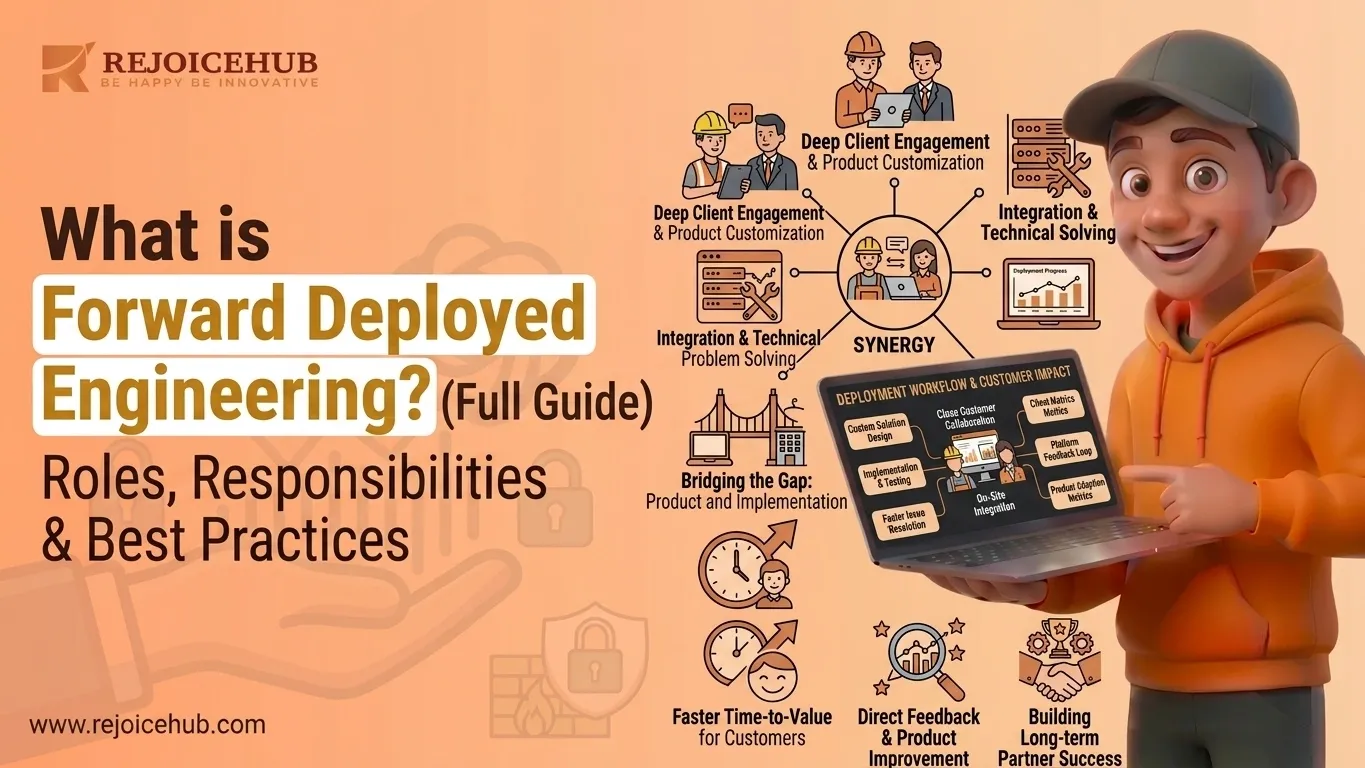
If you've done any research on how companies like OpenAI, Anthropic, or even more traditional consultancies like Palantir develop and deploy AI applications, you've undoubtedly come across the term Forward-Deployed Engineering. It's one of the fastest-growing fields within the broader technology space, representing the cutting edge of enterprise AI infrastructure.
In this guide, you'll learn the basics of what constitutes Forward-Deployed Engineering, how it differs from standard software engineering or consulting work, and why companies are doubling down on these kinds of specialized resources to accelerate their own AI initiatives.
What is Forward-Deployed Engineering?
Forward-Deployed Engineering (FDE) is a new model where engineers are embedded in a customer site (not in HQ) working on developing software specific to that customer and their needs.
Rather than a product developed by the contractor that the customer then has to figure out how to use, the FDE works on-site to actually learn the customer's requirements and write the code for the software the customer needs to use.
Think of it as the difference between:
Traditional software vendor: "Here's our product. Good luck implementing it." Consulting firm: "Here's a strategy deck. You build it." Forward-Deployed Engineer: "I'm building this with you, in your systems, until it works."
The term was pioneered by Palantir, which has developed a go-to-market strategy built on embedding engineers with government and enterprise clients.
Today the model is being copied by OpenAI, Anthropic, Amazon AWS AI teams, Adobe, and a rising number of AI-native startups, including agencies like RejoiceHub that specialize in building and automating AI agents.
Why Forward-Deployed Engineering Exists
Enterprise AI adoptions have one dirty secret that is rarely discussed: the model itself ends up being the easy part.
A language model is an excellent, generic tool that works out of the box. However, it knows nothing about your CRM, nothing about your company's compliance requirements, and nothing about the legacy codebase, and myriad other domain-specific details that matter in practical applications. In other words, the model is only the beginning.
The real work is in adapting it to the specific business, which is why most enterprise AI initiatives fail at the "last mile" of model deployment.
Forward-Deployed Engineers exist to close that gap. Instead of a slow back-and-forth between vendor and customer, an FDE:
- Embeds with the customer's team
- Learns the real data, systems, and workflows firsthand
- Builds and ships working software, not just recommendations
- Feeds lessons back into the core product
This is the key value proposition RejoiceHub offers to midsize organizations that lack the resources to develop homegrown AI teams: acting as a front-line development partner that lets them realize tangible AI automation gains rather than getting stuck with theoretical PowerPoint presentations.
Forward-Deployed Engineer vs. Traditional Roles
People often confuse Forward-Deployed Engineers with solutions architects, sales engineers, or consultants. Here's the real difference:
| Role | Where They Work | What They Deliver | Writes Production Code? |
|---|---|---|---|
| Forward-Deployed Engineer | Embedded inside the customer's environment | Live, working software on the customer's infrastructure | Yes |
| Solutions Architect | Mostly pre-sale, remote | Technical design, recommendations | Rarely |
| Sales Engineer | Pre-sale, demos | Proof-of-concepts, demos | No |
| Management Consultant | Strategy sessions, workshops | Reports, roadmaps | No |
| Implementation Consultant | Customer site (short-term) | Configuration, training | Sometimes |
The simplest way to remember it: consultants advise, sales engineers demo, and Forward-Deployed Engineers ship.
What Does a Forward-Deployed Engineer Actually Do?
A typical day for a Forward-Deployed Engineer looks less like a corporate dev cycle and more like a startup CTO's schedule. Common responsibilities include:
- Joining the customer's team standups (not just their own company's)
- Mapping the client's actual data, systems, and workflows
- Building and deploying AI agents, pipelines, or integrations directly in the client's environment
- Debugging issues in real time, with real users
- Reporting patterns and gaps back to the product team, so future deployments get faster
This is also how RejoiceHub approaches AI agent development: we don't hand you a generic chatbot template. Our engineers work inside your business context to design agents that fit your actual sales, support, or ops workflows.
Accelerate Your Workflows with Custom AI
Book a free consultation session with RejoiceHub. We'll map out a tailored automation roadmap for your company.
Real Enterprise Examples of Forward-Deployed Engineering
-
Palantir: The Original Forward-Deployed Model
Palantir has built a multi-billion-dollar business by doing this: placing engineers inside the U.S. government, large banks, and manufacturers, working alongside them to tackle complex data challenges. In the past, the company has counted more Forward-Deployed Engineers than traditional software engineers, as the field was their product.
-
OpenAI Enterprise AI: Forward-Deployed Engineering for Fortune 500s
OpenAI has a dedicated Forward-Deployed Engineering team that helps large enterprises evolve from "we tested ChatGPT" to "we run agentic workflows in production." This team partners with enterprise customers to optimize models, design retrieval pipelines, and demonstrate business value, beyond traditional roles like OpenAI's Solutions Architect.
-
Anthropic AI: Applied AI in the Field
Anthropic has pursued a similar approach, hiring Forward-Deployed Engineers to assist enterprise customers in developing safe, reliable agentic systems on top of Claude, narrowing the gap between frontier model capabilities and actual deployed applications.
-
Amazon AWS AI: Embedded Engineering at Scale
Amazon's AWS AI and professional services teams use a comparable embedded-engineering approach, placing technical staff directly with enterprise customers to architect and deploy AI infrastructure and automation at scale.
Why This Matters for Startups and SMBs
You don't need a Fortune 500 reputation to reap the rewards of this innovative model. That is the exact reason why RejoiceHub exists: To introduce our Forward-Deployed Engineering methodology to early-stage companies, startups, and SaaS platforms that are ready to truly embed AI in their operations – not just experiment with it.
The Benefits of Forward-Deployed Engineering
1. Faster Time-to-Value
Forward-Deployed Engineers work directly with your team and existing systems from day one, cutting out the typical back-and-forth and requirements documentation that plagues traditional consulting engagements. By delivering value directly into production, they can deliver working AI systems and solutions within days or weeks versus months, allowing companies to realize business impact faster.
2. Solutions Built for Your Business, Not a Generic Template
All right. Every company is different. Every company has its own set of processes, data models, security requirements, and regulatory constraints. So, instead of shoehorning you into some theoretical best practice, FDEs will build a product around how your business operates. The result is software that is intuitive and easy to work with, unlike custom vs. off-the-shelf AI software that forces a one-size-fits-all approach.
3. Lower Risk of Failed AI Projects
Many enterprise AI initiatives fail because prototypes never make their way to production. Forward-Deployed Engineers help to close the research-to-production gap, accelerating time-to-value and improving the likelihood of ultimately building a successful, production-grade AI system.
4. Continuous Feedback Loop
Given the nature of their work, FDEs are in a unique position to work closely with business users and stakeholders. This gives them the ability to receive continuous feedback from them, which in turn improves the quality of the final AI product delivered.
5. Real ROI, Not Just a Strategy Deck
Unlike many other approaches, forward-deployed engineering is concentrated on actual business results, not on nebulous concepts. It emphasizes substantial improvements, not just tweaks and adjustments. Work that has been automated, simplified, accelerated, and made less expensive is the real measure of value in terms of ROI for AI agent projects.
Forward-Deployed Engineering vs. AI Consulting: What's the Difference?
Many companies mistakenly treat consulting in the field of AI and forward-deployed engineering as the same thing, but the results of these services are fundamentally different. Consulting usually refers to an evaluation of the business, the search for opportunities for improvement, and the development of a strategy for changes.
Meanwhile, when it comes to forward-deployed engineering, this approach goes much further. The FD experts take on the responsibility of not only developing a strategy but also implementing it.
How Forward-Deployed Engineering Powers Enterprise AI Adoption
Enterprise AI adoption isn't stalling because the technology isn't good enough. It's stalling because of the "last mile" problem: connecting capable AI models to messy, real-world business systems.
Forward-Deployed Engineering directly addresses the biggest blockers to AI transformation:
- Data fragmentation: FDEs work inside your actual systems, not a sandbox
- Change management: embedded engineers build trust with the team that will use the tool daily
- Security and compliance: solutions are built with your specific infrastructure and rules in mind
- Slow iteration; feedback loops happen in real time, not through quarterly check-ins, a principle also central to good context engineering in AI systems
If you're looking to build a custom AI agent for your business whether it's automating customer support, qualifying leads, or streamlining internal operations RejoiceHub can help you go from idea to a working AI agent, fast, using the same embedded, forward-deployed approach used by leading AI labs.
Is Forward-Deployed Engineering Right for Your Business?
Forward-Deployed Engineering is ideal for organizations that seek to obtain concrete results through artificial intelligence, not just develop a strategy. It is most appropriate for companies that have a complicated business process or perform special work that requires a specifically tailored solution, instead of a standardized product.
You should consider a Forward-Deployed Engineering approach if:
- You have a clearly defined business process to automate, such as customer support, document processing, sales operations, or internal workflows.
- Your data, infrastructure, or compliance requirements are too specialized for off-the-shelf AI tools to handle effectively.
- Previous AI pilots or proof-of-concepts failed to reach production, leaving you with ideas but no business impact a common stage in the broader enterprise AI adoption roadmap.
- You want a technical partner who collaborates closely with your team, building, testing, and deploying solutions instead of simply delivering recommendations, the same way RejoiceHub helps companies deploy AI agents without an in-house ML team.
For organizations looking to rapidly transition from prototyping to production, Forward-Deployed Engineering can dramatically shorten implementation timelines, reduce project risk, and accelerate ROI. By avoiding months of iterative experimentation with disparate tools, businesses can obtain a production-ready AI solution that is tightly focused on their particular requirements.
Conclusion
Forward-Deployed Engineering isn't just an industry buzzword; it's an insight into an emerging practice. While most people would agree that AI models are powerful tools, few would argue that they require contextual expertise to produce valuable results.
The most successful companies using enterprise AI are not the ones talking the biggest deals - they're hiring forward-deployed engineers to build agents that automate business tasks inside their business.
Whether you're a founder experimenting with early-stage agents or an ops leader struggling to extract value from enterprise AI pilots, this is an idea worth knowing and adopting.
Frequently Asked Questions
1. What is Forward Deployed Engineering?
Forward Deployed Engineering is a way of working where engineers sit inside a customer's team instead of staying at their own company's office. They learn the customer's real systems and problems, then build working software right there, rather than handing over a product and walking away.
2. How is Forward Deployed Engineering different from regular consulting?
Consultants usually study a business and hand over a report or strategy plan, but they don't write the actual code. A Forward Deployed Engineer does the opposite. They roll up their sleeves, join the customer's daily work, and build the real, working software themselves.
3. What does a Forward Deployed Engineer do every day?
Their day looks a lot like joining a startup team. They sit in the customer's meetings, study how the business actually works, build AI tools or agents inside that business, fix problems as they come up, and share what they learn with their own product team.
4. Which companies use the Forward Deployed Engineering model?
Palantir started this model and built its whole business around it. Now companies like OpenAI, Anthropic, and Amazon AWS use similar teams to help big businesses move from just testing AI to actually running it in daily operations, along with newer AI-focused agencies.
5. Why does Forward Deployed Engineering matter for AI projects?
Most AI tools work fine on their own but don't understand a company's specific data, rules, or old systems. Forward Deployed Engineers close that gap by working directly inside the business, which helps AI projects move from a test phase into something the team actually uses daily.
6. Is Forward Deployed Engineering only for large companies?
No, this approach isn't limited to big brands or Fortune 500 companies. Smaller businesses and startups can use the same embedded approach to build AI tools that fit their exact needs, instead of settling for generic software that doesn't match how they actually work.
7. What are the main benefits of Forward Deployed Engineering?
Businesses get working software faster since there's less back and forth. The solution fits their exact needs instead of a generic template, and since engineers work closely with real users, problems get caught early. This lowers risk and helps AI projects actually succeed.