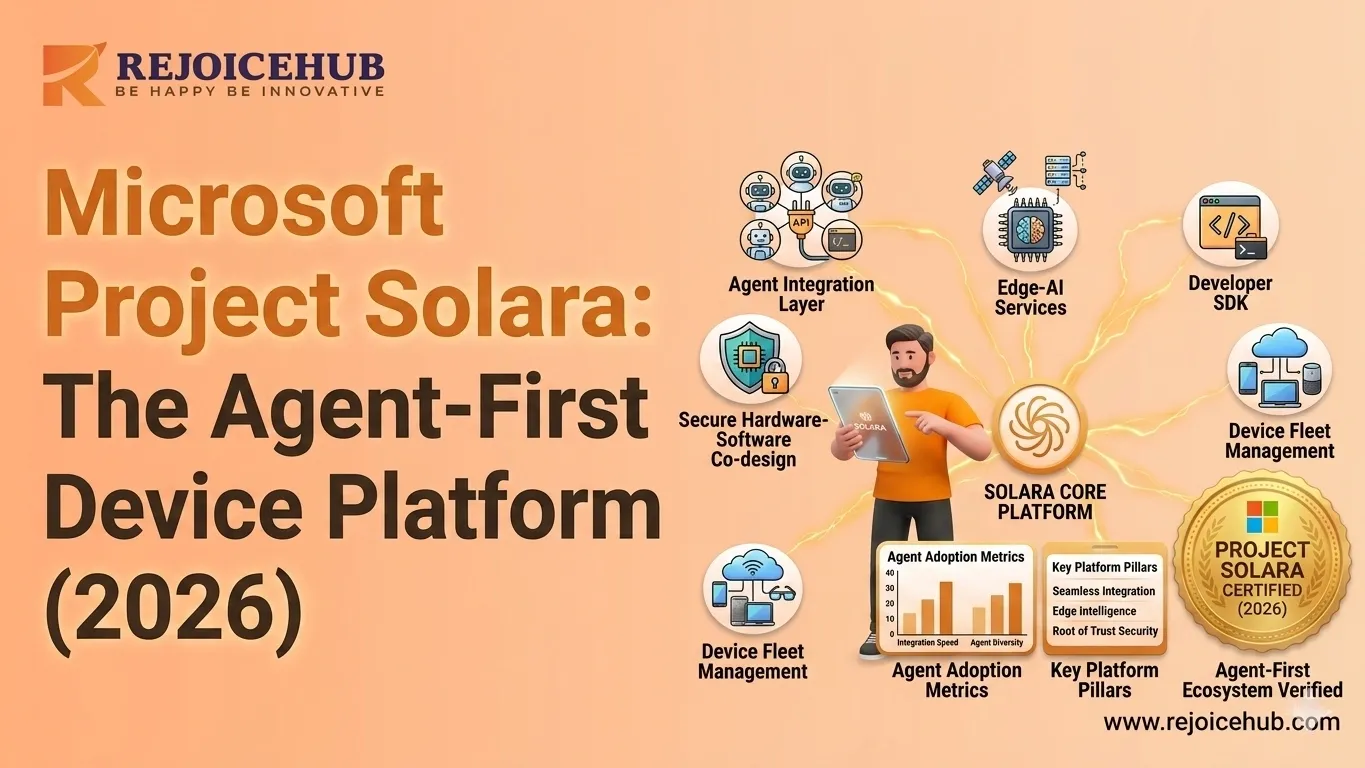
 The way we interact with computers is about to change, and kinda dramatically. For decades, we've been opening apps to get things done, one for email, one for CRM, one for scheduling. But what if a single AI agent could handle all of that for you, automatically, kind of in the background, through just a simple conversation?
That's basically the future Microsoft is building with Project Solara. Announced at the Microsoft Build 2026 Developer Conference, it's a chip-to-cloud platform made to power a new wave of "agent-first" enterprise devices, hardware built to run AI agents instead of traditional applications.
Whether you're a startup founder, a SaaS company, or a business decision maker, understanding Project Solara isn't optional, not really. It's a preview of how work, software, and devices will run over the next five years, give or take.
What Is Microsoft Project Solara?
Microsoft Project Solara looks like a chip-to-cloud platform that was unveiled at Build 2026, and it's built for agent-first devices, kind of from the ground up. Rather than running regular, traditional apps, these devices run AI agents, which handle tasks, reach out to services, and reshape the interfaces on the fly, all via natural language and smart automation, you know, that kind of thing.
The whole mission behind Project Solara is to nudge forward agent-first experiences that feel tailored around you. Like your agents, your tasks, your environment… and you're still in charge, under your control, always.
Microsoft also frames this as agents helping spark a whole new class of devices that can expand the way we work and live today, in a similar pattern to what PCs and phones did before them.
Project Solara is basically at the crossroads of Microsoft's big pillars: Windows, Azure, Copilot, and enterprise security. And it's worth noting: it's not something you can just buy today, it's more like a platform. A blueprint for the next wave of intelligent hardware and software, yeah.
How Does Microsoft Project Solara Work?
Project Solara kind of built on three technical pillars, like a lightweight edge operating system, some cloud-hosted AI agents, and then a dynamic interface layer that adapts to pretty much any device, yeah.
1. Agent-First Architecture
At the core of Project Solara is MDEP, the Microsoft Device Ecosystem Platform. It's kind of a lightweight OS that's based on the Android Open Source Project AOSP rather than Windows.
MDEP is paired with Azure-hosted agent services and persistent cloud state, so the devices end up as interfaces for AI agents running across Microsoft's cloud infrastructure, instead of being fully standalone computers, ya know.
The platform also brings enterprise-grade security and management via Intune and Entra ID, plus what Microsoft describes as "just-in-time UI". This is the ability for agents' experiences to remix their interface dynamically based on which device they are on at that moment.
Key architectural features include:
- Intune device management for enterprise IT control
- Entra ID authentication and Hello for Business biometrics
- Hardware-level privacy controls, including a physical mic mute button
- Ultra-wideband (UWB) presence sensing for automatic login and lock
- Just-in-time UI that dynamically adapts the interface to the device and task
2. Natural Language Interactions
In the Solara model, people don't really open the app. They just talk to an agent, or, you know, let it do its thing in the background sort of quietly.
Think of it like a retail associate wearing a Solara-powered badge. They ask, "What's the inventory status for item #4521?" and the agent goes off, checks the relevant system, brings back the answer, then logs the whole conversation too. Meanwhile, the associate never has to tap through a traditional app UI, nothing like that.
That's the whole vibe here: conversational commands, plus smart task execution. The agent picks up the context, figures out which tools to use, and then wraps up the job for you, without you micromanaging everything. This is precisely what makes agentic AI workflows so powerful for enterprise environments.
How AI Agents Could Replace Traditional Apps
1. The Current App-Centric Model
Today's computing model is sort of built around apps, like everything revolves around them. You end up with one app for email and another for your CRM, then one for scheduling, and yet another for analytics. Each app asks you to log in, then you have to dig through menus and do the tasks by hand, manually clicking around, over and over.
The limitations are real:
- Context switching kills productivity. The average worker uses 9+ apps daily
- Every app has its own learning curve and interface
- Data is siloed your CRM doesn't talk to your calendar automatically
- Automation requires expensive integrations or IT involvement
2. The Agent-Driven Alternative
Project Solara kind of reimagines the whole thing. Like, instead of a bunch of separate apps, you basically get one agent interface, ya know. And rather than digging through menus, you just describe what you need, in plain terms, not too complicated. Plus, instead of all that manual data entry, the agent handles the execution end to end.
For a business, this means:
- One interface for multiple tasks across the entire organization
- Personalized workflows that adapt to each employee's role
- Automated execution of routine processes without human intervention
- A single agent context that carries information across every task
Understanding how AI agents can automate your workflows is quickly becoming a core competency for forward-thinking businesses.
3. Traditional Apps vs. AI Agents: A Direct Comparison
| Traditional Apps | AI Agents (Project Solara) |
|---|---|
| Open a specific app | Ask AI in natural language |
| Multiple interfaces to learn | Single unified interface |
| Manual navigation required | Automated task execution |
| Siloed data per app | Unified context awareness |
| Static, pre-built features | Dynamic, adaptive workflows |
| User adapts to software | Software adapts to user |
Microsoft Solara AI Device Ecosystem Explained
Project Solara doesn't exist in isolation. It connects, and depends on, the entire Microsoft AI ecosystem.
-
Windows: Project Solara runs on MDEP (built on AOSP), not Windows but Solara devices can connect to Windows 365 Cloud PC, giving workers access to full Windows environments through a lightweight device.
-
Copilot: Microsoft's Copilot AI layer integrates with Solara's agent shell, enabling Copilot-powered agents to perform tasks across Microsoft 365 services, data, and workflows.
-
Azure: The intelligence in Solara lives in Azure. AI agents run as cloud services, meaning compute scales on demand and models can be updated without touching the device.
-
AI Agents: These are the core unit of Solara purpose-built for specific tasks like customer service, inventory lookup, or scheduling, each connected to the right data and tools. Businesses exploring use cases of AI agents will find Solara's architecture directly mirrors real-world deployment patterns.
-
Future Devices: Microsoft has shown two reference designs: a stationary desk-mounted AI hub built around MediaTek IoT silicon, and a wearable AI badge powered by Qualcomm hardware. These are concept devices demonstrating what's possible. Partners can build on the platform to create their own form factors.
The result is not one form factor but a constellation of devices working together as one system.
Benefits and Challenges of Agent-First Computing
Benefits
-
Productivity: Eliminating app-switching and manual navigation dramatically reduces time-on-task. Agents execute in seconds what employees currently do in minutes.
-
Automation: Routine processes order lookups, appointment scheduling, report generation run automatically without human intervention.
-
Personalization: Agents adapt to individual users, roles, and contexts. A frontline worker sees a different experience than an operations manager, even on identical hardware.
-
Reduced Training Costs: Natural language interfaces are intuitive. New employees can be productive faster without learning complex software.
-
Scalability: Adding a new agent capability doesn't require deploying new software to every device it's a cloud update.
Challenges
-
Security: Agents that access multiple systems and execute tasks autonomously create new attack surfaces. Enterprise security models must evolve.
-
Privacy: Persistent cloud-based state means data is continuously flowing to and from devices. Data residency and consent policies become critical.
-
Reliability: If your business runs on agents, what happens when the cloud is unavailable? Offline resilience and failover planning are essential.
-
Regulation: AI agents making decisions on behalf of employees will attract scrutiny particularly in healthcare, finance, and legal sectors.
-
Change Management: Shifting from apps to agents is a cultural and operational change, not just a technical one.
The good news? These challenges are solvable, and companies that start building their AI agent strategy for business now will be far better positioned to navigate them.
What Project Solara Means for Businesses and Developers
1. For Businesses
The most immediate opportunity is sort of automation. I mean if your business has frontline workers, customer service teams, field operations, or those repetitive back-office workflows, Project Solara suggests a future where AI agents do the heavy lifting, the whole thing.
But you should ask these strategic questions right now:
- Which of our workflows are repetitive and rule-based enough to be automated by an agent?
- What data do our agents need to access, and is that data clean AND accessible?
- How do we want our employees and customers to interact with AI agents, like in real life, not just in a demo?
And if you're looking to build a custom AI agent for your business, RejoiceHub specializes in end-to-end AI agent development, from workflow analysis to deployment.
2. For Developers
Project Solara signals a major shift in how software is built and sold. The app store era may give way to an agent marketplace era where developers create specialized AI agents rather than standalone applications.
This means:
- Shifting from UI-first to API-first development
- Building agents that integrate with Microsoft's agent orchestration layer
- Designing for natural language interfaces rather than graphical ones
- Leveraging Azure AI services and Microsoft Copilot APIs as foundational building blocks
Developers who want to get ahead should already be thinking about how to build an agentic AI system for business. Those who learn to build on agent-first platforms today will have a significant head start when this becomes the dominant computing paradigm.
Conclusion
Microsoft Project Solara is more than a product announcement; it is like a clear signal from Microsoft that agents will reshape not just software but the devices themselves, too.
This shift, from app-centric routines to agent-driven experiences, will end up changing how companies run, how developers assemble things, and how employees actually get work done day to day. The firms that lean in early to this change will see big competitive gains in efficiency, automation, and how customers feel the whole experience.
Agent-first computing matters because it reduces the friction between what a human means and what digital systems do. Instead of walking through menus and software screens, you simply describe what you need, then the agent handles the rest.
So yeah, this is not a tiny UX upgrade. It's a real rethinking of how humans relate to computers, honestly.
Frequently Asked Questions
1. What is Microsoft Project Solara?
Microsoft Project Solara is a chip-to-cloud platform announced at Build 2026 that powers a new kind of device, one built to run AI agents instead of traditional apps. Instead of opening separate apps for each task, users just talk to an agent that handles everything automatically, in the background.
2. How does Microsoft Project Solara work?
Project Solara runs on MDEP, a lightweight OS built on Android Open Source Project (AOSP), paired with Azure-hosted AI agents. The agents access the right tools, pull data, and complete tasks through natural language. There's no need to navigate menus or switch between multiple apps manually.
3. How do AI agents replace traditional mobile apps with Microsoft Solara?
Instead of opening an app and clicking through menus, you describe what you need and the AI agent handles it end to end. One agent can check inventory, update a CRM, send a message, and log the result all without you ever launching a single app. That's what makes Solara a real shift.
4. What devices does the Microsoft Solara AI ecosystem support?
Microsoft has shown two reference designs so far: a desk-mounted AI hub using MediaTek IoT chips and a wearable AI badge powered by Qualcomm hardware. These are concept devices, not retail products yet. Partners can build their own form factors on top of the Solara platform using Microsoft's guidelines.
5. What is the Microsoft Solara platform and who is it built for?
The Microsoft Solara platform is built for businesses with frontline workers, customer service teams, and repetitive back-office workflows. It's aimed at companies that want to automate routine tasks using AI agents, without the complexity of managing dozens of separate apps and software integrations across teams.
6. What are the main benefits of Microsoft Project Solara for businesses in 2026?
Solara cuts down on app switching, reduces manual data entry, and speeds up routine tasks through AI automation. Agents adapt to each employee's role and run on cloud updates — so no new software rollouts needed. Businesses can expect real gains in productivity, lower training costs, and better customer experiences.
7. What challenges should businesses expect when moving to agent-first computing?
Security is a big one, since agents that access multiple systems create new risks. Data privacy matters too, as agents rely on continuous cloud connections. There's also the challenge of change management shifting from apps to agents isn't just a tech upgrade; it requires training, buy-in, and rethinking how workflows are designed from the ground up.