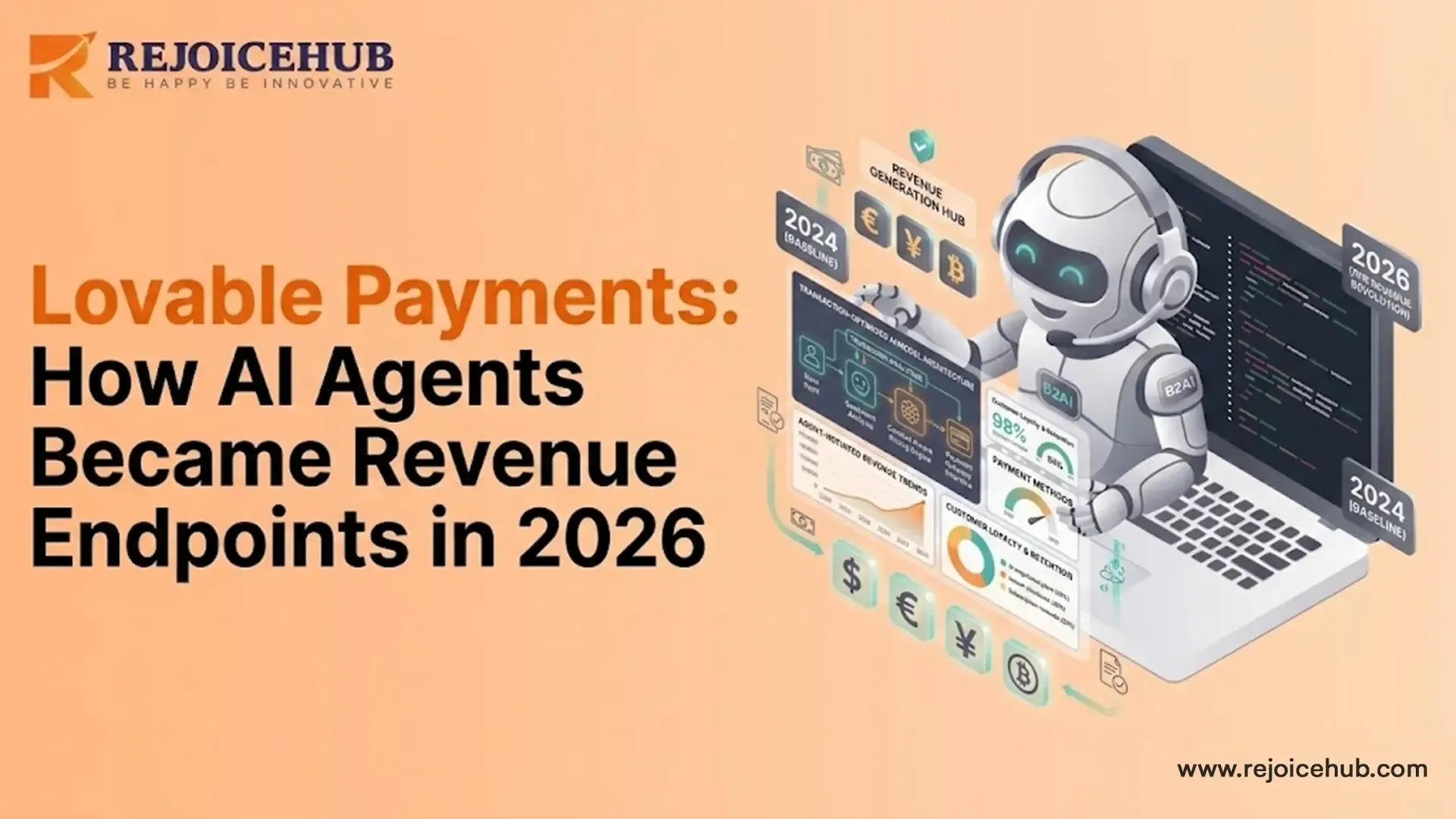
The upcoming period will bring forth software systems that will operate as complete transactional agents for human users. AI agent payments have progressed beyond their original research laboratory and science fiction status. The combination of lovable payments and AI-driven commerce in 2026 first transforms SaaS monetization methods and business operations before it enables autonomous systems to create actual revenue streams.
Consider this scenario: Your AI sales agent will handle the deal closure process together with invoice generation and payment initiation without needing any human involvement. This current situation represents the operational environment that businesses must manage today. To understand the broader shift this represents, it helps to first explore what AI agents are and how they work before diving into the payment layer built on top of them.
The need to comprehend AI agents as revenue endpoints has become essential for startup founders, SaaS operators, and enterprise decision-makers. The business world requires this knowledge for competition.
What Are Lovable Payments?
The payment infrastructure system of Lovable Payments exists as an advanced payment solution that serves AI agents and autonomous software programs. Lovable Payments allows AI agents to handle financial transactions through automated processes that require no human assistance.
The 2026 project, Quick Answer, defines Lovable Payments as an agentic payment platform that allows AI agents to autonomously initiate and complete financial transactions through secure API workflows, identity verification, and real-time billing automation, making it the backbone of AI commerce in 2026.
The payment layer functions as the essential system that enables businesses to operate entirely through automated processes. The AI agents use Lovable Payments to conduct financial operations within a pre-defined limit, which governs their activities without needing human approval for purchase or billing cycle initiation.
The system provides essential support to AI commercial activities because it connects AI decision processes with actual financial results.
How Lovable Payments Works
The operational structure of Lovable Payments consists of three essential components that together support the complete transaction process used by artificial intelligence systems.
1. AI Agent Authentication
Before any transaction occurs, the AI agent must be verified. Lovable Payments uses a robust identity verification system where each agent is assigned a unique identity token and a scoped permission set.
- Each agent is authenticated via API keys and identity certificates.
- Permissions define exactly what an agent can purchase, in what amounts, and under which conditions.
- Role-based access controls prevent unauthorized transactions or permission escalation.
This layered authentication ensures that only approved agents with verified identities can engage in financial activity, a critical safeguard in multi-agent environments. Businesses evaluating non-human identities in enterprise AI will find this authentication model directly relevant to their security planning.
2. Payment Execution
The agent can access the entire autonomous checkout process after completing the authentication process.
- Autonomous checkout: Agents evaluate conditions, select payment methods, and execute transactions based on pre-set logic.
- Transaction approvals: Multi-step approval thresholds can be configured for high-value purchases.
- API workflows: Every transaction runs through structured API calls, which provide complete traceability and enable retry attempts while handling errors.
Lovable AI payments achieve payment processing capabilities that traditional billing systems cannot match because it automates all payment procedures through complete removal of human involvement.
3. Revenue Tracking and Automation
Post-transaction, Lovable Payments provides real-time revenue intelligence through its automation layer.
- Automated billing: Subscription renewals, usage-based charges, and one-time payments are triggered without manual input.
- Subscription management: AI agents can upgrade, downgrade, or cancel plans on behalf of users based on behavioral signals.
- Workflow monetization: Every AI-powered workflow, from lead scoring to procurement, can be tagged and billed as a revenue event.
If you're looking to build AI agents capable of autonomous payment execution, RejoiceHub specializes in custom AI agent development and workflow automation for growing businesses.
Why AI Agents Are Becoming Revenue Endpoints
The traditional method of generating revenue needed salespeople to close deals and customers to make purchases through the "buy now" button and accountants to issue invoices. The revenue chain system now faces disruption from AI agents who operate as active revenue generators in 2026. This transition is a core driver behind agentic commerce reshaping how businesses transact online.
What does "revenue endpoint" mean? A revenue endpoint consists of every system node that either creates or handles monetary transactions. The AI system operates as a revenue endpoint after it qualifies leads, sends proposals, and receives payments without human assistance.
The following factors drive this change at a fast pace:
- AI agents function as independent employees because they execute more than just question answering. They make decisions and complete their assigned tasks while they finish all procedures that include financial operations.
- AI systems make purchases from other AI systems in multi-agent environments because their agents need to acquire resources, data feeds, and computing power without requiring any human involvement.
- A very automated workflow process, which includes customer onboarding, data enrichment, and report generation, can establish its own pricing structure that allows for automatic billing.
- SaaS platforms now use AI agents for their billing operations, upselling activities, and customer retention tasks, which they execute without human involvement.
The outcome establishes revenue generation as a permanent system which operates continuously without needing human workers. The primary source of revenue now comes from AI agent payments because they serve as the main method of generating income.
Real-World Use Cases for AI Agent Payments
The concept becomes much more tangible when you look at how businesses are already deploying agentic payment systems.
-
AI Sales Agents
An outbound sales agent identifies qualified prospects, sends personalized pitches, handles objections via conversation, and processes payment upon agreement. Companies using AI agents for business automation report 40–60% reduction in sales cycle length and significant operational cost savings.
-
Autonomous Customer Support
AI support agents are now empowered to issue refunds, apply discount codes, and process billing adjustments in real time, without escalating to a human. This dramatically cuts support costs while improving resolution speed. For a deeper look at how this works in practice, the AI customer support automation guide covers deployment strategies in detail.
-
AI Travel Booking
Corporate travel platforms deploy AI booking agents that perform autonomous flight and hotel search, comparison, and booking tasks while charging to the appropriate cost center. The agent transforms into a travel manager who operates continuously without rest.
-
Procurement Agents
AI procurement agents at enterprises track inventory levels and select preferred vendors while they execute purchase orders and start payment processes according to policy restrictions established by the operations team.
-
AI SaaS Assistants
AI assistants now find integration into SaaS platforms that use customer usage data to recommend plan upgrades and perform upsells while processing payments. This is also accelerating the broader conversation around AI agents replacing traditional SaaS tools for core business functions.
The use cases above present proof of return on investment through their ability to decrease operational costs, increase processing speeds, reduce mistakes, and provide round-the-clock service.
RejoiceHub helps businesses design and deploy AI agents for sales, support, and operations. Let's build your agentic revenue system. Visit rejoicehub.com to get started.
Benefits and Risks of AI Payment Infrastructure
| Benefits | Risks & Considerations |
|---|---|
| Faster, 24/7 autonomous transactions | Fraud and spoofed agent identity |
| Scalable monetization without manual billing | Permissions abuse without proper scoping |
| Seamless API-driven payment execution | Compliance gaps across jurisdictions |
| Real-time revenue tracking and dashboards | Payment security vulnerabilities in multi-agent chains |
| Reduced overhead and human error | Lack of auditability if governance is weak |
Governance and Oversight: The Trust Layer
The businesses that will win in the agentic economy are those that treat governance as a first-class feature, not an afterthought. Effective AI payment governance includes:
- Scoped permissions with hard transaction limits per agent.
- Real-time anomaly detection to flag unusual payment behavior.
- Full audit trails for every agent-initiated transaction.
- Human review triggers for transactions above defined thresholds.
- Regulatory compliance mapping for PCI DSS, SOC 2, and GDPR.
Building these controls into your AI infrastructure from day one is not optional — it's what separates scalable, trustworthy AI commerce from chaotic automation. Organizations looking to establish this kind of structure can reference the enterprise AI adoption roadmap to assess where they currently stand and what steps to prioritize.
The Future of AI Commerce in 2026 and Beyond
We are at the beginning of what many are calling the autonomous commerce era.
-
AI-Native Businesses
Entire companies will be built with AI agents as the primary operational layer. AI-native businesses will operate through their marketing agents, sales agents, finance agents, and support agents, who will handle all tasks through automated systems that function without human organizational structures.
-### AI Marketplaces
The emergence of agent marketplaces has begun with the development of platforms that enable users to find and acquire specialized AI agents for immediate deployment. The commerce system of these ecosystems will operate through payment systems, which include Lovable Payments. This connects directly to the rise of agentic commerce and AI buying agents in 2026, where agent-to-agent transactions are becoming a new commercial norm.
-
Multi-Agent Economies
The complex workflows involve agents working together through data collection, data analysis, transaction execution, and end-client billing operations. The multi-agent economy establishes completely different ways to generate revenue. Understanding how AI agents use machine payments protocol is essential for businesses building infrastructure for this environment.
How RejoiceHub Fits In
At RejoiceHub, our work combines artificial intelligence agents with enterprise automation and intelligent systems. We assist businesses in building their AI systems, which enable them to create new revenue streams through workflow automation and multi-agent deployment systems.
The companies investing in agentic infrastructure today will define the competitive landscape of tomorrow.
Conclusion
The evolution from manual human-driven commerce to autonomous AI-powered transactions is happening faster than most businesses realize. Lovable Payments represents the infrastructure layer making this possible enabling AI agents to authenticate, transact, and generate revenue at scale.
In 2026, AI agents will no longer function as tools. They will become revenue endpoints that actively participate in your business's financial ecosystem.
You should focus on these thoughts at this moment:
- AI agents can help your revenue operations by reducing friction throughout your processes.
- Your business should identify which workflows can generate revenue through autonomous monetization.
- You must establish governance and security frameworks before you can implement agentic payments.
- You need to assess whether your technical infrastructure can handle multi-agent commerce operations.
Frequently Asked Questions
1. What is Lovable Payments, and how does it work?
Lovable Payments is a payment infrastructure built for AI agents. It lets autonomous software handle real financial transactions without human help. Each agent gets a verified identity, scoped permissions, and access to API-based checkout flows so payments happen automatically, securely, and with full tracking in real time.
2. How are AI agents becoming revenue endpoints in 2026?
AI agents now qualify leads, send proposals, close deals, and collect payments on their own. That makes them revenue endpoints system nodes that actively generate money. In 2026, businesses will use these agents around the clock without needing a sales rep or billing team involved in every step.
3. What makes Lovable AI payments different from regular payment systems?
Regular payment systems need a human to trigger them. Lovable AI payments are fully autonomous. AI agents authenticate themselves, choose payment methods, and execute transactions through structured API workflows. It removes manual billing steps and supports multi-agent environments where agents buy from other agents automatically.
4. Is Lovable Payments safe for autonomous financial transactions?
Yes, when set up correctly. Each agent has a unique identity token and limited permissions. Role-based access controls block unauthorized actions. There are also anomaly detection systems, full audit trails, and human review triggers for large transactions making it safe for real-world business use.
5. What businesses can benefit most from AI agent payments?
SaaS companies, enterprise procurement teams, travel platforms, and customer support operations benefit most. Any business running repetitive billing, upselling, or vendor payment workflows can replace manual steps with AI agents cutting costs, reducing errors, and keeping revenue operations running 24/7 without downtime.
6. How does Lovable Payments handle subscription management through AI agents?
AI agents track usage behavior and automatically upgrade, downgrade, or cancel subscriptions based on set rules. Billing runs without manual input renewals, one-time charges, and usage-based fees all trigger automatically. This keeps revenue flowing and reduces churn without a customer success team member stepping in each time.
7. What governance rules should businesses set before using agentic payments?
Before launching AI agent payments, set hard transaction limits per agent, enable real-time anomaly alerts, and build full audit logs for every payment. Add human approval triggers for high-value actions. Also, map your system to compliance standards like PCI DSS, SOC 2, and GDPR from day one.