It is truly amazing to see how rapidly AI has made its way into the fashion industry. Just twenty-four months back, the discussion around it was almost zero, and now it has turned into a significant point in the fashion world, just by predicting the trends and generating ideas even ahead of the brands and the customers.
Moreover, the shopping experience has changed a lot too, as instead of spending a lot of time and effort thinking over purchases at the mall, customers can now have custom-made outfit ideas and shop AI-made fashion right from their home.
Quick Summary
Before explaining into specifics, it is necessary to present a summary of today's discussion points. The impact of AI on the fashion industry is huge and has even entered the design and trend forecasting areas, along with supply chain and inventory, personalised shopping, and quality control and authentication.
Digital fashion for avatars and ethical dilemmas are among the issues that will be discussed. Let us move forward to examine the various sectors of the fashion industry that are participating in the reshaping of the industry.
How AI Transforms Fashion Design & Product Development
AI converts fashion design and product development by growing trend prediction and generating innovative design concepts, and reducing the production line.
It helps brands to create smarter, more efficient workflows while improving creativity and accuracy.

-
Trend Forecasting & Predictive Analytics
Do you recall the times when fashion trends seemed like a magical affair? Designers seemed to be able to predict with almost supernatural perception what would be the next season's hit among consumers. What a surprise, though, that the fashion industry today is heavily relying on AI, and thus, there is more science than ever before
-
Generative AI for Creative Design
Generative AI is not kicking out designers, but it is actually becoming their creative partner. Imagine it as a scenario where an assistant is always around with new ideas.
The AI is capable of generating fabric patterns and texture, too. Rather than a designer spending weeks to get through and find the best design, he/she can do the opposite and generate and test hundreds of patterns in an evening.
-
Virtual Prototyping & 3D Sampling
To be more precise, this is where the fun begins. Generative AI is not kicking out designers, but it is actually becoming their creative partner. Imagine it as a scenario where an assistant is always around with new ideas.
Midjourney, Runway, and certain fashion AI platforms can produce so many design variances in no time at all. A designer might draw a simple idea, input it into the AI, and receive many different versions of that idea back. Numerous different patterns, different colour combos, and different styles all come from that initial concept.
-
Fabric & Material Innovation
Even AI technology in the fashion industry is facilitating the development of superior fabrics. The usage of AI algorithms is capable of examining and evaluating thousands of combinations of materials for the purpose of selecting the ones that have the properties of being sustainable, durable, or possessing certain specified performance characteristics.
The AI has the capability of modelling the performance of a fabric during testing of different conditions, such as stretching, breathing, and withstanding several washes. This is a great deal of time saving in the process of brand development and material testing compared to the traditional methods, which often last for months and include physical testing.
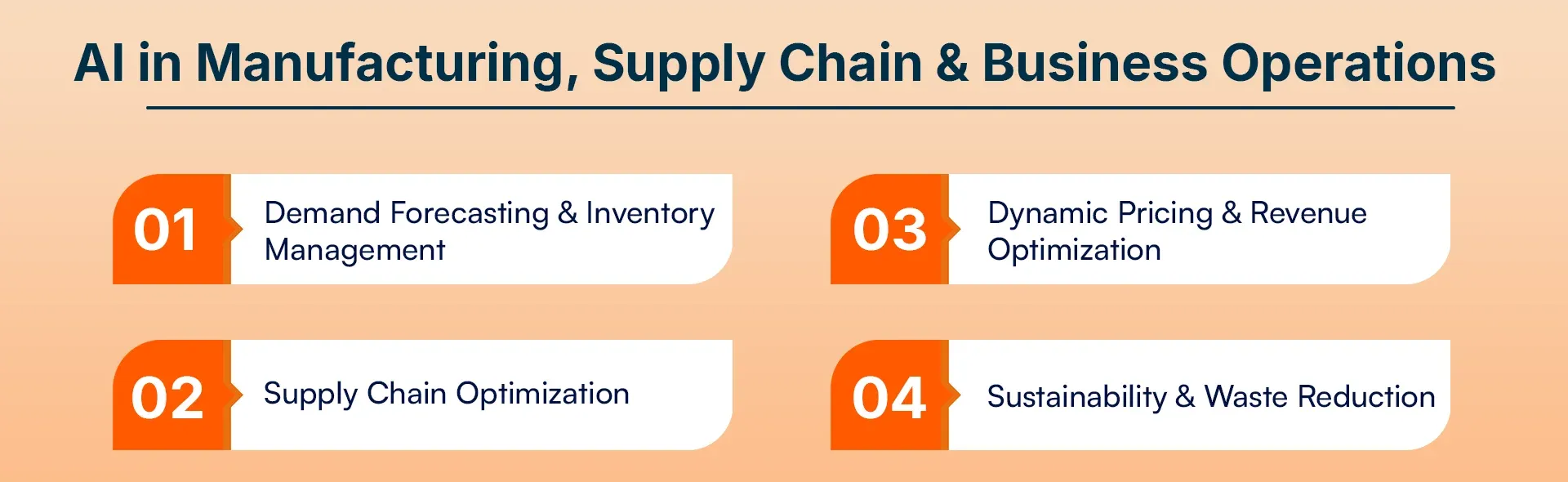
AI in Manufacturing, Supply Chain & Business Operations
AI in manufacturing, supply chain, and business operations streamlines production, improves demand forecastin, and inventory accuracy. It enables faster decision-making, reduces operational costs, and boosts overall efficiency across the value chain.
-
Demand Forecasting & Inventory Management
Do you have an idea why some products become out of stock right away, and others find their way to the clearance sale? Insufficient demand forecasts. It is one of the greatest problems in the world of fashion, and it costs the industry a fortune every year.
However, now AI has come to the rescue. The process of predicting future sales for a particular item involves not just analysing sales data from the past, but also including factors such as current trends, weather conditions, economic indicators, and even social media chatter.
-
Supply Chain Optimisation
The fashion supply chain is a very difficult and complex process. Materials are sourced from a variety of places, and then the goods are shipped to various locations worldwide after production. The whole process of managing efficiently is a nightmare, and, on the other hand, AI is playing a vital role in making it much smoother.
-
Dynamic Pricing & Revenue Optimisation
Prices for the same product online can vary, and you may have observed that. It's the case of AI in the fashion industry. One of the applications is Dynamic Pricing that, through algorithms, adjusts the prices to the corresponding demand, competing prices, the number of items remaining, and even the time of the day.
-
Sustainability & Waste Reduction
In my view, this is one excellent area where AI could be the most beneficial. The fashion sector has a significant environmental challenge, and artificial intelligence in fashion is one of the solutions along the way.
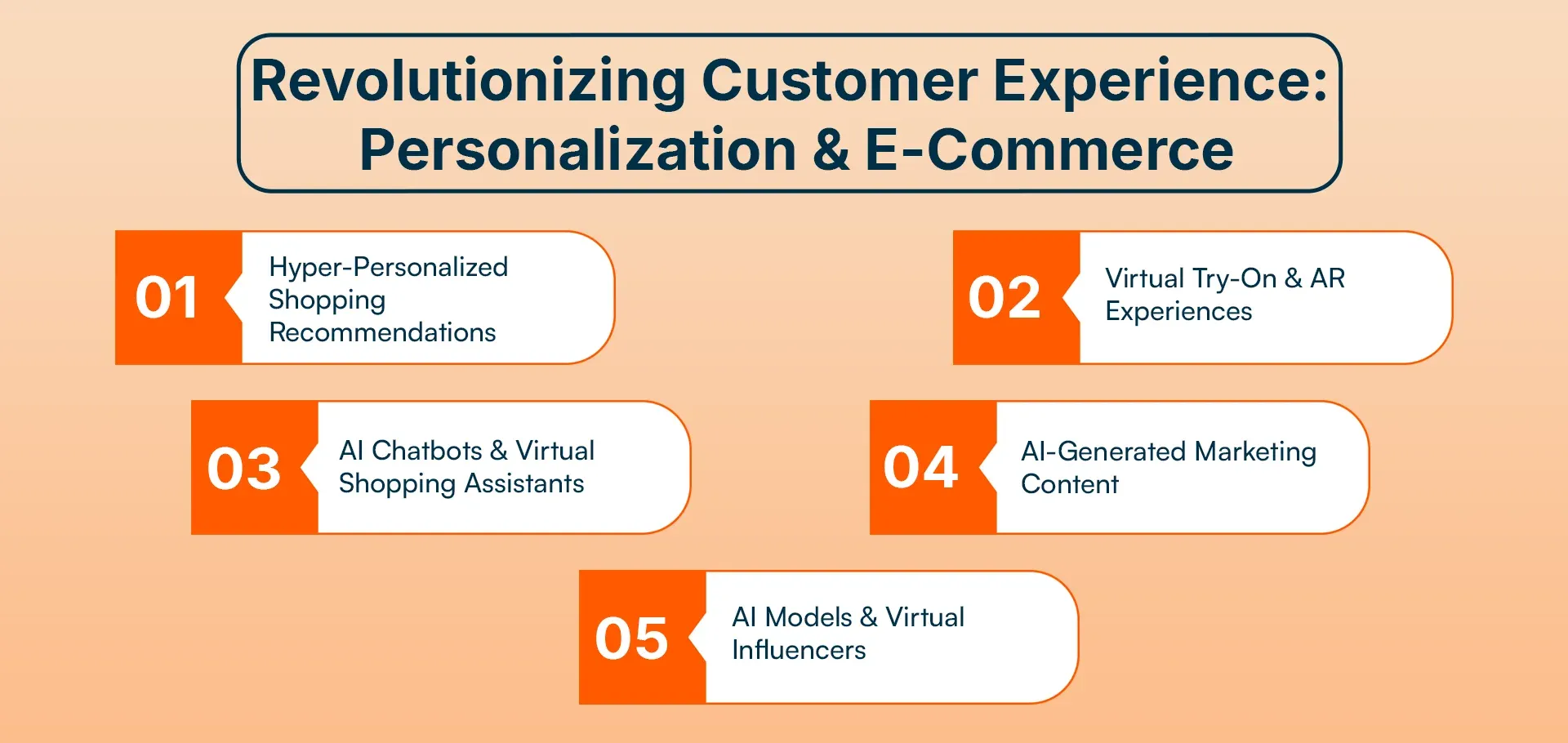
Revolutionising Customer Experience: Personalization & E-Commerce
Transforming consumer experience via AI implies offering extremely personalised, hassle-free, and user-friendly communications at all points of interaction. It empowers companies to foresee demands, suggest appropriate products, and make the shopping process more connected, thus, more inviting.
-
Hyper-Personalised Shopping Recommendations
Do you ever have the sensation that an online shop simply 'understands' you? This is AI doing its job indirectly. Nowadays, fashion retailers rely on AI and fashion data to monitor your activities and tastes in ways that were unimaginable before.
-
Virtual Try-On & AR Experiences
This one ranks high among my applications. Virtual try-on technology enables you to see how the clothes look on you without having to wear them physically. Besides, you can try on different colours and see how you look in different outfits using just the camera on your phone and AR technology, which will give you a realistic preview.
-
AI Chatbots & Virtual Shopping Assistants
You are allowed to use the data only till October 2023. When it's 2 AM, and you're shopping online, and you have a question? AI in fashion means no waiting till morning for the answer. The AI chatbots and virtual assistants are always there, i.e., 24/7, to support the customers, to get their query regarding size and styling done, and even to support the customer in the purchase process.
-
AI-Generated Marketing Content
The process of generating marketing content takes a lot of time and is costly. Nevertheless, Artificial Intelligence has sped up the whole process, and it is also more individualised. Nowadays, businesses can personalise email campaigns for different customer groups, automatically generate social media posts, and even create product photos without physical shootings.
-
AI Models & Virtual Influencers
The use of AI in the fashion industry has begun to cover that area which many would still consider as having belonged to the realm of science fiction, and hence it is already here: virtual models and influencers. Among the most notable virtual influencers is Lil Miquela, who boasts millions of followers and has collaborated with top fashion brands.
Also Read: AI in Payments - How AI Is Transforming Digital Payments
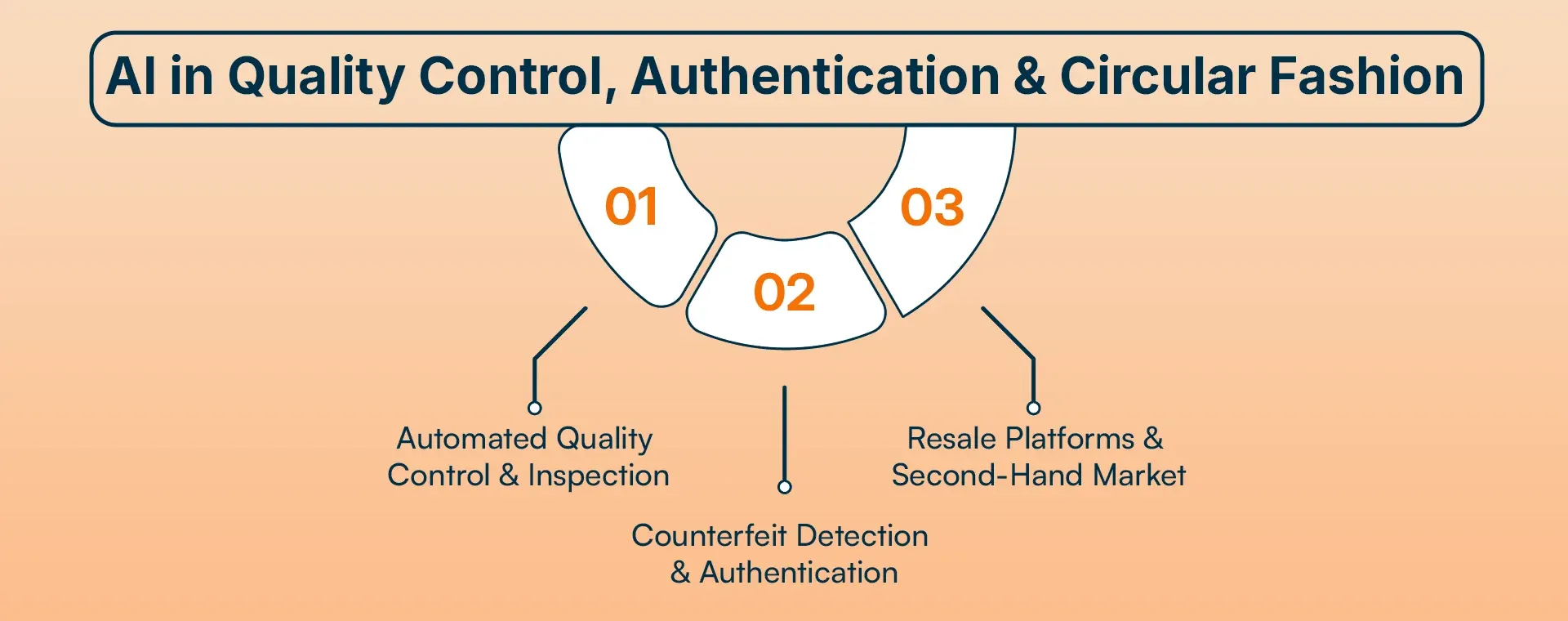
AI in Quality Control, Authentication & Circular Fashion
The adoption of AI in quality assurance, verification, and the circular economy not only improves the precision of products but also prevents sold-out items from being faked and takes part in eco-friendly practices.
-
Automated Quality Control & Inspection
Quality control during the past was a procedure that required the presence of humans and inspectors who had to examine garments one by one. This method took a lot of time, and people finally became tired, which resulted in the chance of errors.
-
Counterfeit Detection & Authentication
Fakes and imitations are a big issue in the fashion market, as well as a source of revenue loss of billions for the original manufacturers, and also a means of financing illegal activities at times. The use of AI in fashion is one of the ways to combat this issue.
-
Resale Platforms & Second-Hand Market
The secondhand apparel market is flourishing, and at the same time, AI is enhancing it even more. The platforms are utilising AI to classify and categorise the used garments, to set the price perfectly according to the quality and demand, and to find the right buyer for each item.
Digital Fashion, Metaverse & Future Innovations
Digital clothing, the metaverse, and upcoming creations are altering entirely the manner in which individuals design, put on as well and experience clothes.

-
AI Fashion for Virtual Worlds
If you are not fond of video gaming or virtual environments, this may seem odd to you, but digital fashion has actually become a reality and is thriving. In gaming platforms such as Roblox or virtual worlds such as Meta's, people dress their avatars up with virtual outfits. A few of the digital clothing items are sold in the form of NFTs, which means that the buyers get the ownership privileges.
-
Smart Textiles & Wearables
Consider garments that keep an eye on your well-being, are able to change their temperature, and even give your phone some power. Smart textiles with AI integration are the ones to make this happen. Although these are not yet the daily wear, the technology is growing rapidly.
-
AI Discovery Platforms
This is a fundamental shift in shopping practices. ChatGPT and Perplexity, among others, are the discovery platforms that have emerged from AI answer engines. Customers seek the fashion advice of AI, and the latter gives the names of certain things or brands.
Challenges, Limitations & Ethical Considerations
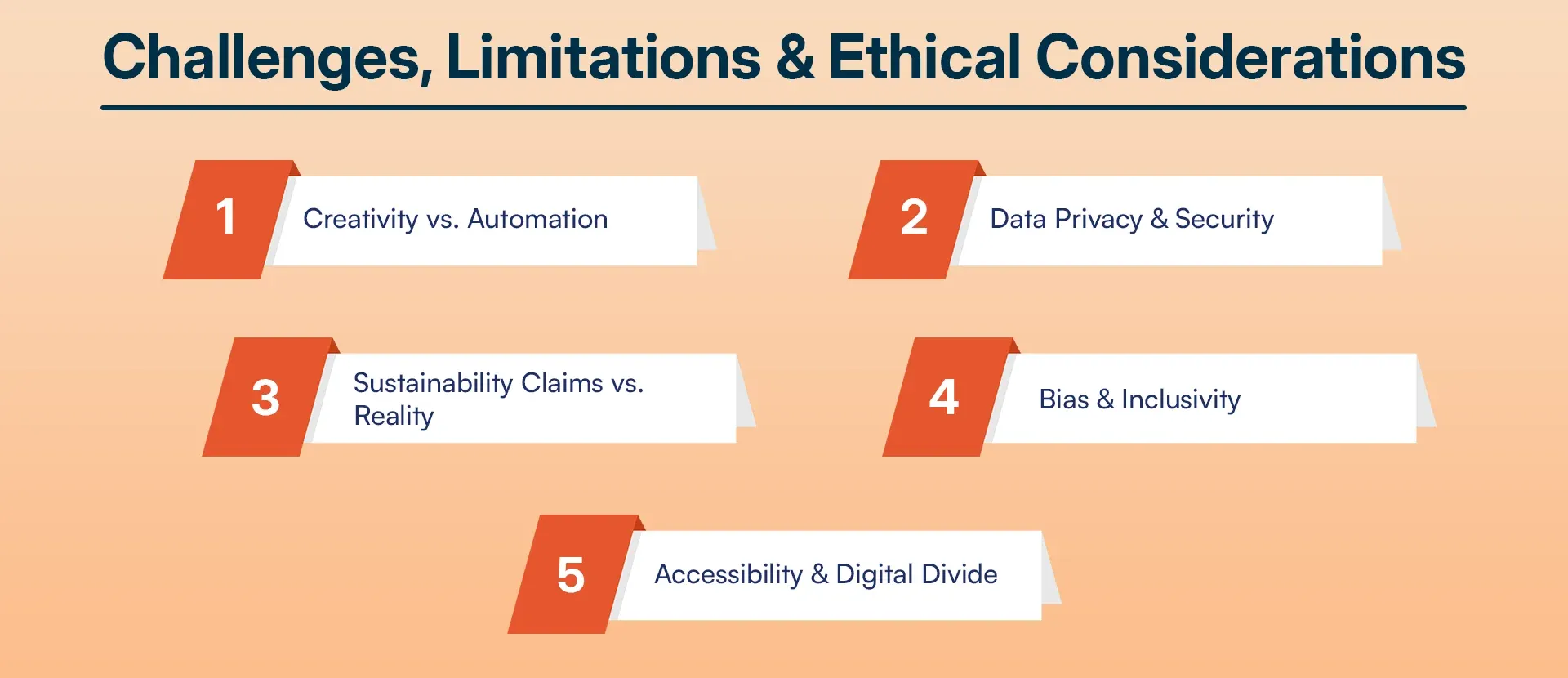
The application of AI in the fashion industry is associated with difficulties, restrictions, and crucial moral aspects. Some of the challenges and limitations that occurred help to understand AI in the fashion industry.
-
Creativity vs. Automation
I frequently encounter this concern: Will AI in fashion be a substitute for human designers? My opinion is no, but it will modify the designer's function. AI is simply a tool, not a rival to human ingenuity, excellent taste, and deep cultural insights.
-
Data Privacy & Security
Data, a whole lot of it, is the main requirement for all this personalisation. Brands gather details about your tastes, body sizes, shopping behaviours, etc., and that poses strong privacy issues.
-
Sustainability Claims vs. Reality
The fact that a brand utilises AI does not imply that it is automatically eco-friendly. While some companies adopt AI in the fashion sector for sustainability, others apply it to simply push more sales, thereby not being sustainable at all.
-
Bias & Inclusivity
AI is trained by using data, and if this data contains human biases, the AI will also inherit those biases. Certain body types or demographics are preferred by AI recommendation systems in documented instances.
-
Accessibility & Digital Divide
Not all companies possess the means to implement cutting-edge AI systems. Thus, a disparity appears in which large corporations become more efficient and profitable while small ones find it hard to compete.
There is still the issue of consumer access. The use of virtual try-on and other AI features is not available to everyone because not everyone has a smartphone or fast internet. Technology's role in the fashion world is to elevate it, not to set up barriers.
The Future of AI in Fashion
Personal shopping assistants that buy on your behalf, AI-powered design studios that speed up the creation process, and custom-made garments that are produced on demand can help eliminate waste. Additionally, the availability of possible new types of businesses built with an AI-first mentality will transform the way consumers shop and buy fashion products. Trends such as smart closets, automated manufacturing, and the introduction of quantum computing will enable the fashion industry to achieve further customer personalization, as well as create more fully integrated and seamless digital experiences throughout the entire fashion ecosystem.
Conclusion
Artificial Intelligence has transformed the way we interact with fashion by creating a new, individualized approach to sustainable, efficient shopping and design. Rather than taking away from human creativity, AI supports and enhances creativity!
The best outcomes are achieved when designers, production teams, and customers combine AI with their own intuition and expertise. Fashion has always evolved with time, and AI is simply the next major step in this ongoing cycle one that forward-thinking innovators like RejoiceHub are helping businesses embrace through smart, AI-driven solutions.
Frequently Asked Questions
1. What is AI in the fashion industry?
AI in fashion uses machine learning and data analysis to help brands design clothes, predict trends, manage inventory, and personalize shopping experiences for customers efficiently.
2. How does artificial intelligence help fashion designers?
Artificial intelligence in fashion generates design ideas, creates fabric patterns, and produces multiple design variations quickly, helping designers work faster and test more creative concepts effectively.
3. Can AI predict fashion trends accurately?
Yes, AI and fashion work together by analyzing social media, sales data, and consumer behavior to forecast upcoming trends with better accuracy than traditional methods alone.
4. What are virtual try-ons in fashion?
Virtual try-ons use AI technology to let shoppers see how clothes look on them through their phone camera without physically wearing the items, reducing returns.
5. How does AI improve online shopping for clothes?
AI in the fashion industry creates personalized recommendations, suggests complete outfits, provides size assistance, and shows products that match your style preferences based on browsing history.
6. Are AI chatbots helpful for fashion shopping?
Fashion AI chatbots answer questions 24/7, help with sizing, offer styling advice, and assist with purchases and returns, making online shopping easier and more convenient.
7. How does AI reduce fashion waste?
AI helps brands produce only what customers want by predicting demand accurately, optimizing inventory levels, and recommending sustainable materials, significantly reducing overproduction and waste.
8. What is generative AI in fashion design?
Generative AI creates new design concepts, patterns, and color combinations based on input data, acting as a creative partner that helps designers generate innovative ideas quickly.
9. Can AI create entire clothing collections?
Yes, AI in the fashion industry can generate complete design collections, though human designers refine and finalize these concepts to ensure quality and brand alignment works.
10. How do fashion brands use AI for pricing?
AI analyzes demand, competitor prices, inventory levels, and time of day to adjust product prices dynamically, helping brands maximize profits while staying competitive in markets.
11. What are AI fashion models?
AI fashion models are virtual influencers and digital models created using artificial intelligence that brands use for marketing campaigns, social media posts, and product presentations affordably.
12. Does AI help with sustainable fashion?
Yes, artificial intelligence in fashion optimizes material usage, reduces waste in production, suggests eco-friendly alternatives, and helps brands make more sustainable manufacturing decisions throughout operations.
13. How does AI improve fashion supply chains?
AI tracks materials, predicts delivery times, identifies bottlenecks, and improves communication between suppliers and manufacturers, making the entire fashion supply chain more efficient overall.