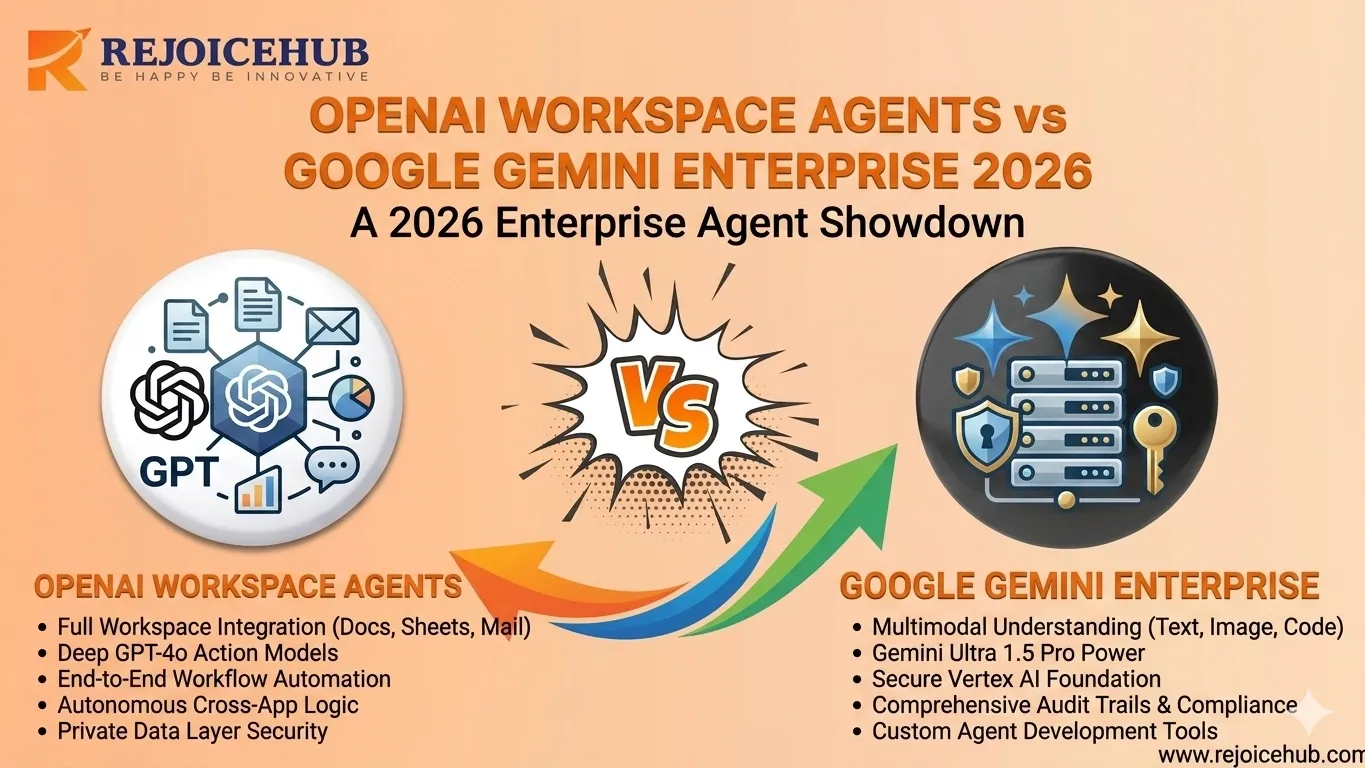
The statistic shows that businesses will achieve $1.3 trillion in AI-driven automation savings by 2026. The two companies that select incorrect enterprise AI agent platforms will experience disadvantages.
In 2026, the real competitive battleground is not just about using AI. The battle will be determined by which platform you select for your AI implementation. If you are still unclear on the fundamentals, understanding what AI agents actually are is the best place to start before evaluating any platform.
OpenAI Workspace Agents and Google Gemini Enterprise Platform currently stand as the two leading competitors in this market. Both solutions possess strong capabilities.
The two systems undergo rapid development. Companies need to select between two systems because both systems deliver separate business advantages, which will require your team to spend three months on rework, and you will waste financial resources and lose business opportunities.
This guide is written for CTOs, startup founders, and business decision-makers in the USA who are evaluating enterprise AI platforms in 2026. By the end, you will know:
- Why the OpenAI vs Google AI comparison matters more than ever
- What each platform actually does (beyond the marketing)
- Which AI agent platform fits your specific business scenario
- The real cost, ROI, and implementation timeline to expect
Already evaluating AI platforms? At Rejoicehub, we help businesses choose and implement the right AI agent platform so you do not waste time or budget on the wrong fit. Let's talk.
What Is an Enterprise AI Agent Platform?
An enterprise AI agent platform serves as a software foundation which allows businesses to create and implement AI-powered autonomous systems that handle complex tasks through API connections and unstructured data analysis while making decisions without needing continuous human monitoring.
Traditional SaaS tools require human users to perform actions by pressing buttons whereas AI agents function independently by processing emails, generating reports, assessing leads, modifying customer relationship management systems, and starting future tasks without any human assistance.
The transition from Software as a Service to artificial intelligence agents shows increasing momentum according to current trends. In 2024, businesses used dozens of disconnected SaaS tools. In 2026, forward-thinking companies are replacing entire tool stacks with orchestrated AI agents that communicate with each other and take action end-to-end.
Enterprise AI agent platforms provide:
- The models (LLMs) that power agent intelligence
- APIs and tooling to connect agents to your existing systems
- Security, compliance, and governance controls
- Monitoring, logging, and performance visibility
OpenAI Workspace Agents: Platform Overview
OpenAI's enterprise offering in 2026 has reached a state of advanced development. The introduction of GPT-4o and o3-mini together with their Agents SDK had created an open AI ecosystem which allows users to implement AI agents without needing extensive machine learning expertise.
Key Features of OpenAI Workspace Agents
Multi-Agent Workflows: OpenAI's Agents SDK enables orchestration of multiple agents working in parallel, where one agent researches, another drafts, and another files. Handoff logic is built in natively.
-
Expansive API Ecosystem: Over 1,000 third-party integrations and plugins let you connect OpenAI agents to Salesforce, HubSpot, Slack, Zendesk, and virtually any SaaS tool your business already uses.
-
Custom GPT Agents: Build custom GPT-based agents tailored to specific roles, such as a sales agent, a support agent, or a data analyst, and deploy them across teams with role-based permissions.
-
Fine-Tuning and RAG: Combine fine-tuned models with Retrieval-Augmented Generation (RAG) to give agents deep knowledge of your proprietary data and documentation.
-
OpenAI Canvas and Realtime API: For businesses building voice-enabled or document-centric workflows, OpenAI's expanded API toolset covers audio, vision, and real-time processing. If you are looking to get started quickly, you can integrate GPT-4 in 5 easy steps without needing deep ML expertise.
Best For: OpenAI Workspace Agents
- Startups and scaling companies with lean engineering teams
- Teams that need to go from idea to deployed agent in days, not months
- Companies building customer-facing AI tools (chatbots, copilots, support agents)
- Businesses with existing SaaS stacks they want to automate quickly
Google Gemini Enterprise Platform: Platform Overview
The Google Gemini Enterprise system functions as an AI platform because it goes beyond its chatbot capabilities. Gemini provides large organizations with complete AI solutions, which include advanced data processing and compliance features through its tight integration with Google Cloud, Google Workspace, and BigQuery.
The enterprise tier of Gemini Ultra and Gemini 1.5 Pro will use Vertex AI as its core system to handle model deployment and create custom agents in 2026.
Key Features of Google Gemini Enterprise
-
Deep Google Ecosystem Integration: If your business runs on Google Workspace (Docs, Sheets, Gmail, Meet), Gemini agents natively plug into these tools, automating document workflows, email processing, and meeting summaries at scale.
-
Gemini Models and Vertex AI: Vertex AI lets enterprises fine-tune Gemini models on proprietary datasets, deploy agents via pipelines, and manage model versions with MLOps-grade control.
-
BigQuery and Data Cloud Advantage: Gemini agents can query, analyze, and act on massive datasets inside BigQuery, which is a game-changer for data-heavy industries like finance, healthcare, and retail.
-
FedRAMP and HIPAA Eligible: Google Cloud's compliance posture makes Gemini Enterprise a strong choice for regulated industries including government contractors, healthcare providers, and financial institutions.
Multi-Modal Capabilities: Gemini natively handles text, images, audio, and video, enabling richer agent experiences that go beyond text-only automation. This makes it particularly valuable for teams exploring how generative AI can help business operations at an enterprise scale.
Best For: Google Gemini Enterprise
- Large enterprises already on Google Cloud or Google Workspace
- Companies in regulated industries requiring FedRAMP, HIPAA, or ISO 27001 compliance
- Data-heavy organizations with significant BigQuery or GCP workloads
- Businesses needing multi-modal AI agents (text + image + video)
OpenAI vs Google AI: Head-to-Head Comparison (2026)
Here is a breakdown of how these two enterprise AI platforms measure up across the metrics that matter most:
| Criteria | OpenAI Workspace Agents | Google Gemini Enterprise | Winner |
|---|---|---|---|
| Ease of Use | Very intuitive, plug-and-play API | Steeper learning curve, GCP knowledge needed | OpenAI |
| Customization | High - GPT builder + fine-tuning | High - Vertex AI + custom model tuning | Tie |
| Integration | 1,000+ third-party APIs and plugins | Deep Google Workspace and GCP ecosystem | Google (enterprise) |
| Pricing Flexibility | Pay-as-you-go, startup-friendly tiers | Enterprise contracts, volume discounts | OpenAI (startups) |
| Security and Compliance | SOC 2, GDPR compliant | ISO 27001, HIPAA, FedRAMP eligible | |
| Multi-Agent Workflows | Native multi-agent orchestration | Gemini agents + Vertex pipelines | Tie |
| Data Privacy | API data isolation | Google Cloud data residency controls | |
| Speed to Deploy | Hours to days | Days to weeks | OpenAI |
Use Cases: Which Enterprise AI Platform Fits Your Business?
Platform selection is not an isolated abstract; implementation should be a direct mapping to your operational context. The following are three real-life examples.
Scenario 1: Startup or Growth-Stage Company - Choose OpenAI
Your SaaS startup employs 30 people to develop automated systems for sales outreach, customer onboarding, and support ticket management. Your development team consists of two members who must deliver results within a short timeframe.
OpenAI is your answer. The API functions correctly according to its documentation, which shows high-quality standards, while users can establish operational multi-agent systems during a weekend hackathon. The pay-as-you-go pricing model enables budget control, while the plugin system prevents users from needing to create new integrations because existing ones can be reused.
Real example: A SaaS startup automates lead qualification using a GPT-4o agent that reads inbound emails, scores leads, and updates HubSpot, all triggered in real time. This is exactly the kind of workflow covered in detail when exploring how AI agents help automate business workflows.
Scenario 2: Large Enterprise on Google Workspace - Choose Google Gemini
You are a 2,000-person financial services company running Google Workspace, with massive data pipelines in BigQuery and strict compliance requirements. Your IT team lives inside GCP.
Google Gemini Enterprise is built for you. Native Workspace integrations mean your agents can read documents, summarize meetings, and file reports without leaving the Google ecosystem. BigQuery connectivity unlocks real-time data agents that finance teams actually trust.
Real example: A regional bank deploys Gemini agents to automate loan document processing, reading PDFs, extracting structured data, and flagging exceptions, all within HIPAA-compliant GCP infrastructure.
Scenario 3: Hybrid Enterprise (Mixed Stack) - Evaluate Based on Primary Workflow
Your business uses Microsoft 365 and Google Cloud together with Salesforce as your CRM solution. You require AI agents to support both internal analytics work and external customer communication needs.
Your automation project requires you to select your main automation target for implementation. The best solution for customer interfaces requires you to use OpenAI agents because they deliver faster performance while supporting more extensive system connections. The Gemini agents work best for internal data analytics, which requires access to GCP services. You can connect everything through either LangChain platforms or your own custom orchestration systems. For teams navigating this kind of complexity, understanding agentic AI workflows will help you design the right architecture from the start.
Cost, ROI and Implementation Considerations
Pricing Overview
OpenAI: API pricing is token-based (starting around $0.005 to $0.015 per 1K tokens for GPT-4o). Enterprise plans offer volume discounts and dedicated capacity. Ideal for variable-load workloads.
Google Gemini Enterprise: Typically negotiated as part of Google Cloud contracts. Gemini for Workspace starts at approximately $30/user/month for enterprise tiers. Better economics at very large scale with committed use discounts.
ROI Timeline
Most businesses deploying AI agents see measurable ROI within 60 to 90 days when they use automation to handle specific business processes. Full enterprise automation programs typically show ROI within 6 to 12 months.
- Quick wins (30 to 60 days): Customer support automation, email triage, data entry elimination
- Medium-term wins (3 to 6 months): Sales pipeline automation, report generation, internal knowledge management
- Strategic wins (6 to 12+ months): Full workflow orchestration, multi-agent pipelines, process reinvention
To understand what a strong AI agent business automation strategy looks like in practice, it helps to study real-world deployment examples before committing to a roadmap.
Implementation Effort
OpenAI: Low-to-medium effort. Clean APIs, extensive documentation, strong community. Most teams can deploy initial agents in 1 to 4 weeks.
Google Gemini: Medium-to-high effort. Requires GCP/Vertex AI familiarity. Enterprise deployments typically take 4 to 12 weeks with proper architecture planning.
People tend to underestimate the difficulty of integration tasks. The majority of implementation work occurs through the process of linking AI agents to traditional systems, data warehouses, and current SaaS applications, and this challenge exists on all platforms.
At Rejoicehub, we have helped 50+ businesses implement AI agent platforms from first deployment to full workflow automation. We handle the integration complexity, so your team does not have to. Visit rejoicehub.com.
Final Verdict: Which Enterprise AI Platform Wins in 2026?
There is no universal winner in the OpenAI vs Google AI platform comparison, and any guide claiming otherwise is selling you something.
The right enterprise AI platform is the one that maps to your business model, team capabilities, existing infrastructure, and growth trajectory.
| Choose OpenAI If... | Choose Google Gemini If... |
|---|---|
| You are a startup or scaling company | You are a large enterprise on GCP |
| Speed to market is your top priority | Compliance (HIPAA, FedRAMP) is non-negotiable |
| You need wide third-party integrations | Your data lives in BigQuery or Google Workspace |
| Your team has strong developer skills | You need multi-modal agents (text + image + video) |
| Budget is variable and usage-based | You have enterprise-scale volume and predictable contracts |
The most sophisticated enterprises will ultimately use both, with OpenAI agents handling rapid customer-facing deployments and Google Gemini managing deep data and compliance-heavy workflows. The AI platform comparison in 2026 is not about which model is smarter; it is about which infrastructure fits your operational reality.
Conclusion
The decision between OpenAI Workspace Agents and Google Gemini Enterprise Platform represents one of the highest-impact technology decisions your business will make during 2026.
The correct implementation of AI agents results in automatic work elimination, which speeds up revenue processes while providing your team members with ongoing productivity advantages. The incorrect implementation will require you to start over six months later.
The ideal moment to obtain professional assistance with your enterprise AI platform development process occurs before you choose an unsuitable path.
Ready to Build Your AI Agent Workforce?
At Rejoicehub, we help businesses choose and implement the right AI agent platform from initial strategy and platform selection through to full deployment, integration, and optimization.
Our AI engineers, together with our automation experts, will help you establish a proper foundation for your project, which you should start building right from your first day.
Visit rejoicehub.com to schedule your free AI platform strategy call.
Frequently Asked Questions
1. What is the difference between OpenAI Workspace Agents and Google Gemini Enterprise Platform?
OpenAI Workspace Agents are built for speed and easy third-party integrations, making them great for startups. Google Gemini Enterprise ties deeply into Google Cloud and Workspace tools. The biggest difference comes down to how your team works and what infrastructure you already use every day.
2. Which enterprise AI agent platform is better for startups in 2026?
OpenAI Workspace Agents are a stronger fit for startups. The pay-as-you-go pricing keeps costs flexible, the API documentation is clean and beginner-friendly, and small dev teams can get a working agent running within days. You do not need a large engineering team to get started quickly.
3. Is Google Gemini Enterprise good for regulated industries like healthcare or finance?
Yes, Google Gemini Enterprise is one of the top choices for regulated industries. It supports FedRAMP, HIPAA, and ISO 27001 compliance standards. If your business handles sensitive data in healthcare, finance, or government, the Google Cloud infrastructure gives you the security controls you need.
4. How does the pricing compare between OpenAI agents and Google Gemini Enterprise?
OpenAI uses token-based pricing starting around $0.005 per 1K tokens, which works well for variable workloads. Google Gemini Enterprise is typically sold through Google Cloud contracts, starting at $30 per user per month. For high-volume, predictable usage, Google often offers better long-term value.
5. How long does it take to deploy an enterprise AI agent platform?
With OpenAI, most teams can launch their first agent within one to four weeks. Google Gemini Enterprise deployments usually take four to twelve weeks due to the Vertex AI setup and GCP architecture requirements. Your timeline depends on how complex your integrations and existing tech stack are.
6. Can I use both OpenAI and Google Gemini agents together in one business?
Yes, many large enterprises use both platforms together. A common setup is using OpenAI agents for customer-facing workflows because of their speed and integrations, while using Google Gemini for internal data analytics and compliance-heavy tasks inside the Google Cloud environment.
7. What are the best use cases for OpenAI Workspace Agents in 2026?
OpenAI Workspace Agents work best for sales outreach automation, customer support ticketing, lead qualification, and building chatbots or copilots. They connect with over 1,000 third-party tools like HubSpot, Salesforce, and Slack, making them a solid fit for businesses with existing SaaS stacks.