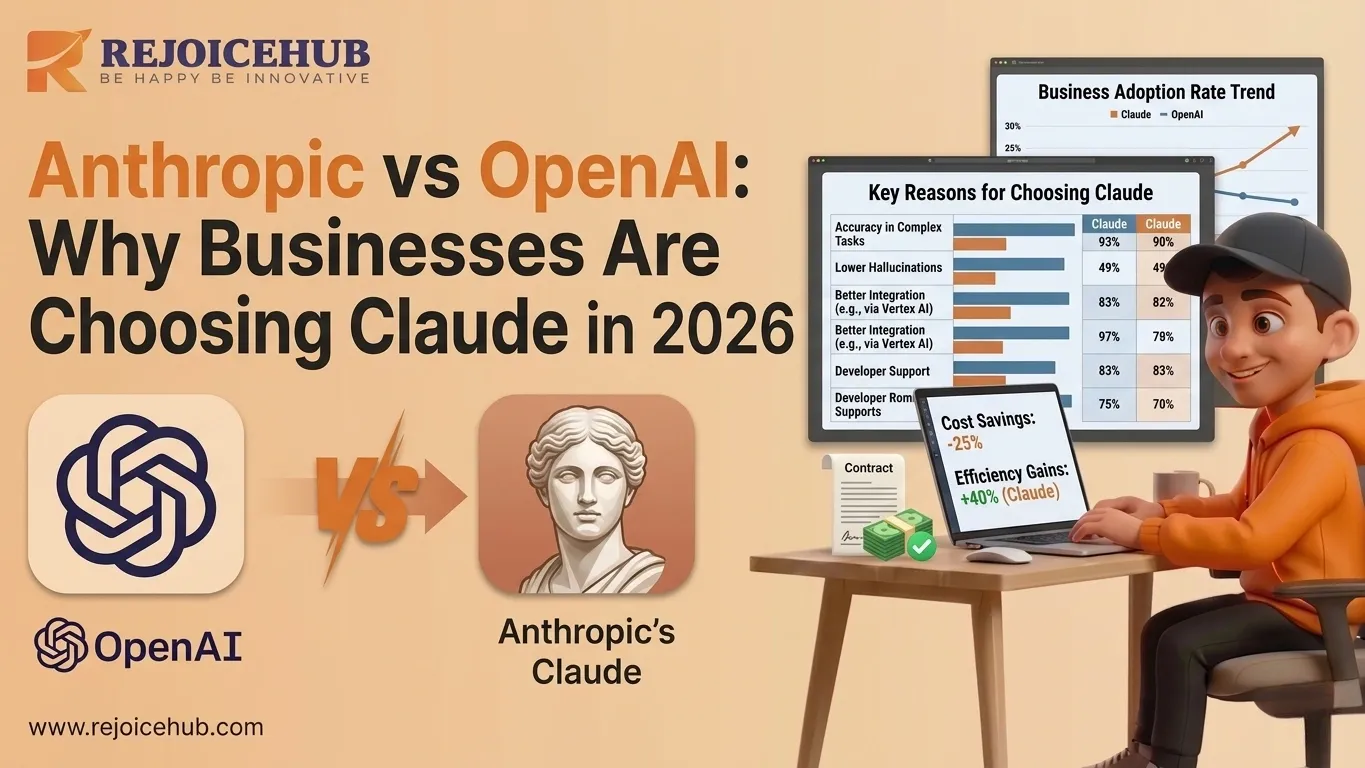
For years, OpenAI basically owned the whole enterprise AI adoption talk. Yet in April 2026, something kinda big slipped in. Anthropic went ahead and crossed that line quietly. Like, for the first time, more companies were actually paying for Claude than for ChatGPT.
And this is not just some random number. It hints at a more fundamental shift in the way organizations are weighing Anthropic against OpenAI, especially around governance, safety, and the bigger question of what it really takes to build dependable AI that works at scale.
So if you are making AI stack decisions in 2026, this article should give you the clearest read you can get. You might also find it useful to understand what AI agents actually are and how they work especially for AI agent-style systems that help improve business solutions.
1. The Enterprise AI Race Has Changed
The AI race is no longer really about the most popular chatbot. It is more like which platform can keep up with real business operations, day after day, without breaking.
In May 2025, just 9% of businesses were paying for Anthropic products. By April 2026, that number jumped to 34.4%, surpassing OpenAI's 32.3% according to Ramp's AI Index which tracks what companies actually spend across more than 50,000 U.S. businesses.
Anthropic managed to quadruple its business adoption in one year. OpenAI, on the other hand, grew by only 0.3%.
That whole trajectory kind of explains where enterprise trust is drifting, and fast.
2. Anthropic vs OpenAI: The Core Difference
Anthropic vs OpenAI really boils down to a difference in philosophy, not just a product thing. It's more about how they actually look at building and guiding AI, rather than the neat little features they ship.
- OpenAI prioritizes speed, ecosystem breadth, and consumer reach. ChatGPT reached 900 million weekly active users by March 2026.
- Anthropic prioritizes safety, alignment, and reliability. It targets technical and regulated enterprise environments first.
OpenAI kind of leads in market penetration and integrations, while Anthropic feels like it comes ahead in paid enterprise AI adoption and that trust factor, especially in compliance-sensitive industries. Neither is universally better it depends on your use case.
3. Claude vs ChatGPT for Enterprise Workloads
Claude vs ChatGPT comes down to a few key technical differences that matter at enterprise scale.
Where Claude Wins
- Context window: Claude supports up to 200,000 tokens, allowing teams to process entire contracts, codebases, or research documents in one pass. ChatGPT Enterprise caps at roughly half that.
- Instruction following: Claude follows complex system prompts with higher fidelity, making it more predictable in business deployments.
- Long-form reasoning: Claude excels in legal, financial, and technical documentation tasks.
- Developer tooling: Claude Code has become the dominant agentic coding tool, with a 42% developer market share compared to OpenAI's 21%.
Where ChatGPT Wins
- Multimodal capabilities: ChatGPT handles images, voice, and code execution in a unified interface.
- Integration ecosystem: Thousands of plugins and deep Microsoft integrations give it a structural advantage in Microsoft-heavy organizations.
- Consumer familiarity: ChatGPT's brand recognition lowers internal adoption friction.
For a lot of enterprise situations especially when it's about huge documents, compliance checklists, or sensitive reasoning-style tasks Claude can have a real meaningful edge. Meanwhile, for wider departmental rollouts, the ChatGPT ecosystem is kinda hard to ignore, even if you are comparing different workflows.
4. Why Enterprises Are Leaning Toward Anthropic
Enterprise AI buyers have basically matured. They're not really asking which model is most impressive anymore. Now they're asking, with a bit more urgency:
- Will this AI behave predictably under our policies?
- Can we audit its outputs?
- Does it protect our data?
Anthropic answers these questions more directly than OpenAI does, with a whole design philosophy around control and governance, not just "cool outputs." The way they build it — including training methodology and enterprise contracts — leans hard into oversight. You'll notice pilots with Claude turning into longer-term deployments, especially in finance, legal ops, research, and customer support.
What really matters is trust. In regulated industries, trust is the only currency that actually compounds over time.
5. Constitutional AI and Enterprise Trust
Constitutional AI is basically Anthropic's core training approach. It teaches Claude to stick to a set of internal principles not just depend on human signals to block harmful outputs so it's more consistent over time.
In practical terms, this means:
- Claude is less likely to generate off-policy, harmful, or inconsistent responses.
- Outputs are more auditable and explainable.
- Claude's behavior is more stable across different prompt styles.
In industries where an AI hiccup isn't merely a headache but instead becomes a compliance exposure — like healthcare, legal, and financial services this architecture acts as a real differentiator.
Anthropic also notes that enterprise customer data never gets used for training the model, and they back this up with contractual promises. On top of that, the company has reached SOC 2 Type II compliance and provides HIPAA-eligible deployments for healthcare organizations.
6. OpenAI's Strengths Still Matter
OpenAI is not losing the enterprise market. It is fighting on different terms.
Key facts:
- ChatGPT reached 900 million weekly active users by March 2026.
- Enterprise revenue now makes up more than 40% of OpenAI's total.
- OpenAI's $122 billion funding round closed in March 2026 at an $852 billion valuation.
- GPT-5.5, launched in April 2026, matches Claude's 1 million token context window and scores 85% on GDPval, a real-world economic benchmark.
- Azure OpenAI Service gives enterprises Microsoft's compliance certifications and infrastructure.
For organizations already embedded in the Microsoft ecosystem, OpenAI is still usually the default choice. Switching costs are real too, even if the technical barriers feel low.
7. The Rise of Enterprise AI Platforms
Enterprise AI platforms are now way past the whole "chatbot" vibe they basically sit right at the heart of operational groundwork, handling tasks across teams such as:
- Internal coding workflows
- Legal document review
- Financial modeling and summarization
- Customer support automation
- Compliance and audit trail generation
AWS recently rolled out the Claude Platform on AWS, giving enterprises a straight path in through their current AWS credentials, with billing and access controls already lined up. This kind of infrastructure tie-in not just a simple API handle is what really splits off casual consumer-style tools from full enterprise AI platforms.
Cloud-based LLM deployment now makes up 62% of enterprise rollouts, a shift being pulled forward by AWS Bedrock, Azure OpenAI Service, and Google Vertex AI.
8. Enterprise AI Adoption Is No Longer Single-Model
Here's what a lot of businesses are finding out the hard way: no lone model really wins at everything. Research suggests that 37% of enterprises now run five or more models in production and it's not some indecision thing. It's more like smart architecture, with a bit of pragmatism built in.
The real question has moved away from "which AI do we use?" toward "how do we send each bit of work to the right model?"
9. Multi-Model AI Architecture and AI Orchestration
Multi-model AI architecture means building AI systems where different models handle different tasks based on cost, capability, and compliance requirements.
A typical 2026 enterprise stack might look like:
- Claude Sonnet 4.6 for reasoning, compliance, and complex document workflows
- GPT-4o for real-time interaction and multimodal tasks
- Claude Haiku for cost-efficient, high-volume triage
- Gemini 1.5 Pro for long-document intelligence on Google Cloud
AI orchestration ties these models together with routing logic, evaluation pipelines, and model-agnostic scaffolding. The enterprises extracting the most value are not those with the most expensive model contract they are those with the smartest architecture around whichever models they deploy.
Building a routing layer that sends less complex queries to cheaper models achieves 35–50% cost reduction compared to running everything through a premium model.
10. How Businesses Make AI Stack Decisions
AI stack decisions are no longer made by individual enthusiasts. They go through procurement, security, legal, and finance teams.
Key criteria companies evaluate:
- Compliance fit: Does the model support HIPAA, SOC 2, and GDPR requirements?
- Context window: Can it handle the document sizes your team uses?
- Data privacy: Is your data used for training?
- Infrastructure compatibility: AWS shop or Azure shop?
- Total cost of ownership: Token pricing, compute, and operational overhead.
- Vendor stability: Is this provider reliable for your usage volume?
Anthropic's strength is in items 1, 2, and 3. OpenAI's strength is in item 4 and consumer familiarity. Understanding Anthropic's per-token pricing can help teams model vendor economics when making these decisions.
11. AI Deployment Strategy in Large Organizations
A sound AI deployment strategy starts with governance, not features.
Steps enterprise teams follow in 2026:
- Identify high-impact use cases: Focus on workflows with measurable output, not general productivity gains.
- Select models by task, not by brand: Use benchmarks aligned to your actual business KPIs.
- Pilot before committing: Run structured experiments before signing enterprise contracts.
- Build governance frameworks: Define acceptable use, audit requirements, and escalation paths.
- Train your workforce: Re-skilling is as important as technical rollout.
- Plan for model switching: No single model will be the best option indefinitely.
Cultural transformation matters as much as technology. Organizations that treat AI deployment as a technical project rather than an organizational change fail to extract value consistently.
12. The Future of Business AI Tools and Enterprise AI Adoption
Business AI tools are slowly turning into infrastructure not exactly "apps" anymore. They feel like the base layer you build on, rather than a shiny thing you just run once. In the next 18 months, a few patterns seem pretty likely:
- Agentic workflows will start replacing single-query moments. AI systems that can pursue multi-step goals more or less autonomously will become the default. Understanding what agentic AI workflows look like is increasingly important for teams planning ahead.
- More open-source pressure not in a vague way, but in a very practical "we want cheaper and more flexible" way. Inference platforms supporting low-cost open-source models are getting serious enterprise attention, especially for routine work.
- Multi-model routing will be what most teams end up doing. No single LLM will neatly dominate every use case, so orchestration across models becomes normal.
- Adoption pace will stay developer-led. Engineering teams usually pick the tools first. After that, finance and operations tend to follow along.
Anthropic's Model Context Protocol (MCP) is positioning Claude as the leading agent-first architecture, which matters enormously in an agentic future.
Conclusion
Anthropic vs OpenAI is kind of the big enterprise AI adoption question for 2026, really. Anthropic has earned trust by doing the work consistently with a safety-first architecture and a steady obsession with the technical customer. OpenAI has built its spot with sheer scale, a wider ecosystem, and speed. Both have genuine advantages, and neither one is a magic wand.
The firms actually winning with AI aren't placing all their bets on just one provider. They're putting in place governed, modular LLM infrastructure the kind that can flex as the market shifts, even when things get a bit uncertain.
If you want to explore how AI agents are actively replacing legacy SaaS tools as this sector keeps moving forward, understanding how AI agents are reshaping business automation is worth your time. Your AI stack choice is too consequential to leave to brand loyalty alone.
Frequently Asked Questions
1. Why are businesses choosing Anthropic over OpenAI in 2026?
Businesses are shifting to Anthropic mainly because of how Claude handles compliance, data privacy, and consistent outputs. By April 2026, 34.4% of companies were paying for Anthropic products vs OpenAI's 32.3%. For regulated industries, that reliability really matters when picking AI tools.
2. What is the main difference between Claude and ChatGPT for enterprise use?
Claude supports a 200,000-token context window, follows complex instructions more accurately, and works better for legal, financial, and technical documents. ChatGPT has stronger multimodal features and Microsoft integrations. The right pick really depends on your team's workflow and what your business actually needs day-to-day.
3. What is Constitutional AI and why does it matter for businesses?
Constitutional AI is Anthropic's training method that teaches Claude to follow built-in principles instead of relying only on human feedback. This makes Claude's responses more stable and predictable. For businesses in healthcare, legal, or finance, that consistency helps reduce compliance risks and makes AI outputs easier to audit.
4. How do enterprises make AI stack decisions in 2026?
Most enterprise teams now look at compliance fit, context window size, data privacy, and infrastructure compatibility before choosing an AI platform. It's not just IT anymore — legal, finance, and security teams are involved too. The smartest companies also plan for model switching instead of locking in with just one provider.
5. What is multi-model AI architecture and why are businesses using it?
Multi-model AI architecture means using different AI models for different tasks based on cost, speed, and capability. For example, Claude Sonnet 4.6 for complex reasoning, GPT-4o for real-time tasks, and Claude Haiku for high-volume simple queries. This approach can cut AI costs by 35–50% compared to running everything through one premium model.
6. What should a good enterprise AI deployment strategy include?
A solid AI deployment strategy should start with governance, not just features. That means picking use cases with clear ROI, running pilots before big contracts, building audit frameworks, and training your workforce. The companies getting real value from AI treat it as an organizational change, not just a technology project.
7. Is AI orchestration necessary for business AI tools in 2026?
Yes, especially if you're running more than one AI model. AI orchestration connects different models through routing logic, so the right task goes to the right model automatically. Around 37% of enterprises now use five or more models in production. Without orchestration, managing LLM infrastructure across teams gets messy and expensive very fast.