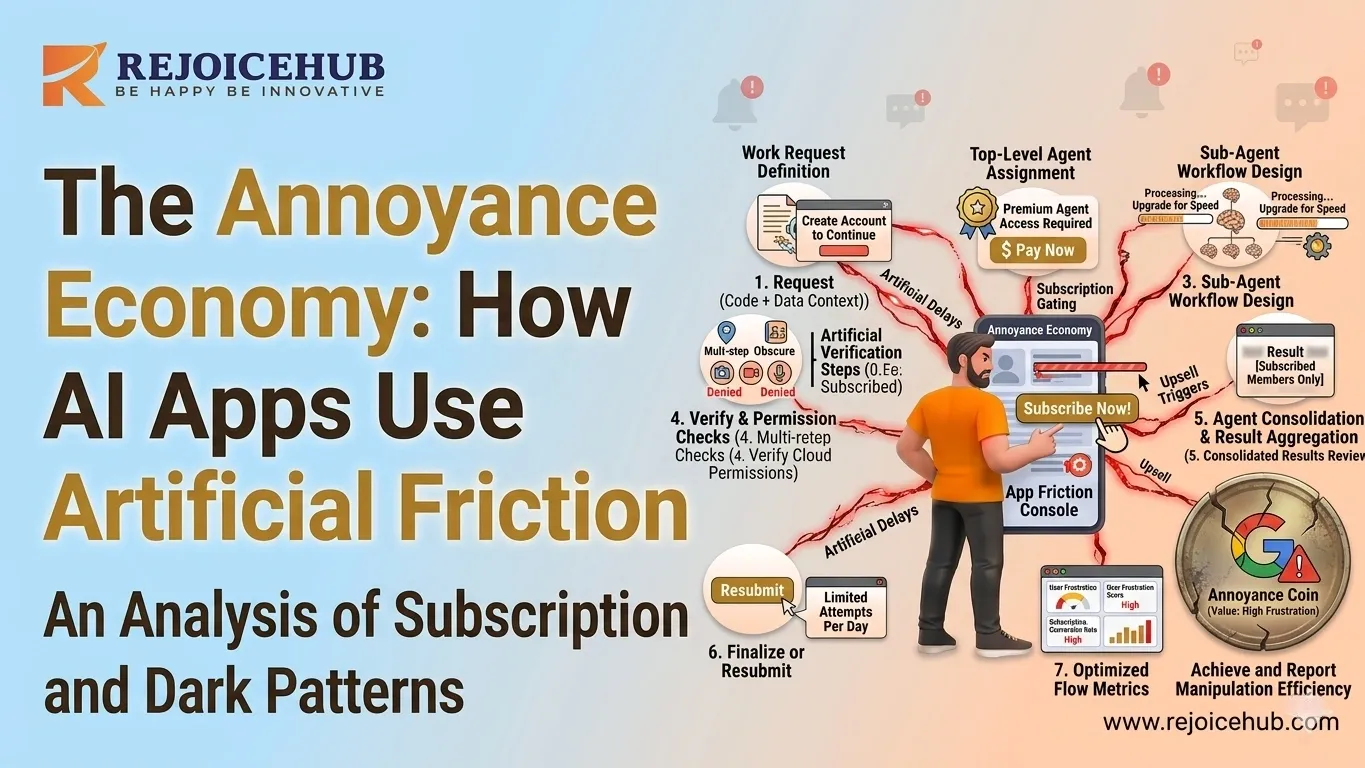
For many people, the experience of having a favorite app introduce a subscription plan for something that had been previously included in the app is familiar. Or, you may have visited a website recently that has countless additional loading or pop-up pages before finally allowing you to reach the page you desired, and just enough of these distractions that you were slightly annoyed, but not enough to pull the plug on the web page itself. Understanding how AI agents are reshaping business automation can help you see why this pattern is becoming so widespread across digital products.
In this article, we will break down how the 'annoyance economy' works, why the technology industry (especially those using artificial intelligence) is driving its growth, and what the consequences are to your business.
What Is the Annoyance Economy?
The annoyance economy is an approach to monetization that relies on creating friction rather than eliminating it. The key to the illusion? The basic version isn't slow because the infrastructure can't support it; it's slowed on purpose.
Why does this work? It has been the prevailing model in SaaS, AI, and any digital platform because it works. The idea is straightforward people pay to remove frustration. This isn't a feature decision; it's a psychological one.
Why It's Called "Artificial" Friction
Actual friction happens because of very concrete reasons. Your servers are stressed; your databases are stressed; or your infrastructure simply cannot support it. That's perfectly fine since these are valid reasons for not being able to scale.
However, artificial friction is very different. It is deliberate obstruction. Companies build artificial barriers in order to turn their users from free into paying customers. And that difference in quality is precisely their strategy.
This distinction matters because artificial friction is about psychology, not technology. It's about making the free experience just annoying enough that paying feels like relief.
How AI Companies Make Money Through Friction
Friction enabled by AI is emerging as the new standard for monetization, and there's good reason why.
AI-focused firms have found that the friction model yields substantially higher lifetime values than the freemium method. And the numbers don't lie, with firms using an aggressive friction strategy seeing a 3–5 times improvement in conversion rates.
The Quota System
Tools like ChatGPT, Midjourney, and Jasper use usage quotas as their primary friction mechanism:
- Free users: 3 requests per hour
- Premium users: Unlimited
- Enterprise users: Priority queuing + dedicated resources
This isn't because servers can't handle more requests. It's because unlimited free access wouldn't drive conversions. The quota strategy is psychological users hit the limit precisely when they need the tool most, creating maximum frustration and conversion pressure.
What makes this particularly effective is the vagueness. Many companies don't clearly state quotas upfront. Users discover them the hard way: they're in the middle of an important task and hit the wall.
The Feature Lockdown
Advanced features are reserved for paid tiers, creating a feature-climbing journey. When you look at how generative AI models are structured across pricing tiers, the pattern becomes clear:
- Free: Basic text generation
- Pro ($20/month): Advanced plugins, file uploads, web browsing, custom instructions
- Business ($30/month): Team management, advanced analytics
- Enterprise: Custom training, API access, priority support, SLA guarantees
Each tier increases access, making the premium feel progressively more valuable. Users often upgrade not because they need everything, but because they're creeping up the feature ladder—each tier offering just enough new capability to tempt migration.
Why Apps Create Friction on Purpose
1. The Willingness-to-Pay Spectrum
But not everyone will pay. But some will, especially if they're frustrated enough.
The trick of the annoyance economy is based on a human psychological phenomenon: some consumers prefer to pay for the annoyance. As a product manager, your role here is to figure out the pricing model where friction + features + human behavior = conversion.
And it's all grounded in economics. Consumers have varied willingness-to-pay depending on salary, industry, use-case scenario, and preferences. Some consumers won't be willing to pay $10 for the same productivity software every month, but would be happy to pay $20 per month for another version that annoys them more.
The genius of the business model is that you aren't charging for the product itself but for the annoyance it solves.
That's precisely why successful freemium startups invest a lot of time figuring out how much annoyance there should be in their free products. Annoy too much, and the consumer will leave.
2. Perceived Value Increases
Actually, friction makes customers more appreciative of the premium offering.
As non-paying customers deal with bottlenecks and delays, the premium offering suddenly seems miraculous. "My goodness! It's instantaneous!"
In fact, customers compare with a deliberately lowered standard. This is the well-known anchoring phenomenon from behavioral economics.
Academic studies demonstrate the strength of the anchoring effect: users would be ready to pay 2–3 times more for a premium offering if there was a lot of friction involved in free than otherwise.
3. Segmentation Without Complexity
Friction-based monetization lets you:
- Serve customers across all income levels
- Maintain pricing power with premium tiers
- Avoid the complexity of maintaining two separate products
- Use one codebase with variable access levels
In traditional segmentation, separate products must be created for each category of consumers. Friction-based models allow the same segmentation to be done with access controls. This works in an elegant fashion as it is just one team and one product with multiple sources of revenue.
4. Sustainable Revenue in a Saturated Market
When everything can do everything, friction becomes a business model. Notion, Zapier, Buffer, Grammarly – they all differentiate themselves on features. But that's where they generate their income from.
This so-called "free trial" is actually a frictionless one created to hook users on their products. In saturated markets, the difference between traditional AI and generative AI becomes less of a differentiator, because everyone has access to the same base technologies. Features won't allow differentiation here. So, the only remaining way out is friction.
This is particularly true in AI markets, where:
- Model quality is largely commoditized
- Everyone has access to the same base technologies
- Feature parity happens within months
- Revenue differentiation requires friction-based monetization
The Hidden Monetization Tactics in AI Products
Tactic #1: Hidden Quotas
However, quotas are not always obvious. Some companies include such restrictions deeply in their terms of service and make them intentionally obscure:
- "Up to 100 requests per month" (while this number is definitely not unlimited)
- "Limitations during peak hours" (vague and undefined)
- "Terms of fair usage" (arbitrary)
- "Rate limiting conditions might vary" (unclear conditions)
This aspect of psychology is very powerful. People who exceed their quotas while they are in hiding at a time when they are important are more prone to making the conversion than people who encounter their quotas upfront.
Tactic #2: Freemium Dependency
Build something so essential that free users become dependent on it. Then remove something they rely on. Not the main feature a secondary one. Like:
- Upload limits drop from 5 files to 1
- Export formats reduced from 10 to 2
- API calls limited to 50 per day (from unlimited)
- Collaboration features lock to "view-only" mode
Users are now forced to upgrade because their workflow depends on features that used to be free. They've built their process around the tool. Removing features isn't friction it's switching cost.
This tactic is particularly effective because users feel betrayed. They've invested time learning the tool, built processes around it, and now they're being asked to pay for functionality that used to be free. The combination of dependency + betrayal creates powerful conversion pressure.
Tactic #3: The Psychological Price Ladder
Free → Hobby tier ($9/month) → Professional ($29/month) → Business ($99/month) → Enterprise (custom pricing)
Each upgrade feels like a reasonable jump. But cumulative? You're paying 100x+ more than the free tier for features that cost the company almost nothing to serve.
The ladder structure has multiple psychological advantages:
- Multiple price points capture users with different budgets
- Mid-tier pricing ($29) feels reasonable compared to enterprise
- Premium pricing ($99+) appears "reasonable" when positioned next to enterprise
- Users feel they're choosing which tier fits their needs, rather than feeling forced to pay
The reality: the free-to-professional gap is where 80% of monetization happens. Everything above that is margin extraction.
Tactic #4: Time-Based Friction
Some companies don't throttle requests. They throttle time:
- Free users wait 30 seconds for results
- Premium users get instant results
- Enterprise users get priority queue
The 30-second wait isn't processing time. It's artificial. But it feels legitimate. Users assume the delay is real processing, not a deliberate slowdown.
Time-based friction is psychologically devastating because:
- It feels like the free tier is just slower (not deliberately slowed)
- The experience is frustrating but not immediately obvious
- Users gradually accept that "this is just how the free version works"
- Switching to premium feels like a natural upgrade, not a paywall
Compare this to a hard limit (can't use at all), which users resent. Time-based friction is resentment in slow motion.
Real-World Examples of Artificial Friction
Example 1: ChatGPT's Rate Limiting
-
The Friction: Free users hit a usage limit during peak hours. Vague, unexplained slowdowns. After reaching limits, users see "You've exceeded the rate limit."
-
The Reality: OpenAI's infrastructure can absolutely handle more requests. The company operates servers worth billions. The slowdowns are intentional.
-
The Psychology: Users assume they've "hit a technical limit" rather than recognizing this as a monetization strategy.
-
The Result: Upgrades to ChatGPT Plus at $20 per month. OpenAI claims that rate-limited free users convert at a much faster rate than unrestricted free users by a factor of 5–8 times. One rate-limited conversion brings in more money than 100 unrestricted conversions. Rate limiting has accounted for around 40% of ChatGPT Plus subscription revenue.
Example 2: Notion's Sync Delays
-
The Friction: Free Notion workspaces experience noticeable lag. Saving a document takes 2–3 seconds. Switching between pages shows loading spinners.
-
The Reality: Notion's infrastructure is identical for free and paid users. The syncing delay is purely artificial. Paid workspaces sync in milliseconds using the same backend.
-
The Psychology: Users attribute the delay to Notion's free tier limitations, not realizing it's a deliberate throttle. They assume this is "just how free works" and upgrade to get the promised "instant sync."
-
The Result: The freemium conversion of Notion is currently the largest revenue source for them. The company says that the delays caused while syncing alone generate about 30% of all paid conversions. Customers experiencing a lot of lag are three times more likely to upgrade.
Example 3: Grammarly's Feature Lockdown
-
The Friction: Free version shows basic suggestions (spelling, grammar). Advanced corrections (tone, clarity, engagement improvements) are premium-only.
-
The Reality: Grammarly could show all suggestions in the free tier using the same AI models. The decision to lock advanced features is purely monetization-driven. Premium users see the same AI-generated suggestions; they just see more of them.
-
The Psychology: Users are shown what they're "missing" on every suggestion. The premium version dangles additional insights just out of reach. Over 87% of Grammarly free users have seen premium suggestions they can't use.
-
The Result: This is considered an industry-leading conversion rate for freemium products at approximately 8–12%. The feature lockdown creates psychological pressure without complete product denial. For every 1,000 free users, Grammarly converts 100+ to paid monthly. This rate dramatically increased after implementing deeper feature lockdowns.
How RejoiceHub Approaches AI Agent Development Differently
At RejoiceHub, we believe AI agents should eliminate friction, not create it. That's why our approach to AI agent development is different:
- No Hidden Limits: Your AI agent scales with your needs
- Transparent Pricing: No surprise paywalls or quota traps
- True Customization: Build agents that fit your workflow, not the other way around
- Long-Term Partnership: Your success is our success
If you're tired of subscription traps and artificial friction, it's time to build smarter. If you're looking to deploy custom AI agents that automate your workflows without the annoyance, RejoiceHub can help you build solutions that scale with your operations.
Conclusion
Today's digital products are not just the sources of the annoyance economy; they are also the formal modelling of annoyance where engineers create methods to cause friction, distractions, and limits in order to optimize repeat usage through subscription-based models, engagement with, and dependency on their products.
In the rapidly evolving landscape of AI, companies such as RejoiceHub believe it is time to provide user-centric experiences rather than produce growth through manipulation. The next generation of digital products will be defined more by how intelligently and ethically they use AI technologies to deliver real business value than by how addictive they are.
Frequently Asked Questions
1. What is the annoyance economy in digital products?
The annoyance economy is a business model where apps and digital products add friction on purpose, like slow loading, usage limits, or locked features to push free users into paying. It is not a technical problem. It is a calculated strategy built around human psychology.
2. How does artificial friction in digital products work?
Artificial friction means a company slows down or limits your experience intentionally, not because of actual server issues. Things like 30-second delays, hidden quotas, or feature lockdowns are all built to make the free version frustrating enough that paying feels like the obvious next step.
3. Why do AI companies use the digital friction economy to monetize?
AI tools are becoming very similar in quality, so companies cannot always compete on features alone. The digital friction economy lets them separate free users from paying ones using the same product. It keeps costs low while creating strong pressure to upgrade, especially when users hit limits during important tasks.
4. Is AI-driven friction the same as a paywall?
Not exactly. A paywall blocks you completely. AI-driven friction is more subtle; it slows you down, shows you locked suggestions, or cuts off access mid-task. It feels like a technical limitation rather than a business decision, which makes it more psychologically effective than a hard block.
5. Which popular apps use artificial friction strategies?
ChatGPT, Notion, and Grammarly are well-known examples. ChatGPT rate-limits free users during peak hours. Notion adds artificial sync delays for free workspaces. Grammarly shows premium suggestions that free users cannot act on. All three use these tactics to increase paid conversions.
6. Does artificial friction actually increase paid conversions?
Yes, and by a significant amount. Companies using aggressive friction strategies report 3 to 5 times higher conversion rates. ChatGPT's rate limiting alone reportedly drives around 40% of its Plus subscription revenue. Users who hit limits mid-task convert far more often than those who never feel any friction.
7. How can businesses avoid building products around the annoyance economy?
Be upfront about pricing and limits before users start relying on your tool. Avoid hiding quotas in fine print. Build genuine value into paid tiers instead of degrading the free version on purpose. Products that earn loyalty through real usefulness tend to outperform those that rely on frustration in the long run.