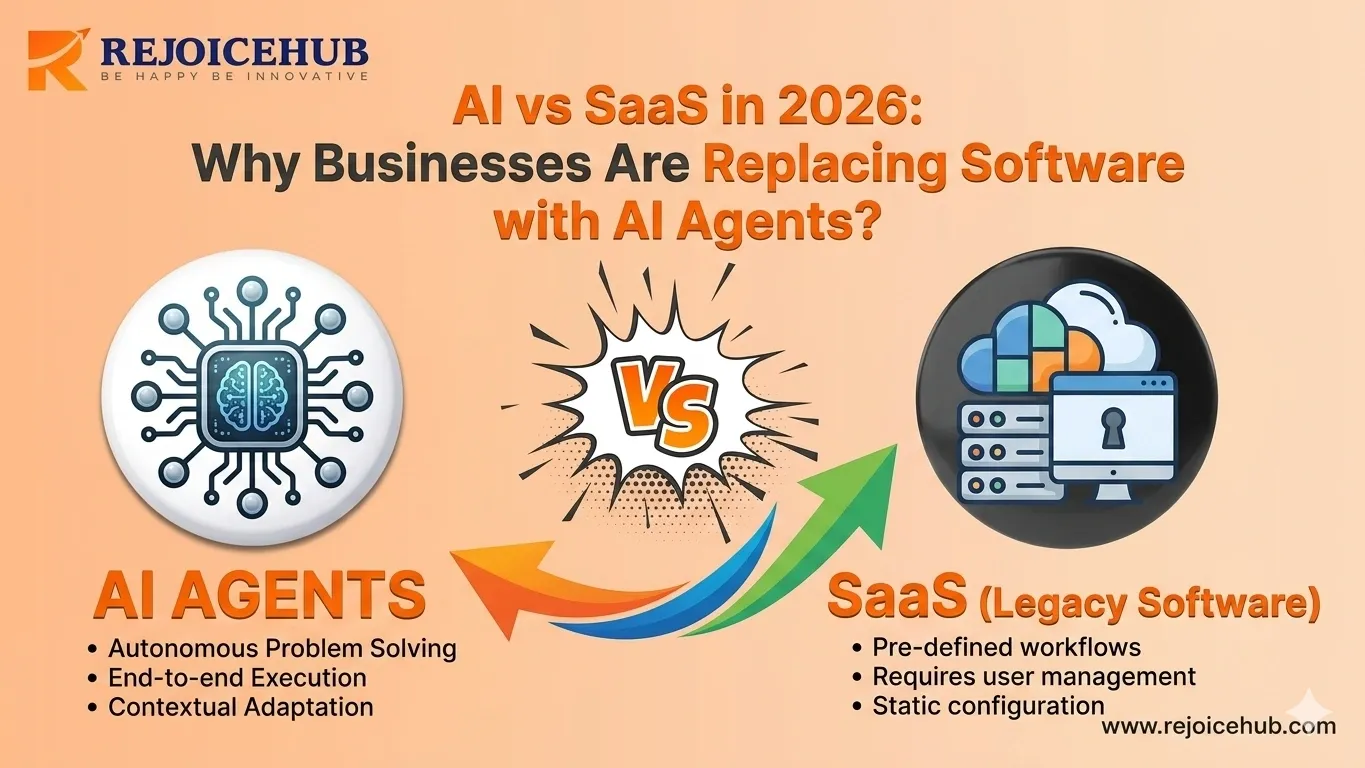
The year 2026 shows that most companies today maintain between 10 and 50 different software-as-a-service subscriptions, which require separate logins, dashboards, pricing tiers, and user learning processes. The result? Teams use all their time to handle software instead of completing their actual work, while organizations suffer from excessive tool usage and financial waste.
Now add this: 54% of CIOs are actively planning to replace or reduce their SaaS stack in favor of AI agents. The change represents a complete transformation of business operations, which goes beyond mere rumors.
What actual events are taking place? What causes businesses to abandon their established tools? The answer to this question shows how AI agents contribute to the overall situation.
The article explains everything according to its content while demonstrating that AI vs SaaS in 2026 represents the most crucial topic that business executives currently discuss in boardrooms.
What Is SaaS vs AI Agents? (Definition + Context)
Before we get into the comparisons, let's make sure we're on the same page.
-
What Is SaaS Software?
SaaS (Software as a Service) provides cloud-based software that users access through subscription models. Users can access Salesforce, HubSpot, Zendesk, Slack, and Mailchimp through their web browser after paying their monthly or annual subscription fees. Users can access pre-built business functions through their web browser-based system after they pay their monthly or annual subscription fee.
SaaS tools excel at performing standardized tasks because they exist as general-purpose solutions that do not meet your specific requirements.
-
What Are AI Agents for Business Automation?
The function of AI agents for business involves creating independent intelligent systems that possess the ability to think, make decisions, and perform actions without human assistance. AI agents perform their tasks automatically by accessing your data and modifying their behavior based on their results, which differs from how SaaS tools operate, requiring human interaction to function.
An AI agent doesn't just store your customer data it analyzes it, acts on it, and learns from it in real time.
The difference between AI agents and traditional software is essentially this: SaaS tools are passive. AI agents are active.
AI vs SaaS: Key Differences Explained
Here's a side-by-side comparison to make it crystal clear:
| Feature | SaaS Tools | AI Agents |
|---|---|---|
| Flexibility | Fixed features, limited customization | Fully customizable to your workflows |
| Cost | Per-seat subscriptions (stacks up fast) | One-time build or usage-based pricing |
| Automation Level | Rule-based, requires manual triggers | End-to-end autonomous execution |
| Scalability | Often requires upgrading plans | Scales without adding seats or costs |
| Human Dependency | High humans configure and operate | Low agents act independently |
| Learning Ability | Static features | Continuously learns and improves |
| Integration | API-dependent, often siloed | Natively connects across systems |
For many forward-looking companies, the debate between AI automation vs. SaaS tools is a no-brainer when placed in such juxtaposition.
Why Companies Are Replacing SaaS with AI
This isn't just about chasing the latest tech trend. There are very real, very painful business reasons driving this shift.
1. Tool Overload Is Killing Productivity
The average mid-size company runs 22–40 SaaS tools simultaneously. That means:
- Employees are switching between apps dozens of times a day
- Data living in silos across platforms
- Hours lost weekly just to manage the tools
The software that was supposed to make work easier has made it harder.
2. Subscription Costs Are Out of Control
The SaaS pricing system operates with a growth model that benefits customers until they discover that their costs will increase as their business expands. A company with 50 employees needs to budget between $15,000 and $50,000 every month for its software subscription expenses.
The multiple tools that organizations use for their operations have various functions that intersect with each other. Many people in organizations fail to use their tools. Organizations pay for tools, but their benefits do not match the actual costs. Understanding why per-seat SaaS pricing is broken helps explain exactly why so many finance leaders are pushing back on renewals.
3. SaaS Doesn't Actually Automate It Assists
The difficult reality is that most software-as-a-service tools do not provide work automation. The tools only convert your work tasks into digital format. The process requires users to log into the system, retrieve reports, and enter information while setting up alerts and making choices. SaaS systems establish organizational frameworks, yet human beings remain responsible for executing the work.
4. Agentic Workflows Are Now a Competitive Advantage
The AI-first companies achieve greater productivity through their small teams because their AI systems manage complete operational processes. Understanding what agentic AI workflows actually are helps clarify why agents handle all functions of the process — which include lead generation, customer onboarding, and campaign reporting.
The companies that depend on separate SaaS solutions cannot match the operational speed and efficiency of their competitors.
Benefits of AI Agents Over SaaS
Still weighing the options? Here's what AI agents actually deliver:
- End-to-end automation: AI agents don't just help with one step. They handle entire processes from start to finish, without human hand-holding.
- Significant cost reduction: One AI agent can replace 3–5 SaaS tools. Instead of five subscriptions, you're running one intelligent system.
- Real-time decision making: AI agents analyze live data and act immediately. No waiting for weekly reports or monthly reviews.
- Personalized workflows: Unlike off-the-shelf SaaS, AI agents are built around your business logic, your customer data, and your goals.
- Continuous learning: AI agents improve with every interaction. The more they run, the smarter and faster they get.
- Reduced human dependency: Your team focuses on strategy while the agent handles execution. That's leverage.
If you're looking to build a custom AI agent tailored to your business, RejoiceHub specializes in exactly that.
How AI Agents Replace SaaS Tools
Let us get more concrete. Here are some real-world illustrative examples of how AI agents replace SaaS tools across major business functions:
-
AI Replacing CRM and Sales Automation
Salesforce and HubSpot serve as traditional customer relationship management systems, which maintain contact information and monitor business development stages. Human operators are responsible for performing outreach, conducting follow-up tasks, and creating sales forecasts.
An AI SDR tool acting as a sales agent can:
- Automatically qualify leads from multiple sources
- Send personalized outreach sequences
- Book meetings, follow up, and update records
- Forecast the pipeline based on real-time data
Result: One AI agent replaces your CRM subscription and a portion of your SDR workload.
-
AI Replacing Customer Support Tools
Zendesk, Intercom, and Freshdesk provide excellent service, yet they still require human operators to function. The organization continues to incur costs for staff members who handle ticket requests.
A well-implemented AI customer support automation agent can:
- Handle Tier 1 and Tier 2 support autonomously
- Escalate complex issues with full context
- Respond across chat, email, and voice 24/7
- Learn from every resolved ticket
Result: Support costs drop by 40–70%, while response times go from hours to seconds.
-
AI Replacing Marketing Automation Tools
ActiveCampaign, Marketo, and Klaviyo require users to manually create and manage their campaigns while they need to develop their target audience segments and improve their campaigns.
An AI agent for marketing automation can:
- Build and launch campaigns based on behavior triggers
- Continuously A/B test and optimize
- Personalize messaging at the individual level
- Report performance and adjust strategy automatically
Result: Better campaign performance, lower tool costs, and zero campaign management overhead.
Want to explore what an AI agent could do for your sales, support, or marketing operations? RejoiceHub builds custom AI agents for growing businesses across the USA.
Is SaaS Dead? The Future of AI vs SaaS
SaaS will continue to exist it is not going to disappear from the market tomorrow.
SaaS tools provide effective solutions for SMBs that require fast and inexpensive resolutions. The core productivity needs of users can be satisfied through products such as Notion, Figma, and Google Workspace because these tools do not require AI capabilities.
The future path of development has become apparent:
- AI-first companies will achieve better operational performance because they use artificial intelligence to enhance customer service and reduce business expenses.
- The transition period will see a hybrid model which uses AI agents to enhance existing systems become the most popular choice.
- The existing SaaS vendors make desperate attempts to incorporate AI capabilities because they believe that their additional AI functions will not provide equivalent value to built-in intelligence systems.
The upcoming technological battle will unfold between SaaS and AI. The future belongs to AI-first systems, which will use SaaS solutions only in situations where they prove genuinely beneficial.
Companies that start building their AI layer now will have a 2–3 year head start on those who wait. Exploring how AI agents are the future of business automation makes it clear that this window of advantage won't stay open forever.
How Businesses Can Transition from SaaS to AI
Most blogs miss this section because they fail to explain how things work. The following steps provide the complete process:
Step 1: Audit Your Current Tool Stack List every SaaS tool you're paying for. Record the expenses, usage patterns, and the main functions of each item. Your assessment will show that 20 to 30 percent of your resources remain unused or serve duplicate functions.
Step 2: Identify Automation Opportunities The search should focus on finding processes that need to be repeated and result in high workflow volume. Learn how AI agents can automate your workflows to identify the best candidates for AI agent development.
Step 3: Implement AI Agents Strategically You should avoid trying to implement all solutions at once. A business should begin with its most important procedure to show return on investment before proceeding to additional processes. A thoughtfully deployed AI agent always shows better results than any rushed implementation.
Step 4: Measure ROI Clearly Track time saved, cost per task, conversion improvement, and support deflection rates. The results generated by AI agents require proper measurement and tracking procedures.
RejoiceHub helps businesses at every stage of this transition from audit to full deployment of custom AI agents built for specific business workflows.
Conclusion
The current state of AI now functions as essential infrastructure rather than its previous status as technological hype.
The companies winning in 2026 are organizations that replaced complex fragmented systems with intelligent solutions instead of stacking multiple SaaS applications on top of each other. The organization achieves improved results through three core benefits: faster outcomes, decreased expenses, and fewer tools to manage.
The 54% of CIOs shifting toward AI agents aren't making a bet on the future. They are responding to changes that have already taken place.
The question now is not whether AI will replace your SaaS stack. The question is whether you will stay ahead of that industry trend or scramble to catch up.
Frequently Asked Questions
1. What is the difference between AI agents and SaaS tools?
SaaS tools are passive they help you do the work, but you still have to do it. AI agents are active they think, decide, and act on their own. In simple terms, SaaS organizes your work while AI agents actually complete it without needing you to step in every time.
2. Why are companies replacing SaaS with AI in 2026?
Companies are tired of paying for 20–40 different tools that still need people to run them. AI agents handle full processes end-to-end, cost less over time, and don't require per-seat pricing. That's why so many businesses are now choosing AI agents over traditional SaaS software.
3. What are the main benefits of AI agents over SaaS tools?
AI agents cut costs, reduce tool overload, and automate entire workflows without human help. Unlike SaaS, they learn and improve over time. One AI agent can often replace three to five separate SaaS subscriptions, saving both money and the time your team spends managing multiple platforms.
4. How do AI agents replace SaaS tools in real business operations?
AI agents can replace CRM tools by qualifying leads and booking meetings automatically. They can handle customer support without staff, and run marketing campaigns on their own. Basically, any repetitive task that a SaaS tool helped with, an AI agent can now do fully on its own.
5. Is SaaS completely dead in 2026?
No, SaaS is not dead. Simpler tools like Figma, Notion, or Google Workspace still make sense for everyday tasks. But for businesses that want real automation and lower costs, AI agents are quickly becoming the smarter choice. SaaS will survive where AI doesn't need to be involved.
6. How much money can a business save by switching from SaaS to AI agents?
A mid-size company can spend $15,000 to $50,000 every month on SaaS subscriptions. One AI agent can replace multiple tools, which cuts that cost significantly. Many businesses also report support cost drops of 40 to 70 percent after switching to AI-powered automation over traditional SaaS platforms.
7. How can a business start replacing SaaS tools with AI agents?
Start by listing every SaaS tool you pay for and spotting what's unused or overlapping. Then find your most repeated, high-volume tasks; those are perfect for AI agents. Build one agent first, measure the results, and expand from there. You don't have to replace everything at once.
8. What makes Google Gemini Enterprise better for large companies?
Google Gemini Enterprise connects natively with Google Workspace tools like Docs, Sheets, Gmail, and Meet. For large companies already running on Google Cloud or using BigQuery for data analytics, Gemini agents fit naturally into existing workflows without requiring major infrastructure changes.
9. What ROI can businesses expect from an enterprise AI automation platform?
Most businesses see measurable ROI within 60 to 90 days when they automate focused workflows. Quick wins like support automation and email triage happen in the first 30 to 60 days. Bigger strategic gains from full multi-agent pipelines typically show up within six to twelve months of deployment.
10. Which AI platform is easier to use: OpenAI Workspace Agents or Google Gemini Enterprise?
OpenAI is generally easier to get started with. Its APIs are well-documented and beginner-friendly, even for smaller dev teams. Google Gemini Enterprise requires familiarity with GCP and Vertex AI, which adds a steeper learning curve for teams that are new to the Google Cloud ecosystem.