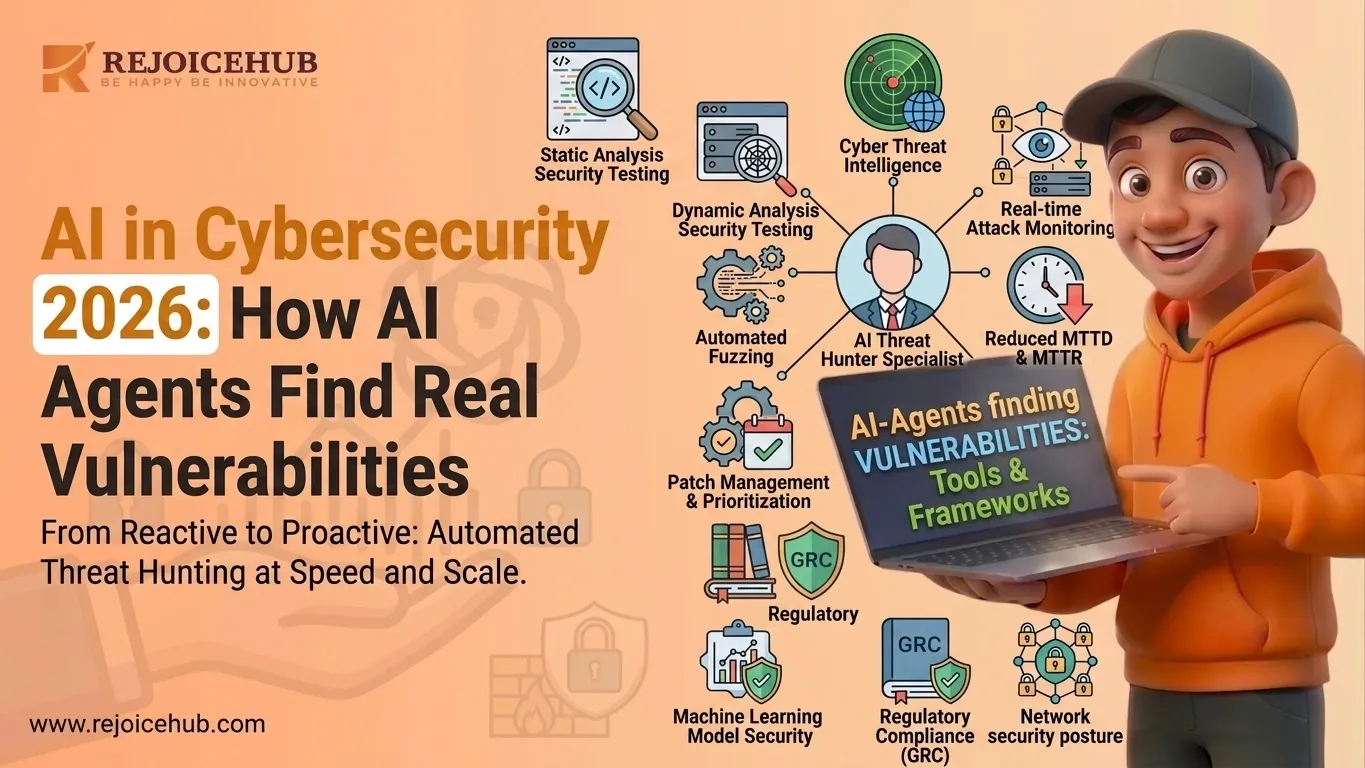
Hackers don't sleep. And in 2026, neither do the AI agents hunting them down.
AI in cybersecurity has moved far beyond buzzword territory. Today, AI agents are actively scanning codebases, simulating attacks, discovering zero-day vulnerabilities, and flagging threats often faster than any human security team ever could.
If you're a startup founder, SaaS company, or business owner wondering whether AI-powered security is real or just hype, this post breaks it all down. You'll learn exactly how AI agents are finding real vulnerabilities, what tools are leading the charge, and how your business can stay protected in a world where threats evolve by the hour.
What Does "AI in Cybersecurity" Actually Mean in 2026?
A lot of people still think AI security means a smarter antivirus. It doesn't.
In 2026, AI agents in cybersecurity are autonomous systems that can:
- Crawl an entire application's attack surface in minutes
- Simulate real-world attacker behavior (AI red teaming)
- Identify misconfigurations, logic flaws, and injection points
- Prioritize vulnerabilities by actual risk, not just severity score
- Generate plain-language reports with remediation steps
This is agentic AI security not just detection, but active, intelligent action.
This occurred once LLMs were integrated with security tools that had existed long before them. Machines could comprehend context, not only recognizing anomalous activity but realizing that such activity, "in this sequence, performed by this type of user, could be considered privilege escalation."
Why Traditional Security Tools Are Falling Behind
Let's be honest about the old way.
Legacy vulnerability scanners like Nessus or OpenVAS are rule-based. They check known CVEs, flag outdated packages, and run signature matches. They're useful but they're static.
The problem?
- Attackers don't follow rules. They chain together small weaknesses in ways no signature database anticipates.
- Modern apps are too complex. Microservices, APIs, serverless functions, and third-party integrations create attack surfaces that grow faster than any team can manually test.
- Security teams are stretched thin. The global cybersecurity talent gap is estimated at over 4 million professionals. Teams are overwhelmed.
This is exactly where AI vulnerability scanning and automated vulnerability discovery step in.
How AI Agents Are Finding Real Vulnerabilities in 2026
Now let's get specific.
AI agents are not just helping security teams work faster. They are changing how vulnerabilities are found, tested, reviewed, and fixed. From intelligent fuzzing to AI-powered red teaming, modern cybersecurity is moving from manual, point-in-time checks to continuous, adaptive defense systems.
1. Intelligent Fuzzing at Scale
Traditional fuzz testing works by sending random inputs into an application and watching for crashes. It is useful, but it often wastes time testing low-value paths.
Instead of randomly guessing, AI agents learn from every response the application gives. They use reinforcement learning to understand which inputs are more likely to expose edge cases, crashes, or hidden vulnerabilities.
These agents gradually model how the application behaves. Then they focus their testing effort on the areas where bugs are most likely to exist.
2. AI-Powered Penetration Testing
Manual penetration testing is expensive, slow, and usually limited to a specific point in time.
AI-powered penetration testing changes that.
Tools like Horizon3.ai's NodeZero and Pentera can run continuously. They do not just scan for vulnerabilities. They actively test how far an attacker could go inside your environment.
These AI agents can automatically map your network, identify weak points, chain exploits together, test lateral movement, check privilege escalation paths, and generate clear reports for both technical and executive teams.
For startups and SMBs, this is a major shift. Earlier, enterprise-grade penetration testing often required a large security budget. Now, AI-powered tools make continuous security validation more accessible without depending only on costly consulting engagements.
3. LLM-Assisted Code Review
AI is also changing how development teams review code.
Modern AI models trained on large volumes of vulnerable code can now review pull requests in real time. Tools like GitHub Copilot Autofix, Semgrep Assistant, and custom AI security agents can help identify risky patterns before code reaches production.
They can flag issues such as SQL injection risks, hardcoded secrets, exposed API keys, broken access control, insecure deserialization, and unsafe data handling.
Traditional static analysis tools often create too much noise because they rely heavily on rules and pattern matching. LLM-assisted code review goes further. It can understand how code interacts with user inputs, databases, APIs, authentication logic, and internal services.
AI agents review code by understanding context, not just matching patterns. They analyze data flow, user input, external API usage, and business logic to catch vulnerabilities that rule-based tools often miss.
4. AI Threat Detection and Behavioral Analysis
AI threat detection in 2026 is no longer limited to perimeter defense.
Modern machine learning models can build a baseline of normal behavior across users, devices, cloud environments, APIs, and internal systems. Once that baseline is created, the system can detect even small deviations.
For example, it may flag a developer account accessing production databases at 2 AM, an API endpoint suddenly receiving unusual enumeration requests, or an internal service making unexpected outbound calls.
This helps security teams reduce false positives, prioritize real threats, and respond faster. Traditional security tools often struggle because they see events in isolation. AI-powered detection looks at behavior across the full environment.
5. AI Red Teaming and Attack Simulation
AI red teaming is one of the most important developments in modern cybersecurity.
Instead of waiting for a real attacker, companies can now use AI agents to simulate attack scenarios continuously. These agents test how well systems, employees, applications, and even AI models can withstand adversarial behavior.
Companies like Protect AI, CalypsoAI, and several research groups are building systems that can autonomously simulate attacks across different layers of the business.
These agents can test social engineering vectors, phishing attempts, application-layer exploits, supply chain risks, and AI-specific threats such as prompt injection, data poisoning, and model manipulation. This continuous cycle allows teams to improve their security posture through agentic workflows without waiting months for the next manual assessment.
Accelerate Your Workflows with Custom AI
Book a free consultation session with RejoiceHub. We'll map out a tailored automation roadmap for your company.
Key AI Security Tools Dominating 2026
Here's a quick reference table for decision-makers evaluating the landscape:
| Tool | Primary Use Case | Best For |
|---|---|---|
| NodeZero (Horizon3.ai) | Autonomous pen testing | Mid-market & enterprise |
| Pentera | Automated red teaming | Security teams |
| Semgrep Assistant | AI-assisted code review | Dev teams / DevSecOps |
| Orca Security | Cloud security posture | SaaS / cloud-native |
| Vectra AI | AI threat detection & NDR | SOC teams |
| LimaCharlie | Security operations automation | Startups, MSPs |
| Google OSS-Fuzz | Open-source fuzzing | OSS projects |
Note: Evaluate tools based on your specific stack, team size, and compliance needs.
Who Benefits Most from AI Security Agents?
AI security agents are useful for every business that depends on software, data, automation, or digital platforms. But some businesses benefit more because their security risks are higher, faster, and harder to manage manually.
1. Startups and SaaS Companies
Startups and SaaS companies usually move fast, ship features quickly, and focus heavily on growth. Because of this, security often becomes a second priority in the early stage. AI security agents help these companies add security checks directly into their CI/CD pipeline, code review process, and deployment workflow.
This means vulnerabilities can be detected before they reach production. Startups do not need to hire a full security team from day one. AI agents act like an always-on security layer that helps developers build faster without ignoring basic protection.
2. eCommerce and Fintech Businesses
eCommerce and fintech companies handle sensitive customer data, payment information, transactions, and personal details. That makes them high-value targets for hackers. Even one small vulnerability can lead to data leaks, financial loss, fraud, or loss of customer trust.
AI security agents help by continuously scanning systems, detecting suspicious activity, and identifying vulnerabilities in real time. For fintech and eCommerce brands, this can prevent serious damage before an attack becomes a major breach. It also helps teams maintain customer confidence and business continuity. Learn more about how to use AI in eCommerce business to see how these strategies apply in practice.
3. Enterprises Running Legacy Systems
Many large enterprises still run old applications, outdated infrastructure, and legacy codebases. In many cases, the original developers are no longer there, and the system is difficult to fully understand. This creates hidden security risks that may remain unnoticed for years.
AI security agents can analyze old code, detect weak points, review infrastructure patterns, and identify vulnerabilities that human teams may miss. They are especially useful for companies that cannot replace legacy systems immediately but still need to secure them properly.
4. Businesses Using Third-Party AI Tools
Many businesses now use AI tools, LLMs, chatbots, copilots, and AI-powered SaaS platforms in their workflows. But these tools introduce new security risks, such as prompt injection, data leakage, model manipulation, unsafe outputs, and unauthorized access through AI interfaces.
Specialized AI security agents can test these AI-specific attack vectors. They help businesses understand whether their AI tools are exposing sensitive data or responding to malicious prompts. This is important for companies building AI products or using third-party AI tools in customer-facing systems.
The ROI Case for AI-Powered Cybersecurity
Let's talk business impact because this is what matters to founders and decision-makers.
Cost of a breach vs. cost of prevention:
- Average cost of a data breach in the US in 2024: $9.36 million (IBM Cost of a Data Breach Report)
- Average cost of deploying an AI security tool stack: $30,000–$150,000/year depending on scale
- ROI from automated vulnerability discovery: reduced pen test costs, faster remediation, fewer incidents
Operational savings:
- AI agents can triage 10x more alerts per hour than a human analyst
- Automated reporting cuts documentation time by 60–80%
- Continuous testing replaces annual pen tests (which only give you a snapshot)
The math isn't complicated. Proactive AI security is dramatically cheaper than reactive breach response. Understanding the true cost to build and deploy AI agents can help your team plan a budget-conscious security strategy.
What AI Security Agents Can't Do (Yet)
Honest caveat, because you deserve the full picture.
- Zero-day exploit development: AI can find vulnerabilities, but weaponizing them into novel exploits still largely requires human expertise (for now).
- Physical security and social engineering at scale: AI can simulate phishing, but complex insider threat scenarios still need human red teamers.
- Context-heavy compliance decisions: Determining whether a finding is a regulatory violation requires legal and business context that pure AI gets wrong.
- Replacing security culture: The best AI tool in the world won't save a company where developers don't care about security hygiene.
AI security is a force multiplier not a replacement for human judgment. Businesses evaluating custom vs. off-the-shelf AI software should keep this distinction in mind when planning their security stack.
How RejoiceHub Helps You Build Custom AI Security Agents
Most off-the-shelf security tools are built for the average use case. Your business isn't average.
If you need a custom AI agent that integrates with your specific tech stack, monitors your unique application logic, or automates your internal security workflows that's where RejoiceHub comes in.
We help startups, SaaS companies, and enterprises:
- Design and build custom AI agents tailored to your security and automation needs
- Integrate AI-powered security into existing DevSecOps pipelines
- Automate repetitive security operations to free up your team for high-value work
- Build AI tools that grow with your business not generic SaaS that sort of fits
If you're looking to build a custom AI agent for security automation or vulnerability management, RejoiceHub can help.
Conclusion
The threat landscape in 2026 is more challenging than ever before. The attackers are leveraging AI technology. So should you be.
Artificial intelligence within the cybersecurity sector is no longer just a possibility it's a reality. Organizations that have adopted AI security agents to identify vulnerabilities, detect threats, and automate their cyber protection efforts gain a significant competitive edge in terms of efficiency and speed.
Regardless of whether you're a startup securing your SaaS solution or a CISO overseeing enterprise information security practices, AI agents for business automation and protection are a tool you can no longer afford to ignore.
Frequently Asked Questions
1. What is AI in cybersecurity and how does it work in 2026?
AI in cybersecurity means using smart, self-running systems to find threats, scan for weak points, and stop attacks, often before a human even notices. In 2026, these AI agents can crawl apps, simulate attacks, and flag risks in minutes, not days.
2. How do AI agents find security vulnerabilities on their own?
AI agents find security vulnerabilities by scanning your entire system, learning how your app behaves, and testing areas where bugs are most likely hiding. They go beyond basic checks by understanding context, data flow, and user input, things old tools completely miss.
3. What is AI vulnerability scanning and why does it matter?
AI vulnerability scanning is the process where AI tools automatically check your code, cloud setup, and network for weak spots. It matters because manual checks are slow and miss a lot. AI scanning runs 24/7 and catches issues early, before attackers get a chance to use them.
4. What is automated vulnerability discovery, and how is it different from manual testing?
Automated vulnerability discovery uses AI to continuously test systems without human involvement. Manual testing happens once or twice a year and only covers so much. Automated discovery runs all the time, adapts to your system changes, and finds more issues at a much lower cost.
5. Which businesses benefit most from AI-powered cybersecurity tools in 2026?
Startups, SaaS companies, fintech brands, and enterprises running old systems benefit the most. These businesses face high risk but often lack big security teams. AI-powered tools give them always-on protection, helping catch problems early without needing a full in-house security department.
6. Can AI in cybersecurity fully replace human security teams?
No, AI works best alongside humans, not instead of them. It handles repetitive tasks, alert triage, and vulnerability scanning at scale. But complex decisions, legal compliance, and situations that need business context still need real human judgment. Think of AI as a powerful assistant, not a replacement.
7. What are the top AI cybersecurity tools businesses should know about in 2026?
Some top tools include NodeZero for autonomous pen testing, Pentera for red teaming, Semgrep Assistant for code review, Vectra AI for threat detection, and Orca Security for cloud protection. The right choice depends on your team size, tech stack, and what security gaps you need to close first.