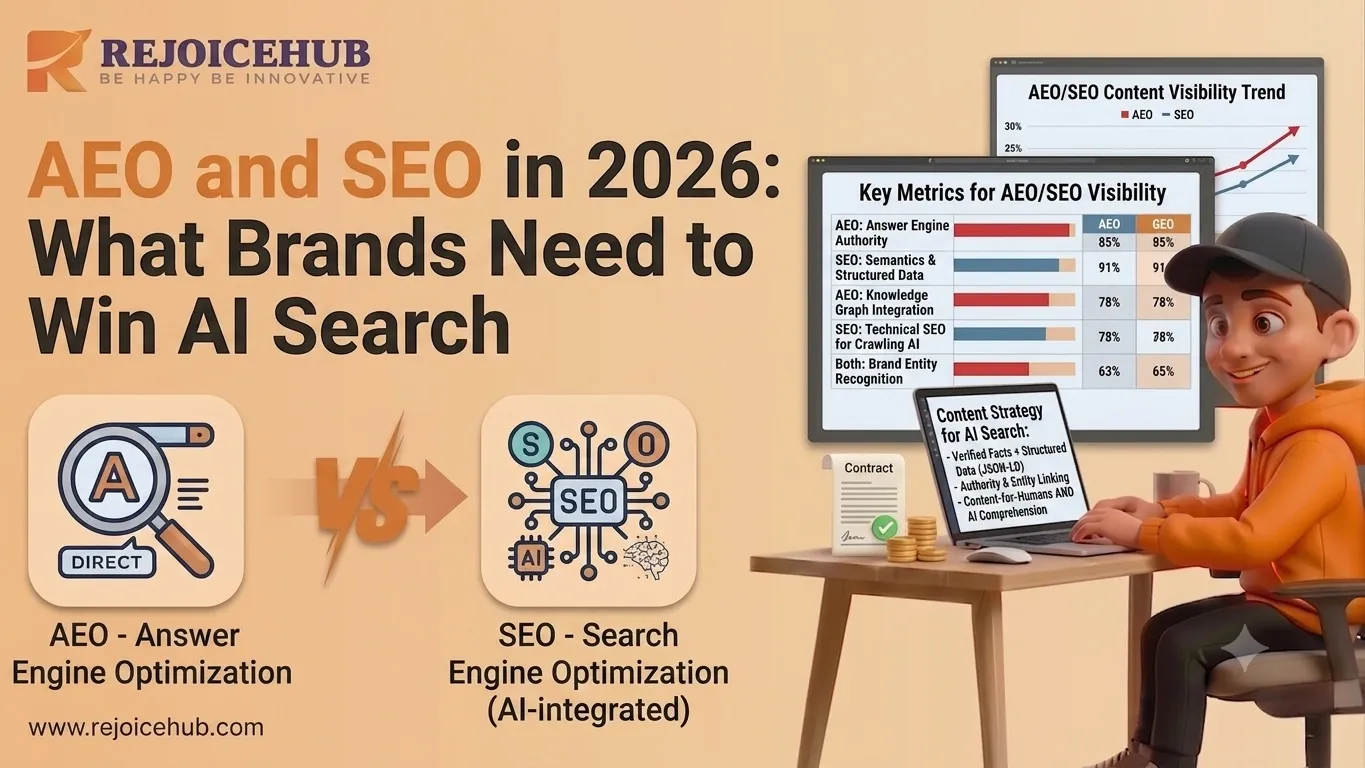
One brand, RejoiceHub, saw its organic traffic drop by 34% in a single quarter. It was not because of a Google penalty or poor content, but because the search landscape had changed. Their competitor started appearing inside ChatGPT, Google's AI Overviews, and Perplexity while they were still focused only on ranking for page-one blue links.
That moment made one thing clear: SEO is no longer just about getting clicks from Google search results. Brands now need to be visible where people are asking questions, comparing options, and making decisions through AI-powered search.
Search in 2026 is very different from what it was in 2022. Today, users are not only clicking blue links on Google; they are getting direct answers from Google's AI Overviews, ChatGPT, Gemini, and Perplexity. These AI systems now answer millions of questions every day, and the brands they cite are becoming the ones users notice, trust, and choose.
That is why traditional SEO alone is no longer enough. AEO, or Answer Engine Optimization, helps brands structure their content so AI systems, voice assistants, and answer engines can easily understand, extract, and cite their expertise. If you want a solid foundation before diving deeper, this guide on what SEO is and its different types is a great place to start.
If you're only doing traditional SEO, you're optimizing for a shrinking slice of the pie.
AEO (Answer Engine Optimization) is the practice of structuring content so that AI systems, voice assistants, and answer engines can extract, cite, and surface your brand's expertise.
SEO (Search Engine Optimization) is still critical, but in 2026, it means something more layered than keyword density and backlinks.
This article breaks down both disciplines, their key signals, and the exact tactics brands need to rank in both Google and AI search in 2026.
What SEO Actually Means in 2026
-
Keyword Density Is Dead. Semantic Completeness Is Alive.
Google's ranking systems have moved well beyond just lining up keywords. In 2026, semantic completeness meaning how thoroughly and accurately your writing covers a topic is turning into a main quality signal.
So if someone searches "how does compound interest work," Google isn't simply looking for a page that repeats that phrase. It wants a page that also, naturally, touches connected ideas: principal, APY, the compounding cadence or frequency, and maybe even a few examples.
In practice, pages that map out the full semantic landscape of a subject tend to beat the ones that are too narrow or overly crammed with target phrases.
What to do:
-
Map every piece of content to a topic cluster, not just a single keyword.
-
Use tools like SurferSEO, Clearscope, or NeuronWriter to check semantic coverage.
-
Write for the reader who has five related questions. Answer all of them.
-
Entity SEO: Be Something Google Knows Exists
In 2026, one of those kinda underrated ranking signals is entity recognition, and it's honestly easy to overlook. Google's Knowledge Graph holds billions of entities people, brands, products, locations, and even concepts. When Google can confidently link your brand or author with a specific entity, it tends to trust what you publish more consistently.
Practical steps to build entity authority:
- Create and maintain a Google Business Profile.
- Ensure your brand's Wikipedia page (or Wikidata entry) exists with accurate, sourced information.
- Use consistent NAP (name, address, phone) data across all directories.
- Write author bios that link to verified social profiles (LinkedIn, Twitter/X, industry publications).
- Get mentioned in entity-rich publications news sites, Wikipedia references, and academic databases.
Entity SEO is about making Google say "I know who this brand is" not just "I've seen this domain before."
-
Website Authority in the Age of AI
Domain authority is still relevant, but it's moving away from raw backlink count toward topical authority. A brand that posts 30 deeply researched pieces on supply chain logistics will, in most cases, beat a generalist site with 500 backlinks on the same subject.
Building topical authority:
- Publish content clusters around your core topic pillars.
- Cross-link internally using descriptive anchor text.
- Earn links from topically relevant sources, not just high-DA domains.
- Update old content regularly freshness still signals relevance.
Understanding how AI tools are reshaping web development workflows is one example of how topical depth within a niche builds long-term authority faster than breadth alone.
AEO The New Discipline Brands Are Ignoring
-
What Is Answer Engine Optimization?
AEO is basically the habit of arranging your content so AI systems and answer tools can pull out clear, attributable answers and point back to the source.
If someone asks ChatGPT "what is the best project management software for small teams," GPT has to fetch relevant material from around the web (through Bing, Brave, or its own crawl). The brand whose pages are more cleanly structured, more readable for machines, and more often referenced by other sites is the one that tends to get named.
-
Answer-First Content Structure
The single most impactful AEO change you can make is shifting from an introduction-first to an answer-first structure.
Traditional SEO writers were taught to build up to the answer context, background, then the answer at paragraph four. AI systems don't wait. They extract the first clear, direct answer they find.
Answer-first structure looks like this:
H2: What is [Topic]?
[40–60 word direct definition immediately under the heading]
[Supporting detail follows]
Every major section should open with the answer. Let the explanation follow.
-
Generative Engine Optimization (GEO): How AI Decides What to Cite
GEO (Generative Engine Optimization) is the emerging practice of optimizing content for retrieval by generative AI systems — ChatGPT, Gemini, Perplexity, Claude, and AI Overviews.
GEO signals differ from traditional SEO signals. Research from Princeton and Georgia Tech has identified that content with the following attributes gets cited more often in generative AI responses:
| GEO Signal | Why It Matters to AI |
|---|---|
| Statistics and data | AI models prefer citable, verifiable facts |
| Quotations and expert opinions | Adds authority that AI can attribute |
| Fluency and clarity | Low-perplexity text is easier for models to extract |
| Structured formatting | Headers, lists, and tables help AI parse content |
| Topical depth | Comprehensive coverage signals expertise |
Practical GEO tactics:
- Include original research, surveys, or data with clear sourcing.
- Quote named experts with their credentials.
- Use numbered lists and comparison tables wherever relevant.
- Avoid vague, filler sentences AI skips them.
- Add a "Key Takeaway" or "Summary" section at the end of each major section.
To understand how generative systems fundamentally differ from traditional models, a clear breakdown of generative AI vs traditional AI is worth reading before building your GEO strategy.
-
Featured Snippets and AI Overviews: The Same Game, Different Stage
Google's Featured Snippets and AI Overviews pull from content that is:
- Formatted like a direct reply (question → quick response, without rambling)
- Supported by trust signals like entity recognition, quality backlinks, and EEAT
- Easy to scan with structure such as headers, lists, or tables
To optimize for both:
- Turn your H2 headings into the exact questions your audience actually asks.
- Put the answer to that question in the first 60 words right under the heading.
- Add backing material data, proof points, and real examples so it feels credible.
- For longer sections, finish with a compact summary bullet list.
It's the combination that helps search systems understand your intent and also confirm it.
Accelerate Your Workflows with Custom AI
Book a free consultation session with RejoiceHub. We'll map out a tailored automation roadmap for your company.
Schema Markup and LLM-Friendly Structured Data
-
Why Schema Is More Important Than Ever
Schema markup also called structured data was always important for SEO. But in 2026, it has become even more critical for AI search. Structured data lets machines get a clear, unambiguous understanding of what your content is about: the article type, who wrote it, the date, FAQs, how-to steps, ratings, and product details.
Essential schema types in 2026:
- Article / BlogPosting: with author, datePublished, publisher
- FAQPage: for Q&A sections (directly consumed by AI Overviews)
- HowTo: for step-by-step guides
- Product: with price, availability, reviews
- Organization: with sameAs links to social profiles and Wikipedia
Minimal implementation example (JSON-LD):
{
  "@context": "https://schema.org",
  "@type": "Article",
  "headline": "AEO and SEO in 2026",
  "author": {
    "@type": "Person",
    "name": "Your Name",
    "url": "https://yoursite.com/about"
  },
  "publisher": {
    "@type": "Organization",
    "name": "Your Brand"
  },
  "datePublished": "2026-06-01",
  "dateModified": "2026-06-08"
}
Add the FAQPage schema to every article that contains a Q&A section. This is one of the highest-leverage schema implementations for both Google and AI Overviews.
-
LLM-Friendly Structured Data: The Next Frontier
Beyond standard schema, there is a growing practice of making content easier for large language models to interpret and retrieve. This tends to include:
- llms.txt a proposed standard (similar to robots.txt) that provides a curated summary of your site's content in plain text for AI crawlers.
- Clear content hierarchy: consistent use of H1 → H2 → H3 with no skipped levels.
- Atomic paragraphs: one idea per paragraph, so models can extract individual claims cleanly.
- Explicit sourcing: linking to primary sources so AI systems can verify claims.
Understanding what Model Context Protocol (MCP) is gives useful context here, as it's part of the broader infrastructure that determines how AI systems retrieve and use structured content.
AI Visibility Metrics and Citation Sources
How Do You Know If AI Is Citing Your Brand?
This is the question every marketing team is asking, but it is also harder to answer than the usual SEO metrics. There is no "position 1 in ChatGPT" dashboard yet, and it makes everything a bit fuzzy. Still, there are a few approaches that help in practice.
Tracking AI visibility:
- Search your brand in ChatGPT, Gemini, Perplexity, and Bing Copilot manually and with teams on rotation.
- Use tools like Profound, Otterly.ai, and AthenaHQ that monitor brand mentions in AI-generated responses.
- Track referral traffic from Perplexity and Bing (which power several AI tools) in Google Analytics 4.
- Monitor branded search volume in Google Search Console spikes often correlate with AI-driven brand discovery.
Citation sources AI prefers:
- Wikipedia and Wikidata
- High-authority news publications
- Government and academic domains (.gov, .edu)
- Well-known industry publications
- Your own website if it has strong entity associations and structured data
As AI agents increasingly automate business workflows, the brands that are already visible inside AI-generated responses will have a compounding advantage over those still optimizing only for traditional search clicks.
EEAT The Human Signal That AI Can't Fake
Google's EEAT framework (Experience, Expertise, Authoritativeness, Trustworthiness) is the skeleton for how content quality is judged in 2026, and it increasingly guides what AI systems decide to cite.
Building EEAT in practice:
| Signal | Action |
|---|---|
| Experience | Show real first-hand accounts, case studies, and personal results |
| Expertise | Author bios with credentials, links to professional profiles |
| Authoritativeness | Citations from trusted third-party sources |
| Trustworthiness | HTTPS, clear privacy policy, editorial standards page, correction policy |
For YMYL (Your Money, Your Life) content health, finance, legal, safety EEAT signals are not optional. They're a prerequisite for ranking. This is especially visible in competitive categories like artificial intelligence in finance, where trust signals directly determine whether a page earns visibility or gets passed over entirely.
Key Takeaways
-
SEO in 2026 is about semantic completeness, entity authority, real topical depth, and EEAT not the old idea of keyword density.
-
AEO is an answer-first layout where you put the direct answer up front under each heading, plus FAQPage schema, so Google and other systems can extract it faster.
-
GEO is formatting built for extraction statistics, expert quotes, tables, and structured clarity so generative AI can pull facts and cite them without friction.
-
Featured Snippets and AI Overviews react to the same signals: heading-as-question, direct answer immediately, then supporting evidence that's easy to parse.
-
Schema markup matters, especially for Article, FAQPage, and Organization. It tells Google and AI crawlers what the content structure is, even when everything else looks normal.
-
Tracking AI visibility is a new discipline not just classic rankings. Tools like Profound, Otterly, and Bing referral data show what's actually happening.
-
EEAT is the trust layer that all other signals depend on. If trust is weak, the content usually struggles in both traditional and AI search.
Conclusion
Brands dominating search in 2026 aren't deciding between SEO and AEO. They are designing content architectures that serve both: clear enough to be extracted by AI, semantic enough to rank well with Google, and EEAT-rich enough to be trusted by both machines and people.
The largest failure point in 2026 search is viewing AI search as a separate channel. It isn't. It is simply consuming content differently. The post that earns high rankings through Google's algorithm should also have the right structure to be cited in ChatGPT. The FAQ that shows up in an AI Overview should also have won the Featured Snippet.
For brands building in fast-moving categories from generative AI in modern manufacturing to AI-powered customer experiences the brands that align their content architecture with both search and AI systems today will be the ones that compound their visibility over the next several years.
The search bar hasn't disappeared. It has simply gotten smarter. So must your strategy.
Frequently Asked Questions
1. What is AEO and how is it different from SEO?
AEO stands for Answer Engine Optimization. It means writing content so AI tools like ChatGPT or Perplexity can pull answers from it easily. SEO helps you rank on Google. AEO helps you get cited inside AI-generated answers. In 2026, you really need both to work together.
2. Why is traditional SEO not enough in 2026?
Because people are not just clicking Google links anymore. Millions of searches now end inside AI tools like Google's AI Overviews, Gemini, and ChatGPT. If your content is not structured for AI to read and cite, your competitors who are will keep showing up instead of you.
3. How do I optimize my content for Google's AI Overviews?
Write your H2 headings as real questions people ask. Then put a short, direct answer around 40 to 60 words right under that heading. Add supporting facts, data, or examples after. This structure helps Google grab your content for AI Overviews and featured snippets both.
4. What is GEO or Generative Engine Optimization?
GEO means setting up your content so generative AI tools like ChatGPT, Claude, or Perplexity can find, understand, and cite it. That means using statistics, expert quotes, clean formatting, and structured tables. The cleaner and more factual your writing is, the more likely AI systems will reference it.
5. What schema markup should I add for AI search in 2026?
Start with Article, FAQPage, and Organization schema at minimum. FAQPage schema is especially powerful because Google's AI Overviews reads it directly. Add author details, publish dates, and sameAs links to your social profiles. These signals help both Google and AI crawlers understand what your page is about.
6. How can I track if AI tools are citing my brand?
Search your brand name manually in ChatGPT, Perplexity, Gemini, and Bing Copilot. Use tools like Profound or Otterly.ai to monitor AI mentions. Also check referral traffic from Perplexity in Google Analytics 4 and watch for branded search spikes in Google Search Console those often mean AI is driving discovery.
7. What does EEAT mean, and why does it matter for AI search?
EEAT stands for Experience, Expertise, Authoritativeness, and Trustworthiness. Google uses it to judge content quality, and AI systems follow similar signals when deciding what to cite. Add real author bios, link to credentials, use trusted sources, and show first-hand experience. Without strong EEAT, your content struggles in both search types.