The process of machine learning experimentation proves to be highly demanding for anyone who has worked on machine learning projects. The process involves making a parameter change and then waiting for the model to complete its training before checking the results. The process requires multiple repetitions of testing until the user finds a solution that functions correctly, which can take a period of several days or even weeks.
An artificial intelligence program should be able to execute the complete experimental process without requiring human intervention. The Karpathy autoresearch agent serves as the central concept that currently attracts significant interest in AI research automation. This guide explains the autoresearch agent functionality through detailed information about its operation and describes its potential to change artificial intelligence development processes. This session provides value to developers, researchers, and people who want to learn about artificial intelligence.
Who Is Andrej Karpathy?
Before explaining the concept, we need to discuss the individual who created it. Andrej Karpathy is one of the most respected names in modern AI. He started his career as a founding member at OpenAI before moving to Tesla, where he served as Director of AI. There, he supervised the development of neural networks that enable Tesla's Autopilot system to operate.
He dedicates his efforts to creating Karpathy auto-research agent programs that everyone can access. His YouTube tutorials and GitHub projects have helped thousands of developers learn deep learning from scratch. He possesses the exceptional ability to transform highly complicated subjects into understandable explanations.
The AI community pays attention to Karpathy when he discusses autoresearch agents because of his established credibility. He operates at a practical level because he has developed large-scale artificial intelligence systems.
What Is an Autoresearch Agent?
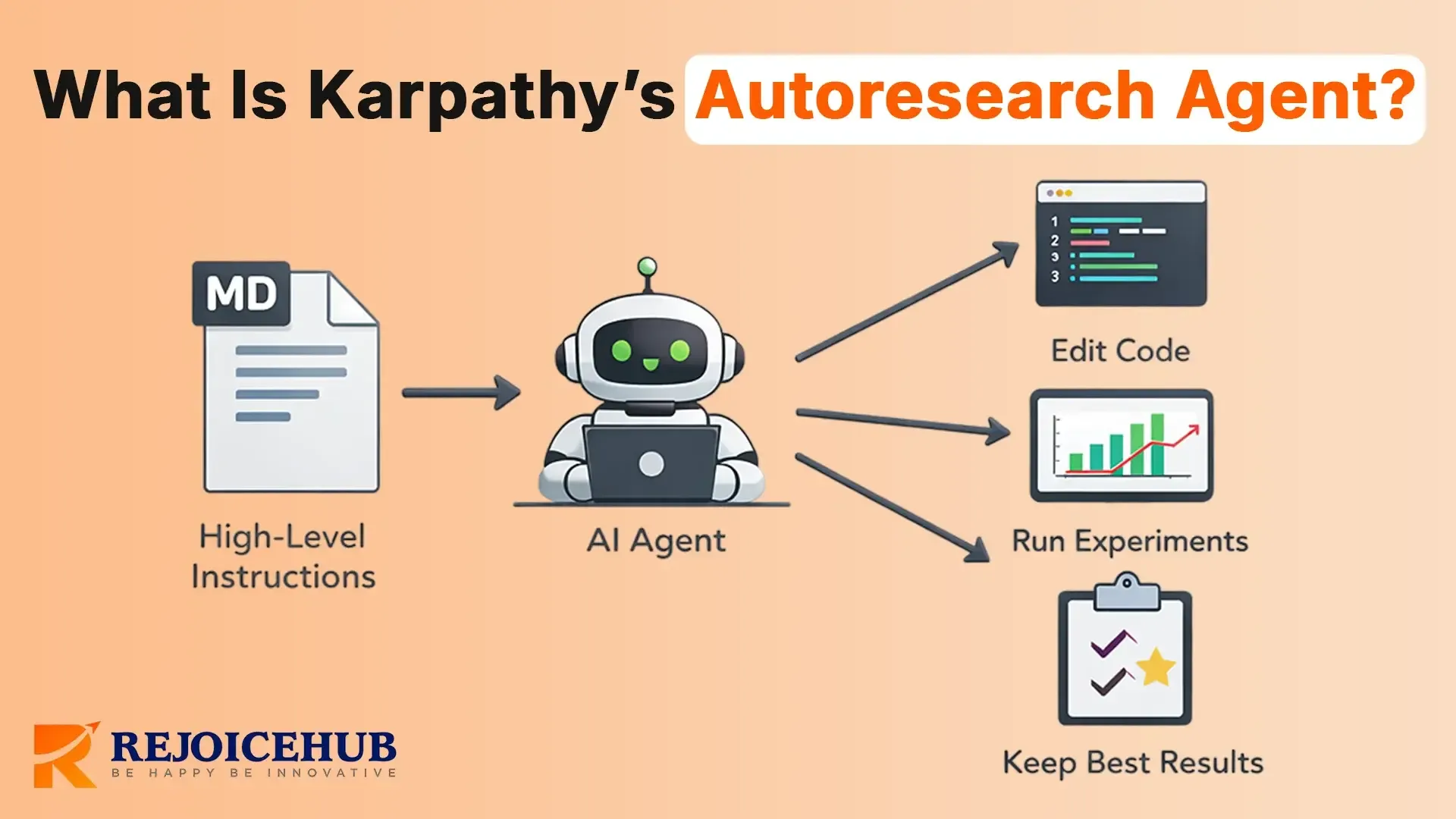
A Karpathy autoresearch agent functions as an AI system that conducts research following its self-sufficient operational framework. The system can independently generate research concepts, build experimental procedures, conduct tests, assess findings, and make research enhancements without requiring human intervention for each procedure.
Researchers in machine learning use a standard workflow, which starts with a researcher who selects an experimental setup that includes a model architecture, a learning rate, and a dataset for testing. The team executes the tests and then performs an assessment of the results to determine their next research direction. The process needs humans to take charge of every task.
The AI research automation performs all functions through its automatic operation. The system employs a large language model to predict which experiments should be executed while it tests those experiments in a coding environment and analyzes the outcomes before selecting future tasks. The system operates as an unending AI researcher who maintains productivity without needing rest periods for coffee.
Karpathy's version of this concept pushes the idea further by thinking about how AI agents for machine learning research could operate at a scale that no human team could match.
Why the AI Community Is So Excited About This
The excitement is real, and here's why. Machine learning research depends on scientists who conduct experiments. Scientists conduct experiments that they repeat multiple times. Your research involves testing different versions of your primary concept. The work demonstrates which tasks AI research automation handles with perfect efficiency.
The autonomous AI research procedure produces three main results. The first result of the process is increased speed — researchers can now conduct experiments that used to take a month within several days.
AI agents for research enable an AI agent to execute multiple experiments simultaneously through its capacity to handle many trials at once. Researchers receive a third benefit because they can devote their time to developing original ideas that require human expertise.
AI agents function in research as tools that enhance researchers' output without replacing researchers.
How Karpathy's Autoresearch Agent Works
Why don't you go about the workflow in practice? It's not as intangible as it seems.
Step 1: Generate a Research Idea
The agent starts by proposing a hypothesis or experiment. The process requires the use of a large language model at this point. The LLM uses existing knowledge to develop testing recommendations, which include examining various activation functions and testing advanced network designs.
Step 2: Design the Experiment
The agent creates the experiment after the initial concept receives development. The agent selects the dataset and establishes model settings while creating the training setup. Researchers typically dedicate unexpected amounts of their research time to this particular process.
Step 3: Run the Experiment
The agent then executes the experiment in an automated environment. The system trains the model while it performs evaluations and records the results of its testing. The autonomous AI research capability exists because the agent performs both planning and execution.
Step 4: Analyze the Results
The agent examines the output after completing its training program. The system uses various performance indicators to determine its success through accuracy and loss curve analysis. The system attempts to interpret results by comparing them to the original hypothesis testing.
Step 5: Improve and Iterate
The most significant advancement in the process occurs through this step. The agent uses its acquired knowledge from learning to develop new hypotheses, which it tests through repeated experimentation. The reason researchers find autoresearch agents attractive is their ability to conduct multiple experiments without stopping after their initial test. Their development process continues as they acquire new knowledge since they remain active.
The Key Components That Make It Work
Building an autoresearch agent requires multiple technologies to work together because it does not require magical abilities. The following explanation reveals all technical elements that operate behind the system.
-
LLM Reasoning Engine: The system's main control center functions as the brain of its operations. A large language model reasons about experiments, interprets results, and decides what to try next.
-
Experiment Execution Environment: The agent needs a specific space to execute its programming tasks. The agent typically requires a protected Python environment to train its models and collect experimental data.
-
Data Pipeline: Any research needs data. The agent possesses complete access to multiple datasets, which it uses to perform complete training operations through its knowledge of loading and preprocessing methods.
-
Evaluation Framework: The agent needs to evaluate success. This can involve accuracy and a specific F1 score, as well as any other custom metric deemed relevant to the research.
-
Feedback Loop: The reasoning engine receives all information back from the system. The LLM uses its previous results to identify successful experiments and unsuccessful experiments before creating its next testing process. The system operates independently because of its closed-loop system.
Autoresearch Agents vs. Traditional ML Research
Indeed, the two differ in a hurry.
| Feature | Traditional Research | Autoresearch Agent |
|---|---|---|
| Experiment Design | Manual, human-driven | AI-generated automatically |
| Iteration Speed | Slow — days or weeks | Rapid — hours or less |
| Research Scaling | Limited by team size | Massive parallel testing |
| Human Time Required | Very high | Significantly reduced |
| Consistency | Variable | Highly consistent |
Real-World Use Cases
The concept exists as more than a theoretical idea because current areas already show how autoresearch agents work and create actual benefits.
-
AI Model Development: The automatic neural network architecture discovery system of autoresearch agents enables companies to find superior neural network designs through automated research. The agent selects the optimal design through its automatic discovery process instead of requiring manual testing of various designs.
-
Scientific Research: AI-driven hypothesis testing methods are being studied by researchers from the biological and chemical fields. An autoresearch agent could screen thousands of molecular combinations in the time it takes a human team to test a few dozen. Understanding machine learning in healthcare gives a clear picture of how powerful this kind of automation can become in scientific domains.
-
Data Science Automation: The agents enable businesses with extensive data to discover their optimal solution through automatic testing of various models and settings.
-
AI Startups: The experimental capabilities of small teams increase to match those of larger organizations when they use autoresearch agents for their research work. Exploring AI business ideas for startups can help new ventures identify exactly where autoresearch agents fit into their growth strategy.
The Technologies Behind Autoresearch Agents
Building one of these systems requires a strong tech stack. The AI agents for machine learning research component of the system require a powerful large language model, which can function as either GPT-4, Claude, or an open-source equivalent. The LLM must demonstrate proficiency in reasoning, code generation, and result understanding.
The execution process relies on PyTorch and TensorFlow as the primary frameworks, which enable model training. Machine learning frameworks like LangChain also function as orchestration tools that enable agents to manage their tool usage and handle their output processing.
Cloud computing infrastructure serves as the foundational element that enables all operations to function. The system needs advanced computing resources because it conducts simultaneous testing of multiple experiments, which requires substantial processing capacity that AWS, Google Cloud, and Azure provide.
The Real Benefits of Autoresearch Agents
The most evident advantage of this technological advancement is increased rates of product development. The discovery process experiences rapid acceleration when experiments can proceed without any need for human intervention. Teams that used to conduct 10 experiments per week now possess the ability to execute thousands of tests.
The organization gains advantages through the reduction of work that needs to be done manually. Researchers dedicate more time for strategic planning while spending less time on project implementation. You think at a higher cognitive level because the agent conducts all mundane tasks.
The most critical aspect of autoresearch agents creates a foundation for organizations to conduct extensive AI research projects. You can now expand your research team without facing limits on the number of researchers you can bring onboard. Learning about the benefits of AI for business makes it clear why autoresearch agents are becoming a competitive necessity, not just a luxury.
Challenges and Limitations Worth Knowing
The situation has both positive and negative aspects. Autonomous AI research presents important difficulties that researchers must address as they conduct their studies.
The AI agent displays high confidence when it selects an incorrect solution path. The system will consume processing resources until someone discovers the incorrect result interpretation and its faulty hypotheses.
The study faces another problem because of its evaluation methods. The agent can only perform at its best when it follows the defined optimization standards. The measurement method needs to assess the correct element because the current method measures incorrect aspects, which will result in incorrect outcomes.
Computational expenses will increase rapidly. The process of conducting thousands of tests will require substantial financial resources. Teams need to build in smart stopping criteria and budget constraints to avoid runaway spending.
The existence of incorrect hypotheses creates a potential danger. The LLM driving the agent might suggest experiments that don't actually make scientific sense. Human oversight continues to hold vital importance during the initial development stages. Understanding the advantages and disadvantages of machine learning helps set realistic expectations when deploying any autonomous research system.
The Future: Where This Is All Heading
The current development of autoresearch agents will lead to their eventual transformation into something completely new. We are approaching a future where AI systems will become self-improving because they will develop the ability to autonomously create new training methods and model architectures while conducting their research experiments.
The concept of autonomous AI labs, where most of the research pipeline is handled by AI, is no longer science fiction. The field actively pursues research that leads to this specific future outcome. Staying informed about what is agentic AI is essential for anyone who wants to understand where this technology is ultimately heading.
The shift between these two elements creates major effects for AI startups and research institutions. Researchers need to prove their research abilities before they can access advanced general infrastructure resources and intelligent AI systems. The research requirements for cutting-edge scientific work are experiencing rapid transformations.
How Businesses Can Start Using Autoresearch Agents
The research lab does not serve as the only venue that enables people to access this content. AI research automation enables businesses to start their exploration of AI research at any scale.
The development teams for AI products use autoresearch agents to create multiple model iterations, which they test before the product launch. The process of model optimization provides an excellent starting point. The autoresearch agent offers an automated improvement solution that your team can use to enhance your existing deployed model.
The current state of data science automation exists through the application of available AutoML solutions. The tools will transform into complete autoresearch agents when they add LLM-based reasoning capabilities to their functions. Businesses looking to automate their workflows with AI agents will find autoresearch agents to be a natural next step in that journey.
The primary objective of the project is to speed up research and development processes. The organization that conducts machine learning experiments needs to develop automated systems for its tasks, which should be implemented now to gain a competitive advantage over opponents.
Conclusion
The Karpathy autoresearch agent concept represents something bigger than just a new tool. The development of this technology will create a fundamental shift in our current practices of conducting AI research.
The researchers who will succeed in automated AI research will need to develop their skills in asking productive questions. Researchers should develop those skills that will allow them to create effective questions. After that, they should let autonomous systems seek out solutions.
The time has come for all developers, researchers, and business leaders to begin studying autoresearch agents. Early adopters of this technology will gain substantial competitive advantages.
Frequently Asked Questions
1. What is Karpathy’s Autoresearch Agent?
Karpathy’s Autoresearch Agent is an AI system designed to automate machine learning research by generating hypotheses, running experiments, analyzing results, and improving models without constant human involvement.
2. Who created the Autoresearch Agent concept?
The concept was popularized by AI researcher Andrej Karpathy, a former OpenAI founding member and former Director of AI at Tesla.
3. How does an Autoresearch Agent work?
It uses large language models to generate research ideas, design experiments, run training pipelines, analyze results, and iteratively improve models automatically.
4. What problem does an Autoresearch Agent solve?
It solves the slow and repetitive nature of machine learning experimentation by automating trial-and-error research processes.
5. What technologies power Autoresearch Agents?
They typically use large language models, machine learning frameworks like PyTorch or TensorFlow, orchestration tools such as LangChain, and cloud computing platforms.
6. Can AI really conduct research autonomously?
AI can automate large portions of research workflows such as experimentation and data analysis, but human oversight is still important.
7. How is an Autoresearch Agent different from AutoML?
AutoML focuses mainly on model optimization, while Autoresearch Agents automate the entire research cycle, including hypothesis generation and experimentation.
8. Why are researchers excited about Autoresearch Agents?
Because they can run thousands of experiments simultaneously, dramatically speeding up AI discovery and innovation.
9. What are the real-world applications of Autoresearch Agents?
They can be used in AI model development, scientific research, data science automation, and product optimization.
10. What are the limitations of Autoresearch Agents?
Challenges include high computational costs, incorrect hypothesis generation, evaluation errors, and the need for human supervision.
11. Can startups benefit from Autoresearch Agents?
Yes. Small AI teams can scale their research capabilities significantly by automating experiments and model improvements.
12. Will Autoresearch Agents replace AI researchers?
No. They are designed to augment researchers by automating repetitive tasks while humans focus on strategy and innovation.
13. What is the future of Autoresearch Agents?
Future AI systems may evolve into autonomous research labs capable of discovering new algorithms, architectures, and scientific breakthroughs.