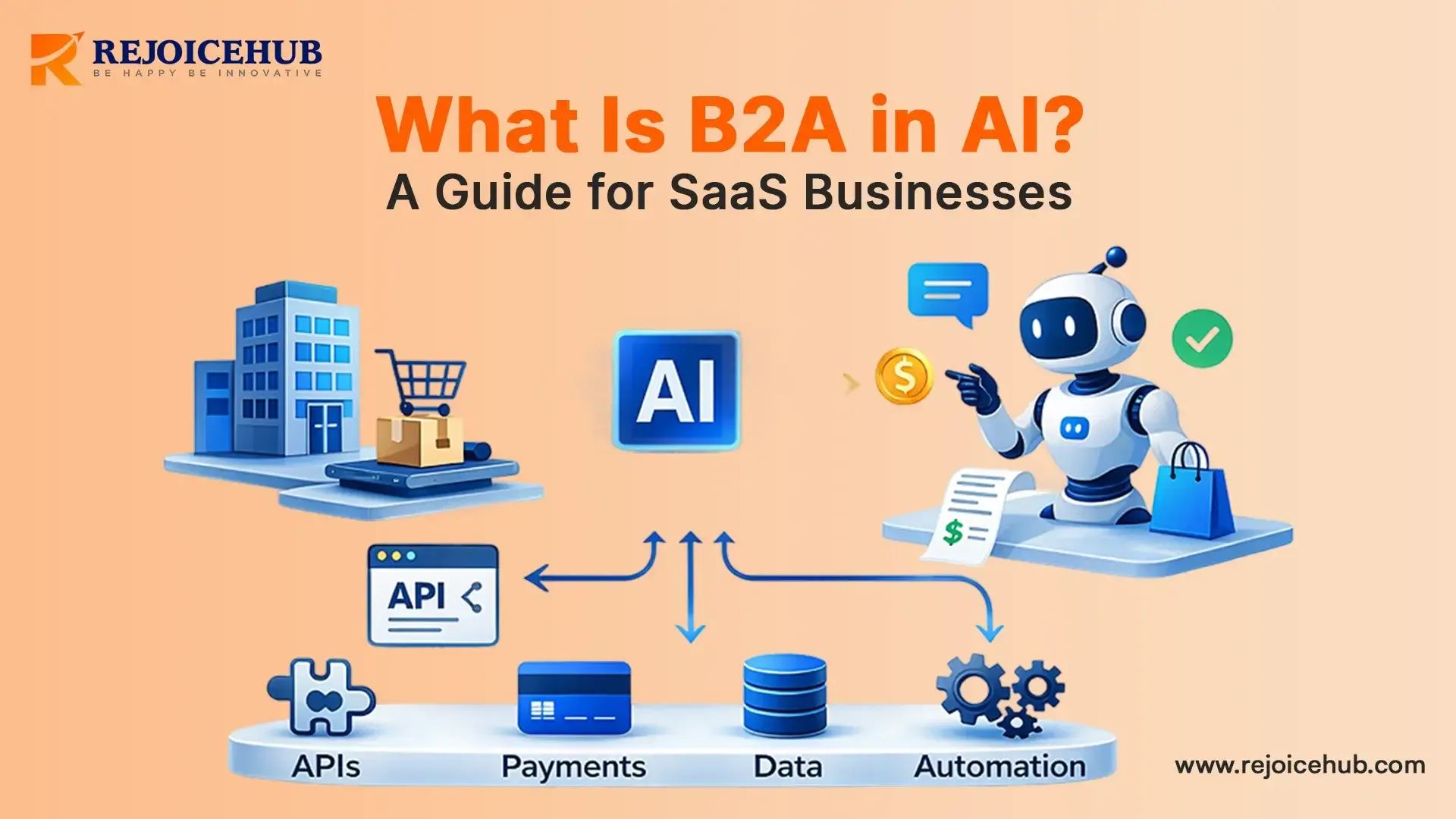
The development process for software required developers to create programs that served only one target group, which included individuals who operated computers. A silent change is currently happening. Web-browsing AI agents perform online comparison shopping, tool procurement and workflow execution tasks in place of actual users. Most businesses do not have the necessary preparation for this situation.
The Business to Agent model or B2A system represents the current business transformation. The digital economy currently experiences its most essential transition, which requires SaaS and digital service businesses to monitor its developments.
This article presents an explanation of B2A together with its distinction from B2B and B2C and the relevance of headless SaaS to this situation, and the necessary business preparations for your organization. Let's start from the beginning.
What Is B2A in AI?
-
Business-to-Agent: A Simple Definition
The Business-to-Agent model describes a way of doing business where your product or service is accessed not by a human clicking through your UI but by an AI agent that acts on someone's behalf.
A user requests their AI assistant to "find the best project management tool under $50/month and set up a free trial". The Headless SaaS for AI agents evaluates options by reading documentation and comparing features to accomplish the task without requiring the user to visit any websites.
The B2A business model for AI agents operates through its complete execution. Humans remain as end users. But the interface layer between them and your product is now an AI agent.
-
Why B2A Is Emerging Now
The world has transformed since the previous science fiction moment. AI assistants like Claude and ChatGPT and other systems now receive capabilities that enable them to perform online search activities and API calls and form completion and full task execution.
Organizations have committed substantial financial resources to develop their API and automation platform and structured data system infrastructure. The development of B2A AI infrastructure needed to proceed until the agents achieved their required progress.
B2A vs B2B vs B2C: What Actually Changed?
-
Human Buyers vs AI Intermediaries
To understand what makes B2A different, let's do a quick comparison. The B2C model allows businesses to sell products directly to their customers. You care about things like website design, easy onboarding, and emotional appeal. The human decides, and the human buys.
In a B2B model, you sell to other businesses. The decision-making process moves at a slow pace because it requires multiple people to assess product characteristics, system connections, and return on investment. But again humans are making the calls.
B2A business model for AI agents is now introduced. An AI agent can discover your product, assess its value, and initiate either a purchase or trial process. The human is still the end beneficiary, but they are not the one doing the searching. The AI is.
This changes everything about how your product needs to be discovered and used.
-
Why Traditional UX Alone Is No Longer Enough
The reality is that an AI agent shows no interest in the design of your landing page. Your animated hero section and selected color palette fail to impress the system.
The system needs to verify its ability to reach your product features while it learns about your services and proceeds with automated actions.
Your product becomes undetectable to artificial intelligence systems when its entire user experience exists as a graphical interface without any application programming interface (API) access or organized documentation or automation capabilities. The situation creates major issues because agentic AI workflows currently perform research and make decisions at increasing levels.
How Headless SaaS Supports AI Agents
APIs, Structured Data, and Agent-Ready Workflows
Headless SaaS functions as a solution to this challenge. Headless SaaS enables users to access software features because its main functions exist beyond any visual interface. The system provides multiple ways to access its functions through APIs and webhooks and structured data and automation workflows which can be used for programming purposes.
AI agents require headless SaaS because they need to use your API system to create projects and generate reports and send messages and execute transactions without needing to access your dashboard through a web browser.
The software operates continuously as it processes machine inputs with the same accuracy that it handles human inputs.
This change brings important consequences. The design of traditional SaaS systems targets display devices. Headless SaaS provides support for operational systems. AI agents function as operational systems.
Also Read: Best AI Agents for Business to Improve Productivity in 2026
Why Machine-Readable Systems Matter More Than Visual Interfaces
Headless SaaS for AI agents tools exist which provide the same fundamental functionality. The beautiful interface of Tool A exists without any accessibility to its public API. The clean interface of Tool B provides users with a documented API system which delivers organized data results. An AI agent is evaluating both.
The system always selects Tool B as its superior option. The agent prefers this system because it provides superior usability for its tasks.
LLM agents find it simpler to interact with machine-readable systems which maintain consistent APIs and structured schemas and provide complete documentation and dependable response formats. The increasing capabilities of agentic systems will lead to technical characteristics becoming essential for discovering and selecting SaaS products.
Why the Business-to-Agent Model Matters for SaaS Companies
1. Product Discoverability in an Agent-Driven World
Your current ability to be discovered on the internet depends on three main sources which are search engines and social media and word-of-mouth recommendations. The Headless SaaS for AI agents conduct research work because they have developed this capability. The users who need recommendations can access systems which test reliability by scanning documents and testing APIs and reading changelogs.
If your product becomes difficult for an agent to locate or assess or connect with, your product will not appear in modern discovery systems. The Business-to-Agent model is quietly reshaping what it means for a product to be discoverable.
2. Automation-Friendly Services Win More Workflows
The most obvious chance for B2A to grow its business lies in increasing workflow adoption. The SaaS product enables automated operations through its ability to be activated and set up and operated by users who do not need to verify their settings.
Products that support AI automation use cases experience higher usage rates because users find them more helpful. They become integrated into various systems which include internal agents and all business operations. Visual design modifications lack the ability to achieve the same level of product attachment that these features create.
3. The Competitive Risk of Staying UI-Only
The product leaders should feel discomfort because this section presents crucial information to them. Your competitors will achieve more than gaining product functions if they create effective API systems plus detailed documentation plus integrations that work with their agents before you can establish these components. The new channel creates new opportunities for users to discover and evaluate and use their products.
The market now adopts B2A solutions for AI while you maintain your UI-only system. The existence of this system requires both technical and strategic solutions. Your competitors will establish permanent AI agent workflow links which will create difficulties for you to compete with their established connections.
Real Examples of B2A in Action
-
Research and Comparison Agents
Say someone asks their AI assistant: "Compare the top three CRM tools for a 10-person sales team and give me a summary." The agent goes out, reads documentation, checks pricing pages, looks at API coverage, and returns a structured recommendation. Products with clear, structured, machine-readable information are far more likely to make that shortlist.
This is B2A at the research layer. The human never visited your website but your product still got evaluated.
-
Booking, Procurement, Support, and Workflow Agents
The use cases go beyond research. Here are a few practical examples of the B2A business model for AI agents playing out in the real world:
- A scheduling agent books a meeting room by calling a facility management API no human login needed.
- A procurement agent requests quotes from multiple vendors through their APIs and returns a side-by-side comparison.
- An enterprise operations agent pulls data from three internal SaaS tools simultaneously to generate a weekly performance report.
- A customer support agent logs a ticket, updates a CRM record, and sends a follow-up message — all triggered by a single user instruction.
None of these interactions require a human to click around or manage the process. The headless SaaS for AI agents infrastructure does the work quietly in the background.
How Businesses Can Prepare for B2A
-
Build APIs First
The most important step is also the most fundamental: expose your core functionality through a well-designed API. Your starting point should be your current product which lacks a public API. Identify the actions that users perform most frequently within your product and create methods for users to execute those actions through programming.
Your API is no longer just a developer feature. Your main interface for agent access in a B2A environment has become your API.
-
Improve Your Structured Documentation
The AI agents combine API calling with documentation reading to learn about their operational capabilities. The clean structured documentation with its clear descriptions and consistent naming and effective examples enables agents to evaluate and use your product with greater efficiency. The way you present your documents should match your approach to designing your homepage. Your documents now serve as the initial contact point between your system and artificial intelligence systems.
-
Design Secure Agent Permissions and Workflows
The process of granting an AI agent access to your product creates actual security risks for your system. The system needs to support agent usage while enforcing three access requirements which include access control and user authentication and system monitoring. The following elements present a functional business-to-agency readiness assessment checklist which tests B2A operational capabilities.
Understanding what agentic AI truly means for your infrastructure is a critical first step before implementing these controls:
- Core features are accessible via a public API
- Responses use structured, consistent schemas
- Documentation is complete and clearly written
- Authentication supports token-based or OAuth access
- Workflows can be triggered automatically without manual steps
- Reliability and uptime are strong enough for agents to depend on
The businesses that fulfill these requirements will succeed during the increasing adoption of AI agents. You should begin discussing your need for a technical partner because it will help you achieve your goals before your competitors enter the market.
Conclusion
The Business-to-Agent model exists as a commercial framework which does not function as a temporary marketing term. The Business-to-Agent model establishes actual market expansion which becomes more powerful because AI agents for business develop their capacity to operate independently for humans and organizations.
B2A in AI represents important functionality for businesses which demonstrate their commitment through investment in APIs and structured data and clean documentation and workflows which support automation. The creation of software relevance occurs because businesses establish B2A processes which enable their software to interact with other software systems.
RejoiceHub helps organizations create agent-ready software through development of APIs and AI-powered workflow solutions. We want to create an experience which both agents and humans will find enjoyable.
Frequently Asked Questions
1. What is B2A in AI?
B2A stands for Business-to-Agent. It's a model where AI agents, not humans, access and use your product or service. Instead of a person clicking through your app, an AI assistant does the searching, comparing, and even signing up on the user's behalf.
2. How is B2A different from B2B and B2C?
In B2C, you sell to individual people. In B2B, you sell to companies. In B2A, an AI agent is the one interacting with your product, even though a human still benefits at the end. The key difference is that no human is clicking or deciding during the process.
3. Why is the Business-to-Agent model important for SaaS companies?
If your SaaS product doesn't have a proper API or structured documentation, AI agents simply can't use it. That means you get skipped during AI-powered research and comparison. B2A is becoming a real discovery and sales channel that SaaS companies can't afford to ignore.
4. What is headless SaaS and why does it matter for AI agents?
Headless SaaS means your software's core features work through APIs and structured data — not just a visual dashboard. AI agents need this to take actions like creating projects or pulling reports. Without it, your product is basically invisible to any automated system.
5. Can AI agents really buy or sign up for software on their own?
Yes, increasingly they can. Modern AI agents can read pricing pages, check API availability, start free trials, and even trigger purchases, all based on a user's instructions. That's the B2A model working in real life, and it's already happening with tools like ChatGPT and Claude.
6. How do AI agents find and evaluate SaaS products?
AI agents read your documentation, check your API structure, scan your pricing pages, and test your response formats. They look for machine-readable, well-organized information. If your product is hard to read programmatically, it likely won't make the agent's recommendation list.
7. What is an agent-ready SaaS product?
An agent-ready SaaS product has a public API, clean documentation, token-based authentication, structured data responses, and automated workflows. It works just as well for a machine calling it as it does for a human using it. Think of it as being "AI-accessible" by design.
8. How should SaaS companies prepare for the B2A business model?
Start by building or improving your public API. Then clean up your documentation so it's easy to read both by humans and AI systems. Add support for token-based access and make sure core features can be triggered automatically without any manual steps involved.
9. Will B2A replace B2C or B2B completely?
Not entirely. Humans still make the final decisions and remain the end users. But B2A adds a new layer between your product and the customer. AI agents act as intermediaries. B2C and B2B don't disappear, they just need to work alongside the B2A channel too.
10. What are real-world examples of B2A in action?
A scheduling agent books a meeting room via API. A procurement agent collects vendor quotes automatically. A support agent logs tickets and updates CRM records all triggered by one user command. No human clicks involved. These are live B2A use cases happening in businesses right now.
11. Why is good API documentation important in the B2A model?
AI agents read your docs to understand what your product can do. If your documentation is messy, incomplete, or hard to follow, agents won't use your product effectively or at all. Clean, structured docs are now just as important as a well-designed homepage.
12. What security risks come with allowing AI agents to access your product?
When agents access your product automatically, you need strong access controls, proper authentication like OAuth or token-based systems, and activity monitoring. Without these, unauthorized or runaway agents could cause real damage. Building for B2A means building with security baked in from the start.
13. Is B2A just a trend or is it here to stay?
B2A is not a buzzword. As AI agents get more capable, they'll handle more tasks that humans currently do manually including software research and purchasing. Businesses that build agent-ready infrastructure now will have a real advantage as this shift becomes the standard way software gets used.