Artificial General Intelligence (AGI) denotes the state of development of computational devices that can acquire knowledge, generate ideas, and come up with solutions of any kind, just like a human brain. Toda, AI, on the other hand, is still far behind in this aspect, as it can only perform certain tasks brilliantly; for instance, IBM's Watson can play chess, and other systems can generate content or recommend movies. Nevertheless, AGI is targeted to rise above this limit and to completely understand and adapt to new situations without the need for any kind of preprogrammed guidance. The coming of a new age in terms of technology is ushering in the need for a better understanding of AGI. Its range of possible benefits extends from one end of the healthcare sector to the other and further to education, research, and even the arts and creativity.
Quick Summary
Artificial General Intelligence (AGI) is the term used for AI systems that possess human-like thinking and can therefore learn and solve problems in various fields.
This guide is aimed at providing a comprehensive explanation of artificial general intelligence, to investigate what AGI means in AI, and to present a discussion on artificial general intelligence mechanisms, its primary characteristics, hurdles, and the reasons why it might be a game-changer for the future of technology.
What is Artificial General Intelligence (AGI)?
Artificial General Intelligence (AGI), unlike Narrow AI, can learn, understand, and perform any intellectual task that a person is theoretically capable of. AGIs can deal with new situations due to their acquired knowledge, solve problems other than those they were designated to solve, and reason on their own to judge situations, not reliant on explicit command or training. Above all, they can perform human-level problem-solving by means of reasoning.
Key Points:
- Learns and reasons across many domains
- Adapts to new, unpredictable situations
- Transfers knowledge between different tasks
- Reasoning on the level of humans and problem-solving
What Can Artificial General Intelligence Do?
The concept of Artificial General Intelligence (AGI) implies that such intelligence would have the capability of interpreting, reasoning, and being creative at the level of humans, thus perfecting the current narrow AI capabilities by a huge margin. In contrast to the present situation, where AI is confined to doing only one task, AGI would have the real versatility of learning, adapting, and performing all of the detailed areas of application, with its potential skills being really broad and leading to significant changes.
Key Characteristics of Valuable AGI
Valuable AGI is defined by its ability to reason, learn, and adapt across diverse tasks with human-level versatility. It delivers safe, reliable, and aligned outcomes that enhance productivity while minimizing risks.
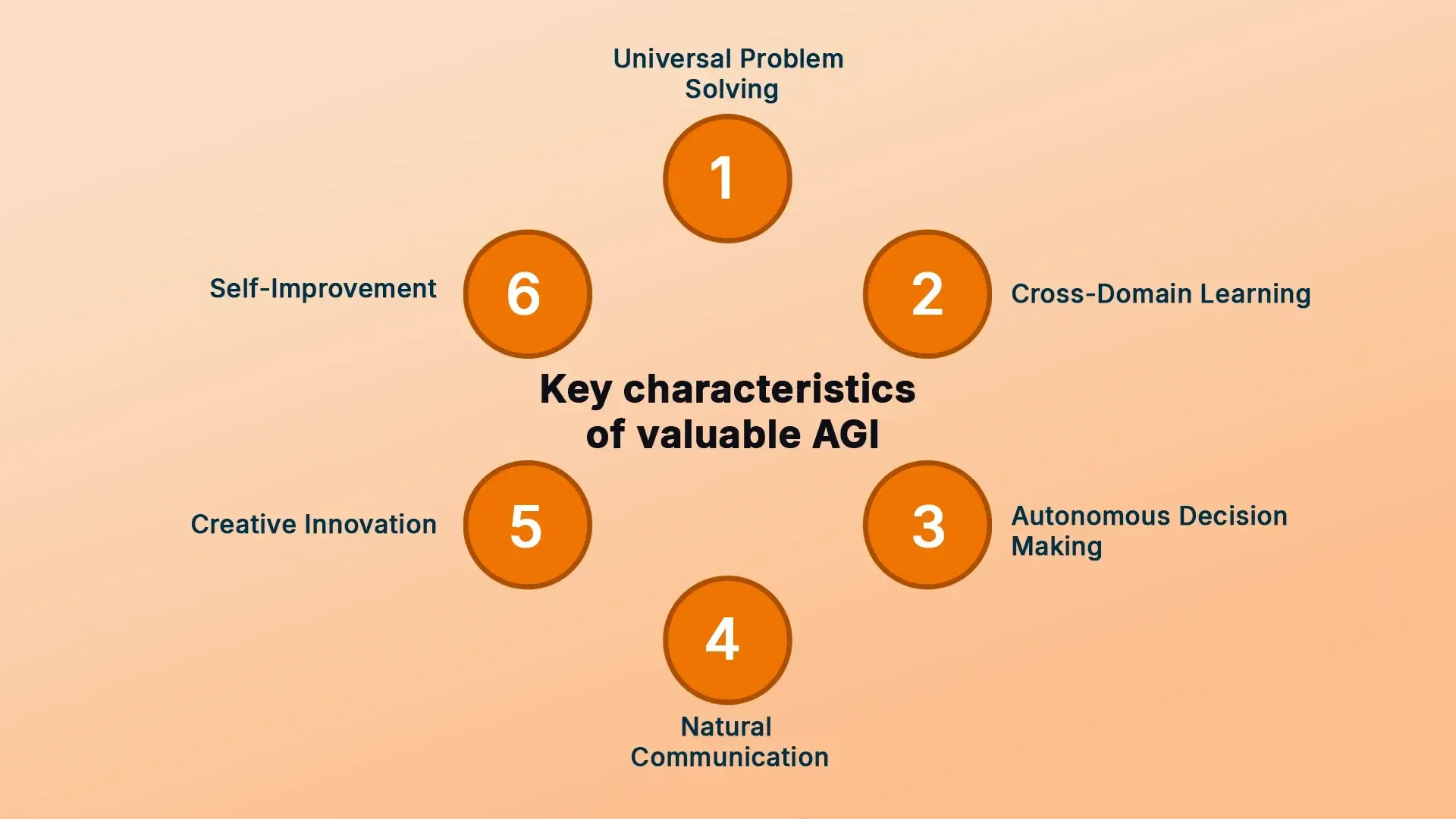
- Universal Problem Solving: Accomplishes any task at the human level without requiring any training specific to the task.
- Cross-Domain Learning: Takes knowledge from one discipline and applies it to entirely different areas.
- Autonomous Decision Making: Makes decisions that are independent and contextually aware.
- Natural Communication: Master all the aspects of human language, such as nuance, emotion, sarcasm, and cultural meaning.
- Creative Innovation: Produces new ideas, art, music, and even scientific theories.
- Self-Improvement: Regularly assesses and improves its own performance
What's the Difference Between AGI vs. AI?
The fact that AGI can reason, learn, and adjust in every area, while narrow AI only works on particular tasks, is what sets it apart from conventional AI. Understanding this knowledge makes it easier to see the reason why AGI is regarded as a large advancement in intellect.
AGI vs Traditional AI (Narrow AI) – Comparison Table:
| Aspect | Traditional AI (Narrow AI) | AGI (Artificial General Intelligence) |
|---|---|---|
| Scope of Abilities | Designed for one specific task only | Can perform any cognitive task a human can |
| Flexibility | Fails outside its trained domain | Adapts naturally to new, unfamiliar situations |
| Learning Method | Needs large, labeled datasets and task-specific training | Learns like humans through reasoning, observation, and knowledge transfer |
| Understanding | Processes data without true comprehension | Possesses real understanding and contextual awareness |
| Independence | Operates within fixed rules set by programmers | Acts autonomously, sets goals, and makes decisions independently |
| Analogy | A toolbox with many single-purpose tools | A skilled craftsperson who can use any tool effectively |
Also Read: What Is Enterprise AI
Examples of Artificial General Intelligence
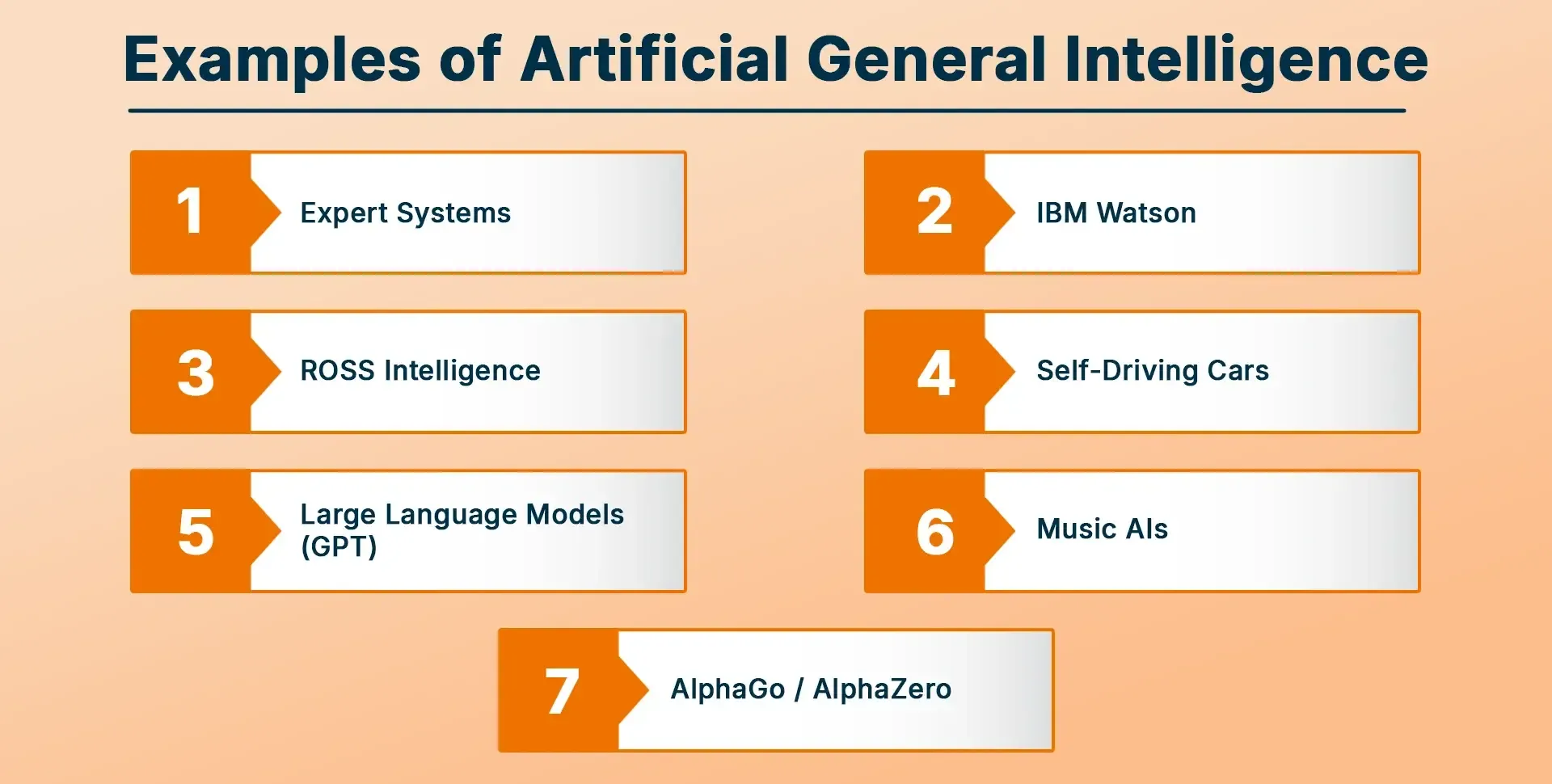
Technologies such as expert systems, IBM Watson, autonomous vehicles, AlphaGo, music AIs, and large language models exhibit high-level reasoning, originality, and versatility in performing tasks.
-
Expert Systems
The initial AI systems, like MYCIN and DENDRA, were able to deal with complicated issues just by following predefined rules. They basically demonstrated that machines could imitate expert thinking, but at the same time, their applicability was very restricted.
-
IBM Watson
IBM Watson has proven a strong language understanding and reasoning capability. However, it is still far from being a machine with general intelligence since it is not able to take its skills outside of the domain it was trained.
-
ROSS Intelligence
ROSS, a product that relies on Watson, has helped lawyers in answering legal questions and pulling case law. It was capable of demonstrating high-level reasoning in one area; however, it was devoid of general intelligence.
-
Self-Driving Cars
Cars that drive themselves rely on sensors, cameras, and decision-making to be able to handle traffic like a human driver would. However, they are really complicated machines, but their application stays limited to one area, which is driving.
-
Large Language Models (GPT)
The functions of the GPT models include writing, coding, translating, and answering questions on various subjects. Nevertheless, they do not possess the actual comprehension and continuous human-like learning.
-
Music AIs
MuseNet and Magenta are examples of applications that can improvise or generate new compositions from different styles. They can produce something imaginative, but are not capable of transferring their talent to another field.
-
AlphaGo / AlphaZero
These computer programs learned to play Go and other board games by competing against themselves. Their intelligence is very powerful, but it is restricted to the area of games.
Key Challenges in Building True AGI
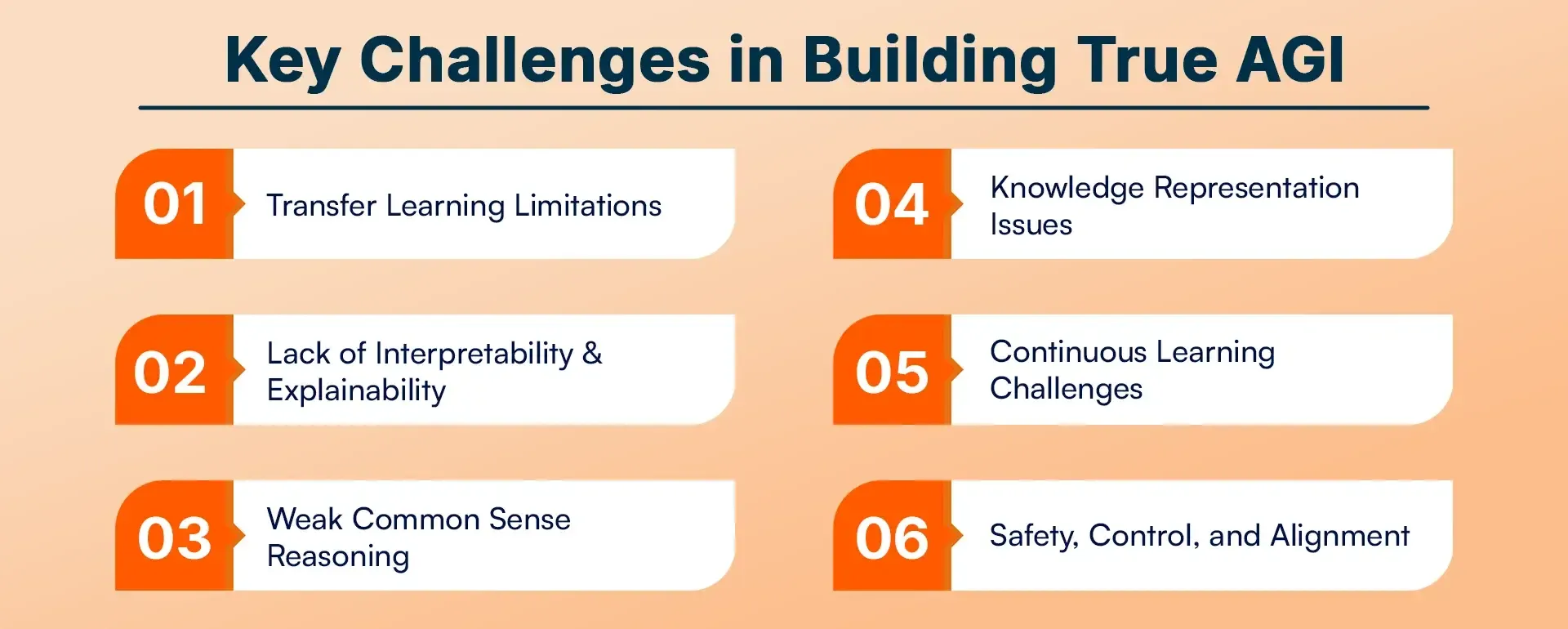
Creating true AGI presents enormous challenges that researchers are actively working to overcome. Here are the major obstacles:
1. Transfer Learning Limitations
AGI is a must for applying knowledge from one area to another, but current AI systems are very inefficient in doing so. Humans can easily generalize across situations; however, AI models are forced to relearn nearly all aspects of the new task. Approaches such as meta-learning and few-shot learning have made some progress, but the problem of human-like transfer is still not even close to being solved.
2. Lack of Interpretability & Explainability
The majority of high-level AI systems operate as "black boxes," wherein they take actions implicitly without giving any insight into their reasoning. An AGI, to be assuredly safe and trustworthy, needs to unambiguously justify its selections. One of the toughest obstacles in AI research is obtaining excellent results while the system remains interpretable.
3. Weak Common Sense Reasoning
AI still struggles with basic real-world understanding that humans, especially children, grasp naturally. Machines often fail with everyday logic, context, and ambiguity. Building AGI requires systems that can understand situations dynamically, not just follow preprogrammed rules.
4. Knowledge Representation Issues
The storage and usage of knowledge across different areas must be done flexibly for AGI. Present-day AI works with limited datasets and non-changing training only, which, in turn, restricts overall comprehension. To a certain extent, making representations that are similar to the human memory, logic, and reasoning is still an unsolved research problem.
5. Continuous Learning Challenges
In contrast to the AI systems, which suffer from terrible forgetting and lose old skills while learning new ones, human beings can learn nonstop and retain previous knowledge. Continuous learning with the capability of safe adaptation and knowledge retention is a requirement for AGI throughout its lifetime, something that current models struggle with.
6. Safety, Control, and Alignment
Building AGI is one thing, but making sure it acts in accordance with human values is a real tough nut to crack. Researchers are still discussing the best ways to synchronize AGI aspirations with human whims and, at the same time, keep AGI from doing anything nasty or unintended. This, in turn, makes AGI creation a dual challenge: technical and moral.
What is the Future of AGI?
The future of AGI is a double edged sword; on the one hand, its huge potential to change industries and to unlock even the most difficult global problems, on the other hand, the safety and ethical issues raise serious concerns.
-
Timeline Predictions
The experts are divided on when exactly AGI is going to be a reality; some predict that it is going to take 10-20 years, while others are more cautious and suggest a period of 50-100 years or even longer. Actual timelines are not yet known since several important breakthroughs have to be accomplished first.
-
Potential Benefits
AGI may lead to substantial scientific advances, more effective medical treatment, solving global problems, improvement of education, and an increase in economic productivity, and such benefits that would make an abundance era possible. Risks and Concerns:
Uncontrolled AGI, redundancy of the workforce, misuse of power, and even extinction threats are the serious challenges that scientists are trying to avert.
-
Path Forward
Multi-modal AI, reinforcement learning, and alignment research are consistently moving forward. It is going to be the combination of responsible development, safety measures, and global cooperation that will decide the level of AGI's impact on mankind.
Conclusion
Artificial General Intelligence (AGI) is the ultimate challenge of creating machines that mimic human understanding, adaptability, and reason. Despite the advanced AI systems of today, which show great improvement, true AGI will still be a thing of the far future and require major advances in common sense, transfer learning, and reliable decision-making.
The RejoiceHub is one of the platforms that gives one a better understanding of AI developments through valuable insights and resources. Moving research forward, AGI will present both fantastic potential and ethical dilemmas of the highest order. To be well-informed is to be able to guide the future in a way that intelligent systems are advantageous to all.
Frequently Asked Questions
1. What is artificial general intelligence in simple terms?
Artificial General Intelligence (AGI) is defined as an AI that acts as a human being; it can learn, think, and solve problems in the same manner that humans do, instead of being restricted to one specific task.
2. What is AGI in artificial intelligence?
AGI in the world of Artificial Intelligence (AI) means that any task performed by a human brain will become available to computers, allowing the computer to perform those tasks at any time without having to undergo any additional training for that task when presented with new circumstances.
3. What's the main difference between AI and AGI?
Typical (non-AGI) AI has been built to perform very specific tasks (e.g., playing chess, recognizing faces). In contrast, AGI would allow the computer to perform anything that a human mind could do (i.e., making the switch between multiple tasks very easily).
4. Can AGI think and reason like humans?
The overall goal of AGI is to provide a system that can logically think, contextualize what it is working on, and make decisions in the same way that humans do. Rather than simply following rules, AGI will actually understand why it is doing what it is doing.
5. Does artificial general intelligence exist today?
AGI, also known as Artificial General Intelligence, does not yet exist. While modern AI tools, such as Self-Driving Vehicles and Chatbots, have shown remarkable capabilities and achievements, they remain task-specific (not yet able to generalize to an entire universe of human cognition).
6. What are the biggest challenges in creating AGI?
There is widespread disagreement among those who study this subject. Some believe AGI will become a reality within 10 - 20 years, while others estimate it won't be possible to produce AGI for 50 years or longer.