For the last two years, most discussions about AI have revolved around the same question: which one is the smartest? GPT-4, Claude, and Gemini developers have made choices when creating their models, as if they were hiring an employee, basing them on their intelligence.
However, companies that have been using AI agents in production have discovered that the model itself is rarely the reason why an agent fails. The real reason is the harness, the layer around the language model that determines how it will be used, which plans the agent's actions, memories, tools, and more.
Harnesses are what distinguish between a model that can perform one task reliably and an agent that can perform it consistently and successfully every time.
In this article, we will discuss what an Agent Harness is, how it works, what differences it has compared to the AI model itself, and why agent harness engineering is such an important and promising career field.
What Is an Agent Harness?
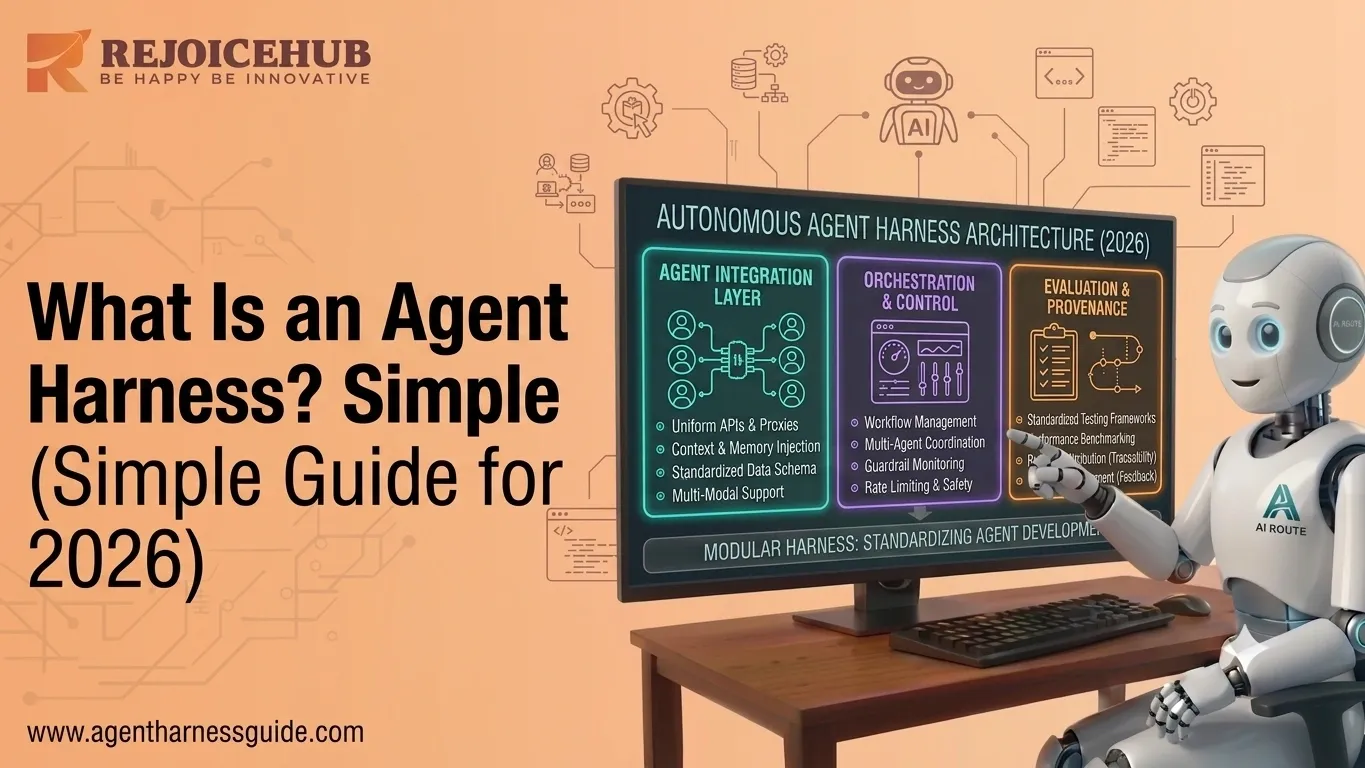
An Agent Harness is the software layer surrounding the AI model, providing it with structure and enabling it to perform tasks, retrieve context, execute tools, verify results, and ultimately provide a reliable and dependable response beyond just text generation.
The LLM is like the engine, while the harness is the car around it - the steering wheel, brakes, fuel pump, and dashboard that make the engine drivable.
Purpose of an Agent Harness:
- Break a user request into a plan the model can execute
- Connect the model to tools, APIs, and data sources
- Manage short-term and long-term memory
- Check outputs before they're delivered
- Recover gracefully when something goes wrong
Why the term is getting attention: As companies transition from chatbots to agentic AI workflows, they have found that replacing their previous model with "a better model" often fails to address flaws in the workflow design, and that the harness often matters more than the model in achieving reliable large-scale performance.
Model vs. execution layer, in one line: The model generates intelligence. The harness turns that intelligence into action.
How an Agent Harness Works
An Agent Harness typically runs through six repeatable steps every time an agent handles a task.
Step 1 – Understand the User Request
The harness parses the input, identifies intent, and determines what "success" looks like for this specific task.
Step 2 – Plan the Task
The request is broken into smaller, sequential steps or sub-goals that the model can tackle one at a time, rather than attempting everything in a single leap. This planning layer is closely tied to context engineering, which determines what information the model sees at each step.
Step 3 – Retrieve Context and Memory
The harness pulls relevant data from past conversations, documents, customer records, or business rules so the agent isn't working blind.
Step 4 – Execute Tools
The agent calls APIs, databases, or third-party tools (CRM, email, code execution, search) needed to complete each step of the plan. Many harnesses now rely on standardized protocols like the Model Context Protocol (MCP) to connect models to these tools consistently.
Step 5 – Validate the Output
Before anything reaches the user, the harness checks it against rules, guardrails, or a secondary review pass to catch errors or hallucinations.
Step 6 – Deliver the Response
The final, validated output is formatted and returned as a message, an action, or a completed workflow.
Simplified flow:
User Request → Plan → Retrieve Context → Execute Tools → Validate → Deliver
This loop is what allows an agent to handle multi-step, real-world tasks like updating a CRM record, drafting a follow-up email, and logging the interaction without a human manually stitching each step together.
Agent Harness vs AI Model: What's the Difference?
Businesses often assume upgrading the model will fix agent performance. In practice, the harness controls far more of the outcome.
Accelerate Your Workflows with Custom AI
Book a free consultation session with RejoiceHub. We'll map out a tailored automation roadmap for your company.
| Factor | AI Model | Agent Harness |
|---|---|---|
| Purpose | Generates language and reasoning | Orchestrates planning and execution |
| Responsibilities | Predicts the next best output | Manages workflow, tools, and logic |
| Memory | None by default (stateless) | Manages short-term and long-term memory |
| Tool Use | Cannot act on its own | Connects model to APIs, tools, systems |
| Decision-Making | Suggests options | Enforces rules, routing, and validation |
| Scalability | Same model regardless of workflow | Adapts to new tools and use cases |
| Reliability | Inconsistent without structure | Adds guardrails and error recovery |
| Enterprise Readiness | Not deployment-ready alone | Built for compliance, security, monitoring |
Why a better harness often beats a bigger model: top model + bad harness = contextually incorrect responses, wrong tool calls, silent failures; while a mid-tier model + well-architected harness = consistent performance wins. This is one reason many teams are exploring custom vs off-the-shelf AI software before committing to a stack.
If you need to build a custom AI agent, we can design a harness architecture that makes your model production-ready.
Why Agent Harness Engineering Matters in Enterprise AI
For enterprises, an unreliable agent isn't a minor bug it's a business risk. That's why agent harness engineering has become its own discipline.
- Reliability: A strong harness ensures agents behave consistently across thousands of interactions, not just in demos.
- Cost Optimization: Smart orchestration reduces unnecessary model calls, cutting API and compute costs.
- Security: The harness enforces access controls so agents only touch approved data and systems.
- Compliance: Regulated industries (finance, healthcare, legal) need audit trails and rule enforcement built into execution, not left to the model's judgment.
- Monitoring: Harnesses log every step, making it possible to trace exactly why an agent did what it did.
- Human-in-the-Loop: Critical actions can be routed for human approval before execution.
- Observability: Teams get visibility into failures, latency, and performance essential for debugging at scale.
- Multi-Agent Coordination: Complex workflows often need multiple specialized agents working together, which only a harness can manage.
Real-world examples:
- Customer support: An AI customer support agent harness routes tickets, pulls order history, drafts a response, and escalates only edge cases to a human cutting response time significantly.
- Software engineering: A coding agent harness plans a fix, writes code, runs tests, and validates output before opening a pull request.
- Internal copilots: An HR or finance copilot retrieves the right internal documents, applies company policy, and generates compliant answers instead of generic ones.
Best Practices for Building an Agent Harness
- Keep prompts modular break large prompts into reusable, task-specific components instead of one giant instruction block.
- Design reusable tools build tool integrations (CRM, email, search, code execution) once and reuse them across agents.
- Add guardrails set clear rules for what the agent can and cannot do autonomously.
- Track metrics measure task success rate, latency, and error frequency, not just output quality.
- Test workflows run agents through edge cases and failure scenarios before production deployment.
- Use memory responsibly store only what's needed, and be deliberate about what persists across sessions.
- Monitor failures build logging and alerting so failed steps are caught and reviewed quickly.
Teams starting from scratch often benefit from a structured approach to building an AI agent stack for business, which lays out how these practices fit together before any code is written.
Conclusion
Selecting the right model is only half the battle; businesses that invest significantly in AI agents (the really successful ones) are already incorporating an Agent Harness - the planning, memory, tool orchestration, and validation layer that makes an agent reliable, safe, and scalable.
As enterprise AI evolves, agent-harness engineering will differentiate between companies that employ trustworthy AI systems and those that are limited to powerful but unreliable demos. Understanding where your organization sits on the broader AI adoption roadmap can help clarify whether investing in a custom harness is the right next step.
Planning to build enterprise AI agents? RejoiceHub helps businesses design and deploy secure, scalable AI systems with custom agent architectures, orchestration, and integrations. Talk to our team to see what a purpose-built agent harness could do for your business.
Frequently Asked Questions
1. What is an Agent Harness?
An agent harness is the software layer around an AI model that helps it plan tasks, use tools, remember context, and check its own answers. Think of it as the car around the engine — it turns raw intelligence into real, usable action.
2. How does an Agent Harness work?
It follows six simple steps: understand the request, plan the task, pull in context or memory, run the needed tools, check the output for mistakes, and then deliver the final answer. This loop lets an agent handle real, multi-step jobs on its own.
3. Why is an Agent Harness more important than the AI model?
A smart model without a good harness still makes mistakes, picks the wrong tools, or fails quietly. A well-built harness adds structure, memory, and checks, so even a mid-level model performs consistently. That's why agent-based engineering is getting so much attention lately.
4. What is the difference between an AI model and an Agent Harness?
The AI model generates language and ideas, but it has no memory and can't act alone. The agent harness manages memory, connects tools, enforces rules, and keeps things reliable. In short, the model thinks, and the harness gets things done.
5. Why does agent harness engineering matter for businesses?
Businesses need agents that work the same way every single time, not just in a demo. Agent harness engineering adds security, compliance, monitoring, and human approval steps where needed. This keeps costs down and builds trust, especially in fields like finance or healthcare.
6. Can a good Agent Harness fix a weaker AI model?
Yes, in many cases. A well-designed harness adds planning, guardrails, and validation that cover gaps in a mid-tier model. This often leads to more consistent results than simply switching to a bigger, more expensive model without fixing the workflow around it.
7. What are some real-world examples of an Agent Harness in use?
Common examples include customer support agents that pull order history and draft replies, coding agents that write and test code before opening a pull request, and internal copilots that answer HR or finance questions using company policy documents.