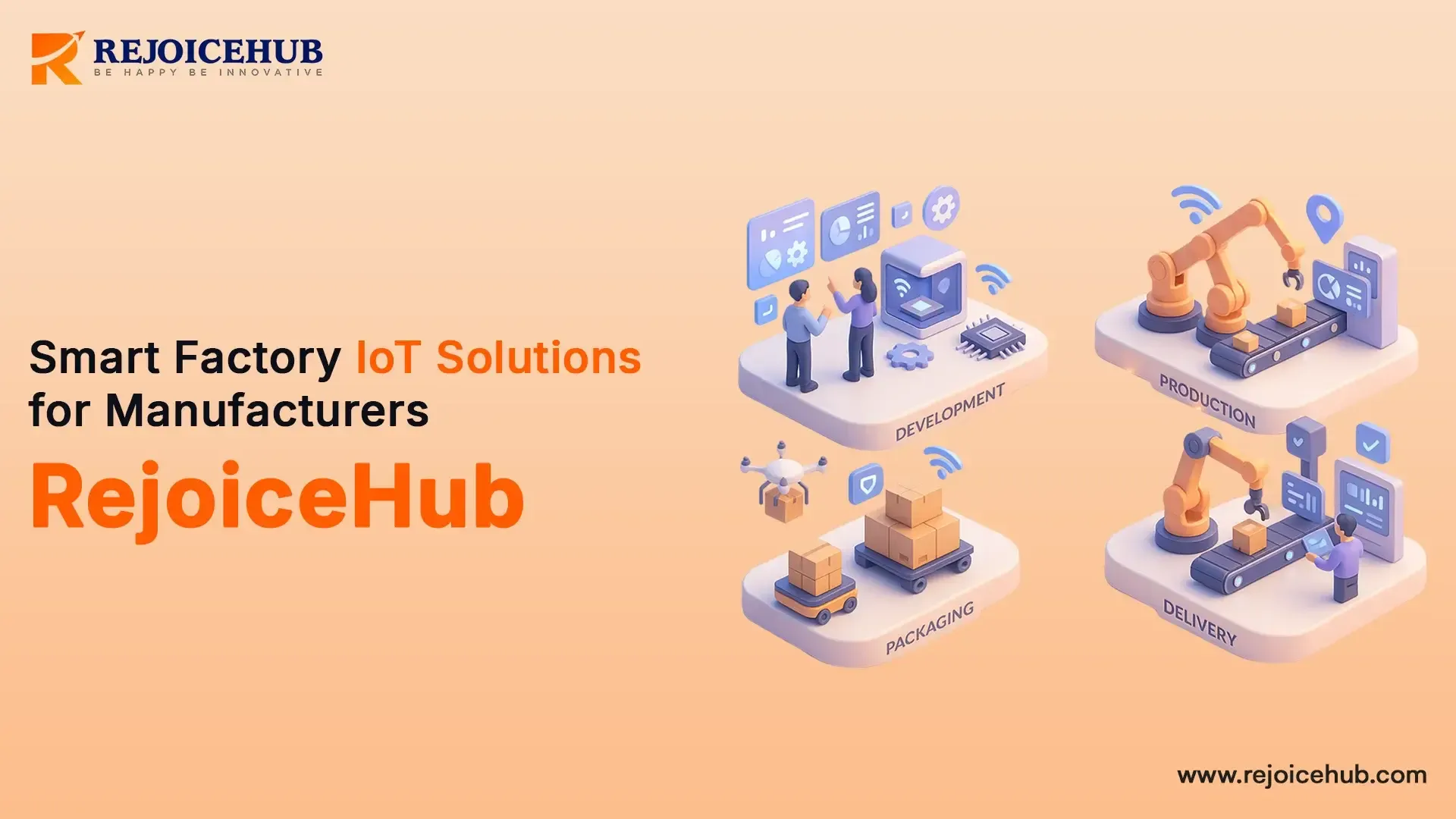
Imagine what it would be like if the factory you worked at didn't just run smoothly, but also listened to you and responded appropriately based on your input. The factory would use the Internet of Things (IoT). The Internet of Things allows the factory to listen and learn from the people who work in the factory.
We started Rejoicehub to support manufacturers in adapting to the smart factory transformation. Implementing a smart factory solution is not only about having new toys; these investments create a significant increase in efficiencies. Manufacturers will experience reduced waste, downtime, lead time, and improved overall product quality while simultaneously creating a more productive and less-stressful environment for their employees.
Quick Summary
Through the implementation of IoT Technologies, IoT has allowed for the maturity of factories into Smart Factories and has provided real-time monitoring, predictive maintenance, improved quality control measures, optimised inventory, and reduced energy consumption.
While some challenges remain regarding the integration of IoT into existing processes and the associated costs of implementing an IoT strategy, Rejoicehub provides manufacturers with a way to seamlessly implement IoT. This includes thorough assessments, gradual roll-outs, dashboarding, training, and ongoing technical support, which therefore increases the overall productivity, quality, and profitability of the Manufacturer’s operations.
Why IoT Is a Game-Changer on the Factory Floor
The Industrial Internet of Things (IIoT) is bringing revolutionized efficiency to production facilities by changing how factories operate today.
Contrary to the traditional manufacturing model that relies on scheduled hours, manual inspections, and reactive maintenance, where manufacturing and production take place, the IIoT enables factories to operate in real-time by utilizing a software platform that provides continuous monitoring of all aspects of the manufacturing process.
All of this means that instead of waiting until a machine has completely failed, workers are alerted to impending problems through alerts sent from sensors on machines. As a result of this capability, factories can adjust production accordingly in real-time based on immediate feedback and are less likely to waste materials.
Due to the cost of downtime, rework, and lost productivity due to manufacturing errors and defects, the implications of increased speed and reduced costs are significant. In fact, every minute of downtime adds up over time, making the benefit of utilizing the IIoT to reduce errors and cut costs significant.
What Smart Factories Do
-
Predictive Maintenance Machines Will Inform Us of Their Need for Assistance
Smart factories utilize sophisticated sensors to record vibration, temperature, and pressure as technologies measure these natural indicators that all machines generate. When the sensor detects an anomaly, it alerts maintenance personnel to correct the issue before a failure occurs.
This results in fewer emergency repairs, unplanned downtime, and extends the life of the machine. In many cases, this alone can make maintenance a more manageable and predictable process for the manufacturer.
-
Real-time Monitoring and Process Improvement Understand What's Going On Now
The Internet of Things (IoT) provides an uninterrupted flow of data from machines to management, such as how the machine runs, production times, power consumption, and external environmental factors such as heat and humidity. Management receives this data continuously via dashboards, where they can see exactly what is occurring.
With access to this real-time data, bottlenecks, machine idleness, energy spikes, or inefficiencies can be identified shortly after they occur, rather than waiting for end-of-month reports. This allows for quicker responses, increased production efficiency, and optimally utilizing resources.
-
Quality Control & Lower Defects
Using IoT to track production quality during the manufacturing process and not waiting until the end-of-line testing allows for real-time monitoring of conditions affecting product quality throughout the manufacturing process. Sensors or cameras can detect abnormalities in temperature, humidity, or vibration that could impact the quality of the finished product. If any condition falls out of specification, it is possible to stop the production line or notify the supervisor so that corrective action can be taken immediately.
By eliminating defects, reducing scrap, and lowering rework costs, manufacturers will feel more confident in the quality of their products as they leave the factory.
-
Smarter Inventory & Supply-Chain Handling
With IoT, you also have real-time information about your raw materials, work-in-progress items, and completed product inventory. RFID tags, smart shelves, or sensor technology provide information on the status of incoming versus outgoing product inventories, along with an understanding of where your products are stuck (aka: stuck in shipping) and when you are getting ready to run out of a batch.
This data allows manufacturers to optimize their material supply chain with greater accuracy, reducing the likelihood of excess inventory and excess stockout situations, so that the right amount of product is available to meet production demand. Better planning yields more reliable cash flow and less wasted material, resulting in smoother operations.
-
Energy Efficiency & Sustainability
While factories are like utilities, the Internet of Things can provide information on usage data for all of their equipment. By doing this, manufacturers can identify ways in which they waste energy, and apply that insight to power off machines when they are not in use and schedule off-peak hours when machines are being used less than maximum capacity.
Additionally, manufacturers can better use HVAC systems or optimize airflow/air conditioning use based on the time of the year or how many machines are in work areas. By taking these corrective actions, manufacturers can save money on their energy costs while providing a cleaner and safer environment.
What a Smart Factory Could Look Like: A Simple Story
Suppose you operate a medium-scale manufacturing facility. When you install IoT sensors and connect all of your equipment, including machines, inventory storage shelves, and electric meters, you can expect some significant improvements.
The first change occurs in the early morning when a vibration sensor detects a minor issue with Machine A. Maintenance receives an instant notification of the problem through an alert system. A member of the maintenance department will check on the vibration sensor alert and determine that the bearing in Machine A requires replacement before a breakdown occurs. As a result, production continues uninterrupted.
Second, while running production, an assembly line on the maintenance dashboard shows an idle assembly line according to the production status. As a result, the manager will utilise the new information provided by IoT sensors to identify that there are prolonged idle periods on one of the machines and is able to make direct adjustments to the operator's job task and/or the flow of production. Consequently, the manager is able to increase production output by increasing line and operator speed without having to incur additional labour costs or the use of additional equipment.
The traditional methods of quality control resulted in a failed quality check for a batch of products. However, the introduction of sensors to monitor the humidity and temperature of the environment early indicated the environmental changes, which triggered the system to notify the team. As such, the team was able to adjust the environmental controls, and the next batch of products passed all quality checks and experienced no waste or recalls.
In addition, Inventory racks are now equipped with smart tags to monitor the inventory levels of raw materials. If a raw material was running below a designated threshold, the system would automatically trigger a reorder before the production line ran out, ensuring that the production line did not have any downtime or require emergency materials.
At the end of a month, the energy-use dashboard shows that several machines remain idle for extended periods during overnight hours. The team decided to implement an auto-shutdown feature for machines at 10 pm, thereby reducing the amount of energy being consumed and providing the company with lower energy bills and a lower carbon footprint.
All of these examples illustrate a current state of the manufacturing industry where IoT is allowing for an advancement in technology.
Also Read: 9 Benefits of the Industrial Internet of Things (IIoT)
Why This Matters
In the modern global economy, competition is very intense. The profit margins for companies are very small, and company's clients want products and services delivered in an efficient manner (on time, every time); with the same level of quality every time; and to be able to count on an consistent quality standard from one to the next; In addition, if a company has inefficiencies caused by a lack of downtime, delivery delays, etc., then it not only causes a loss of profits for the company, but they also lose business through reprints, dissatisfaction, and damaged reputations.
Companies that utilize IoT Solutions will be able to accomplish many things, such as:
-
Providing their factories with a more reliable and predictable operation.
-
Increasing the likelihood of manufacturers producing quality products every time, rather than just once in a while.
-
Maximizing utilization of the factory’s resources: people, raw materials, and energy.
-
Reducing costs and ultimately making more money (all the time).
-
Speeding up the time to get products to the market and making the customer happy.
-
Supporting the movement for
For a partner like Rejoicehub, helping factories make this shift means giving them a competitive edge not just today, but long into the future.
Some Real-World Challenges
Creating a Smart Factory isn’t something that happens quickly; here are some common challenges that manufacturers face and how to think through them:
-
Capital costs: Smart Factory infrastructure (sensors, connectivity, etc.) requires a substantial upfront investment, and retrofitting some types of machinery may present an even larger challenge.
-
Systems integration difficulty: Older machines, multiple brands of machinery & differing communication protocols all present obstacles to making everything work together effectively.
-
Data management: While collecting large amounts of data seems like an accomplished task, it is how that data is collected & presented to you in a meaningful format (dashboards, analytics, recommendations, etc.) that takes the expertise.
-
Implementing change methods: Workers have become accustomed to performing the same job using the same methods over time. Incorporating Data to make decisions will require training, buy-in & patience.
-
Ongoing maintenance costs: Internet of Things (IoT) devices, networks, and software all require continuous support and must be treated as an integral component of your overall Smart Factory operations; they cannot be designed once and operated indefinitely.
-
Increased security and Reliability: Increased connectivity of devices equates to increased security risk as the number of vectors for attack also increases. The ability to rely on the data collected, as well as your ability to recover from network downtime, is crucial.
A Smart Factory is not just about instant gratification; rather, it’s about a long-term transformation, and if you invest the time and resources up front in addition to establishing a long-term relationship with the right partners, you will be well-positioned to reap the long-term benefits!!
How Rejoicehub Helps Because Transformation Works Better With a Guide
Rejoicehub isn't simply a technology provider; we're a partner that transforms factories into the place where transformation happens. Here is what we offer as your partner:
-
Evaluating Factory Readiness means studying your existing systems: all the processes that run within your factory, including your machines, logistics, inventory, maintenance, and your data management systems.
-
Creating a Custom Roadmap & Proof Of Concept; we will not implement everything at once; Instead, we create a phased rollout of your IoT deployment, small initial pilot projects, prove the model, then we roll out larger projects.
-
Implementation of sensors and IoT Devices: We work with you on selecting the right types of sensors for your process (e.g., vibration, temperature, energy usage, RFID), installing them properly, and connecting them to the appropriate network (Edge or Cloud). As part of our service, we will assist you in integrating your sensors with your enterprise resource planning (ERP) or manufacturing execution systems (MES).
-
Real-Time Data Visualization Tools: To enhance business operations, provide greater visibility into production, maintenance, energy use, and inventory through dashboards that allow you to monitor your operations in real-time and take action on findings.
-
Training and Change Management: We partner with your team (operators, maintenance personnel, and management) to provide training on how to use your new dashboards, implement new workflows, and develop a culture of data-driven decision-making.
-
Continuation of Support and Scalability: Our role as a partner continues after implementation. We will continue to support your system, assist you with expanding your dashboard capabilities, and increase the capacity of your systems as you grow your business.
Conclusion
Transitioning from a standard factory to a smart, connected factory with IoT technology doesn’t happen overnight, but it's a process worth doing.
Implementing IoT technology can provide a greater operational benefit than simply streamlining existing operational practices; it can enable a shift in mindset regarding how the factory views manufacturing-related activities, moving away from keeping machines operational to maximizing the use of time, resources, and materials that support production.
Many manufacturers are striving to create manufacturing facilities that are resilient, efficient, provide high-quality products, and are prepared to meet future product requirements. Creating these types of facilities would not only improve profitability for manufacturers but would also increase competitiveness within their respective or related industries. Here at RejoiceHub, we would be happy to assist you along this journey through the intelligent application of IoT technology.
Frequently Asked Questions
1. What is a Smart Factory in simple words?
A Smart Factory is a factory that uses the Internet of Things (IoT) to connect machines and devices. IoT gives manufacturers the ability to collect and analyze real-time information from their equipment, inventory levels, and energy usage. This allows them to identify problems before they occur, reduce downtime, eliminate waste, and maintain a consistent level of production.
2. How does IoT help in manufacturing?
Two ways the Internet of Things (IoT) helps manufacturers are by providing real-time data and improving efficiency. By providing manufacturers with visibility into their operations, IoT provides manufacturers with real-time data about their operations. With access to this information, manufacturers can identify problems quickly, reduce the amount of time spent on unproductive activities, increase production levels, and continue producing consistently.
3. What is the difference between IoT and IIoT?
While IIoT supports Industrial Machinery; IoT provides functionality to Day-To-Day Equipment like smart homes, etc. Whereas an IIDO will focus on the safety/reliability, Real Time Monitoring of production processes and providing an improvement in operational efficiency of factories and their production processes.
4. How does predictive maintenance work in a smart factory?
Predictive Maintenance is based upon Sensor Monitoring (Vibrational, Thermal, Pressure). Predictive Maintenance utilizes alerting users of the potential failure before it occurs through the analysis of sensor data and comparing it against the expected operating thresholds.
5. What are the biggest challenges in building a smart factory?
There are many ways in which manufacturers face significant challenges, with high set-up fees, outdated equipment, and issues like data management, employees learning how to use that equipment, and connecting systems securely and dependably being just a few examples.
6. How can IoT improve product quality?
One advantage of using IOT is that it tracks the various environmental factors (temperature, humidity, vibration, etc.) that exist during production. So if there is any type of malfunction, it alerts the manufacturer immediately so they can make the necessary adjustments.
7. How does RejoiceHub help manufacturers adopt Smart Factory solutions?
RejoiceHub assesses whether your factory is ready for operation, configures sensor devices, creates reporting dashboards, educates your personnel in using the smart factory technology, and continuously assists you to ensure optimal performance and longevity of operations.