Running AI at scale is kinda expensive. Brutally expensive.
In 2025 alone, OpenAI spent $34 billion in total operating costs, with nearly $20 billion in operating losses. A huge chunk of that bill went to one thing: compute. Specifically, renting Nvidia GPUs to power every ChatGPT query, every Codex task, and every API call made by developers building on top of OpenAI's models.
That's the backdrop behind OpenAI's biggest infrastructure move to date: Jalapeño, its first custom-built AI chip. To understand why this matters, it helps to first understand what AI agents are and how they depend on inference infrastructure to function at scale.
So, what even is it? How does it work, really? And could it change the economics of AI inference not just for OpenAI, but for every company shipping AI today? Let's unpack it.
What Is OpenAI's Jalapeño Chip?
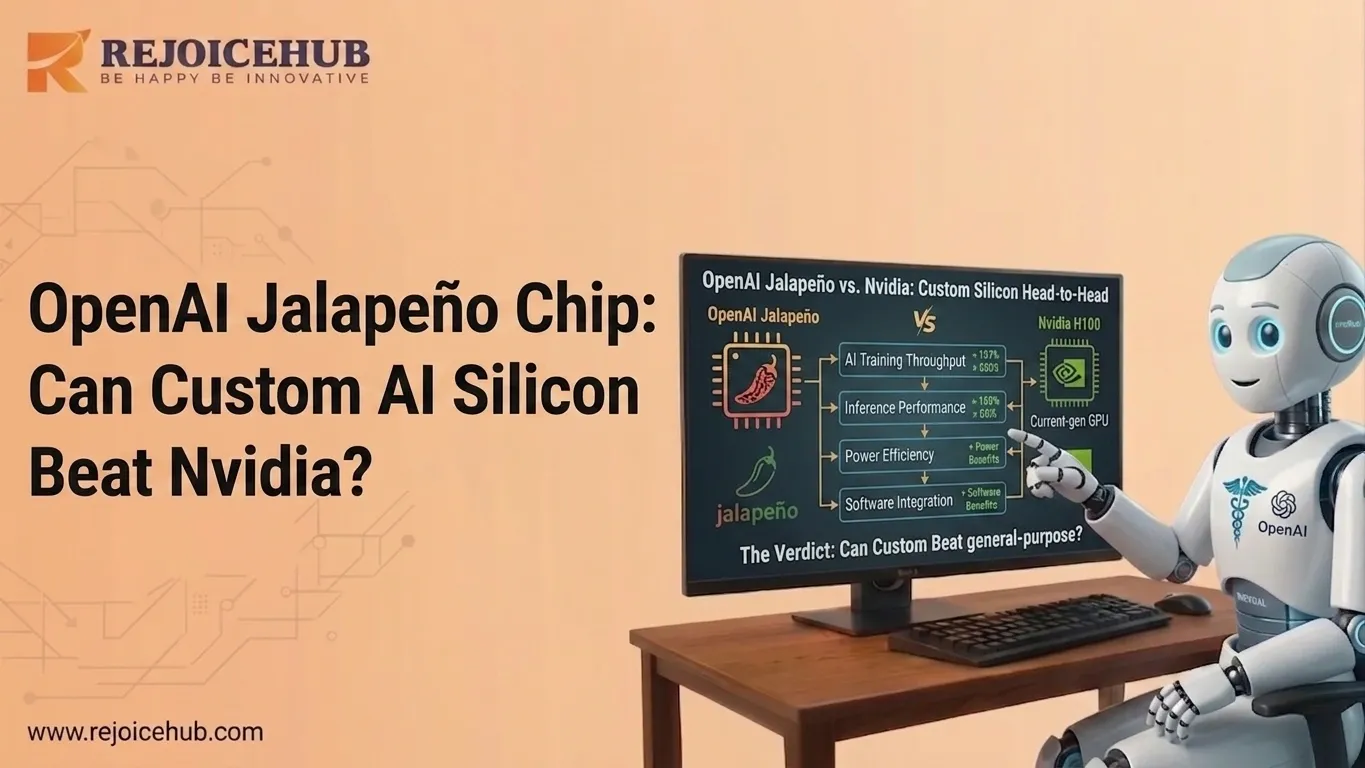
OpenAI's Jalapeño chip is a custom-built AI inference processor basically an application-specific integrated circuit (ASIC) that was made from the ground up to run large language models (LLMs) efficiently at scale. It was developed with Broadcom, and they unveiled it on June 24, 2026. The whole point is inference workloads only, and they say it brings up to 50% lower cost per token vs current-generation Nvidia GPUs.
The general-purpose GPU is the "do everything" machine, handling graphics rendering, scientific simulation, and lots more. But Jalapeño does one main job: serving AI models to end users as quickly and as cheaply as possible.
OpenAI calls it their "first Intelligence Processor," and it looks like a clear move into the AI hardware race with Google, Amazon, Microsoft, and Meta.
Why OpenAI Is Building Its Own AI Chip
-
Reducing Dependence on Nvidia
For years, OpenAI has leaned almost completely on Nvidia's GPUs to train and serve its models. Nvidia's H100 and B200 chips are pretty exceptional but total dependence on one supplier is a structural vulnerability. If anything breaks or slows down, everything feels it.
Back in 2023 and 2024, GPU shortages made AI companies wait months on hardware allocations. Meanwhile, pricing power sits almost entirely with Nvidia. Also, Nvidia chips are made to support everyone, not tuned narrowly for OpenAI's models so there's an efficiency mismatch baked in.
Jalapeño changes that whole setup. OpenAI framed it like this: "By designing more of the stack ourselves, we can serve more intelligence with greater efficiency." And it's not like OpenAI hasn't started diversifying already reportedly, it's using Cerebras chips for some inference workloads, and Jalapeño is the bigger next step.
-
Lowering AI Infrastructure Costs
The financial math is stark. In 2025, OpenAI paid Microsoft over $10.59 billion just for R&D and compute infrastructure. Research and development costs, driven mostly by model training and serving, accounted for roughly 56% of total spending. That's not sustainable for a company eyeing a public offering in 2026.
Jalapeño is focused specifically on inference, since that's where the volume is. Every user query, every time someone asks ChatGPT a question or kicks off a Codex task through an agentic AI workflow, becomes an inference moment. If OpenAI could cut inference costs by 50% at the scale it runs, that would mean billions of dollars saved each year.
-
Improving AI Scalability
Custom silicon allows a tighter fit between hardware and software. General-purpose GPUs typically land around 60–70% utilization on inference workloads, meaning as much as 40% of chip capability is wasted on tasks that inference never actually needs.
Jalapeño was built specifically to close that gap reaching utilization much closer to theoretical peak performance by dropping unneeded compute and avoiding extra data movement. The result: the same physical infrastructure serves more people, faster, at lower cost.
How OpenAI's Jalapeño Chip Works
1. AI Inference Optimization
Jalapeño is an ASIC Application-Specific Integrated Circuit. Unlike a GPU, which is a general-purpose parallel processor, this one is hardwired for one specific job: running transformer-based LLMs in production.
The architecture is centered on the exact patterns of how LLMs behave during inference the kernels they use, how they shuttle data between memory and compute, and how they line up communications across networking layers. Nothing in it that inference doesn't need, and everything in it tuned for that purpose.
2. Specialized AI Accelerators
One of the most striking things about Jalapeño is its development speed. The chip went from initial schematics to fabrication readiness in just nine months, while typical high-performance semiconductor development cycles take two to three years.
OpenAI did this by leaning on its own AI models to accelerate parts of the chip design process a pretty solid proof of concept for AI helping craft sharper AI hardware.
Engineering samples are already running production workloads for OpenAI's GPT-5.3-Codex-Spark model in test environments. Full data center deployment is slated to kick off by end of 2026.
3. Efficiency Compared With General-Purpose GPUs
The headline performance claim comes from Broadcom CEO Hock Tan, who said Jalapeño delivers roughly 50% lower inference cost per token than current-generation GPUs. OpenAI's own language is a bit more careful, describing "performance per watt substantially better than current state of the art," with a detailed technical report coming in the next few months.
AI Training vs. AI Inference: Why It Matters
This distinction is critical for understanding why Jalapeño is a big deal.
| AI Training | AI Inference | |
|---|---|---|
| What it does | Builds the model | Runs the model |
| When it happens | Once (or occasionally) | Billions of times per day |
| Cost profile | Very expensive, one-time | Frequent, cumulative |
| Hardware focus | Raw compute power | Speed + efficiency |
| Example | Training GPT-5 | Answering a user's question |
Training a frontier model can cost hundreds of millions of dollars, and it doesn't happen very often. Inference is the day-to-day operational reality every user query, every API call, every automated job.
As AI gets worked into more products and workflows, inference volume scales almost exponentially. It's where AI economics gets won or lost, and it's turning into the main battleground for every major AI company.
That's why OpenAI built Jalapeño. Not to replace Nvidia for training (it won't), but to grab ownership of the cost structure for serving AI to users.
Accelerate Your Workflows with Custom AI
Book a free consultation session with RejoiceHub. We'll map out a tailored automation roadmap for your company.
OpenAI Jalapeño Chip vs. Nvidia GPUs
| Feature | Nvidia GPUs (H100/B200) | OpenAI Jalapeño |
|---|---|---|
| Primary Use | Training + Inference | Inference-optimized |
| Architecture | General-purpose | Purpose-built ASIC |
| Inference Cost | Baseline | ~50% lower (claimed) |
| Power Efficiency | Strong | Potentially higher |
| Software Ecosystem | Massive (CUDA, 4M+ devs) | OpenAI internal stack |
| Availability | Widely available | OpenAI internal (2026+) |
| Training Capability | Excellent | Limited |
-
Performance Goals
Jalapeño isn't trying to beat Nvidia at everything it wants to beat Nvidia at one specific thing: running OpenAI models for end users at the lowest possible cost per token. Nvidia's H100 and B200 still feel like the gold standard for training frontier models, and that's unlikely to change soon. But Jalapeño doesn't have to win the training race. It just has to win the workload that gets run billions of times a day.
-
Cost Efficiency
If that 50% cost reduction claim holds up in production, it could be transformative. At OpenAI's scale, we're talking about potentially billions in yearly savings that could be redirected toward model development, product investment, or simply reducing the company's continuing operating losses.
-
Scalability
Because Jalapeño is tuned to OpenAI's particular model architectures, it can be deployed in setups optimized for those workloads tighter integration between software, serving systems, networking, and silicon. That kind of broad optimization is something off-the-shelf GPUs simply can't match.
What This Means for Businesses Using AI
If you're a startup, SaaS company, or enterprise building AI-powered products, the Jalapeño announcement has real implications even if you never touch the chip directly.
-
Lower AI API costs. If OpenAI's inference costs drop significantly, competitive pressure will push those savings into API pricing over time. Lower inference costs mean lower bills for every developer and business using OpenAI's APIs.
-
Faster response times. Purpose-built inference hardware reduces latency. Faster AI responses mean better user experiences in products built on ChatGPT, Codex, or OpenAI's API.
-
More capable AI agents. Richard Ho, who leads OpenAI's hardware program, noted that Jalapeño is designed with agentic workloads in mind the kind of multi-step, autonomous AI tasks that Codex and similar products rely on. As that hardware matures, agentic AI becomes more viable at scale.
-
A more stable supply chain. OpenAI reducing its dependence on a single hardware supplier means fewer service disruptions from GPU shortages or allocation bottlenecks.
For businesses building AI applications today whether that's automating workflows, deploying AI agents, or building AI-native products a more cost-efficient AI infrastructure layer makes the economics of those products significantly more attractive.
If you're looking to build scalable AI agents or automate business workflows, RejoiceHub's AI development team can help you architect and deploy AI solutions built for the next generation of AI infrastructure. Explore our AI development services →
The Future of Custom AI Silicon
OpenAI is not alone. Jalapeño is the latest entry in an increasingly competitive field of custom AI hardware.
-
Google TPUs Google has been building Tensor Processing Units since 2016. Their latest generation powers Gemini models, giving Google a multi-year head start on custom inference silicon.
-
Amazon Trainium & Inferentia AWS offers both training-optimized (Trainium) and inference-optimized (Inferentia) chips as part of its cloud services, enabling third-party developers to use custom silicon via the cloud.
-
Microsoft Maia Microsoft launched its Azure Maia 100 accelerator in late 2023, followed by the Maia 200 (built on TSMC's 3nm process) in January 2026. The Maia 200 already powers GPT-5.2 models within Azure data centers a sign of how tightly Microsoft and OpenAI's infrastructure is becoming integrated.
-
Meta MTIA Meta has developed its Meta Training and Inference Accelerator (MTIA) series through multiple generations (300, 400, 450, and 500) to power its recommendation and AI workloads.
The pattern is clear: every major AI lab and cloud provider is investing in custom AI agent infrastructure. The era of every AI workload running on off-the-shelf Nvidia GPUs is ending not because Nvidia is being displaced, but because the largest AI operators no longer want to accept one default architecture for every job.
Jalapeño confirms that OpenAI is now in this game at the infrastructure level. The company that built the most widely used AI models in the world is now building the hardware those models run on.
Conclusion
OpenAI's Jalapeño chip is more than just a hardware announcement it feels like a strategic signal about where AI is going next. Inference is now the new frontier, because training a model costs a lot once, but serving it costs a lot every single day, especially at massive scale. The business that cracks inference economics ends up owning the AI game.
Custom silicon changes the whole picture. A chip purpose-built for LLM inference cutting out the waste you get with general-purpose GPUs could bring around 50% cost reductions at scale. That's not a marginal tweak; it's a structural shift.
Then there's vertical integration, which is becoming the competitive moat everybody talks about. OpenAI is now designing models, building products, running data centers, and with Jalapeño, making the chips themselves. That full-stack control lets them tune every layer in ways that pure software firms or chip-agnostic cloud providers can't match.
For businesses building on AI right now, this should be a reason to feel optimistic. A more efficient AI infrastructure layer means lower costs, smoother performance, and more capable AI agents which are the building blocks for the next wave of AI-powered products.
Ready to build your next AI-powered product on a foundation designed for scale? RejoiceHub specializes in AI agent development, automation workflows, and enterprise AI integration. Whether you're automating operations, building customer-facing AI, or deploying intelligent workflows, we help you move from idea to production. Talk to our team at rejoicehub.com
Frequently Asked Questions
1. What is OpenAI's Jalapeño chip, and what does it do?
OpenAI's Jalapeño is a custom-built AI chip made just for running AI models, not training them. It was built with Broadcom and announced in June 2026. Its only job is inference, which means answering user queries faster and cheaper than general-purpose Nvidia GPUs.
2. How does the Jalapeño chip compare to Nvidia GPUs for AI data centers?
NVIDIA GPUs like the H100 and B200 are great for both training and inference, but they're built for everyone. Jalapeño is tuned specifically for OpenAI's models, which means less wasted compute and around 50% lower cost per token during inference workloads in data centers.
3. Which AI chip is better for enterprise AI workloads, custom ASICs or Nvidia?
It depends on what you need. NVIDIA still wins for model training and flexibility. But for high-volume inference like running AI agents or chatbots at scale, purpose-built chips like Jalapeño can be significantly cheaper and more power-efficient for enterprise AI environments.
4. What are the best AI chips for data centers in 2026?
In 2026, top options include Nvidia's H100 and B200, Google's TPUs, Amazon's Inferentia, Microsoft's Maia 200, and now OpenAI's Jalapeño. Each is built for different jobs. NVIDIA leads in general use, while custom chips are winning the inference cost battle at scale.
5. Why are big AI companies building their own chips instead of using Nvidia?
NVIDIA is expensive, and general-purpose GPUs waste compute on inference tasks they weren't built for. Companies like Google, Meta, Microsoft, and now OpenAI want tighter control over cost and performance. Custom chips let them tune hardware directly to their own models and workloads.
6. How much cheaper is AI inference on Jalapeño compared to current Nvidia GPUs?
Broadcom's CEO says Jalapeño delivers around 50% lower inference cost per token compared to current Nvidia GPUs. OpenAI describes it as having "substantially better performance per watt." A detailed technical report is expected later in 2026 once the full data center rollout begins.
7. Will OpenAI's Jalapeño chip lower API costs for developers and businesses?
Possibly, yes. If OpenAI cuts its own inference costs by 50% at scale, competitive pressure should push some of those savings into API pricing over time. That means lower bills for startups and businesses building products on ChatGPT, Codex, or OpenAI's developer API.